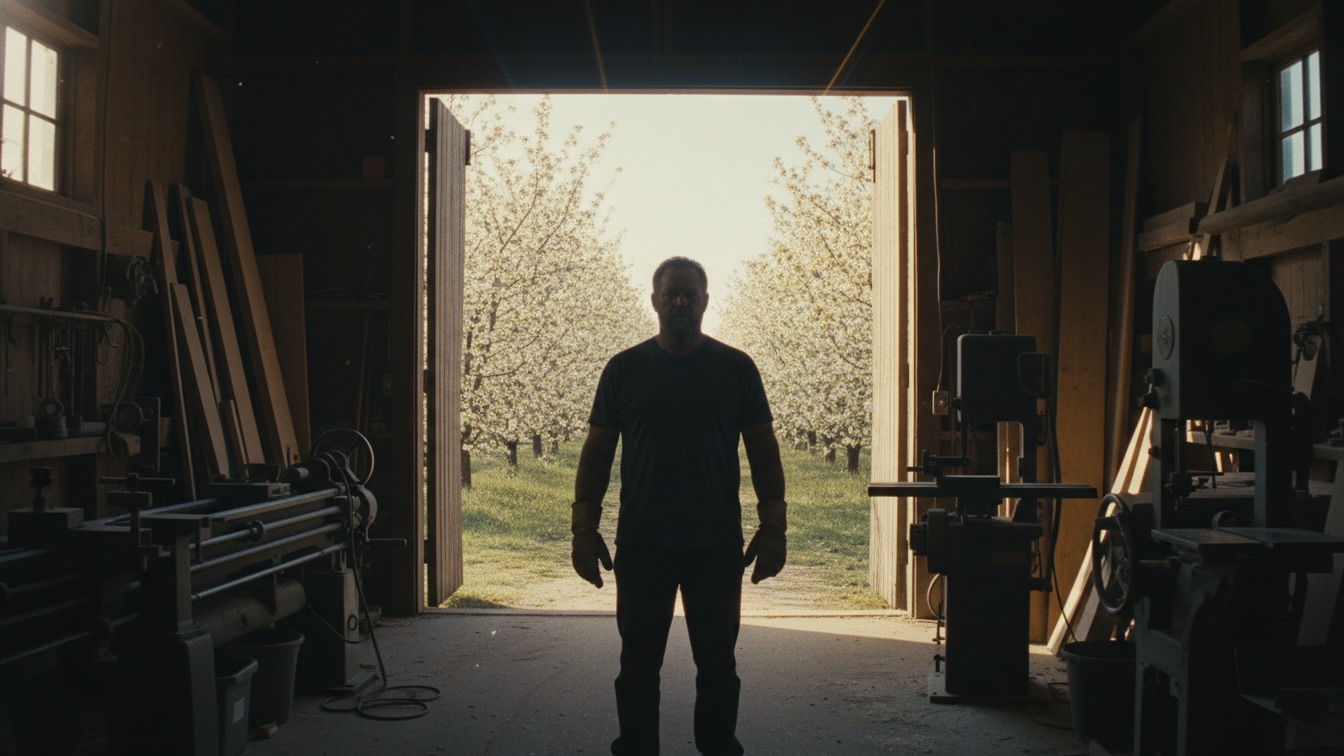
Ed Thomas finds himself trapped in the suffocating atmosphere of his woodworking shop, paralyzed by financial insolvency and the inability to secure necessary materials due to global trade disruptions. As he struggles to maintain his identity as a craftsman, he is confronted by his nephew, Paul, who serves as a cynical reminder of the harsh economic reality. The shop, once a place of productive creativity, has become a site of decay, marked by a physical manifestation of stress Ed identifies as a Shadow Mass. As the business faces imminent collapse from mounting debts and supply chain failures, Ed watches his masterpiece—a white oak table—begin to crack under the strain of his neglect. The chapter concludes with the arrival of a mysterious figure at his door, signaling the final confrontation between Ed’s fading legacy and the cold, unyielding pressures of the modern world.
The central theme of this narrative is the collision between the timeless, tangible nature of craftsmanship and the volatile, ephemeral nature of global finance. Ed represents the archetype of the artisan whose worth is tied to the physical transformation of raw materials, while the world outside is governed by abstractions like tariffs, fuel surcharges, and liquid assets. The story highlights how these modern economic forces dehumanize labor, reducing years of learned skill to a mere spreadsheet entry. By contrasting the slow, organic growth of the cherry trees outside with the rapid, artificial decay of the workshop, the author suggests that human systems have become disconnected from the natural laws of growth and patience.
Furthermore, the story explores the theme of generational dissonance. Ed and Paul view their precarious situation through fundamentally different lenses, which prevents them from finding common ground. Ed clings to the romanticized ideals of his father’s era, seeing his work as a moral anchor, whereas Paul views the world through a lens of existential nihilism. This divide illustrates the erosion of legacy; Paul does not see a tradition to be preserved but a sinking ship to be abandoned. The "Shadow Mass" serves as a powerful metaphor for this psychological burden, representing the collective weight of societal expectations, personal failures, and the encroaching anxiety of an uncertain future.
Ed is a man defined by his devotion to his craft, yet he is clearly suffering from a profound psychological fracture. He views his workshop as a sanctuary of order and purpose, but his identity is so deeply intertwined with the shop that its potential failure feels like a personal dissolution. His insistence on formal language and his refusal to use the word "cooked" indicate a defense mechanism; he is trying to impose a sense of dignity on a situation that is spiraling out of his control. Ed’s internal state is characterized by a mix of nostalgia for his father’s era and a mounting sense of helplessness as he realizes his traditional skills cannot protect him from invisible, global forces.
The physical manifestation of the Shadow Mass suggests that Ed is experiencing a psychosomatic reaction to his grief and stress. His inability to finish the white oak table, and his subsequent horror at seeing it crack, serves as the objective correlative for his own mental state. He is a man who has poured his life into the wood, and as the wood fails, so does his resilience. Ed’s final stance, bracing for the arrival of the visitor, reveals a tragic nobility; he is a man who has lost his material foundation but remains desperately attached to the performance of his own integrity.
Paul functions as the voice of a disillusioned generation, providing a stark, pragmatic contrast to Ed’s idealism. He is not malicious, but his detachment and reliance on his phone highlight his alienation from the physical labor that gives Ed’s life meaning. Paul’s motivation is survival, and he refuses to participate in the "theatrical" struggle that Ed demands. By dismissing the history and soul of the shop, Paul forces Ed to confront the reality that the world no longer values the slow, intentional work of the artisan. He is the messenger of the modern world, arriving with the red-inked notices that represent the finality of the economic winter.
The narrative voice is heavy with sensory detail, utilizing the scent of sawdust and the sight of cherry blossoms to ground the reader in the shop's environment. This sensory saturation serves to make the eventual "curdling" of the atmosphere feel more visceral and disturbing. The author employs a slow, deliberate pacing that mirrors the careful, rhythmic movements of woodworking, which makes the sudden interruptions—the slams of the door, the sliding of the letters—feel all the more jarring. This rhythmic structure effectively conveys Ed’s internal tension between his desire for calm, productive labor and the chaotic reality of his impending bankruptcy.
The tone is melancholic and introspective, shifting into a surrealist register when describing the Shadow Mass. By treating this shadow as a physical, encroaching presence, the text elevates Ed’s financial crisis into a metaphysical struggle against an indifferent universe. The author’s use of light—from the "heavy, grey mass" inside to the "vibrant, cruel" colors of the sunset outside—serves as a constant barometer for Ed’s mental stability. The prose is evocative and restrained, allowing the reader to feel the weight of the silence and the coldness of the encroaching frost, reinforcing the sense of an inevitable, tragic conclusion.


