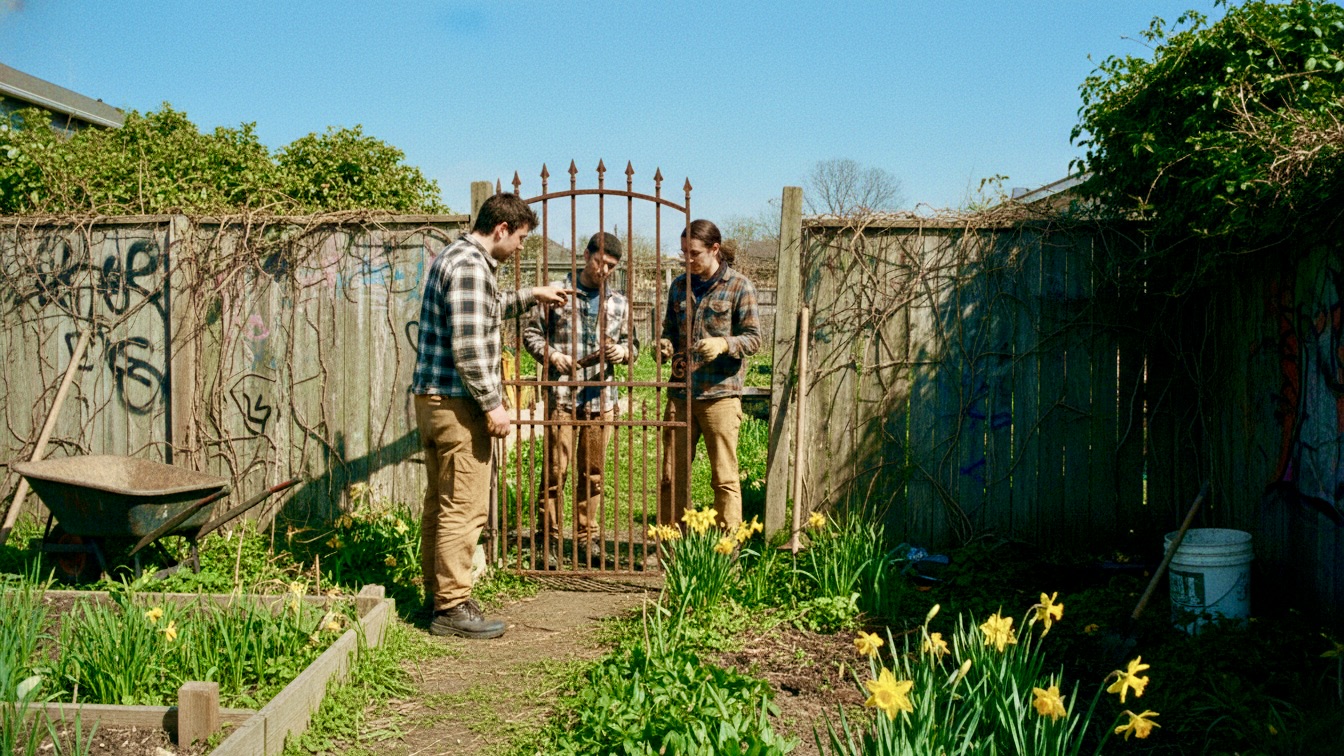
Devon and the team descend into the hall's basement, discovering the garden’s true purpose as a storage for sorrow.
The basement door didn't want to open. It wasn't locked. It was just heavy, like the air on the other side was pressing back. I had to put my shoulder into it. The wood felt damp under my hand, cold enough to sting. When it finally gave, the sound wasn't a creak. It was a wet tear.
'Great start,' Alex said. He was already holding his phone up, the flashlight cutting a clean, clinical white circle into the dark. 'Smells like a literal sewer. Are we sure the archives aren't just a pile of compost by now?'
'It is not sewage,' Mary said. She pushed past me into the dark. She didn't have a light. She didn't seem to need one. 'It is the smell of things staying where they were put. Most people can't handle that much honesty.'
I followed them down. The stairs were concrete, crumbling at the edges. Every step felt like a gamble. My boots made a flat, dead sound. Usually, in a basement this old, you hear the house. You hear the pipes humming or the boiler kicking on. Here, there was nothing. It was that silence again. The kind that makes your ears ring because they’re searching for a frequency that isn't there.
We reached the bottom. The floor was uneven, pitched at an angle that made my inner ear itch. The Shadow Mass was here, too. It wasn't just in the corners. It was hanging from the ceiling like low-hanging fog, only darker. It looked like visual noise. Like a low-resolution texture in a video game that hadn't finished loading. When Alex’s light hit it, the beam didn't pass through. It just stopped.
'My signal is dead,' Alex muttered. He tapped his screen aggressively. 'Zero bars. Not even E. We’re in a literal Faraday cage of bad vibes.'
'The vault is in the back,' Mary said. Her voice sounded thin. 'Behind the furnace.'
We picked our way through the junk. It was a graveyard of community center history. Broken folding chairs. A stack of 'Keep Our Town Clean' posters from the nineties, the colors faded to a sickly grey. A box of deflated basketballs that looked like giant, shriveled raisins. Everything was covered in a layer of dust that felt more like soot.
I stopped by a rusted filing cabinet. The metal was pitted with holes. I touched the top drawer, and a flake of rust fell off, drifting through the air in a slow, unnatural spiral. It didn't fall straight down. It circled my hand twice before landing.
'Devon, move,' Alex said. He was getting twitchy. He kept swinging the light around, catching glimpses of things that shouldn't have been there. A shadow that stayed on the wall after he moved the beam. A door that seemed to change its width every time he looked away.
We found the vault. It wasn't a safe. It was a heavy iron door set directly into the foundation. No handle. Just a keypad from an era before touchscreens, the buttons made of yellowed plastic.
'The code,' I said, looking at Mary.
'1-9-6-8,' she said. 'The year the roses refused to die.'
I pressed the buttons. They felt gummy. There was no beep, just a mechanical thunk from inside the wall. The door swung open on its own.
Inside, the vault was surprisingly dry. The walls were lined with wooden shelves, packed with leather-bound ledgers and rolled-up blueprints. In the center was a small desk with a single lamp. I reached for the switch, not expecting it to work.
It clicked. The bulb flickered to life, casting a warm, orange glow that felt like a punch to the gut after the cold white of Alex’s phone.
'Okay,' I said. I felt my heart rate settle slightly. 'Archives. Let’s find the 1960s stuff.'
I grabbed a roll of blueprints from the '68 shelf. The paper was thick, more like vellum than modern bond. I spread it out on the desk.
'This isn't a garden,' I said. I traced the lines with my finger. 'Look at the angles. None of them are ninety degrees. This path... it loops back on itself but the map says it goes straight.'
Alex leaned in, his phone light overlapping with the lamp. 'That’s literally impossible. If you build like this, the structure collapses. You can't have a three-sided square.'
'He wasn't building a structure,' Mary whispered. She was looking at a ledger, her eyes scanning the handwritten notes. 'He was building a circuit.'
'A circuit for what?' I asked.
'Look at the annotations,' she said, pointing to a column of names. I recognized some of them. Former mayors. Business owners. Families who had lived in the town for a century. Next to each name was a date and a series of numbers.
'What are the numbers?' Alex asked.
'Weights,' Mary said. 'In grams. The weight of the things they couldn't carry. Mr. Henderson. 1970. Lost his son in the war. Forty-two grams. Mrs. Gable. 1972. The fire. Sixty grams.'
I felt a cold sweat break out on my neck. 'You’re saying this garden... it stores people’s grief? Like a hard drive?'
'It was a service,' Mary said, her voice devoid of irony. 'The town was drowning in it. After the factory closed, after the fever. People were broken. The gardener offered them a trade. Give the garden the weight, and you can walk light again. He used the geometry to trap the energy in the soil. He called it the "Great Unburdening."'
'That’s insane,' Alex said. 'You can't just put an emotion into the dirt. That’s not how science works. That’s not how anything works.'
'Then explain the Shadow Mass,' I said. I looked toward the vault door. The visual noise was thicker now. It was creeping over the threshold, a tide of black static that seemed to be eating the light from the hallway. 'Explain why the ground outside feels like a heartbeat. The garden isn't just plants, Alex. It’s a battery. And it’s been charging for fifty years with no outlet.'
I turned back to the blueprints. I was looking for the Anchor. I found it in a separate detail drawing. It was located in the center of the Grotto, buried six feet deep. It wasn't a rock or a statue. It was a box.
'The Anchor is the processor,' I said. My voice was shaking. 'It’s the point where all the lines intersect. If the garden is the circuit, the Anchor is the chip. It holds the core. The first grief.'
'Whose?' Alex asked.
'The gardener’s,' Mary said. 'He lost everything before he started. He didn't want to forget. He wanted to make a place where nothing ever changed, so he wouldn't have to say goodbye again.'
Suddenly, the lamp on the desk flickered. The shadows in the vault didn't just move; they reached. A long, thin finger of darkness stretched across the blueprint, erasing the drawing of the Grotto.
'We need to go,' I said. 'Now.'
'The door!' Alex yelled.
I looked up. The Shadow Mass had filled the doorway. It wasn't a cloud anymore. It was solid. It looked like a wall of black glass, vibrating with a low-frequency hum that made my teeth ache.
'It knows we found the map,' Mary said. She didn't sound scared. She sounded resigned.
'Alex, the light!' I shouted.
Alex turned his phone toward the door. The beam hit the black glass and shattered. Literally shattered. The light broke into a thousand tiny white sparks that fell to the floor and went out.
'My phone is burning!' Alex dropped the device. It hit the floor and hissed. The screen was melting, the plastic turning into a black liquid that flowed toward the Shadow Mass like it was being called home.
I grabbed the blueprints. I didn't know why, but I knew we couldn't leave them. I shoved them under my jacket. The paper was hot against my chest.
'How do we get out?' I asked Mary.
'The garden doesn't want you to leave,' she said. 'You are new. You are empty. You are perfect storage.'
I felt a surge of anger. Not fear, but pure, sharp irritation. This was my project. My grant. My life. I wasn't going to be a folder in a dead man’s filing cabinet.
I looked at the desk lamp. It was the only thing still fighting the dark. I grabbed the heavy brass base.
'Devon, what are you doing?' Alex hissed. He was backed against the shelves, his eyes wide.
'Breaking the geometry,' I said.
I swung the lamp at the Shadow Mass. I didn't aim for the center. I aimed for the corner of the doorframe where the shadows were anchored to the physical world.
As the brass hit the wall, there was a sound like a gunshot. The lightbulb exploded, showering us in glass. For a second, it was absolute dark. Then, a spark.
The electricity from the broken lamp surged into the damp wall. The Shadow Mass recoiled. It didn't disappear, but it flinched. It pulled back just enough to show a sliver of the hallway.
'Run!' I grabbed Alex by the collar and shoved him toward the gap. Mary was already moving, surprisingly fast for her age.
We scrambled through the opening. The air in the hallway was freezing, but it felt like oxygen after the vault. We didn't stop. We ran past the deflated basketballs and the rusted cabinets. Behind us, I could hear the Shadow Mass expanding, the sound like a thousand whispers all trying to speak at once.
We hit the stairs. I didn't look back. I could feel the weight of the blueprints against my ribs, a physical pressure that seemed to be trying to push my heart out of rhythm.
We burst through the basement door and back into the main hall. I slammed the door and Alex shoved a heavy plastic table against it.
We stood there, panting. The hall was silent. The winter moon was shining through the high windows, casting long, pale rectangles on the linoleum.
'Is it... is it over?' Alex asked. He was shaking. He looked down at his empty hands. 'My phone. It’s gone. All my data. My photos.'
'It’s just hardware, Alex,' I said, though I knew that wasn't true for him.
'It isn't over,' Mary said. She was standing by the window, looking out at the garden. 'You took the map. You took the secret. The garden won't stay behind the glass anymore.'
I walked over to her. I looked out.
The snow was gone. Not melted. Gone.
In its place was a sea of black mud, churning and bubbling despite the sub-zero temperature. And in the center of the Grotto, the white lily was no longer alone. Dozens of them were popping up through the sludge, their pale petals glowing with that impossible, internal light.
They were arranged in a perfect circle. A bullseye.
'The Anchor is shifting,' Mary said. 'It’s coming up for air.'
'We have to destroy it,' I said. I felt a strange clarity. The burnout was gone. The irony was gone. There was only the task. 'If we don't, this town... it’s just going to be a graveyard of things people couldn't say.'
'How?' Alex asked. 'We don't even have a shovel that won't snap.'
I reached into my jacket and pulled out the blueprints. I spread them on the floor. In the moonlight, the lines seemed to shimmer.
'We don't use tools,' I said. I pointed to the handwriting in the margin. 'The gardener didn't build this with a shovel. He built it with an intention. To break it, we have to change the intention.'
'That sounds like some hippie nonsense,' Alex said, but he knelt down anyway.
'It’s code, Alex,' I said. 'Think of it like that. We’re going to rewrite the permissions.'
I looked at the names in the ledger. The weights.
'Mary, you were there,' I said. 'In '68. You saw him bury the box. What did he say?'
Mary closed her eyes. Her face looked like carved stone in the moonlight. 'He said, "Rest now. The earth will remember so you don't have to."'
'That’s the bug,' I said. 'The earth shouldn't remember. The earth should recycle. We need to tell the garden to let go.'
Suddenly, the floor beneath us groaned. Not the wood—the actual ground. A deep, tectonic sound that vibrated in my marrow.
I looked at the door to the basement. The plastic table was sliding. Something was pushing from the other side. Not a hand. A pressure.
'We have to go out there,' I said.
'Are you serious?' Alex backed away. 'It almost ate us in the basement. Out there, it’s... it’s the whole world.'
'It’s not the whole world,' I said. 'It’s just a garden. And we’re the landscapers.'
I grabbed a flashlight from the supply closet. It was a heavy, industrial thing. I checked the batteries. Full.
'Alex, get the salt,' I said.
'Salt? For what? Demons?'
'For the ice,' I said. 'And for the chemistry. We need to change the pH of the situation.'
We walked to the back door. I could feel the Shadow Mass on the other side. It wasn't a monster. It was a mood. A thick, suffocating depression that wanted to wrap itself around us and never let go.
I pushed the door open.
The garden was waiting. The lilies were humming, a high-pitched sound that felt like a needle in my ear. The black mud was rising, crawling up the stone walls of the hall like a slow-motion flood.
'Stay on the path,' I said. 'Even if the path moves.'
We stepped out. The mud didn't feel like mud. It felt like velvet. It didn't stick to my boots; it tried to pull them in.
We headed for the Grotto. The geometry was warped now. The willow trees looked like they were miles tall, their branches touching the stars. The stars themselves were swirling, a drain of light in the center of the sky.
'I see it!' Alex shouted.
He was pointing at the center of the lilies. There was a ripple in the mud. A corner of something metallic was poking through.
It was the Anchor.
We ran toward it, but the ground stretched. For every three steps forward, we seemed to slip two steps back. The air was getting thicker, harder to breathe. It tasted like copper and old tears.
'Devon, look out!'
A vine, black and slick as oil, whipped out of the mud and wrapped around my ankle. I fell hard, the air leaving my lungs in a sharp wheeze.
The vine didn't just pull. it burned. I could feel a cold fire spreading up my leg. Images started flashing in my mind. Not my memories. Other people’s. A car crash. A letter from a lawyer. A dog that didn't come home.
'Get off me!' I screamed.
I kicked with my free foot, but it was like kicking water. The vine tightened. I was being pulled toward the lilies.
'The salt!' I managed to gasp.
Alex scrambled over. He didn't hesitate. He ripped open the bag and dumped the entire thing onto the vine.
The reaction was instant. The vine shriveled, a sound like steam escaping a pipe filling the air. It released my leg and retreated into the mud, hissing.
I scrambled up. My leg was numb, but I could move.
'The box,' I said. 'We have to open it.'
We reached the center. The lilies were so bright now they were blinding. They weren't flowers anymore. They were holes in the dark, bleeding white light.
In the middle of the circle, the box sat in a shallow pool of black liquid. It was iron, rusted but solid. No lock. Just a heavy lid.
I reached for it.
'Wait,' Mary said. She was standing at the edge of the circle. 'If you open it, the weight has to go somewhere. It doesn't just vanish.'
'It goes back,' I said. 'To the people. To us. We have to carry our own shit, Mary. That’s the deal.'
'Some of it is too heavy,' she whispered.
'Then we carry it together,' I said. I looked at Alex. He looked terrified, but he didn't run. He stepped up next to me and put his hand on the lid.
'On three,' I said.
'One.'
The ground shook. The Shadow Mass rose up around us, a wall of black static a hundred feet high.
'Two.'
The lilies screamed. A sound of pure, unadulterated grief that threatened to shatter my skull.
'Three!'
We heaved. The lid didn't budge at first. It felt like it was welded to the center of the earth. Then, with a sound like a world breaking, it flew off.
For a second, there was nothing.
Then, the sky fell.
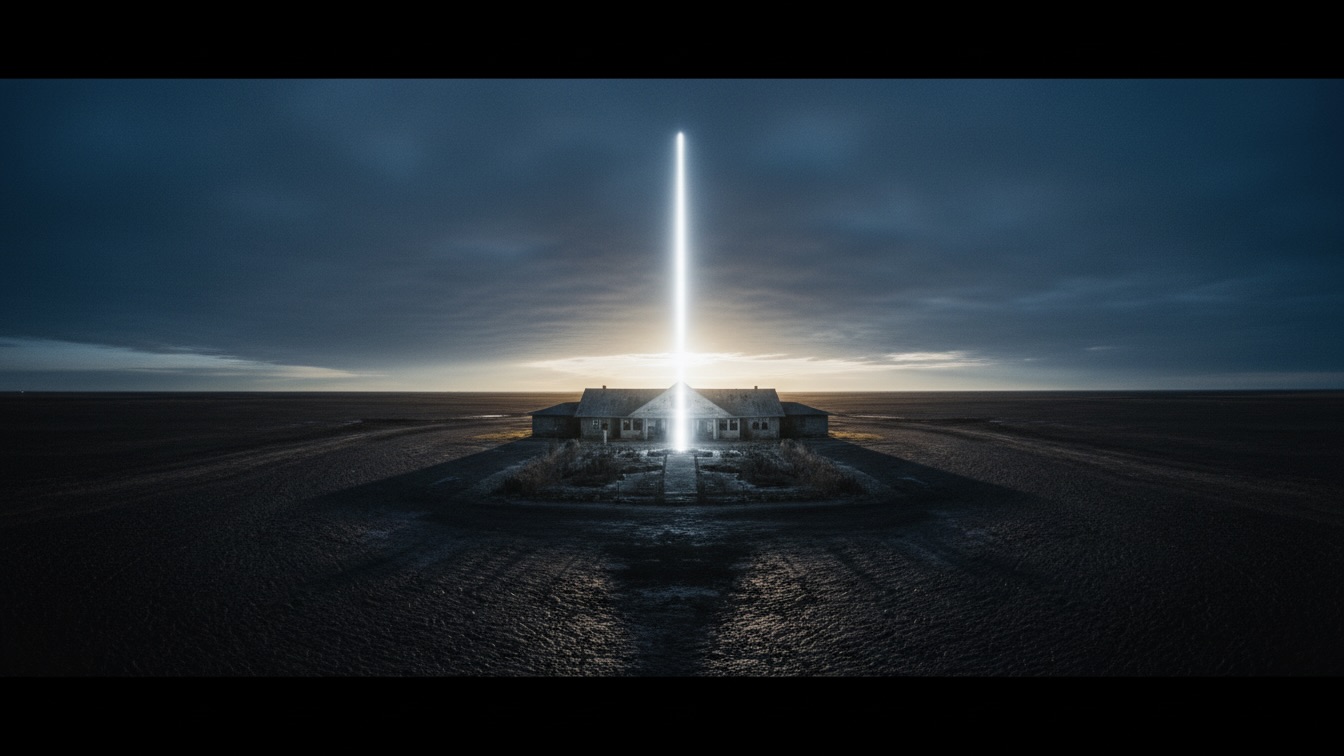
“As the lid hit the mud, the white light from the lilies turned into a blinding, horizontal pillar that sliced the night in two.”