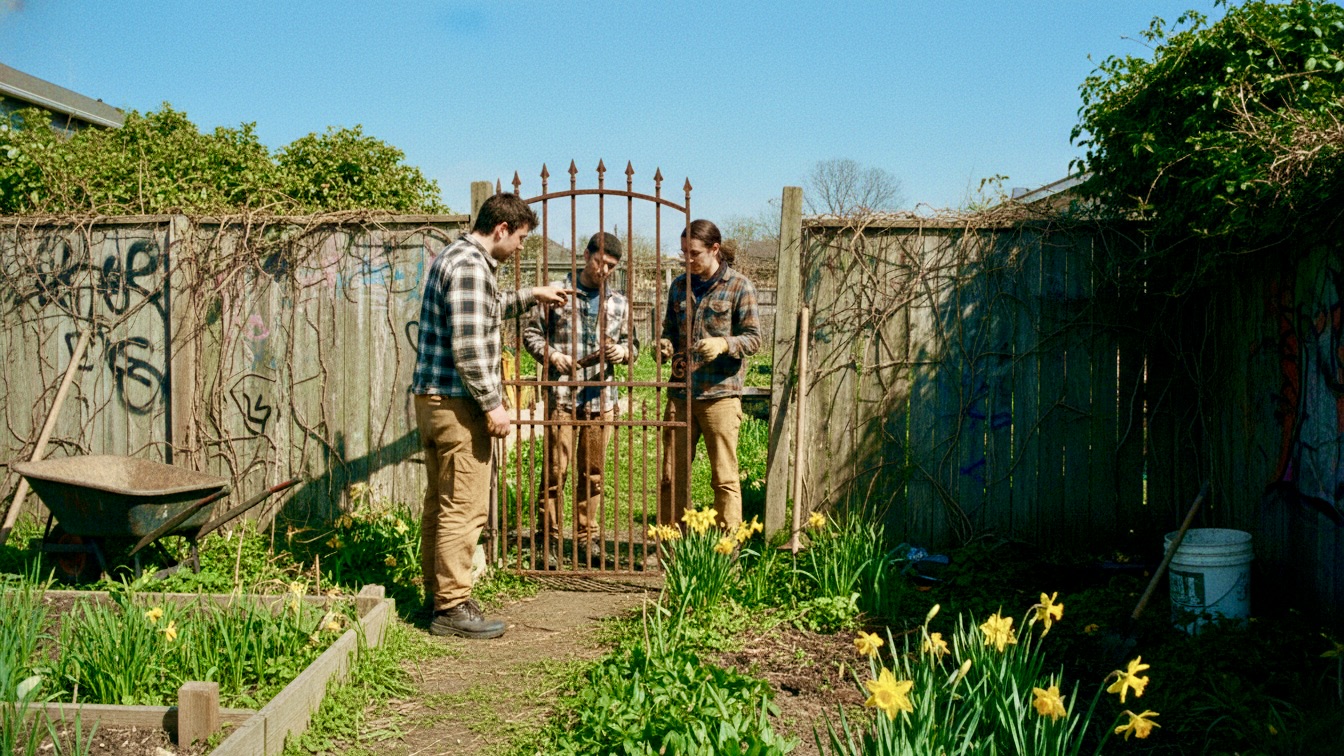
The story follows Devon, a landscaper tasked with modernizing a neglected garden that has developed a reputation for being cursed. Alongside his business partner Alex and an elderly woman named Mary, Devon confronts the reality that the garden resists standard development. After Mary warns him that the land is not dead but merely waiting, Devon ventures into the overgrown space to prove his own rationality. He discovers that the environment defies physical laws, bending his metal tools and distorting his perception of time and space. Upon narrowly escaping the garden with a twisted probe and shredded clothing, he realizes the project is far more dangerous than a simple renovation. The chapter concludes with the trio deciding to investigate the historical archives to identify the "Anchor" that keeps the garden trapped in its unnatural state, while a mysterious, glowing lily appears as an omen of what lies ahead.
The narrative explores the tension between human hubris and the indifferent, often hostile, power of the natural world. Devon and Alex represent the modern desire to categorize, sanitize, and monetize nature through planning, grants, and branding. Their reliance on blueprints and digital metrics serves as a barrier against the reality of the land, which operates under an ancient, non-linear logic. By attempting to impose a modern aesthetic on a space that has withdrawn from time, the characters represent the clash between the ephemeral nature of human ambition and the eternal, subterranean endurance of the earth.
Another central theme is the psychological impact of the uncanny on the structured mind. The garden acts as a catalyst for a shift in perspective, forcing the characters to confront the limits of their rational worldview. As the physical environment begins to swallow their sense of north and time, the characters are stripped of their professional identities. This transition from external, superficial "optics" to a primal, internal recognition of something greater than themselves highlights the fragility of the human ego when faced with the inexplicable.
Devon serves as the anchor for the reader's perspective, representing the transition from a rigid, pragmatic professional to a man haunted by the unknown. His initial reliance on physics and logical planning is a psychological defense mechanism against the anxiety of his stagnant career. When he enters the Grotto, his fear is not just of the physical danger, but of the loss of his own identity as a competent, rational man. His shift in tone at the end of the chapter indicates a profound transformation, as he trades his desire for simple completion for a darker, more obsessive curiosity.
Mary functions as the bridge between the human world and the dormant, supernatural force of the garden. She possesses a deep, intuitive knowledge of the land, speaking in riddles that highlight the shortsightedness of her companions. Her theatricality serves to emphasize the gravity of the situation, positioning her as a guardian of the garden's secret history. She represents the memory of the land, holding onto the truth that the garden is not a place to be fixed, but a patient, living entity that has been waiting for someone to acknowledge its true nature.
Alex is the embodiment of modern anxiety and superficiality. His primary motivation is the maintenance of his personal brand and the success of his professional reputation. Throughout the chapter, he uses his phone as a shield against uncomfortable truths, clinging to the hope that his investment can be salvaged through sheer bureaucratic force. His eventual inclusion in the search for the archive suggests that his veneer of irony is cracking, and he is being dragged into a reality he cannot control or monetize.
The author utilizes a sensory-rich, atmospheric prose style to build a sense of mounting dread. The pacing is expertly managed, beginning with a grounded, conversational tone in the recreation hall that slowly dissolves into a surreal, claustrophobic experience within the garden. By focusing on tactile details, such as the smell of ozone, the metallic taste of blood, and the sensation of walking through waist-deep water, the narrative grounds the supernatural elements in physical reality.
The tone shifts effectively from the mundane frustration of a business meeting to the high-stakes tension of a survival horror encounter. The narrative voice remains tightly tethered to Devon, which makes his gradual loss of certainty feel intimate and unsettling. The use of geometric imagery—blueprints, squares, and the bending of the Big Dipper—serves to heighten the contrast between the rigid, man-made world and the chaotic, shifting architecture of the garden. This stylistic duality reinforces the central conflict, making the reader feel the pressure of the environment as much as the characters do.


