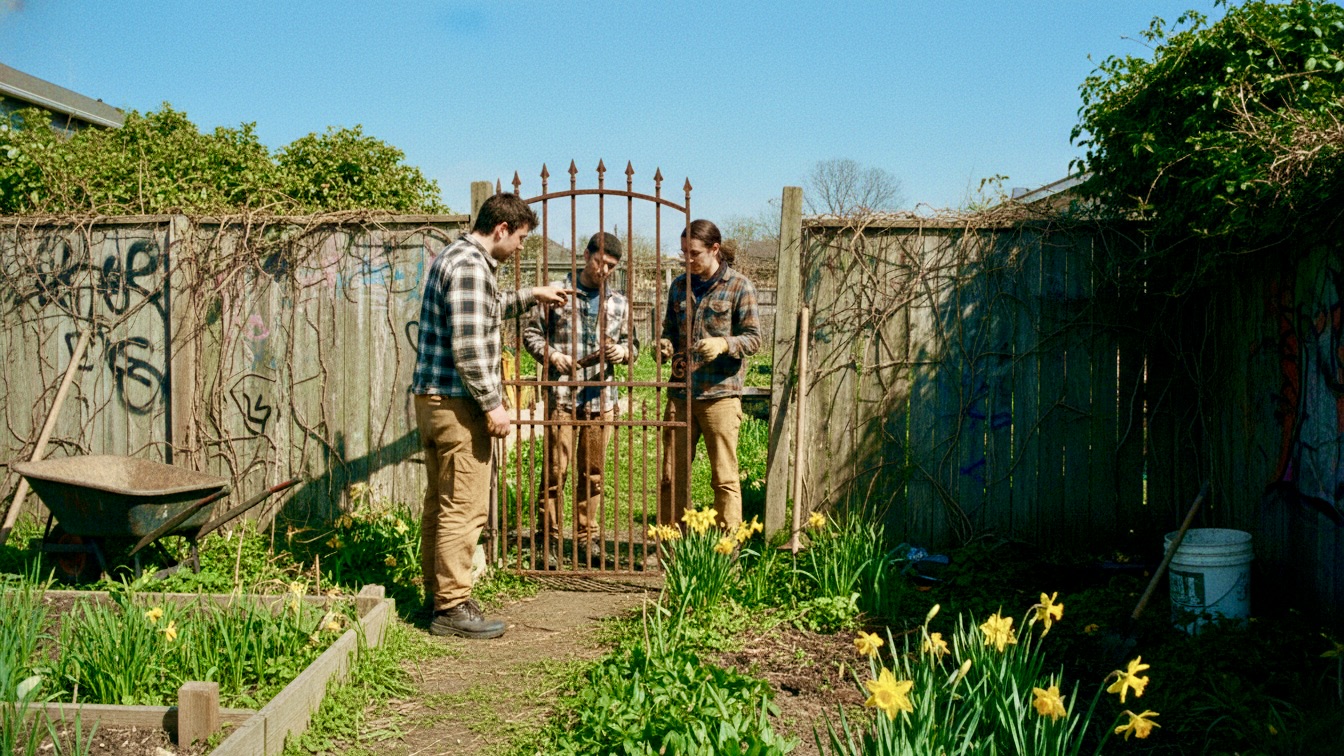
Format: Short Film / Anthology Episode | Est. Length: 10-12 minutes
This episode serves as the pilot for The Overgrowth, an anthology series exploring locations where the boundary between reality and anomalous, sentient geography has worn thin. Each installment follows a group of professionals—architects, surveyors, or urban planners—who encounter "pockets" of reality that refuse to conform to modern logic, suggesting a hidden, ancient architecture underlying the world.
A landscape architect and his team meet in a decaying community center to finalize plans for a garden renovation, only to realize the shadows in the room are leaning in to listen to their conversation. Outside, the garden they intend to "modernize" waits in a state of absolute, unnatural silence, swallowing the winter light.
A cynical urban developer and his team attempt to renovate a long-abandoned sanctuary, only to discover the land is a sentient anomaly that resists modern geometry. They must abandon their tools and uncover the secret of "The Anchor" before the garden consumes them entirely.
The primary themes focus on the arrogance of modernization and the tension between human control and the untamable persistence of nature. The story explores the concept of "geographic trauma," where land retains the memory of past events, and the psychological fragility of individuals forced to confront realities that defy scientific explanation.
The narrative also touches upon the existential dread of losing one's identity to a larger, indifferent force. It questions whether progress is always a virtue or if some things are better left buried, highlighting the clash between the sterile, digital-first mindset of 2026 and the raw, archaic power of the earth.
The protagonists risk more than just their professional reputations; they face the potential erasure of their own sense of time and perspective. If they fail to understand the nature of the garden, they risk being "taken" by the anomaly, becoming permanent fixtures in a space that exists outside the flow of normal time.
The external conflict pits the team’s modern construction equipment and logic against the garden’s impossible, shifting physical laws. Internally, the characters struggle with their own skepticism and the desperate need to maintain their professional identities, which acts as a barrier to understanding the true nature of the threat.
Devon, a landscape architect, struggles to finalize a renovation project for a community garden that has been boarded up since the 1970s. Despite warnings from Mary, an elderly local who understands the garden's history, Devon and his business partner Alex insist on using modern construction techniques to "fix" the space, ignoring the ominous signs that the land is not merely dead, but waiting.
When Devon ventures into the garden to prove his skepticism, he is nearly trapped by shifting thorns and a distorted reality that bends light and sound. Returning with a twisted metal probe and a shredded jacket, he realizes that the project is not a simple landscaping job, but an encounter with an ancient, sentient force known as "The Anchor."
Devon: A pragmatic architect obsessed with order and modern metrics. He begins the episode as a firm believer in physics and logic, but ends it as a cautious initiate, realizing his professional tools are useless against the supernatural.
Alex: An image-conscious entrepreneur who views the world through the lens of branding and optics. He remains the primary skeptic throughout, using his phone as a shield against reality, though he eventually joins the search for the truth out of necessity.
Mary: An enigmatic, theatrical octogenarian who acts as the bridge between the past and the present. She serves as the mentor figure who understands that the garden is a living system, shifting from a cryptic warning-giver to a guide for the team’s descent into the mystery.
The team debates the renovation in the recreation hall, establishing the conflict between Devon’s desire for order and Mary’s warnings about the garden’s sentient nature. The tension peaks when Devon enters the garden, experiencing the physical distortion of space and time before barely escaping the shifting thorns. The episode concludes with the trio deciding to abandon their excavators to investigate the garden's history, as a single, impossible lily blooms in the darkness.
The episode begins with a clinical, cold detachment, reflecting the characters' focus on blueprints and budgets. As the narrative progresses, the mood shifts into one of claustrophobic dread and disorientation, culminating in a final state of dark, obsessive curiosity as the characters accept their new, dangerous mission.
If expanded, the season would follow the team as they attempt to locate and neutralize "Anchors" in different locations across the city, each with its own unique set of physical anomalies. The overarching arc would reveal a hidden network of these sites, suggesting that the entire city is built upon a foundation that is slowly waking up.
As the characters delve deeper, they would undergo a transformation, losing their connection to their "modern" lives and becoming increasingly attuned to the logic of the anomaly. The season would build toward a confrontation with the entity responsible for placing these Anchors, forcing the team to choose between restoring the world as they knew it or embracing the new, chaotic reality.
The visual style is characterized by high-contrast lighting, with a focus on deep, heavy shadows that seem to possess mass. The cinematography utilizes wide, static shots for the hall to emphasize the characters' isolation, shifting to handheld, disorienting camera movements once they enter the garden.
The tone is grounded in "New Weird" fiction, blending the mundane details of urban development with surreal, cosmic horror. Comparable works include the atmospheric dread of True Detective (Season 1) and the surreal, reality-bending architecture of House of Leaves.
The target audience is adults aged 25-45 who enjoy psychological thrillers, cosmic horror, and atmospheric, character-driven dramas. It is intended for viewers who appreciate slow-burn narratives that prioritize mystery and thematic depth over jump scares.
The pacing is deliberate and measured, mirroring the slow, creeping nature of the garden’s influence. The first act is dialogue-heavy to establish the stakes, while the second and third acts accelerate into a tense, rhythmic tempo as the reality of the garden begins to bleed into the characters' world.
The production should rely heavily on practical effects for the garden, using forced perspective and distorted sets to create the sense of "wrong" geometry. The "Shadow Mass" should be rendered as a physical, viscous element rather than a simple lighting effect, perhaps using specialized ink or projection mapping to give it a tangible, shifting quality.
The sound design is critical; the transition between the natural, windy world and the "dead" silence of the garden must be jarring. The use of low-frequency hums and metallic, rhythmic thrumming will be essential to establish the garden as a living, breathing entity that the audience can feel as much as hear.


