A Working Definition Worth Keeping
If you’ve spent any time around sustainability circles, you’ve heard the phrase “living lab” — but ask ten people what it means and you’ll likely get ten different answers. A team at Concordia University’s Carbon Governance Living Lab has done the field a real service by cutting through that ambiguity. In their Roadmap to Designing Living Lab Governance Structures (MacDonald et al., 2026), they lean on the European Network of Living Labs‘ widely recognized definition: a living lab is a “user-centred, open innovation ecosystem based on a systematic user co-creation approach, integrating research and innovation processes in real-life settings.”
Strip away the jargon, and the idea is straightforward: people working together, in the actual places they live, to design and test solutions to problems no single organization could solve alone. That definition really matters because it names three things that make a living lab different from a pilot project, a focus group, or a research study.
First, the people affected by the problem aren’t just consulted. They’re co-creators, shaping the agenda from the very start. Second, the work happens in the real world, not in a lab bench or a survey: messy, unpredictable, and grounded in lived experience. Third, the process is iterative, cycling through exploration, co-design, experimentation, and evaluation, so solutions evolve as understanding deepens. The Concordia report frames these as guiding principles: engaging a diversity of stakeholders, supporting co-creation, and anchoring research in real-world settings — and organizes everything else about how to run one around five structural features: oversight, coordination, communications, engagement, and evaluation.
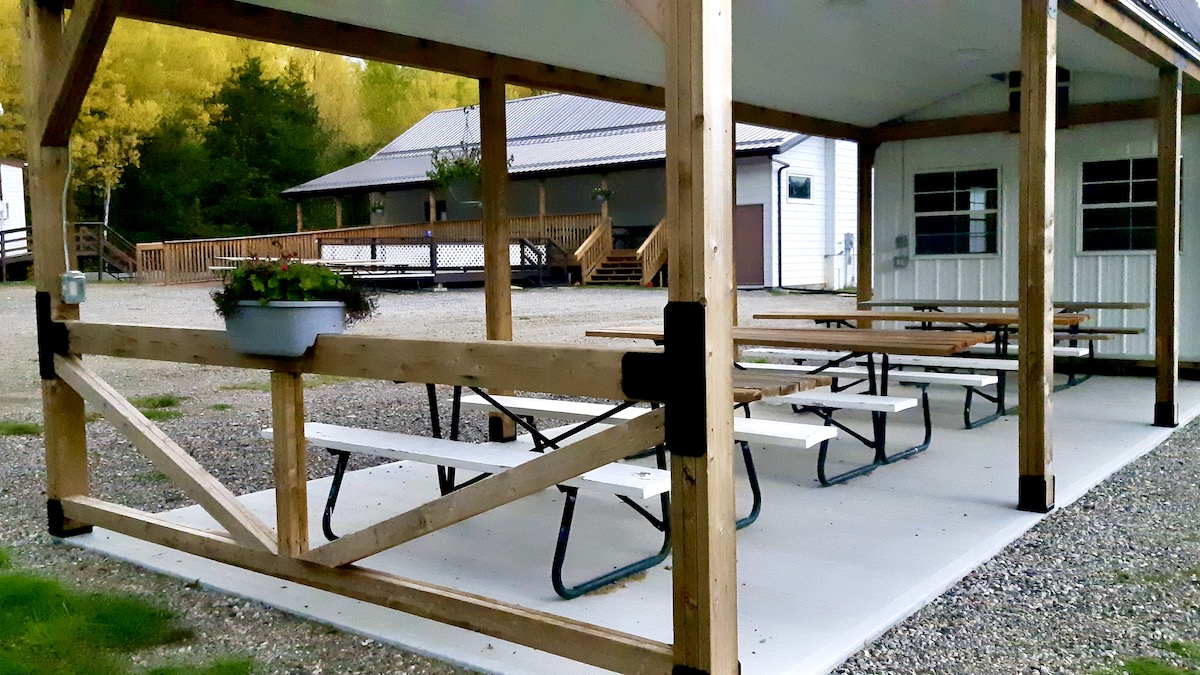
Consider our Art Borups Corners Living Lab, as a way of seeing what this looks like in practice. Since we established the program three years ago, we’ve always focused on arts and land-based participatory research. Activities and projects bring people together around the land itself, using our local gardens, forests, and gathering spaces to co-create community-led responses to reconciliation, food security, and climate adaptation.
Nobody arrives with a finished solution to hand over. Instead, team members bring their own knowledge: local food systems experience, traditional knowledge, farming and land-management know-how. Working through cycles of gathering, designing, testing, and reflecting on the land, the community shapes what gets built and how it works. That’s the living lab in action — the land is the laboratory, and the people are the researchers and innovators.
The Concordia team’s point, and it’s a good one, is that none of this runs on good intentions alone. Governance — who decides, who coordinates, how people communicate, who gets to participate, and how results are evaluated — is what makes a living lab thrive or quietly fall apart.
Their roadmap, drawn from a literature review, interviews with 30 practitioners across 26 living labs, and their own hands-on experience, lays out 11 key design decisions with the trade-offs spelled out honestly. If you’re starting a living lab, or just want to understand how the good ones actually work, it’s a terrific, practical read.
We’ve learned a lot from their work this summer, through hours of discussions and we found the report incredibly useful as we continue to explore board and governance models moving forward. Do yourself a favour and check it out.
MacDonald, A., Champoux-Pellegrin, J., Drummond, I., Hansen, T., Guimont, D., Bossert, M., Bothello, J., Garard, J., Soliz, A., Sabet-Kassouf, N., Lesnikowski, A., Paulin, M., & Paquin, R. (2026). Roadmap to Designing Living Lab Governance Structures. Concordia University.