5 Critical Failures in the Consultation for Canada’s Nuclear Repository
The Deep Geological Repository (DGR) proposed for the Revell site is no ordinary infrastructure project; it is a million-year commitment to the management of high-level radioactive waste. This “pre-closure” and “post-closure” saga spans a geological epoch, yet the federal government’s current consultation framework is failing a basic test of contemporary democracy: talking to the people in the backyard.
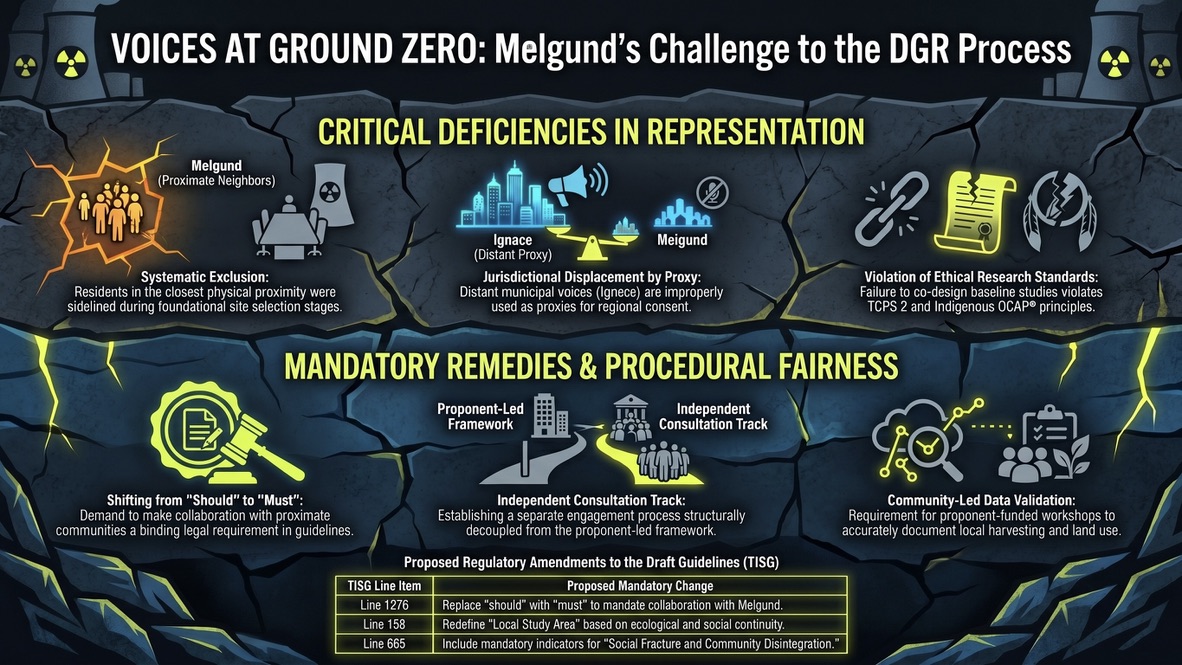
While the project promises a permanent solution for nuclear waste, it has created an immediate crisis of “social license.” Residents of Melgund Township and the communities of Borups Corners and Dyment—those in the closest physical and ecological proximity to the site—find themselves systematically disenfranchised by a “procedurally deficient” process. In the world of federal impact assessments, “meaningful participation” is not a legal checkbox; it is the bedrock of the Impact Assessment Act (2019). When the primary neighbors to a million-year risk are sidelined, the integrity of the entire assessment is compromised.
Here are the five critical failures currently undermining the procedural integrity of Canada’s nuclear future.
1. The Proximity Paradox: Silencing the Front Lines
The site selection process is governed by a “Proximity Paradox”: the residents bearing the “highest degree of environmental, health, and psychosocial risk” are the ones with the quietest voices in the room. Communities like those in Melgund Township, Borups Corners, and Dyment sit on the project’s immediate footprint, yet they were marginalized during the foundational site selection phase.
By the time these residents are invited to the table, the most significant variable—the location itself—has been settled. This renders subsequent consultation “procedurally hollow.” You cannot ask a neighbour for their “lived experience” after you have already decided to build a nuclear tomb under their feet.
“This exclusion ignores the legislative mandate to consider the ‘lived experience’ of those most directly impacted and constitutes a failure to uphold procedural fairness.”
– Submission to the Impact Assessment Agency of Canada
2. The Proxy Problem: Manufacturing a Veneer of Consent
A “smoking gun” for any investigative analysis is the “Jurisdictional Displacement” currently occurring in the Revell site selection and the processes that will be followed. Many residents closest to the site feel the Township of Ignace has been improperly elevated to act as a representative “host” voice—a proxy for unorganized territories like Melgund and the surrounding area that it does not legally or geographically represent.
The record is dangerously silent on any direct engagement between Ignace and the adjacent residents of Dyment or Borups Corners. There is no documented evidence of site-level community meetings or outreach initiated by Ignace within the unorganized territories most impacted that actually form the project’s physical footprint. Using a distant municipal voice to manufacture a “distorted evidentiary basis” for regional consent is more than a clerical error; it is a structural attempt to bypass the most impacted voices in favour of a more compliant municipal partner.
3. Ethical Erosion: The Top-Down Extraction Model
The Proponent’s current research methodology is a relic of an outdated, colonial approach to impact assessment. Many residents spoke up this week about how they feel the Proponent’s process violates the Tri-Council Policy Statement (TCPS 2) and ignores the principles of Ownership, Control, Access, and Possession (OCAP®) and other knowledge systems.
Rather than adopting a Community-Based Participatory Research (CBPR) framework—where local knowledge is co-designed and co-validated—the Proponent has utilized a “top-down” extraction model. In this model, local and Indigenous knowledge is treated as a “resource” to be harvested rather than a partnership to be respected. This violates the ethical “principle of Justice,” which requires a fair distribution of research burdens and benefits. By excluding Melgund residents and the most impacted local peoples closest to the site from the co-design of baseline studies, the Proponent has ensured the baseline is fundamentally incomplete and ethically compromised.
4. The Hidden Cost of Exclusion: Social Fracture as an Impact
Exclusion is not a victimless procedural oversight; it is a direct “impact pathway” for psychosocial harm. There have been many comments on how the systematic marginalization of Melgund residents and those living closest to the site itself has triggered “social fracture” and “community disintegration.” This isn’t just a feeling; it is a measurable weakening of the social fabric caused by a loss of community agency.
The Proponent often attempts to “defer” these social impacts to processes like an Environmental Impact Statement (EIS) stage. This is a tactical error that undermines the assessment’s validity. Deferral effectively excludes affected communities from defining the parameters by which their own social conditions are measured. To restore integrity, the following indicators must be mandated in the baseline immediately:
- Community cohesion metrics
- Trust-in-process indicators
- Psychological stress markers
5. The Power of a Single Word: Why “Must” is Better than “Should”
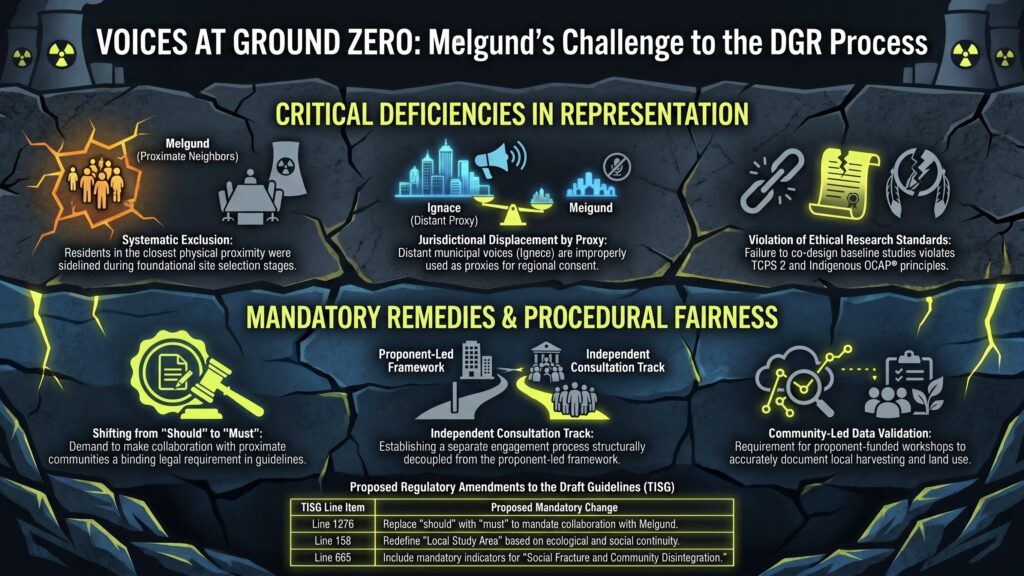
In policy and law, language determines enforceability. The current Draft Tailored Impact Statement Guidelines (DTISG) are riddled with discretionary language that allows for “selective engagement.” Specifically, Line 1276 currently states the Proponent “should” work with local peoples. This makes the inclusion of Melgund a “procedural nullity.”
In our submission, we requested the DTISG must be amended to replace “should” with “must” to create binding requirements. Without mandatory language, the guidelines are merely suggestions that the Proponent can ignore at its convenience. The following line-item amendments are the battlegrounds for the project’s enforceability:
- Line 1276: Must be changed to must to force direct collaboration with the Melgund Township communities, residents and local peoples living closest to the site.
- Line 158: Must redefine the “Local Study Area” based on social continuity and ecological connectivity, not arbitrary municipal boundaries.
- Line 261: Must require “Lived Experience” to be treated as primary baseline data, weighted equally with municipal submissions.
- Line 685: Must include mandatory indicators for “Social Fracture and Community Disintegration.”
Conclusion: Restoring Procedural Integrity
The Deep Geological Repository (DGR) for Canada’s Used Nuclear Fuel Project cannot proceed on a procedurally deficient record. The Federal government must enforce a “retroactive correction” for the residents of Melgund and Borups Corners. This requires an independent consultation track, structurally decoupled from the Proponent and Ignace-led process, and the funding of community-led validation workshops to ensure that data on issues such as food security, harvesting, recreation and land use is accurate and community-verified.
After all, if the people living on the front lines of a million-year project aren’t given a mandatory seat at the table, can any assessment of its safety truly be considered “complete”?




).jpg)