Solving the Empty Gallery Dilemma with Budget-Friendly, Carbon-Neutral Log Pedestals
How can you fill an arts space on a small budget and with minimal resources? It was a big topic of discussion at one of our recent design and planning workshops last month.
A major component of our winter arts program this year is the exciting challenge of designing a brand-new gallery and heritage space. We have found ourselves working within a lovely, expansive area that is, quite frankly, ideal for showcasing art. However, it is currently a blank slate. Back in 2022, this very space was heavily damaged by a devastating flood. After a long journey of being fully restored, it is finally standing ready and waiting to be put to good use! We are officially on the case to bring it back to life.
As we looked around the empty room, we had to ask ourselves: what is the easiest, most authentic way to create the display furniture we need? More importantly, how can we do it on a reasonable budget without sacrificing the quality the art deserves? In the high-end art world, the “white cube” aesthetic usually reigns supreme, relying on pristine, geometric white plinths. But for a community-focused project like ours, those traditional stands are often too expensive to build, transport, and maintain.
We needed a solution that felt as resilient as the building itself.
Our answer came from the surrounding landscape: the log pedestal. This approach offers a compelling, eco-friendly alternative that bridges the gap between professional curation and environmental consciousness. Because these plinths are made from raw timber, they are entirely biodegradable and free from the resins and glues found in standard MDF furniture. By sourcing “fall-down” wood or storm-cleared debris from our local forests, we are essentially locking carbon into the wood rather than releasing it through industrial processing, all while eliminating the carbon footprint of shipping heavy furniture.
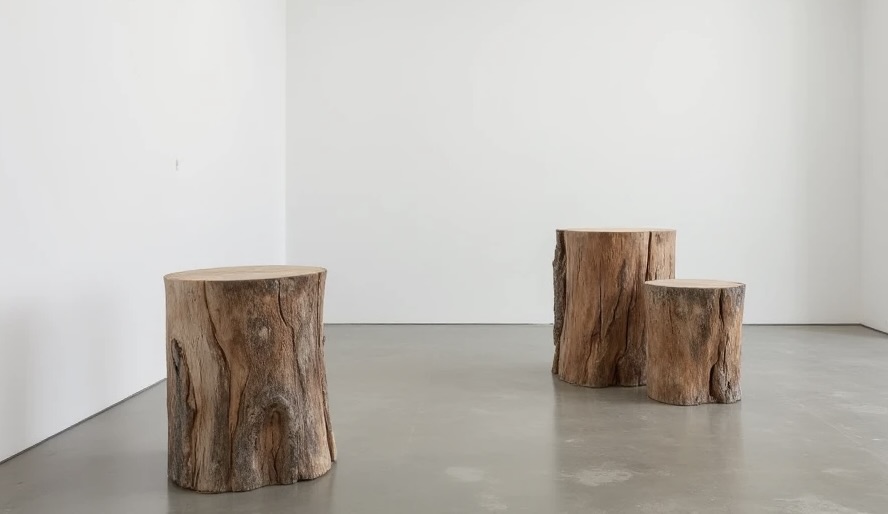
Art on a budget
From a financial perspective, logs represent a true budget-friendly revolution. While a standard professional plinth requires advanced carpentry and expensive finishes, nature has already done the heavy lifting here. A simple, level cut on the top and bottom provides a “ready-made” display with almost zero construction costs. Unlike fragile drywall boxes that chip and dent, these solid wood pillars are incredibly durable and actually gain character as they age.
Visually, this “rustic-minimalist” aesthetic breaks the sterile gallery atmosphere, providing a stunning organic contrast to smooth ceramics or polished bronze. The varying heights and natural diameters of the logs create a rhythmic, forest-like environment that encourages visitors to move through our restored space more fluidly. By embracing the materials of our local landscape, we are reducing our overhead while making a bold statement about the beauty of the natural world and the bright future of our heritage space.