An look at Statistics Canada’s 2023 Survey on Giving, Volunteering and Participating
This article is offered as a foundation for work we are undertaking in the months ahead. This fall and winter, our arts incubator and nonprofit partners will be exploring boards, governance, and strategic capacity building as a central focus of our programming season. The following analysis is intended to ground that work in the national data and emerging best practices that will shape our approach.
The Numbers Tell a Story
Canada’s nonprofit and charitable sector is the backbone of community life. From food banks and arts collectives to religious congregations and environmental advocacy groups, these organizations stitch together the social fabric of towns and cities across the country. But new data from Statistics Canada reveals that this fabric is wearing thin.
Released in June 2025, the 2023 Survey on Giving, Volunteering and Participating (SGVP) paints a sobering picture of declining participation across nearly every dimension of civic life. Between 2018 and 2023 — a period spanning the COVID-19 pandemic, rising inflation, and profound labour market shifts — Canadians pulled back from the very activities that sustain community well-being.
The data do not suggest a temporary disruption. They signal a structural shift in how Canadians engage with their communities, one that demands a strategic response from the organizations that depend on their time, energy, and generosity.
The Decline in Volunteering: By the Numbers
Overall Volunteer Participation Is Down
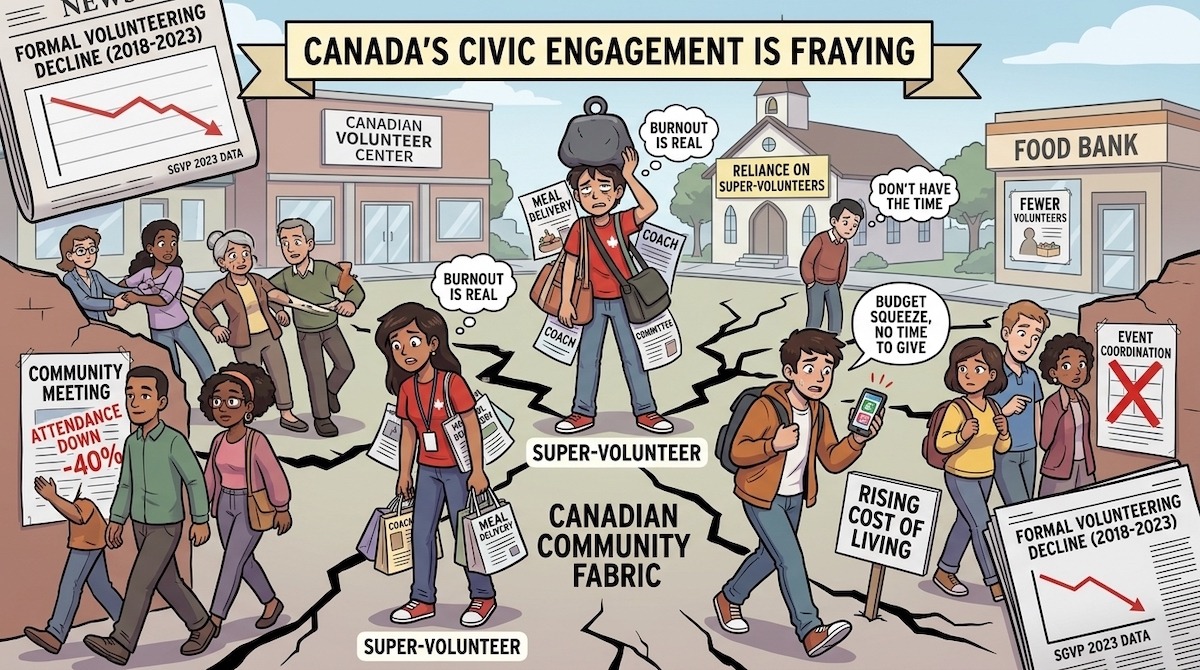
The overall volunteer rate — combining both formal volunteering through organizations and informal volunteering in the community — fell from 79% in 2018 to 73% in 2023, an 8-percentage-point decline. More striking is the drop in total hours: Canadians volunteered 4.1 billion hours in 2023, down from 5.0 billion in 2018 — an 18% decrease.
On average, each volunteer contributed 173 hours in 2023, or 33 fewer hours than in 2018. The burden of this decline was not evenly distributed. While the proportions of men and women who volunteered were similar in 2023, women’s average annual volunteer hours dropped by 21%, a statistically significant decline. Men’s hours did not fall as sharply.
Formal Volunteering: The Core of the Sector Is Shrinking
Formal volunteering — unpaid work done on behalf of charitable or nonprofit organizations — experienced the steepest contraction. The formal volunteer rate plummeted from 41% in 2018 to 32% in 2023. The number of formal volunteers fell to approximately 11 million Canadians, and total formal volunteer hours dropped by 28%, from roughly 1.7 billion to 1.2 billion hours.
Certain sectors were hit harder than others:
| Sector | Change in Volunteer Hours (2018–2023) |
|---|---|
| Hospitals | -47% |
| Sports and recreation associations | -34% |
| Education and research | -30% |
| Religious organizations | -23% |
Social service organizations, religious organizations, and sports and recreation associations still accounted for more than half of all formal volunteer hours in 2023, but their capacity to deliver services has been significantly diminished.
Who Is Disengaging Most?
The survey reveals that the retreat from volunteering is not uniform across the population. Three groups stand out for the magnitude of their withdrawal:
- Women: While women remained as likely as men to volunteer in 2023, their average annual formal volunteer hours dropped sharply (-20%), and their total volunteer hours (formal and informal combined) fell by 21%.
- Young adults aged 25 to 34: This cohort experienced the largest decline of any age group. Their formal volunteer rate fell by 24%, and their total volunteer hours plunged by 42%.
- People with less than a high school diploma: This group saw the largest decline in formal volunteering rate (-29%), suggesting that socioeconomic barriers to participation are widening.
Among volunteers with higher education, hours also fell: university-degree holders saw a -20% drop in average formal volunteer hours, and high school diploma holders saw an -18% decline.
Informal Volunteering: Community Improvement in Retreat
Informal volunteering — direct help to friends, neighbours, and community improvement activities not tied to an organization — also declined. The informal volunteer rate fell from 74% in 2018 to 66% in 2023.
The driver of this decline was not a pullback from helping individuals directly (which fell only -3%), but rather a sharp drop in community-improvement activities (-19%). The most dramatic decreases were in:
- Actively participating in public meetings on community affairs: -40%
- Coordinating a group or event:-34%
- Total hours dedicated to improving the community:-34%
These activities are the lifeblood of grassroots democracy and local problem-solving. Their decline suggests that Canadians are not only doing less for organizations — they are also less engaged in the informal civic infrastructure that holds communities together.
Charitable Giving: Fewer Donors, Similar Dollars
The story of charitable giving is one of concentration. While the total value of donations remained virtually unchanged at $13.4 billion (in 2023 dollars), the number of donors shrank dramatically.
The proportion of Canadians aged 15 and older who made a donation fell from 68% in 2018 to 54% in 2023. This decline coincided with the rising cost of living, which likely squeezed household budgets and reduced the capacity of ordinary Canadians to give.
The Rise of the “Top Donor”
In 2023, top donors — the 10% of donors who contributed the most money — gave $9.5 billion, representing 71% of the total value of all donations. Remarkably, while there were fewer top donors in 2023 than in 2018, the total value of their contributions did not decrease significantly. The decline in giving came from other donors.
This concentration of philanthropic support raises important questions about the sustainability and equity of nonprofit funding. Organizations are increasingly dependent on a smaller pool of wealthy contributors, while broad-based community support erodes.
Shifting Priorities in Giving
The destination of charitable dollars also shifted. Religious organizations saw donations fall by 22% ($1.4 billion), coinciding with a decline in religious participation from 45% in 2018 to 37% in 2023. In contrast, social service organizations were the only category to see a significant increase, receiving 20% more in donations than in 2018 — a reflection, perhaps, of heightened awareness of poverty and housing insecurity in the post-pandemic period.
The Concentration Problem: Doing More with Less
One of the most concerning patterns in the data is the growing concentration of civic engagement. In 2023, as in 2018, the top 10% of volunteers accounted for 61% of all volunteer hours. These “super-volunteers” were more likely than others to engage in both formal and informal activities, and their hours did not decline sharply.
This means the overall drop in volunteering was driven primarily by the withdrawal of casual and moderate volunteers — the people who might serve on a committee once a month, help at an annual event, or lend a hand when asked. Their departure hollows out the middle layer of organizational capacity, leaving nonprofits dependent on a small core of deeply committed individuals who are themselves at risk of burnout.
Why This Matters
The decline in volunteering and giving is not merely a sectoral concern. It is a community concern. Nonprofits and charities deliver services that governments and markets cannot or will not provide: mental health support, youth mentorship, elder care, environmental stewardship, arts and culture, and emergency relief.
When the volunteer base shrinks, organizations face a stark choice: reduce services, hire more paid staff (if funding allows), or ask remaining volunteers to do more. All three options carry costs — to service quality, to organizational sustainability, and to the well-being of the people who keep these organizations running.
Moreover, the decline in informal community engagement — attending public meetings, coordinating events, maintaining public spaces — signals a weakening of the social capital that enables communities to solve problems collectively. A society in which fewer people trust their neighbours, participate in local decision-making, or lend a hand is a society less resilient in the face of future crises.
A Strategic Response: Four Pathways Forward
The data are clear. The question is what community organizations can do to adapt, rebuild, and thrive in this new landscape. The following strategic framework is organized around four project objectives designed to help nonprofits and charities respond to the challenges documented in the SGVP data.
Here are some potential considerations we’re thinking about:
Objective 1: Create or Adapt Organizational Strategy to Build Resilience and Capacity to Deliver Programs and Services
The 28% drop in formal volunteer hours and the 18% decline in total volunteer hours demand a fundamental rethinking of how organizations operate. Resilience in this context means designing systems that can absorb shocks — whether the sudden loss of a cohort of volunteers, a funding shortfall, or a surge in demand for services.
Strategic Recommendations:
- Diversify the volunteer pipeline: With young adults (25–34) withdrawing most sharply, organizations should invest in targeted recruitment strategies for this demographic. This may include shorter-term, project-based volunteer roles; skills-based volunteering that aligns with career development; and flexible scheduling that accommodates precarious work arrangements.
- Reduce reliance on “super-volunteers”: While top volunteers are invaluable, the concentration of 61% of hours among 10% of volunteers creates fragility. Organizations should develop succession plans, distribute responsibilities more broadly, and create “on-ramp” roles that allow new volunteers to contribute meaningfully without requiring a years-long commitment.
- Build financial reserves and diversify revenue: With donor participation falling from 68% to 54%, organizations overly dependent on small-donor fundraising are at risk. Strategies should include cultivating major donor relationships, exploring social enterprise models, and advocating for stable government funding.
- Conduct organizational health assessments: Use the SGVP data as a benchmark to evaluate your own volunteer and donor trends. If your organization’s decline is steeper than the national average, diagnose the root causes — whether geographic, demographic, or programmatic.
- Foster partnerships and mergers: In sectors with the sharpest declines (hospitals: -47%; sports and recreation: -34%), collaboration may be more viable than competition. Shared back-office functions, joint fundraising, or formal mergers can preserve service delivery while reducing administrative burdens.
Objective 2: Prepare for the Future by Developing or Adapting Digital Technology to Deliver Programs and Services
The pandemic accelerated digital transformation across the sector, but the SGVP data suggest that technology adoption remains uneven. With fewer volunteers available for in-person service delivery, digital tools offer a pathway to maintain — and potentially expand — reach.
Strategic Recommendations:
- Adopt hybrid service delivery models: For organizations in sectors with steep hour declines (hospitals, education, sports), hybrid models can reduce the volunteer burden while maintaining engagement. Examples include virtual mentoring, online fitness classes, and telehealth support services.
- Invest in volunteer management technology: Modern volunteer management platforms can reduce administrative overhead, improve scheduling flexibility, and enhance communication with volunteers — all of which are critical for retaining a shrinking volunteer base. Features like mobile-friendly sign-ups, automated reminders, and impact dashboards can improve the volunteer experience.
- Use data analytics for targeted outreach: With donor participation down to 54%, data-driven fundraising is essential. CRM systems that segment donors by giving history, engagement level, and demographic profile can help organizations focus limited resources on the most promising prospects.
- Develop digital literacy among staff and volunteers: As technology becomes central to service delivery, organizations must ensure that both paid staff and volunteers have the skills to use digital tools effectively. This is especially important for engaging older volunteers who may be less comfortable with technology, and for reaching younger volunteers who expect seamless digital experiences.
- Explore AI and automation for routine tasks: Chatbots for donor inquiries, automated scheduling for volunteer shifts, and AI-assisted grant writing can free up human capacity for high-touch, relationship-based work that machines cannot replicate.
Objective 3: Enhance Staff and/or Volunteer Skills to Deliver Programs and Services
The SGVP data reveal that the volunteers who remain are being asked to do more with less. The average volunteer contributed 173 hours in 2023 — still substantial, but down from 206 hours in 2018. To maximize the impact of every hour and every dollar, organizations must invest in the skills of their people.
Strategic Recommendations:
- Implement trauma-informed training: The post-pandemic period has heightened mental health challenges among both service recipients and volunteers. Training staff and volunteers in trauma-informed care, de-escalation, and self-care can improve service quality and reduce burnout.
- Develop leadership and succession pipelines: With the concentration of hours among top volunteers, organizations are vulnerable to the loss of key individuals. Structured leadership development programs — including board training, committee chair mentorship, and volunteer supervisor certification — can build a deeper bench of capable leaders.
- Offer skills-based volunteering pathways: The decline among university-educated volunteers (-20% in hours) suggests that highly skilled individuals may be seeking more meaningful, expertise-aligned roles. Create opportunities for professionals to contribute their specialized skills (legal, financial, marketing, IT) in ways that benefit both the organization and the volunteer’s career.
- Strengthen diversity, equity, and inclusion (DEI) competencies: The sharp decline in volunteering among people with less than a high school diploma (-29%) and the gendered decline in women’s hours (-21%) suggest that organizations may be failing to create inclusive environments. DEI training for staff and volunteers can help identify and remove barriers to participation.
- Provide financial literacy training for board members: With donor bases shrinking and funding models shifting, board members need sophisticated financial acumen. Training in nonprofit finance, risk management, and strategic budgeting can improve governance and organizational sustainability.
Objective 4: Design and/or Pilot an Innovative Program or Service to Address a Community Need
The SGVP data do not only document decline — they also reveal where need is growing. Social service organizations were the only category to see a significant increase in donations (+20%), suggesting that Canadians recognize rising poverty, housing insecurity, and mental health challenges. Meanwhile, the 40% drop in public meeting attendance and the 34% decline in event coordination suggest that traditional models of community engagement are losing traction.
Innovation is not a luxury in this environment. It is a necessity.
Strategic Recommendations:
- Pilot micro-volunteering programs: With average volunteer hours down by 33 per person, organizations should experiment with bite-sized commitments — 1-hour shifts, single-event roles, or task-based contributions that can be completed remotely. Micro-volunteering lowers barriers for time-strapped individuals, particularly young adults and working parents.
- Develop social enterprise initiatives: To offset the decline in broad-based giving, organizations can create revenue-generating services that also advance their mission. Examples include thrift stores operated by social service agencies, training cafes run by workforce development organizations, or consulting services offered by environmental nonprofits.
- Create intergenerational engagement programs: With young adults disengaging most sharply and older adults remaining more active, programs that pair seniors with younger volunteers can transfer knowledge, build relationships, and sustain organizational memory. Examples include elder mentorship programs, intergenerational community gardens, and paired tech-support initiatives.
- Experiment with participatory governance models: The 40% decline in public meeting attendance suggests that traditional town halls and committee structures are no longer effective. Organizations should pilot new forms of community input — digital deliberation platforms, citizen assemblies, participatory budgeting, and pop-up consultations — to re-engage residents in decision-making.
- Address the root causes of disengagement: Rather than simply recruiting more volunteers, innovative programs should ask why people are disengaging. Is it time poverty? Financial stress? Erosion of trust? Programs that address these underlying factors — such as employer-supported volunteer leave, sliding-scale membership models, or community wellness hubs — may be more effective than traditional recruitment campaigns.
Conclusion: A Call to Action
The 2023 Survey on Giving, Volunteering and Participating is more than a statistical report. It is a warning. Canada’s nonprofit and charitable sector — and the communities it serves — are navigating a period of profound transition. The old models of engagement, built on assumptions of stable volunteer bases, broad-based giving, and informal civic participation, are no longer reliable.
But the data also point to resilience. Top donors have maintained their giving. Social service organizations have seen increased support. And millions of Canadians still contribute billions of hours to their communities. The task ahead is to build on these foundations — to adapt, innovate, and create new forms of engagement that fit the realities of contemporary Canadian life.
For community organizations, this means thinking strategically about resilience, embracing digital transformation, investing in people, and designing programs that meet people where they are. The decline is real. But so is the opportunity to build something stronger in its place.
This article is based on data from Statistics Canada’s 2023 Survey on Giving, Volunteering and Participating, released June 23, 2025. The survey was conducted from September 15, 2023, to March 30, 2024, among Canadians aged 15 and older in the ten provinces.