Dramatic Treatment for The Bronco's Last Stand
The Bronco's Last Stand
Format: Short Film / Anthology Episode | Est. Length: 10-12 minutes
Series Overview
Imagine a high-octane anthology series set in a near-future surveillance state where the digital world has become a suffocating cage, and the only freedom lies in the "Analog Underground." This series, potentially titled Retrograde, explores the lives of couriers, smugglers, and rebels who rely on pre-digital technology to transport forbidden items and data beneath the all-seeing eye of a technocratic regime. The Bronco's Last Stand serves as a pilot or standalone episode within this universe, establishing a gritty, tactile world where the roar of a combustion engine is a defiant scream against a silent, electric oppression.
Episode Hook / Teaser
Silas, an aging courier, grips the wheel of a battered 1978 Bronco as shattered glass and a mysterious, inward-bulging rear door hint at a violent struggle that has already occurred. In his rearview mirror, the harsh blue and amber strobes of high-tech pursuit vehicles pierce the night, signaling that the chase is not just active, but escalating into a lethal hunt.
Logline
Driving a crumbling relic of the past, an aging smuggler must outmaneuver a coordinated fleet of futuristic pursuit vehicles to deliver a mysterious package, only to discover that his relentless escape was actually a calculated herding toward a terrifying, supernatural destination.
Themes
Obsolescence and Resilience: The story juxtaposes the tactile, mechanical grit of the 1978 Bronco and its elderly driver against the sleek, silent, and soulless efficiency of the pursuing technology. It explores the theme of "old iron" refusing to die in a world that has moved on, highlighting a stubborn defiance inherent in analog existence within a digital age.
Determinism vs. Free Will: The narrative constructs a high-stakes struggle for freedom, only to subvert it with a crushing realization of control. The theme pivots from a desperate fight for survival to the horror of realizing that every "choice" made during the chase was manipulated by a higher power to force a specific outcome.
Stakes
For Silas, the immediate stakes are life and death; if the Bronco fails or the pursuers catch him, he dies, and the package is lost. However, the deeper stakes involve the preservation of the "package"—an object of immense density and importance that seemingly acts as a lure or key—and the terrifying implication that Silas’s entire life of running has been leading to this singular, inescapable moment.
Conflict / Antagonistic Forces
External Conflict: Silas battles a coordinated fleet of armored sedans and heavy rigs that utilize superior speed and durability to box him in. He also fights the physical limitations of his dying vehicle—overheating engine, slipping transmission, and structural failure—and his own aging, pained body.
Internal Conflict: Silas struggles with the despair of isolation and the physical agony of his age, constantly fighting the urge to give up. The ultimate antagonistic force is revealed to be the "Entity" on the bridge, a supernatural or hyper-advanced force that represents an insurmountable destiny he cannot outdrive.
Synopsis
Silas speeds through a decaying industrial district in a ruined 1978 Bronco, protecting a heavy, mysterious package in the backseat while being hunted by a fleet of unmarked, high-tech vehicles. The pursuit is brutal and physical; Silas is rammed, boxed in, and forced to utilize desperate maneuvers, such as ducking into narrow alleyways and using a lumbering semi-truck as a shield on the highway. As the Bronco’s systems begin to fail critically—engine overheating and frame buckling—Silas pushes the machine beyond its limits, driven by a singular goal: reach the bridge, which he believes is his only route to safety.
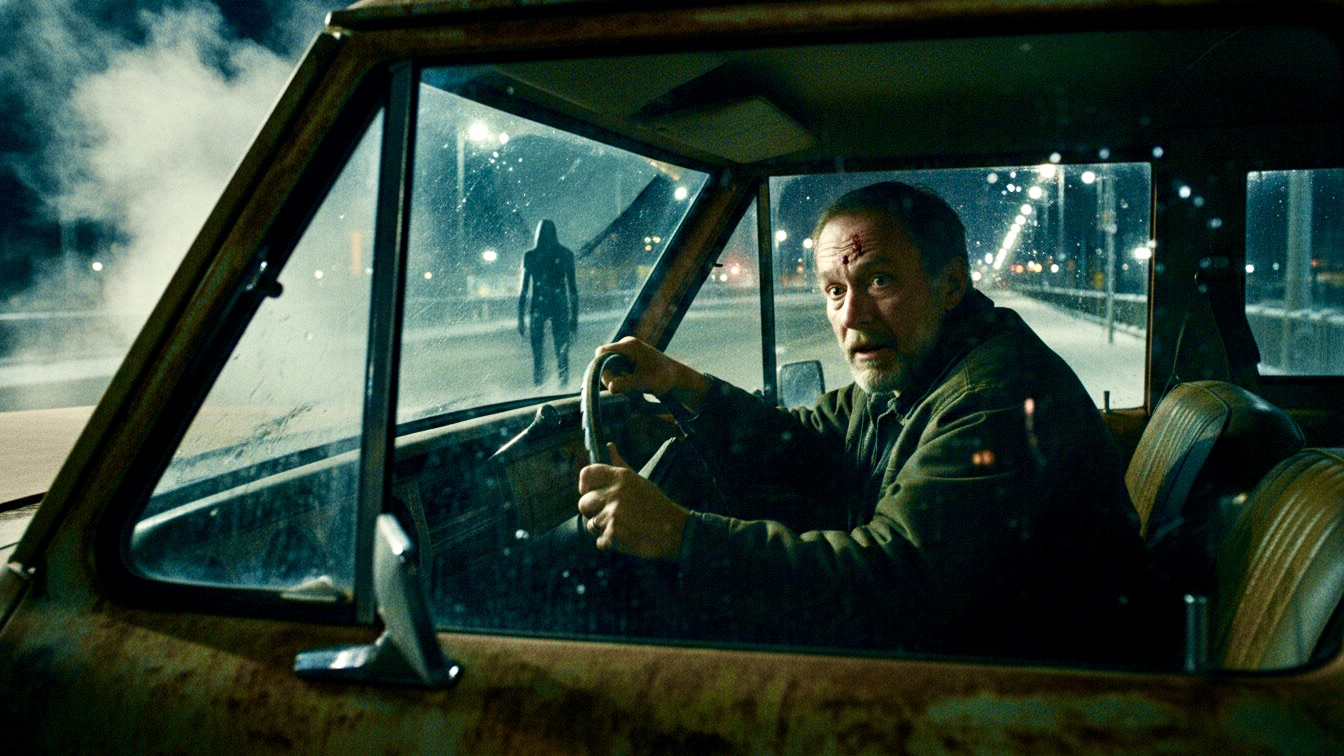
Upon breaking through a traffic jam and reaching the solitude of the bridge, the Bronco finally succumbs to its injuries, dying in a cloud of steam. Silas’s moment of relief is shattered when he sees a tall, dark, humanoid figure standing perfectly still in his path, bearing a symbol he has feared his entire life. In a chilling twist, Silas realizes the relentless pursuit was never meant to capture him, but to herd him to this specific location, delivering him and the package directly to the entity waiting in the silence.
Character Breakdown
Silas: A gritty survivor of a bygone era, Silas is defined by his stubbornness and his symbiotic relationship with his mechanical truck.
Psychological Arc:* He begins in a state of high-adrenaline desperation, fueled by a defiant belief that he can outwit his pursuers through skill and grit. He ends in a state of paralyzed horror and resignation, stripped of his agency as he realizes his defiance was merely a tool used by his enemies to guide him to his doom.
The Pursuers: Faceless and voiceless, these drivers operate with hive-mind precision, representing the cold, unyielding nature of the antagonistic force. They serve not as characters, but as environmental hazards that shape Silas's path.
The Entity: A tall, dark humanoid figure appearing at the climax. It represents the "End of the Road," a force of absolute authority and inevitability that contrasts with the chaotic energy of the chase.
Scene Beats
The Warehouse Escape: Silas navigates the industrial district, assessing the catastrophic damage to his Bronco while identifying the "monster truck" rigs closing in on him. He realizes the severity of the threat when the blue and amber lights flood his cabin, forcing him to accept that his usual tricks won't suffice against this organized force.
The Alleyway Gambit: In a desperate bid to shake the larger vehicles, Silas drifts the Bronco into a narrow, garbage-strewn alley, scraping the paint off the brick walls. The maneuver buys him a fleeting moment of respite as one pursuer crashes, but the victory is cut short when a black sedan rams him immediately upon his exit, escalating the physical violence of the chase.
The Highway Gauntlet: Merging onto the main avenue, Silas is boxed in by a sedan and a rig, forcing him to use a slow-moving semi-truck as a physical shield. He executes a high-risk weave through traffic, straining the Bronco’s transmission to its breaking point to slip through a "suicidal sliver" of space between vehicles, leaving his pursuers tangled in the wreckage behind him.
The Bridge and The Fall: Silas reaches the bridge, the engine finally dying in a hiss of steam, and allows himself a moment of relief believing he has outrun the threat. The silence is broken by the visual reveal of the Entity standing in the road, pulsing with blue light, which triggers Silas’s realization that the chase was a herding maneuver.
Emotional Arc / Mood Map
The episode begins with High-Octane Anxiety, immersing the audience immediately in the sensory overload of the chase (noise, speed, impact). It transitions into Gritty Determination during the alleyway and highway sequences, offering brief spikes of Hope when Silas successfully maneuvers. This crashes abruptly into Dread as the car dies, followed by Cosmic Horror in the final moments, shifting the genre from action-thriller to supernatural mystery, leaving the audience with a lingering sense of helplessness.
Season Arc / Overarching Story
If expanded into a series, this episode establishes the "Courier Network," a group of individuals unknowingly serving a dark purpose for the entities represented by the symbol. Future episodes could follow different drivers or the origin of the package, revealing that these "deliveries" are parts of a ritual or technology being assembled by the antagonists. Silas’s disappearance would serve as the inciting incident for a younger protagonist who finds the wreckage of the Bronco and begins to investigate the truth behind the symbol.
The season would escalate from disparate chase stories into a unified narrative about the resistance against this "Herding," with the Entity on the bridge revealed as one of the "Collectors." The overarching theme would move from individual survival to collective rebellion, as characters realize they are rats in a maze and attempt to break the walls rather than run the course.
Visual Style & Tone
Cinematography: The visual style should be claustrophobic and kinetic, utilizing tight shots inside the cabin to convey Silas’s cramped, sweaty reality, contrasted with wide, sweeping drone shots of the neon-lit city to show his isolation. The lighting should rely heavily on practical sources—sodium vapor streetlights, harsh LED headlights, and the strobing blue/amber of the pursuers—creating a "tech-noir" aesthetic similar to Drive or Nightcrawler, but with the rusted texture of Mad Max.
Tone: The tone is relentless and industrial. The sound design is crucial; the Bronco’s engine should sound like a dying animal—coughing, wheezing, and roaring—contrasted against the synthesized, electric hum of the enemy vehicles. The atmosphere is heavy with the smell of exhaust and old leather, grounding the sci-fi elements in a visceral, tactile reality.
Target Audience
The primary audience includes fans of high-concept sci-fi and action thrillers, specifically those who enjoy the "lo-fi sci-fi" aesthetic of Black Mirror, District 9, or Children of Men. It appeals to adult viewers (18-45) who appreciate visual storytelling, vehicular action, and dark, twist endings that recontextualize the narrative.
Pacing & Runtime Notes
The pacing is designed as a relentless crescendo. The first 8-9 minutes are a non-stop, accelerating chase with zero downtime, utilizing fast cuts and shaky cam to mirror the Bronco’s instability. The final 2-3 minutes shift abruptly to a slow, creeping tempo once the car dies; the camera stabilizes, the editing slows, and the silence becomes deafening, emphasizing the stillness of the Entity and the finality of Silas’s fate.
Production Notes / Considerations
Vehicle Fabrication: The production will require a hero vehicle (the '78 Bronco) modified for stunt driving, with a roll cage disguised by the interior set dressing. The "bulged" door effect needs to be a practical element, perhaps with hydraulics or a fixed prop to suggest the weight of the package pressing outward. The enemy vehicles should be modified modern SUVs with matte black wraps and custom LED arrays to strip them of brand identity and make them appear monolithic.
VFX vs. Practical: The chase sequences should rely on 90% practical effects—real driving, physical rams, and squibs for sparks—to maintain the gritty, analog feel. CGI should be reserved strictly for the "Entity" at the end to give it an uncanny, impossible smoothness that contrasts with the dirty reality of the rest of the film, and for background city extensions to establish the dystopian scale.