“The data was perfect, the hypothesis proven, yet Yuki stood amidst the wreckage of his own heart.”
The Variable of Loss
The morning light in the hotel room was aggressive. It sliced through the gap in the heavy blackout curtains, a laser beam of pure, headache-inducing white that bisected the unmade bed. Yuki Sato lay perfectly still, watching dust motes dance in that beam, suspended in Brownian motion. His head felt like it had been packed with wet cotton, a dull, throbbing pressure behind his eyes that had less to do with the two whiskeys he’d consumed and everything to do with the sheer, crushing weight of the silence in the room.
He checked his watch. 8:15 AM. The biological clock he had rigorously trained for years demanded he rise, shower, shave, and consume a balanced breakfast before reviewing his presentation notes. But the code of his life had been corrupted. The subroutines weren't firing.
He sat up, the movement nauseating. The room smelled of hotel detergent and the stale, recycled air of the HVAC system—a sharp contrast to the woodsmoke and ozone that had permeated his clothes for the last three months. He missed that smell. He missed the biting cold that made his lungs ache. He missed the chaotic clutter of the Blackwood cabin.
He missed the man who had walked away.
Yuki forced himself to stand. Routine was the only structural integrity he had left. If he stopped moving, the building would collapse. He showered in water that was too hot, scrubbing his skin until it turned pink, as if he could wash away the phantom sensation of Kaito’s hand on his collarbone. He dressed in his suit—the charcoal grey one, the armor of the academic elite. He tied his tie with mechanical precision, the silk cool against his fingers. In the mirror, the man staring back looked successful. He looked composed. He looked like a liar.
The meeting with Dr. Vane was scheduled for 9:00 AM in the hotel’s executive business suite. Yuki arrived at 8:58 AM.
Dr. Silas Vane was already there, seated behind a mahogany desk that looked too large for the room. He was typing on a laptop, his face illuminated by the blue glow of the screen. Vane was a man of dry textures—papery skin, brittle hair, a voice like crushed leaves.
"Sato," Vane said without looking up. "Punctual."
"Dr. Vane." Yuki placed the leather-bound portfolio on the desk. It contained the final report on the micro-climate variances and the caribou migration patterns. It was the culmination of two years of theory and three months of grueling field application.
Vane stopped typing. He closed the laptop and pulled the portfolio toward him. He opened it, his eyes scanning the executive summary with the speed of a predator assessing prey. The silence in the room was punctuated only by the turning of pages.
"Excellent," Vane murmured after a long minute. He tapped a finger on a graph showing the correlation between lichen growth and herd density. "The regression analysis is tight. The data is clean. This secures the tenure track, Yuki. You know that."
"I know," Yuki said. His voice sounded thin, tinny in his own ears.
"The board is already talking about a follow-up grant. Larger scope. Maybe Greenland. Or a simulation model run from Cambridge. No need for field work next time. We can hire technicians for the mud."
Technicians. That’s what Kaito was to Vane. A line item. A pair of hands to carry the heavy boxes.
Vane flipped to the title page. He smoothed his hand over the text. "'Integrative Analysis of Boreal Ecosystems.' By Yuki Sato." Vane paused, his finger hovering over the second name. "And Kaito Hayashi."
Yuki stared at the names. Printed in stark black Helvetica. Sato & Hayashi.
They looked right together. Balanced. The serif of the ampersand acting as a bridge. Yuki looked at the data tables he had agonized over—the columns of numbers that defined the world in predictable, safe integers. He looked at the charts that mapped the chaos of nature into smooth curves.
Suddenly, the numbers meant nothing. They were just ink on paper. They didn't capture the sound of the wind howling through the spruce at midnight. They didn't capture the terror of the ice cracking under the snowmobile. They didn't capture the warmth of whiskey in a tin mug, or the way Kaito’s laugh seemed to vibrate through the floorboards of the cabin, anchoring Yuki to the earth.
The data was a map of a place Yuki could no longer reach.
"He was essential," Yuki said. The words came out before he authorized them.
Vane looked up, raising an eyebrow. "Hayashi? He’s a competent guide. Good with a rifle. But essential? The intellect is yours, Sato. He was just the... logistics."
"No," Yuki said. He felt a tremor in his hands and clenched them behind his back. "He wasn't logistics. He was the constant. The data is meaningless without the context he provided. I wouldn't have survived the first week without him. I wouldn't have seen the patterns."
Vane chuckled, a dry, dismissive sound. "You're being sentimental. It’s a common side effect of isolation. You bond with whoever is there. It passes."
"It hasn't passed."
Vane sighed, closing the portfolio. "Yuki, you have a bright future. You are going to be a giant in this department. Don't let a summer fling with a bush-league mechanic confuse your trajectory. Take the win. Go home. Prepare for the symposium."
Take the win. Go home.
Yuki looked at the sterile beige walls of the office. This was the prize. This safe, air-conditioned box where men like Vane reduced the vibrance of the world into grayscale spreadsheets.
"Thank you, Dr. Vane," Yuki said stiffly. "Is that all?"
"Yes. Go get some rest. You look terrible."
Yuki turned and walked out. The door clicked shut behind him, sealing the report inside. He walked down the hallway, the carpet muffling his footsteps. He felt unmoored. Drifting.
He reached the elevator but didn't press the button. Instead, he pulled his phone from his pocket. The screen was cold against his thumb. He scrolled through his contacts until he reached the one he had avoided for a decade.
Father.
The name loomed on the screen like a threat. Yuki’s heart hammered against his ribs—a frantic, irregular rhythm that defied his calm exterior. He had spent his life curating a version of himself that would please the man on the other end of this line. A version that was academic, respectable, solitary, and sexless.
He thought of Kaito standing in the bar, offering that sad salute. I'm just getting out of the way before you realize you're ashamed of me.
Yuki closed his eyes. The shame wasn't of Kaito. The shame was of the silence.
He pressed call.
It rang once. Twice. Three times.
"Yuki?" His father’s voice was sharp, surprised. It was 9:00 PM in Tokyo. "Is everything alright? Has something happened with the grant?"
"No," Yuki said. He walked over to the hallway window, looking out at the gray slush of the city streets below. "The grant is secure. The report is submitted. Vane is pleased."
"Good," his father said. The relief was audible. "I expected nothing less. You have worked hard for this."
"I did," Yuki said. "But that's not why I'm calling."
A pause. The static on the line hissed. "Oh?"
Yuki took a breath. It felt like inhaling broken glass. "I'm calling because I need to tell you something. I need you to know who I am."
"Yuki, you are tired. We can speak when you return to—"
"I'm in love," Yuki interrupted. The words hung in the air, foreign and terrifying.
Silence stretched across the ocean. "I see," his father said slowly, his tone guarding against disappointment. "Is she a colleague? An academic?"
"He," Yuki said. "His name is Kaito. He is a field specialist. He fixes engines and tracks caribou and he is the bravest man I have ever known."
The silence returned, but this time it was heavy. It was a physical weight, pressing down on Yuki’s chest. He gripped the phone so hard his knuckles turned white. He waited for the explosion. He waited for the lecture, the disappointment, the disownment.
"He makes me happy," Yuki added, his voice breaking. "For the first time in my life, Father, I am actually happy. Not just successful. Happy."
Five seconds passed. Then ten.
"Father?"
Click.
The line went dead.
Yuki pulled the phone away from his ear. He stared at the screen. Call Ended.
He stood there in the hotel hallway, the disconnect tone buzzing in his mind. The worst-case scenario had happened. The rejection was absolute. The silence was final.
And yet, the floor didn't open up. The ceiling didn't collapse. Yuki took a breath, and it went all the way to the bottom of his lungs. The tightness in his chest, the iron band that had been constricting him for years, suddenly snapped.
He was still standing.
He was alone, yes. But he was free. The energy he had spent holding up the walls of his closet rushed back into him, a sudden, dizzying surge of adrenaline.
"Kaito," he whispered.
He checked the time. 9:15 AM. Kaito had said he was flying out in the morning.
Yuki ran to the elevator, hammering the button. When the doors opened, he didn't wait for them to fully retract before squeezing through. He sprinted through the lobby, ignoring the concierge who waved at him.
He burst out into the cold morning air. He hailed a cab, practically diving into the back seat.
"The Aurora Grand Hotel," Yuki barked. "Fast."
The ride was a blur of gray buildings and dirty snow banks. Yuki drummed his fingers on his knee, his mind racing. Don't be gone. Please, don't be gone.
He threw a wad of cash at the driver before the car fully stopped and scrambled out. He ran into the lobby of the Aurora Grand—a cheaper, rowdier establishment than his own. He went straight to the front desk.
"Room 204," Yuki panted, slamming his hand on the counter. "Hayashi. Is he in?"
The clerk, a young man with a nose ring, looked unimpressed. He tapped a few keys. "Hayashi... checked out an hour ago."
Yuki felt the blood drain from his face. "Where did he go? Did he say?"
"Dude, people just drop keys in the bucket. I don't interview them."
"Think!" Yuki snapped, his control fraying. "He had gear. Duffel bags. Did he call a cab? A shuttle?"
"Uh, yeah. The airport shuttle. Picked him up at... 8:30."
Yuki spun around, his hands in his hair. The airport. But which terminal? Which airline? Kaito was heading to the Aleutians. That meant a connector flight.
He pulled out his phone again. He dialed the only other number that mattered.
"Yeah?" The voice was crackly, accompanied by the roar of a propeller engine. Mari.
"Mari! It's Yuki."
"Sato? I can barely hear you. I'm doing a pre-check on the bird. What's wrong? You sound like you ran a marathon."
"Kaito left. He's at the airport. I need to know where he's going. What flight is he on?"
"He didn't tell you?" Mari’s voice softened, losing its metallic edge. "Oh, kid. He said you two were done. He said you chose the podium."
"I didn't! I mean, I did, but I was wrong. Mari, please. I have to stop him."
"He's heading to Anchorage first. Cargo hop. Dispatch center is out of King Salmon. Look, if he's flying commercial to the hub, there's only one flight out of here that connects to the bush planes before noon. Alaska Air, flight 492. Leaves at..." She paused, checking something. "10:15."
Yuki looked at his watch. 9:35 AM. Forty minutes. The airport was thirty minutes away in good traffic. In this slush?
"I have to go," Yuki said.
"Yuki," Mari barked. "The roads are ice. Don't kill yourself."
"I won't," Yuki lied. He hung up.
He ran back to the street. No cabs. The line at the hotel stand was five deep. He cursed, a word he never used, loud and guttural.
Across the street, a rental car agency. Yuki didn't run; he sprinted. He burst through the doors, startling the agent.
"I need a car," Yuki said. "Now. Whatever is ready."
"Sir, we have a reservation process—"
Yuki slapped his corporate credit card—the platinum one—on the counter. "Charge me double. Triple. Just give me the keys."
Five minutes later, Yuki was behind the wheel of a silver sedan that smelled of synthetic pine. It wasn't the rugged 4x4 they had used at Blackwood. It was a commuter car, light and floaty on the suspension.
He peeled out of the lot, the tires spinning on the slick pavement before the traction control kicked in with a juddering thud. He merged into traffic, cutting off a delivery truck. The driver honked; Yuki didn't blink.
He was a cautious driver. Yuki Sato obeyed speed limits. He slowed for yellow lights. He kept two car lengths of distance.
Not today.
Today, Yuki Sato was a variable in a chaotic system. He wove through the morning congestion, his eyes scanning for gaps in the flow. He hit the highway on-ramp and floored the accelerator. The engine whined in protest, but the speedometer climbed. 70. 80. 90.
The landscape blurred into streaks of white and gray. The road was treacherous—patches of black ice hiding in the shadows of the overpasses. The steering wheel shuddered in his hands. Every time the car slipped, sliding sideways on the slush, Yuki corrected with a reflex he hadn't known he possessed. He wasn't thinking about the physics of friction coefficients. He was thinking about Kaito's eyes.
"You're on a rocket ship to the top... I'm just a guy who likes the cold."
"Stupid," Yuki hissed at the windshield. "Stupid, stubborn idiot."
He checked the dashboard clock. 9:52 AM. He was making time, but the exit was still five miles away.
Traffic slowed ahead. Brake lights bloomed like red poppies in the snow. Construction. One lane closed.
"No," Yuki groaned. "No, no, no."
He didn't stop. He saw the shoulder—covered in a layer of untreated snow, littered with gravel. Illegal to drive on. dangerous.
Yuki swerved right. The tires crunched onto the gravel. The car bucked, fighting him. He held the wheel steady, accelerating past the line of idling cars. He saw angry faces in the windows he passed. He saw a construction worker waving a flag, shouting at him.
Yuki didn't care. The rules of society were for people who had time. Yuki had twenty minutes.
He took the exit ramp too fast. The back end of the car swung out. He steered into the skid—counter-steer, don't brake, throttle control—Kaito’s voice in his head, teaching him on the frozen lake. The car snapped back into line. He shot through the intersection, running a dark orange light.
The airport terminal loomed ahead, a sprawling structure of glass and steel.
He abandoned the car in the temporary loading zone. He didn't lock it. He didn't check for his bags—he didn't have any. He ran into the terminal.
It was chaos. A wall of noise and body heat. Families fighting over luggage, announcements echoing over the PA system, the smell of fast food and jet fuel.
Yuki looked at the departure screens. Alaska Airlines Flight 492. Anchorage. Gate B7. Boarding.
Boarding.
Gate B7 was at the end of the concourse. Past security.
Yuki reached the security checkpoint. The line was a snake of weary travelers winding back and forth between the stanchions.
"Excuse me," Yuki said, pushing past a man in a parka. "Emergency. Please."
"Hey, wait your turn!" someone shouted.
Yuki ducked under the ribbon barrier. He scrambled toward the front. A TSA agent stepped in his path, hand raised.
"Sir, get back in line."
"I have to get to Gate B7," Yuki gasped, his chest heaving. "It's a life or death matter."
The agent looked at him. He saw a man in a crumpled, expensive suit, hair wild, glasses fogged, sweat on his brow. He didn't look like a threat. He looked desperate.
"Boarding pass?" the agent asked sternly.
Yuki froze. He didn't have a ticket.
"I... I'm not flying. I just need to talk to someone at the gate."
"No ticket, no entry. Sir, you need to step back."
Yuki looked past the agent. The metal detectors were right there. Beyond them, the concourse. Beyond that, Kaito.
He considered running. He calculated the probability of making it past the guards, the sprint to the gate... and the subsequent arrest. He couldn't help Kaito from a holding cell.
"Please," Yuki begged, his voice cracking. "He's leaving. I just need five minutes."
The agent’s expression softened imperceptibly, but he shook his head. "I can't do it, sir. It's federal law."
Yuki looked around wildly. He saw the exit lane—the one-way revolving doors where passengers arrived. A group of flight attendants was walking through, pulling their roller bags.
It was impossible. It was illogical.
Yuki backed away from the agent. "Okay. Okay."
He turned and ran toward the ticket counters. He found the Alaska Airlines desk. No line. Thank god.
"I need a ticket," Yuki told the agent, slapping his credit card down again. "Flight 492. Anchorage."
The woman typed slowly. "That flight is boarding, sir. I can't check bags."
"No bags. Just me."
"It's very expensive for a walk-up..."
"Buy it!" Yuki shouted.
She flinched, then typed faster. The printer whirred. She handed him the boarding pass. "Gate B7. You have to run."
Yuki snatched the paper. "Thank you."
He sprinted back to security. He flashed the pass. He threw his shoes in a bin, his belt, his wallet. He went through the scanner. He didn't wait to put his belt back on. He shoved his feet into his shoes, grabbed his wallet, and ran.
Gate B1... B3...
His lungs burned. His legs felt like lead. The polished floor was slippery under his dress shoes.
"Final boarding call for Flight 492 to Anchorage," the PA system announced. "All passengers should be on board."
Yuki pushed himself harder. He rounded the corner near the food court.
Gate B7.
The door to the jetway was still open. The agent was just reaching for the strap to close the lane.
But Yuki stopped.
He stopped because he saw him.
Kaito wasn't on the plane yet. He was standing by the massive floor-to-ceiling window near the gate podium. He had his duffel bag slung over one shoulder, but he wasn't moving toward the jetway. He was staring out at the tarmac, at the ground crew loading luggage into the belly of the 737.
He looked tired. The slope of his shoulders was heavy. He wore his battered field jacket, the one with the patch on the elbow Yuki had watched him sew by the firelight. He looked like a man who was leaving half of himself behind.
The noise of the terminal seemed to fade into a dull roar, leaving only the sound of Yuki’s own ragged breathing. The chaotic variables of the morning settled into a single, crystal-clear focus.
Yuki took a step forward. Then another.
Kaito turned his head, as if he felt the shift in atmospheric pressure. His eyes scanned the crowd, weary and resigned, until they locked onto the disheveled figure standing in the middle of the aisle.
Kaito froze.
Yuki stood ten yards away, chest heaving, tie askew, glasses crooked, stripped of all his armor, staring back at the only hypothesis that had ever mattered.
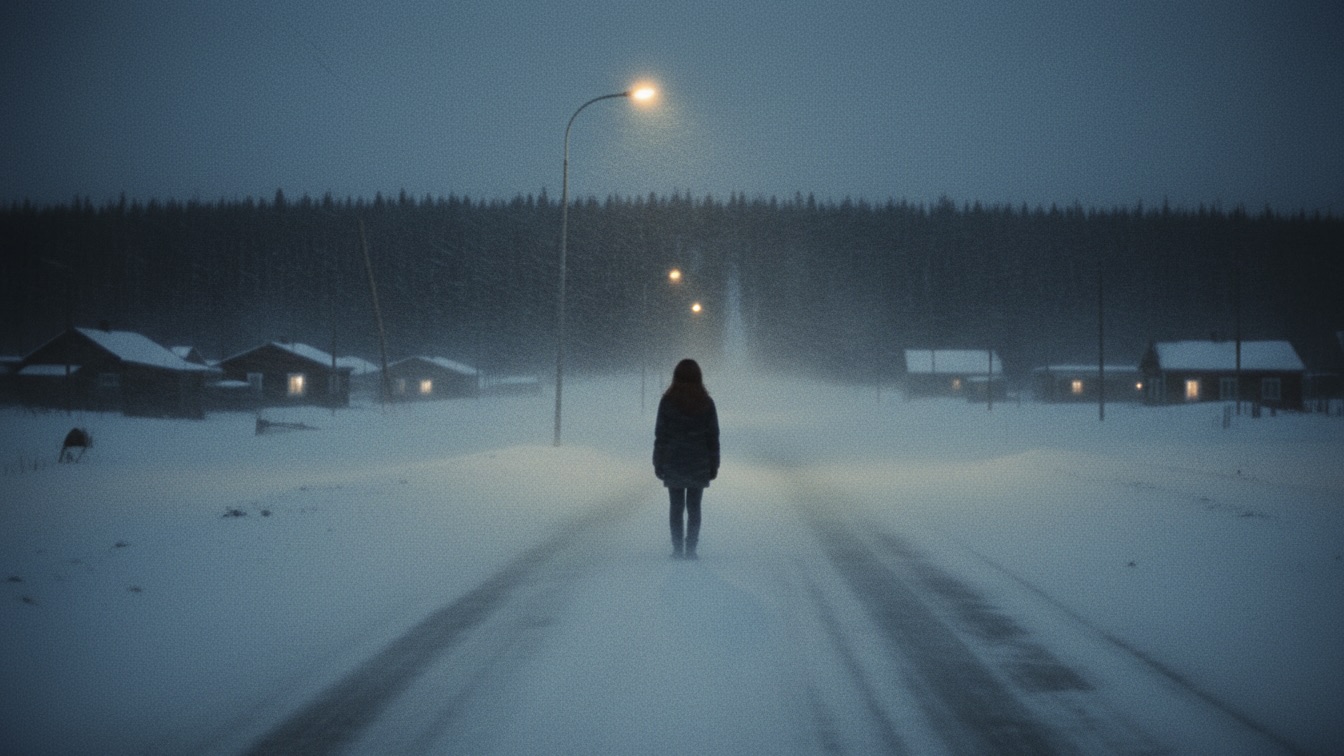
“Kaito froze, locking eyes with Yuki, who stood ten yards away, stripped of his armor and staring back at the only hypothesis that had ever mattered.”