Format: Short Film / Anthology Episode | Est. Length: 10-12 minutes
Imagine a world where the digital revolution is fought in the sweltering, claustrophobic margins of society, where every bit of data is paid for in sweat and hardware failure. This story serves as a visceral entry point into a gritty, near-future anthology where the high-stakes war against corporate surveillance is stripped of its neon-lit glamour and reduced to the raw struggle for survival against the elements and failing infrastructure.
Set in a near-future urban landscape dominated by Aura, a monolithic tech corporation, the series The Decentralized follows various underground cells attempting to dismantle corporate hegemony through localized digital strikes. Each episode focuses on a different specialized team, highlighting the physical and psychological toll of resistance in a world where privacy is a relic. The overarching narrative explores the slow-burn formation of a global network built on the sacrifices of individuals who operate in the shadows of defunct laundromats and basement server rooms.
A bead of sweat crawls down a matte black server rack toward a critical air intake as the thermometer hits ninety-six degrees. If the moisture hits the hardware, the resistance dies before the download finishes.
Three underground activists must prevent their salvaged server from melting down during a record-breaking heatwave to leak evidence of corporate human rights abuses. Failure means losing the data, their hardware, and their only chance at exposing the truth behind the New Haven project.
The primary theme is the physical reality of digital warfare, emphasizing that "the cloud" has a heavy, sweating, and vulnerable physical footprint. It explores the concept of trust as a byproduct of shared suffering and manual labor rather than corporate-mandated "culture" or mission statements.
The story also touches on the disparity between the sanitized, air-conditioned world of the elite and the gritty, desperate conditions required to challenge their power. It suggests that true revolution is not found in grand gestures, but in the refusal to quit when the environment becomes physiologically unbearable.
For Edgar and his team, the stakes are existential: if the server hits 105 degrees, an automatic shutdown will lock them out long enough for Aura to patch their security vulnerabilities. Beyond the hardware, the lives of unhoused children being used as test subjects for neural interfaces hang in the balance. Losing this data means the New Haven project continues unchecked, and the team's months of sacrifice result in total failure and potential discovery by corporate authorities.
The primary antagonist is the environment—a lethal combination of a mid-July heatwave and a failing basement infrastructure that threatens to cook the hardware. Externally, Aura’s sophisticated AI firewall and biometric security systems provide a ticking-clock digital obstacle that requires immense processing power. Internally, the team must battle physical exhaustion, frayed nerves, and the temptation to abandon their miserable conditions for the comfort of the corporate world they are fighting.
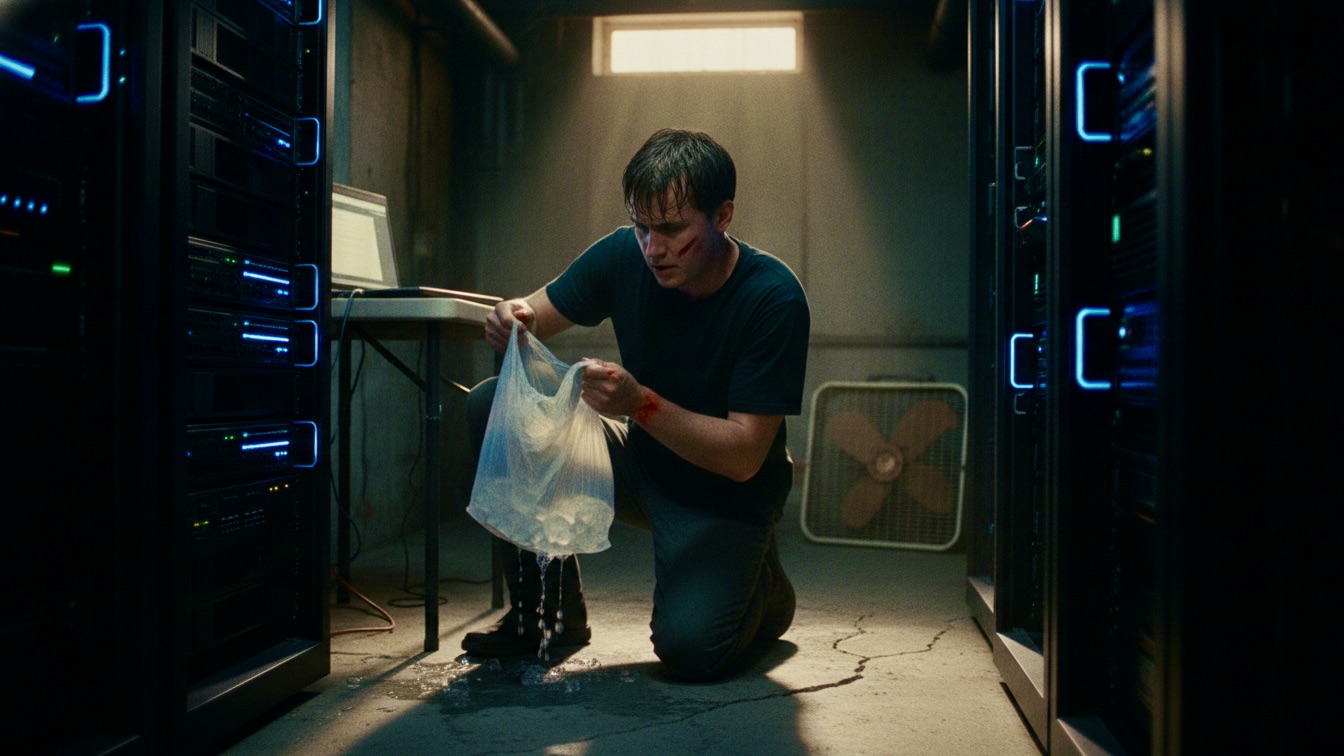
In the sweltering basement of a defunct laundromat, Edgar, Joanie, and Tariq struggle to maintain a salvaged server rack during a brutal heatwave. They are attempting to decrypt the "New Haven project" manifest, which contains evidence of Aura Corp’s illegal neural testing on unhoused youth. As the temperature redlines, the team uses a bag of melting ice and manual fanning to keep the hardware alive, pushing their bodies and their equipment to the absolute breaking point.
The climax occurs when a cooling fan fails, forcing Edgar to bypass the thermal governors with a dangerous, unregulated power surge from a lead-acid battery. The gamble pays off, allowing Joanie to complete the decrypt and upload the files to the cloud just as the power grid fails. The team escapes into a breaking summer storm, having secured the evidence and solidified their bond through the shared trauma of the mission.
Edgar is the hardware specialist who views the servers as an extension of his own body; he starts the episode in a state of high-tension anxiety and ends with a sense of quiet, battle-hardened resolve. He is the tactical lead, willing to risk electrocution or permanent hardware damage to ensure the mission's success. His arc represents the transition from technical fear to the total commitment of a true believer.
Joanie is a brilliant, high-intensity coder who operates in a near-catatonic state of "the zone" when under pressure; she transitions from clinical focus to raw panic when the system fails, finally finding a rare moment of relief when the upload clears. Her arc represents the intellectual burden of the resistance and the vulnerability of the mind when the body is failing. She is the only one capable of navigating Aura's behavioral locks, making her the team's most vital and fragile asset.
Tariq is the group's physical anchor and logistics provider; he begins the story exhausted from the external heat and ends as the literal support system, fanning the router for twenty minutes without complaint. He embodies the endurance and loyalty required to keep the technical experts functioning. His psychological state remains the most stable, acting as the bridge between Edgar’s hardware obsession and Joanie’s digital immersion.
The episode opens with extreme close-ups of sweat on metal and the rattling of a dumpster-found fan, establishing the suffocating atmosphere and the immediate threat of hardware failure. Edgar monitors the rising CPU temperatures while Joanie battles Aura’s biometric locks, highlighting the disparity between their high-tech goals and low-tech reality. Tariq arrives with a meager bag of ice, emphasizing their dire financial situation and the physical toll of the heatwave.
As the temperature hits 102 degrees, the team realizes the cooling is insufficient, prompting Edgar to kneel in the grit and manually bridge the cooling fans. He slices his thumb on the metal casing, a small physical sacrifice that mirrors the larger stakes of their mission. The fans scream to life, buying them a few degrees of safety, while Tariq provides manual airflow to the router using a piece of cardboard.
The midpoint tension peaks when a fan motor finally burns out and the system initiates a hardcoded thermal shutdown at 105 degrees. In a moment of desperation, Edgar bypasses the safety circuits using a lead-acid battery, causing a dangerous blue spark and filling the room with the smell of burning plastic. This "all-or-nothing" gamble allows Joanie to finalize the decrypt in the seconds before the entire system fries.
The upload completes just as the city’s power grid begins to fail, plunging the basement into a dull orange glow. The team shares a moment of silent, exhausted victory in the dark, realizing they have successfully leaked the New Haven manifest to the world. They evacuate the basement as a summer storm breaks outside, the rain providing a sensory and thematic release from the oppressive heat of the episode.
The episode follows a trajectory of escalating claustrophobia and sensory discomfort, moving from "stagnant heat" to "mechanical panic." The audience should feel the physical weight of the environment through tight framing and aggressive sound design that emphasizes the failing machinery. The final mood shifts from the frantic energy of the surge to a somber, rain-soaked relief, leaving the viewer with a sense of hard-won triumph.
If expanded, the season would track the fallout of the New Haven leak, showing how Aura Corp retaliates by tightening surveillance and hunting the team. The narrative would escalate from localized basement hacks to a city-wide game of cat-and-mouse, testing if the trust built in the laundromat can survive the pressures of fame and fugitive life.
The thematic arc would explore the "cost of truth," as the characters lose their anonymity and safety. Each subsequent episode would introduce new cells of the resistance, eventually culminating in a coordinated effort to crash Aura’s centralized neural network using the decentralized protocols Edgar and Joanie are developing.
The visual style is "Industrial Noir," characterized by high-contrast lighting, shallow depth of field, and a color palette of matte blacks, bruised purples, and sickly orange glows. The camera should feel handheld and intrusive, capturing the sweat on the actors' skin and the grit on the floor to emphasize the tactile nature of their work.
Tonal influences include the claustrophobic tension of Das Boot and the gritty, low-fi tech aesthetic of Mr. Robot. The soundscape is crucial, utilizing the constant, rhythmic drone of failing fans and the sizzle of melting ice to create an auditory experience of impending disaster.
The target audience is adults (18-45) who enjoy high-stakes techno-thrillers and "competence porn" where characters solve problems through grit and technical skill. It appeals to viewers interested in social commentary regarding corporate overreach, privacy, and grassroots activism in a world that feels increasingly digitized and impersonal.
The pacing is a relentless "ticking clock" structure, with the 10-12 minute runtime mimicking the real-time countdown to hardware failure. The first act establishes the atmospheric dread, the second act focuses on the frantic manual interventions, and the third act provides the explosive climax and the rain-soaked denouement.
Production requires a highly detailed, "lived-in" basement set with practical lighting effects to simulate brownouts and electrical sparks. The server rack must be a practical prop capable of emitting safe theatrical smoke and being handled roughly by the actors to maintain the sense of physical realism.
Special attention must be paid to the "sweat" continuity on the actors and the hardware, as the moisture is a central plot point. Practical water and ice effects will be used to ground the digital stakes in a physical reality, minimizing the need for CGI in favor of visceral, practical tension.


