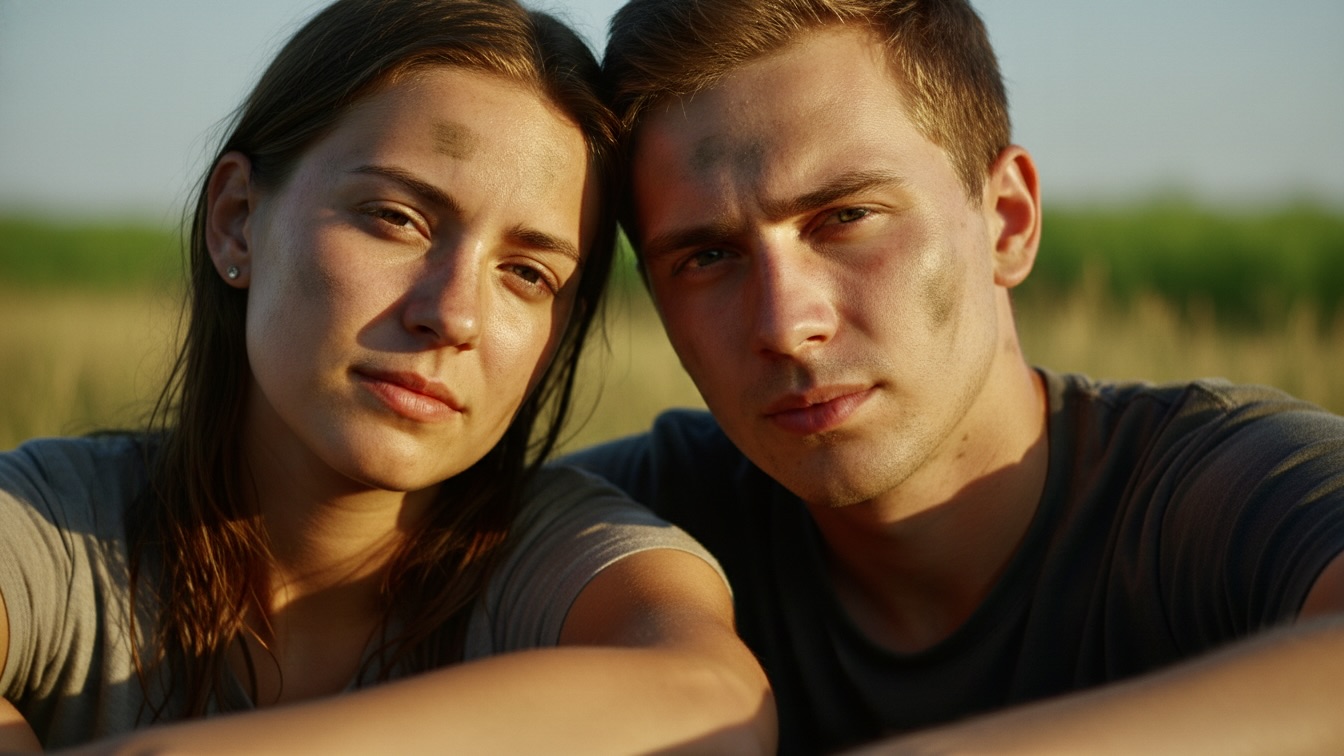
We found the map stuffed inside granddad's jacket. Ten minutes later, we were hunting ghosts in the dirt.
The heat in the attic was heavy enough to break your jaw. I stood under the exposed rafters, sweat stinging my eyes, holding a cardboard box that was rapidly losing its structural integrity. My phone vibrated in my back pocket. Another delivery notification. I ignored it. I ignored the mounting negative balance on my banking app. I ignored the fact that I was twenty-two, completely stalled out, and currently choking on dust in a dead man's house in Winnipeg's North End.
Downstairs, the front door slammed.
I froze. The house had been silent for three days. I set the box down. The cardboard scraped against the unfinished floorboards. I wiped my forehead with the back of my forearm and walked to the narrow staircase.
"Ben?"
The voice was sharp. Efficient.
"Up here," I called back.
Footsteps clicked on the hardwood downstairs. Not sneakers. Boots. Expensive ones. Tyler appeared at the bottom of the attic stairs, staring up at me. She wore a black linen shirt that looked completely untouched by the humid August air outside. Her hair was pulled back. She looked like she had just stepped out of a Toronto boardroom, which she probably had.
"You're covered in grime," she said.
"It's an attic, Ty. That's how it works."
She crossed her arms. "I thought you'd be done. The realtor wants to list this place by Friday."
"I'm going as fast as I can," I said, my chest tightening. "There's sixty years of junk up here. You want to help, grab a box."
Tyler stared at the dust motes dancing in the shaft of light cutting through the single window. She didn't move. "I don't have time for this, Ben. I have a flight back tomorrow night. We just need to clear the main floor, hire a junk removal service for the rest, and sign the papers."
"He didn't want his stuff thrown in a dumpster," I said.
"He's dead," Tyler said. Her voice didn't waver. "He doesn't care."
I clenched my jaw. Tyler had always been like this. Cut the cord, move on, don't look back. It was how she handled our parents' divorce. It was how she handled me when I dropped out of college. She just stopped replying to texts.
"Fine," I said. "Grab that trash bag. Start dumping the clothes from the trunk."
She hesitated, then walked up the narrow stairs. The temperature jumped ten degrees the second she cleared the floorboards. She pulled the black trash bag from the roll and knelt by the old cedar trunk near the window.
We worked in silence for twenty minutes. The only sound was the rustle of fabric and the heavy thud of boots and coats hitting the bottom of the plastic bag. I taped up a box of old National Geographic magazines and pushed it toward the stairs.
"What is this?" Tyler asked.
I turned. She was holding up a heavy leather bomber jacket. The leather was cracked, dry, and stiff. It looked like it belonged in a museum.
"Grandpa's old flight jacket, maybe?" I said.
"It's heavy," she said. She ran her hands over the pockets. "Really heavy. Wait."
She frowned. She pinched the inner lining near the left ribcage. The fabric was a faded orange.
"There's something in here," she said.
"Probably just padding."
"No. It's paper. Thick paper." Tyler dug her manicured nails into the seam.
"Don't rip it," I said, stepping forward.
She ignored me and pulled. The old thread snapped easily. Tyler reached into the gap between the leather and the lining and pulled out a folded square of heavy, yellowed parchment.
I wiped my hands on my jeans and moved closer. She unfolded it carefully. The paper crackled.
It was a map. But not a standard city grid. It was hand-drawn in faded black ink. Lines intersected with crude drawings of landmarks. A river. A bridge. A series of parallel lines that looked like train tracks.
"What is this?" I asked.
"Look at the date," Tyler said, pointing to the bottom right corner.
Scrawled in cursive were the numbers: 1926.
"And look at this," she said. Her finger traced a line from the train tracks to a small square marked with an 'X'. Next to the 'X' were two words: The Vault.
I stared at it. "It's probably a joke. Or some old hunting map."
"In downtown Winnipeg?" Tyler asked. "Look at the street names. That's Main Street. That's the Red River. This is the old railyard. The one they shut down in the nineties."
"Okay, so it's a map of the railyard. So what?"
Tyler looked up at me. Her eyes were suddenly bright. The bored, corporate mask was gone. "Ben. 1926. Prohibition. Grandpa used to tell stories about the bootleggers running whiskey down to the States through the rail yards. Tunnels. Hidden drop spots."
"You're reaching," I said, stepping back. "I need to finish packing."
"Ben, stop," Tyler said. She stood up. "Look at me. What if this is real? What if there's something down there?"
"Down where? A collapsed tunnel? I'm not playing Goonies, Tyler. I have rent due in three days. I need to get this house sold."
"Exactly," she said, stepping closer. "You need money. What if there's something valuable down there? Old bottles. Antiques. Stuff collectors pay thousands for."
"You don't need money," I shot back. "You work in finance. You live in a condo with a concierge. Why do you care?"
Tyler flinched. Just a micro-expression, a slight tightening of her mouth, but I saw it.
"It's an adventure," she said, her voice dropping a fraction of an octave. "When was the last time we did something together? Just the two of us?"
I stared at her. It was a manipulative play. She knew it. I knew it. But the desperation in her eyes was real. And the thought of taping up one more box made my skin crawl.
"Fine," I said. "We look. If it's a dead end, we come back and you hire the junk guys tomorrow."
"Deal," she said.
My Honda Civic idled rough at the red light. The air conditioning was broken, so we drove with the windows down. The August air blowing off the asphalt felt like exhaust and baked dirt. Tyler sat in the passenger seat, the map resting on her knees. She kept checking the drawing against the GPS on her phone.
"Take the next left," she said.
"That's an industrial road," I said. "It's blocked off."
"Just take it."
I wrenched the wheel. The tires crunched over broken glass and loose gravel. We passed a rusted chain-link fence with a faded 'No Trespassing' sign. The road dead-ended into a massive, overgrown lot. This was the old railyard. Decades ago, it was the beating heart of the city's transport hub. Now, it was a graveyard of rusted boxcars, shattered concrete, and waist-high sumac weeds.
I parked the car in the shadow of a crumbling brick warehouse. I cut the engine. The silence was immediate and heavy, broken only by the ticking of the cooling engine block and the hum of cicadas in the tall grass.
"We shouldn't leave the car here," I said.
"It'll be fine," Tyler said, already opening her door. "Bring the flashlight from the glovebox."
I grabbed the heavy Maglite and got out. The sun beat down on the back of my neck. We walked into the weeds. Burrs immediately stuck to my jeans. Tyler walked ahead of me, her expensive boots crushing the dry stalks.
"According to the map, we need to find a concrete pylon with an iron ring," she said, holding the paper up to block the glare.
"There's concrete everywhere," I said, kicking a chunk of broken cinder block.
We walked for fifteen minutes. The heat was relentless. Sweat rolled down my ribs. My phone buzzed again. Another missed delivery opportunity. Another twenty bucks gone.
"Over here," Tyler called out.
She was standing near the edge of a deep concrete trench that used to hold tracks. Overgrown vines completely covered the sides. She pointed down.
I slid down the embankment, the dirt crumbling under my sneakers. At the bottom, partially buried under a mound of dead leaves and garbage, was a massive, square concrete slab. And embedded right in the center was a rusted iron ring.
My breath hitched. "Okay. That's weird."
"It's not weird. It's the map," Tyler said, sliding down next to me. "Help me lift it."
"Ty, that thing weighs two hundred pounds."
"Just grab a side."
I grabbed the iron ring. The rust was rough against my palms. Tyler wedged her fingers under the edge of the slab.
"On three," I said. "One. Two. Three."
I pulled. The muscles in my back screamed. The slab didn't budge.
"Again," she grunted.
We pulled harder. A sharp pain shot up my forearm. Slowly, with a grinding scrape that set my teeth on edge, the concrete shifted. A gap appeared.
A blast of air hit my face. It was cold. Shockingly cold. It felt completely wrong against the burning August heat.
We shoved the slab another six inches, exposing a black, square hole in the ground. I clicked on the flashlight and shined the beam down. Concrete stairs descended into absolute darkness.
"Well," Tyler said, her breathing heavy. "Are we going?"
I looked at her. Her face was flushed, a streak of dirt across her cheek. The corporate ghost was gone. She looked human for the first time in years.
"Yeah," I said. "We're going."
The temperature dropped ten degrees with every step. The stairs were slick with condensation. I went first, sweeping the flashlight beam across the walls. The concrete was heavily cracked, choked with thick roots that had burst through the ceiling looking for water.
At the bottom of the stairs, the tunnel leveled out. It stretched forward, perfectly straight. Water dripped somewhere in the distance. Echoes bounced off the curved ceiling, making it impossible to tell how far away the sound was.
"Watch your step," I said. "There's standing water."
Tyler stayed close behind me. The beam of my flashlight caught twisted shapes of rusted rebar hanging from the ceiling like jagged teeth.
"This structure isn't safe," I said, my voice hushed. The acoustics amplified every syllable.
"We just need to follow the main path," Tyler said. "The map says the vault is at the end of the straightaway, past a brick arch."
We walked for what felt like hours, though it was probably only ten minutes. The darkness pressed in on us. The silence was deafening. My pulse thumped in my ears. Every shadow looked like a drop-off.
Then, the ground vibrated.
It was a low rumble, felt in the soles of my shoes before I heard it.
"What was that?" Tyler asked.
"Train up above," I guessed. "Freight line still runs a mile from here."
Before I could finish the sentence, the ceiling directly above us groaned. A shower of dust rained down, coating my shoulders.
"Move!" I yelled.
I grabbed Tyler's arm and yanked her forward. A heavy, wet cracking sound echoed through the tunnel. A massive chunk of concrete the size of a car tire slammed into the ground exactly where we had just been standing. A cloud of thick, choking dust exploded outward.
I hit the ground hard, dragging Tyler down with me. We coughed, covering our mouths. The air was entirely white with debris.
"Are you okay?" I asked, my voice cracking.
"Yeah," she coughed. "Yeah, I'm okay."
I shined the flashlight back. The path we had just walked down was completely blocked by a jagged pile of concrete and earth. The rubble touched the ceiling.
My stomach turned over. "It's blocked."
Tyler sat up, wiping dust from her eyes. She stared at the pile. "What do you mean it's blocked? We just dig through."
"We can't dig through that, Ty. It's solid concrete and dirt. It weighs tons."
Panic flared in her eyes. "So we're trapped?"
"No, the tunnel keeps going forward. We just can't go back the way we came. We have to find another exit."
She stood up, pacing the narrow space. "This is your fault. You said the structure wasn't safe."
I stood up slowly. The adrenaline was turning into raw anger. "My fault? You forced me down here. You couldn't handle packing boxes for one afternoon. You had to play explorer because you're bored with your perfect life."
"You think my life is perfect?" she snapped, her voice echoing violently off the walls.
"I think you ghosted this family the second things got hard!" I yelled back. "Mom got sick, you left. Dad moved out, you changed your number. Grandpa dies, and you show up three days late in a rented Tesla demanding I hurry up and sell his house!"
Tyler stopped pacing. She stared at me, her breathing shallow.
"I didn't rent the car," she said quietly.
"What?"
"I borrowed it from a friend," she said. She looked down at her hands. They were shaking. "I don't have a car. I don't have an apartment. I don't have a job, Ben."
I froze. "What are you talking about?"
"I got fired two months ago," she said, her voice cracking. The tough, corporate exterior shattered completely. "I made a bad call on an account. They let me go. I couldn't make rent. I got evicted last week. I've been sleeping on a friend's couch. Everything I have left is in a storage unit I can't afford."
I stared at her. The sister I thought had everything figured out. The one I resented for her success.
"Why didn't you call me?" I asked.
"Because I was embarrassed!" she cried out, tears cutting tracks through the dust on her face. "You always looked at me like I thought I was better than you. I couldn't admit I failed. It's a total fake-ass facade, Ben. All of it. I came back because I have nowhere else to go. I needed the house money just to survive."
The anger drained out of me, leaving a hollow ache in my chest. I walked over to her. I didn't hug her—we weren't that kind of family—but I bumped my shoulder against hers.
"I'm broke too," I said quietly. "I'm driving delivery just to cover the minimum payments on my credit cards."
She let out a wet, choked laugh. "We're a mess."
"Yeah," I said. "We are. But right now, we're a mess trapped in a dark tube. Let's find this vault. Maybe grandpa left us a bailout."
We walked forward, the beam of the flashlight cutting through the settling dust. The tension between us had broken. It felt like we were breathing the same air for the first time in ten years.
Fifty yards past the cave-in, the concrete gave way to old, red brick.
"The brick arch," Tyler said, pointing.
We passed under it. The tunnel widened into a circular room. The floor here was completely dry. Against the far wall sat three massive wooden crates, stacked haphazardly. The wood was grey and rotting, but the iron bands holding them together were intact.
I walked up to the nearest crate. I wedged the heavy base of the flashlight under the wooden lid and pried upward. The dry wood splintered and snapped.
Inside, packed in yellowed straw, were glass bottles.
I pulled one out. The glass was thick, dark green, and heavy. The label was mostly eaten away by time, but the stamped wax seal over the cork was perfect.
"Is that..." Tyler started.
"Rye whiskey," I said. "1920s. Unopened."
Tyler's eyes went wide. "Do you know what collectors pay for untouched prohibition liquor? Ben, there are dozens of bottles here."
"We need to figure out how to carry them," I said.
"You don't need to carry them."
The voice came from the dark corridor to our left.
I spun around, aiming the flashlight. A man stood in the archway. He was thin, wearing a heavy, stained winter coat despite the August heat. His face was hidden under a pulled-down beanie, but his eyes caught the light. Wild. Desperate. In his right hand, a long hunting knife glinted.
"Put the bag down," the man said. His voice was raspy.
"We don't have a bag," I said, keeping the beam directly in his eyes to blind him. My heart hammered against my ribs.
"Step away from the boxes," he demanded, taking a step forward.
Tyler froze beside me. I could feel her shaking. I calculated the distance. Ten feet. Too far to rush him.
I looked at the brick walls. The curve of the room. The acoustics.
"Okay," I said loudly. "We're stepping back."
I reached into my pocket and grabbed a heavy steel lug nut I'd picked up off the tracks earlier. I squeezed it tight.
"Ty," I whispered, barely moving my lips. "When he turns, run for the right tunnel."
I threw the lug nut as hard as I could into the dark corridor behind the man. It struck an iron pipe with a massive, ringing CLANG that echoed violently in the confined space.
The man flinched, spinning around to face the noise, raising the knife.
"Go!" I yelled.
I grabbed two bottles from the open crate by the necks. Tyler bolted toward the right-hand corridor. I sprinted after her.
"Hey!" the man screamed, turning back, but we were already moving.
We ran blind. I aimed the flashlight ahead, the beam bouncing erratically. We hit a set of concrete stairs. I scrambled up them, my shins scraping against the rough edges. Tyler was ahead of me, pushing against a heavy wooden grate at the top.
She shoved. It didn't move.
"Help me!" she screamed.
I slammed my shoulder into the wood alongside her. The wood groaned, then splintered. We burst upward, tumbling out onto a steep embankment covered in dry grass.
The sunlight hit my eyes like a physical blow. The sudden oxygen filled my lungs, hot and bright and completely overwhelming. The claustrophobia of the tunnel vanished, replaced by the massive, unbroken blue of the summer sky.
We scrambled up the grass, away from the grate, until we hit the chain-link fence of the rail yard.
We collapsed onto the ground. My chest heaved. Tyler was gasping, lying flat on her back, staring up at the sun.
I looked down at my hands. I was still gripping the two bottles of whiskey by the necks. The glass was cool.
I started to laugh. It started low, then bubbled up until I was choking on it. Tyler turned her head, looked at me, and started laughing too. It was hysterical, exhausted laughter.
"Two bottles," she gasped. "We nearly died for two bottles."
"They're probably worth five grand each," I said, wiping sweat from my eyes.
She sat up, crossing her legs. "We split it. Down the middle."
"Deal," I said.
I looked at her. She was covered in dirt, her expensive boots scuffed, her perfect hair a mess. She looked exactly like the kid I used to build forts with in the backyard.
"What now?" she asked.
"Now," I said, "we go back to the house. We order a pizza. And we pack the rest of the boxes together."
“I looked down at the label on the antique bottle, wiping away the dust to reveal a name that wasn't a distillery, but our grandfather's.”


