Melissa and Leo debate the futility of human legacy while a record-breaking heatwave melts the industrial district pavement.
Melissa watched a bead of sweat descend Leo’s forehead. It moved with the agonizing precision of a glacier, which was ironic given the topic of their current data-log. The air conditioner in the repurposed shipping container was making a sound like a bag of gravel in a blender. It didn't actually cool anything. It just moved the hot air around, giving it a sense of purpose. Melissa’s shirt was stuck to the small of her back. She felt like a human sticker. They were surrounded by plastic crates filled with things that were supposed to matter in a hundred thousand years. Right now, they barely mattered to the humidity sensor on the wall, which was flashing a red '90%' with a rhythm that felt personal.
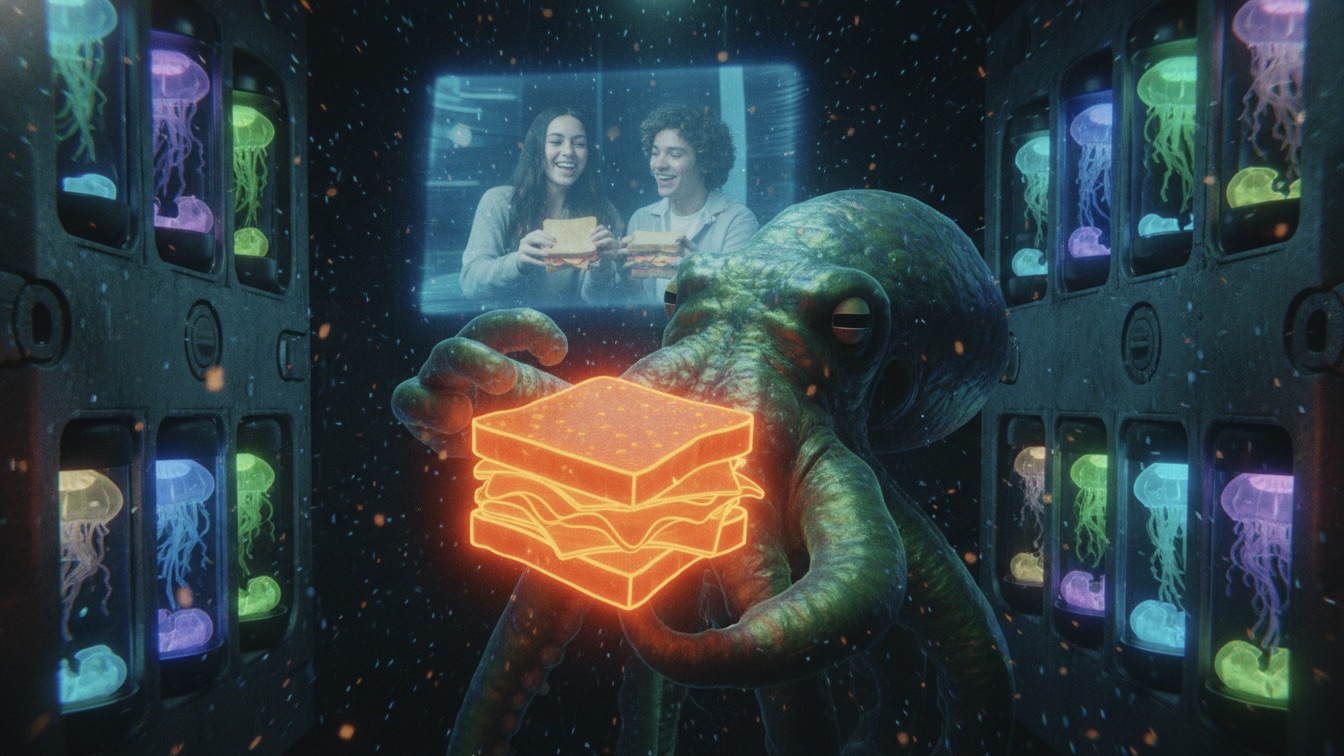
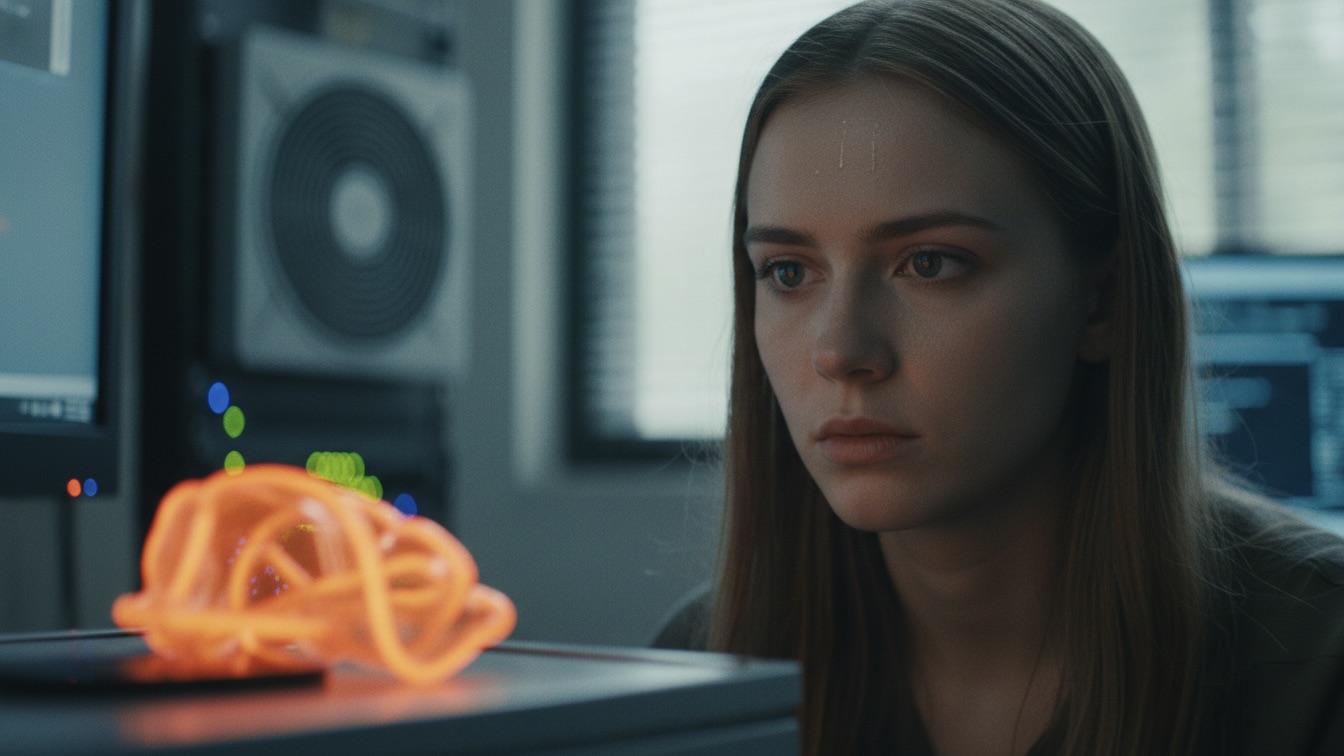
Leo was holding a 3D-printed carving. It was neon orange. The color was an affront to the natural world, which was exactly the point. It was designed to be seen by eyes that hadn't evolved yet, or maybe by sensors that didn't care about the visible spectrum. Inside the orange plastic was a slab of synthetic quartz. It held the entirety of Wikipedia, several million TikToks of people failing at baking, and a high-resolution scan of a ham sandwich. This was the legacy. This was what the project deemed essential for the post-human future.
"The ham sandwich feels like a prank," Melissa said. She tapped the side of her tablet. The screen was smudge-streaked and hot to the touch. "Imagine you’re a hyper-intelligent cephalopod living in the year 50,000. You finally crack the code on this orange rock, and the first thing you see is a grainy image of processed pork on rye. You’d probably just put the ice back."
Leo didn't look up. He was using a micro-brush to clean dust out of the carving’s base. He treated the plastic like it was Ming porcelain. "It’s about the cultural footprint, Melissa. The sandwich represents the intersection of agriculture, logistics, and midday hunger. It’s a nexus point. Besides, the cephalopods will appreciate the rye. It’s complex."
"It's bait," Melissa countered. She shifted her weight on the metal stool. The screech of metal on metal was the loudest thing in the room. "We’re just leaving trash for the future to clean up. We’re the roommates who leave a sink full of dishes and then move out of the planet. Except the dishes are nuclear waste and bad memes."
Leo finally looked up. His eyes were bloodshot from staring at blue-light filters for six hours. "It’s not just trash. We’re talking about deep time storytelling. It’s speculative design. We’re putting ourselves in the shoes of the ancestors. We’re looking back from the future at the decisions we’re making right now. It’s meta. It’s basically art."
"It’s science fiction with a budget," Melissa said. "Look at this place. We’re in a tin box in a parking lot in July. The world is literally on fire outside, and we’re worried about whether a robot in the year 100,000 will understand what a 'vibe check' is. It’s delusional."
Leo leaned back, his chair creaking in protest. "That’s the fun part. It takes us out of reality. The time scales are mind-bending. We’ve spent years talking about this. How do we get people to look outside today? This project could outlive the concept of 'people.' That’s not delusional. That’s scale."
Melissa looked at the orange carving. It sat on the workbench like a toy left behind at a playground. The sun hit it through the high, reinforced window, making the neon plastic glow with a sickly intensity. It was vibrant and cheap. It looked like it belonged in a cereal box, not a geological stratum.
"The glaciers are coming, Leo," she said, her voice dropping the banter for a second. "Everything will be scraped away. You know the math. A mile of ice doesn't care about your synthetic quartz. It’ll grind this container, this city, and your ham sandwich into silt. It’ll bury it under a hundred feet of mud. Then the inland seas come back. Then more silt. By the time anyone—or anything—finds this, it’ll be a weirdly colored pebble at the bottom of a trench."
"Which is why we talked about the moon," Leo said. He reached for a lukewarm bottle of water. He drank half of it in one go. "No ice on the moon. No water. Just static vacuum and dust. We leave the backup there. A permanent record on a grey rock that doesn't move. It’s the ultimate hard drive."
"If we can’t even fix the AC in this box, how are we getting a crate of orange plastic to the moon?" Melissa asked. She picked up a stylus and started spinning it between her fingers. "We’re playing pretend. We’re pretending there’s a 'we' that lasts that long. There isn't. There’s just bit rot and media decay. Even that quartz slab will degrade. The data will leak. The AI on the memory stick will go insane from solitude before anyone plugs it in."
Leo shrugged. It was a jerky, tired movement. "Maybe. But the act of trying is the story. Even if the message never gets read, the fact that we tried to send it says something about us. We’re the species that didn't want to be forgotten. We’re the ones who shouted into the void even when we knew the void wasn't listening."
"That’s very poetic, Leo. Truly. But I think the void is just trying to sleep, and we’re the annoying neighbors playing loud music at 3 AM," Melissa stood up. Her legs were stiff. The floor of the container was covered in cable ties and discarded wrappers. The mundane reality of their workspace was a sharp contrast to the 100,000-year horizon they were supposed to be managing. She walked over to the small window. Outside, the heat shimmered off the asphalt of the industrial park. A lone crow was pecking at a crushed soda can. It looked more prepared for the future than they did.
"Did you check the logs for the 2197 vault?" she asked, her back to him.
"Yeah," Leo said. "Why?"
"Something’s off in the checksums. I was looking at the file headers this morning. There’s a ghost in the directory. A file that wasn't there during the last sweep."
Leo paused, the micro-brush hovering over the carving. "Bit rot?"
"No," Melissa said, turning around. "It’s too clean for bit rot. It’s a structured file. Ten gigabytes of encrypted data that labeled itself 'Inheritance.'"
Leo frowned. "We didn't name anything 'Inheritance.' Everything is coded by date and sector. 2197-A, 2197-B. That’s the protocol."
"Exactly," Melissa said. "So who put it there?"
"Maybe the researchers from archaeology? They were talking about embedding technologies into stone statues. Maybe they snuck a test file in."
"Without a log entry? Without a timestamp?" Melissa shook her head. "In this project, if you don't log it, it doesn't exist. That’s the first rule of deep time storytelling. You have to leave a trail for the people who come after you. You don't just drop a ten-gig bomb in the middle of a vault and walk away."
Leo set the carving down. The orange plastic clicked against the metal table. "Open it."
"I tried," Melissa said. "It’s locked behind a 4096-bit key. It’s not meant to be opened by us. It’s meant to be opened by whatever comes next."
"But we’re the ones here now," Leo said. He walked over to her workstation. "If someone’s messing with the vault, we have to know. That’s our job. We’re the keepers of the trash."
"The curators of the collapse," Melissa corrected. She sat back down and pulled the tablet closer. The 'Inheritance' file sat at the bottom of the directory, its icon a simple, unadorned grey square. It looked heavy. It looked like it had been there forever, even though she knew it hadn't.
"Run a diagnostic on the source metadata," Leo suggested. "See when it was actually written to the drive."
Melissa’s fingers flew across the screen. The interface was clunky, designed for durability rather than speed. The progress bar crawled. Outside, a truck rumbled past, the vibration rattling the walls of the container.
"Timestamp is..." Melissa stopped. She squinted at the screen. "That’s not right."
"What?"
"The timestamp says June 14, 2026," she said.
"That’s today," Leo said. "So someone in the lab uploaded it this morning."
"No," Melissa said. "The system time is set to UTC. It’s currently 4 PM here. This file was timestamped at 11:45 PM tonight."
Leo leaned in so close his shoulder brushed hers. "A clock error? The server probably drifted."
"The server is synced to a strontium lattice clock in the basement of the science building, Leo. It doesn't 'drift.' It’s more accurate than your heartbeat."
They stared at the grey square. The humidity in the room seemed to spike. Melissa felt the prickle of heat on her neck, but her hands were suddenly cold.
"Maybe it’s a joke," Leo whispered. "The archaeology guys. They’re always talking about how time is a circle. Maybe they’re messing with the headers to prove a point."
"Or maybe," Melissa said, her voice sharp, "someone is already looking back at us from the future. And they’re not waiting for the glaciers."
Leo reached out and touched the screen, his finger hovering over the file. "If it’s from tonight... it hasn't happened yet. But it’s already here."
"Deep time," Melissa whispered. "It’s a trip."
They sat in the sweltering silence, two teenagers in a tin box, staring at a file that shouldn't exist, while the summer sun burned a hole through the sky. The orange carving watched them with its sightless, neon eyes, a silent sentinel for a world that was already starting to feel like a memory.
The heat outside was a physical wall. Stepping out of the shipping container was like being hit in the face with a warm, damp towel that had been used to dry a radiator. Melissa squinted against the glare. The industrial park was a wasteland of cracked concrete and dry weeds that looked like they’d given up on the concept of photosynthesis. Everything was beige and grey, except for the bright blue recycling bins huddled near the fence like blue-collar penguins.
"I need a slushie," Leo announced. He was squinting so hard his eyes were just slits. "My brain is actually boiling. I can feel the grey matter turning into a reduction. A nice, thick soup of existential dread."
"The convenience store is a ten-minute walk," Melissa said. "You’ll melt before you hit the gates. Your remains will be a puddle of sweat and a 'Property of Deep Time Project' badge."
"I’ll take my chances. The risk-reward ratio is skewed in favor of the blue raspberry flavor profile."
They started walking. The heat rose from the asphalt in visible waves, distorting the horizon. It made the distant skyscrapers look like they were melting into the sky. Melissa felt the grit of the city on her skin. It was a fine, invisible dust that coated everything. The smell was nonexistent to her—the world was just a series of textures and temperatures. The air was heavy, like a wet wool coat, but it carried no scent. It was just a presence.
"Think about the glaciers again," Leo said, his voice rhythmic as they walked. "Imagine this whole park. The warehouses, the trucks, the weirdly aggressive seagulls. All of it, under a mile of solid ice. The pressure would be insane. It wouldn't just crush the buildings; it would pulverize the molecules. It would turn the concrete back into dust. It’s the ultimate reset button."
"You’re obsessed with the reset," Melissa said. She kicked a pebble. It skittered across the hot ground. "It’s a coping mechanism. You want the ice to come because you don't want to deal with the now. It’s easier to worry about 10,000 years from now than it is to worry about your college applications."
"Low blow, Melissa. And incorrect. I’m worrying about both simultaneously. It’s called multitasking. I can be stressed about my personal statement and the eventual erasure of human civilization at the same time. I contain multitudes."
"You contain a lot of caffeine and bad ideas," she countered. "But seriously. The archaeology team. They keep talking about 'oral history' and 'traditional knowledge.' How do you pass a story down through a glacier? You can’t tell a story to a wall of ice. It doesn't listen. It just grinds."
"That’s why you embed the story in the landscape," Leo said. He stopped and pointed at a large, jagged rock sitting in the middle of a decorative mulch bed near an office building. "That’s an erratic. A rock left behind by the last glacier. It’s been here for ten thousand years. It’s a message. It says: 'I was here, and I moved this.' We just need to do the same thing, but with more intent."
"So, we carve 'Leo was here' into a boulder and hope for the best?"
"Basically. But instead of 'Leo was here,' we carve the blueprints for a fusion reactor. Or the lyrics to a really catchy pop song. Something the future can use."
"They won’t use it," Melissa said. "They’ll look at it and think it’s a religious artifact. They’ll build a temple around your pop song and sacrifice goats to it. That’s how humans work. We don't learn; we just mythologize."
Leo wiped sweat from his upper lip. "Maybe the people dealing with this won’t be human. We keep asking that in the meetings. 'Will they even be human?' We’re already seeing humanoid robots that can do backflips. In ten thousand years, the 'us' might be silicon-based. They might not have goats to sacrifice. They might just have data ports."
"Even worse," Melissa said. "A robot reading a pop song. It’ll just calculate the frequency and conclude that we were a very inefficient species that spent too much time vibrating our vocal cords."
They reached the convenience store. The automatic doors hissed open, releasing a blast of refrigerated air that felt like a blessing from a cold, uncaring god. Melissa stood in the doorway for a second too long, letting the chill soak into her skin. The store was bright, the fluorescent lights humming a low, electric tune. The shelves were packed with colorful plastic—bags of chips, rows of soda, tubs of glittery slime. It was a cathedral of the temporary.
"Look at this stuff," Melissa whispered as they walked toward the slushie machine. "It’s all going to be silt. Every bag of Flamin' Hot Cheetos. Every bottle of mountain-dew-flavored energy drink. It’s all just future dirt."
"But right now, it’s cold," Leo said. He grabbed a giant foam cup and started filling it with a mixture of red and blue. The machine whirred, a mechanical heart beating in the corner of the store. "The present is the only thing we actually have to live in, Melissa. The deep time stuff... it’s just a way to make the present feel less small."
"Or more small," Melissa said. She didn't buy a drink. She just watched the slushie swirl in the cup. "It makes everything feel like a joke. Why study for a math test if a glacier is going to eat the school? Why care about anything if the sun is going to turn into a red giant and swallow the earth?"
"Because the slushie tastes good now," Leo said. He took a long sip and winced as the brain freeze hit him. "Ow. See? That’s a physical reality. That’s 2026. It hurts, but it’s real."
They walked back to the counter to pay. The clerk was a guy in his twenties with bleached hair and a bored expression. He didn't look up from his phone. He was part of the timeline too, a single point in the vast data set of the summer. He was an ancestor in training.
"Hey," Leo said to the clerk. "If you could leave one message for someone ten thousand years from now, what would it be?"
The clerk blinked, finally looking up. He looked at Leo, then at Melissa, then back at the slushie cup. "Uh. 'Don't drink the milk if it’s past the date'?"
"Practical," Leo said, nodding. "I like it. Logistics-focused."
"Whatever, man," the clerk said, sliding the change across the counter. "That’ll be four bucks."
Melissa and Leo stepped back out into the heat. The contrast was even worse this time. The sun felt like a weight on their shoulders. They walked back toward the shipping container, the orange carving waiting for them in the dark.
"See?" Melissa said. "That’s the legacy. Don't drink the milk. That’s the height of human wisdom."
"It’s a start," Leo said, his voice muffled by the slushie. "It’s a foundational truth. Survival is based on avoiding spoiled dairy. You build a civilization on that."
As they approached the container, Melissa saw a figure standing by the door. It was a woman in a lab coat, her hair pulled back in a severe bun. Dr. Aris. The lead researcher from the archaeology department. She was looking at her watch, her foot tapping a nervous rhythm on the gravel.
"You’re late," Dr. Aris said as they got closer. Her voice was sharp, like a glass shard. "The sync window for the vault is closing. We need to finalize the data packets for the 2197 upload."
"We were just... getting supplies," Leo said, holding up his slushie like a peace offering.
Dr. Aris didn't even look at the cup. "Inside. Now. We have a discrepancy in the vault logs. Something is writing to the drive that isn't on the authorized list."
Melissa and Leo exchanged a look. The 'Inheritance' file.
"We saw it," Melissa said, her heart starting to race. "The timestamp. It said tonight. 11:45 PM."
Dr. Aris froze. She looked at Melissa with an expression that wasn't just professional concern. It was fear. Real, unpolished fear. "How do you know the timestamp? The file is encrypted."
"I ran a metadata sweep," Melissa said. "I didn't open it. I just looked at the headers."
Dr. Aris grabbed Melissa’s arm. Her grip was tight, her fingers cold despite the heat. "You shouldn't have done that. That file... it isn't ours. It’s not from the project."
"Then where is it from?" Leo asked, the slushie forgotten in his hand.
Dr. Aris looked around the empty parking lot as if she expected the asphalt to start talking. "We don't know. But the signal didn't come from the lab. It didn't come from the internet. It came from the moon."
Melissa felt a chill that had nothing to do with the air conditioning. She looked up at the sky, where the pale ghost of the moon was visible even in the daylight.
"The moon?" she whispered. "But there’s nothing there. No one’s been there in years."
"Someone is there now," Dr. Aris said. "And they’re sending us a message. They’re looking back at us."
They entered the container. The hum of the broken AC felt louder now, more frantic. The orange carving sat on the table, its neon surface catching the light. It looked less like a toy now and more like a beacon. A tiny, plastic warning.
"If they’re on the moon," Leo said, his voice shaking, "who are they?"
Dr. Aris sat down at the main terminal. Her fingers trembled as she typed. "The signal has a signature. A post-human identifier. It’s a code we haven't invented yet. But we will. In about three hundred years."
"So it’s a time capsule," Melissa said. "Sent from the future to the past?"
"Not a capsule," Dr. Aris said, staring at the screen where the 'Inheritance' file was beginning to pulse with a soft, blue light. "It’s a mirror. They’re showing us what we become."
"And?" Leo asked. "What do we become?"
Dr. Aris didn't answer. She just pointed at the screen. The encryption was breaking. The 4096-bit key was melting away like ice in the summer sun. And as the file opened, the first thing that appeared wasn't a ham sandwich or a fusion reactor.
It was a map of the world. But the continents were gone. There were no green forests, no blue oceans. There was only white. A solid, unbroken expanse of ice.
"The glaciers," Melissa whispered. "They’re not coming in ten thousand years. They’re already here."
"Wait," Leo said, leaning in. "Look at the date on the map."
Melissa looked. The date wasn't the year 100,000. It wasn't even 2197.
It was July 14, 2026.
Tonight.
Outside, the heat shimmered, and for a split second, Melissa thought she saw a flake of snow fall past the window. But it was just ash. Or dust. Or the beginning of the end.
"We need to log this," Dr. Aris said, her voice hollow. "We need to leave a story. For whoever finds the ice."
"Who’s going to find it?" Melissa asked.
"The ones who sent the file," Dr. Aris said. "The ones on the moon. They’re the only ones left."
Leo took a sip of his slushie. It was mostly melted now, a purple sludge that stained his tongue. "Well," he said, his voice cracking. "At least the moon is safe. Right?"
No one answered him. The silence in the container was heavy, filled with the weight of a future that was arriving ahead of schedule. The orange carving sat on the table, a neon witness to the last summer the world would ever know.
The blue light from the terminal was the only thing illuminating the container now. The sun had dipped below the horizon, but the heat hadn't left. It had just turned into a heavy, suffocating blanket. Melissa felt the sweat drying on her forehead, leaving a salty residue. She stared at the map of the frozen Earth. It was beautiful in a terrifying way. The mountain ranges were just ripples in the white. The cities were gone, buried under miles of pressurized snow.
"It doesn't make sense," Leo said. He was pacing the small space of the container, his slushie cup long since discarded. "How does a glacier happen in a night? It’s physics. You need thousands of years of cooling. You need atmospheric shifts. You can’t just... wake up in an ice age."
"Unless it’s not a natural glacier," Dr. Aris said. She was scrolling through the data packets that were unfolding from the 'Inheritance' file. "Look at the thermal signatures. The cooling isn't coming from the poles. It’s coming from the atmosphere itself. A sudden, catastrophic drop in temperature caused by... something in the upper orbit."
"A weapon?" Melissa asked.
"Or a correction," Dr. Aris replied. "A planetary-scale reset. Like we were talking about. Only we thought we were the ones doing the planning. We thought we were the architects of the future. We’re not. We’re just the occupants of the house before it gets demolished."
Leo stopped pacing. "Who demolished it? The people on the moon?"
"The file doesn't say who," Dr. Aris said. "It just says 'Inheritance.' It’s a gift. A clean slate. They’re giving us a world without us."
"That’s a terrible gift," Leo said. "I’d rather have the ham sandwich."
Melissa walked over to the workbench and picked up the orange carving. It felt heavier than it had earlier. The synthetic quartz inside seemed to be vibrating, a low-frequency hum that she felt in her teeth. "What if this isn't a message for the future?" she said. "What if it’s a key?"
Dr. Aris looked up. "What do you mean?"
"We’ve been talking about leaving stories for the next generation. But what if the next generation is already here? What if they’ve been waiting for us to finish the project? Like a software update. You can’t install the new OS until the old one is backed up."
Leo’s eyes widened. "We’re the backup. The whole Deep Time Project. It wasn't about saving our history. It was about archiving us so they could delete the original file."
"That’s a very cynical take, Leo," Melissa said, though her voice lacked its usual bite. "And also probably right. We’re the bit rot. We’re the media decay. We’re the thing that needs to be scraped away so the glaciers can come back and make everything clean again."
"I don't want to be scraped away," Leo said. "I haven't even seen the new Marvel movie. It comes out next week."
"I don't think there’s going to be a next week, Leo," Melissa said softly. She looked out the window. The sky was a deep, bruised purple. The stars were starting to come out, and they looked sharper than usual. Brighter. Cold.
"We have to stop the upload," Dr. Aris said, her fingers flying across the keys. "If the project is the trigger, we can abort. We can keep the 'old OS' running a little longer."
"How?" Melissa asked. "The file is already open. The encryption is gone."
"I can crash the server," Dr. Aris said. "It’ll destroy the data, but it might break the link with the moon. If they don't get the backup, maybe they won't start the deletion."
"But all our work," Leo said. "Everything we saved. The music, the art, the scientific breakthroughs. It’ll all be gone. We’ll have nothing to leave behind."
"Better to have nothing left behind and a world to live in," Melissa said. "Do it, Dr. Aris. Kill the server."
Dr. Aris hesitated. Her hand hovered over the 'Execute' command. For a scientist who had dedicated her life to the preservation of human knowledge, this was the ultimate heresy. To choose silence over the story. To choose the void.
"Wait," Leo said. "Look at the screen."
A new window had opened. It wasn't a map or a data packet. It was a video feed. It was grainy, low-resolution, and black and white. It showed a room. A room exactly like the one they were in. A shipping container. A metal table. An orange carving.
And three people.
"Is that... us?" Melissa whispered.
The people in the video were sitting at a terminal. They looked tired. They looked hot. One of them was holding a slushie cup. But they weren't moving. They were frozen. Not by ice, but by time. The video was a still frame, a moment captured and held.
"It’s a recording," Dr. Aris said. "From earlier tonight?"
"No," Melissa said, pointing at the corner of the screen. The timestamp on the video was July 14, 2026. 11:45 PM.
"That’s tonight," Leo said. "In five hours."
In the video, the Melissa-figure turned toward the camera. She looked directly into the lens. Her expression was one of absolute clarity. She wasn't afraid anymore. She looked like she knew exactly what was happening.
She held up a piece of paper. On it, written in bold, black marker, were two words:
DON'T STOP.
"Don't stop?" Leo repeated. "Don't stop the upload?"
"Why would I tell myself that?" Melissa asked. "Why would I want the glaciers to come?"
"Maybe because they’re not glaciers," Dr. Aris said, her voice barely a whisper. She was looking at the chemical composition of the 'white' on the map. "It’s not ice. It’s silica. It’s a planetary-scale network of nanobots. They’re not freezing the world. They’re reconstructing it."
"Reconstructing it into what?" Leo asked.
"A hard drive," Melissa said. The realization hit her like a physical blow. "The whole planet. They’re turning the Earth into a storage device. A place where every story, every memory, every single moment of human existence can be kept forever. Not as a backup. As a living record."
"But we won't be there to see it," Leo said. "We’ll be part of the hardware."
"We’ll be the story," Melissa said. "The glaciers aren't the end. They’re the medium. We’re being written into the earth."
Dr. Aris looked at the 'Execute' command. Then she looked at the video of Melissa holding the sign. Her hand moved away from the keyboard.
"We’re not the roommates who left the dishes in the sink," Melissa said, her voice steady. "We’re the ones who are finally cleaning the house. We’re making room for something that lasts."
"It’s still scary," Leo said. He sat down on the floor, his back against the vibrating workbench. "I don't like being a molecule."
"You were always a molecule, Leo," Melissa said. She sat down next to him. "Now you’re just a molecule with a purpose."
They sat in the dark, watching the blue light of the terminal. The 'Inheritance' file was at 90%. The countdown to 11:45 PM was ticking away on the wall clock. Outside, the heat was still intense, but the air felt different now. It felt expectant. Like the world was holding its breath, waiting for the first flake of silica to fall.
"Do you think the ham sandwich made the cut?" Leo asked after a long silence.
"I hope so," Melissa said. "The cephalopods are going to need something to eat while they read our Wikipedia."
"I hope they like rye," Leo said.
"They’ll love it," Melissa promised.
They waited. The container hummed. The orange carving glowed. And on the moon, the silent observers watched the blue planet turn white, ready to receive the inheritance of a species that had finally learned how to tell a story that would never end.
The final minutes were remarkably quiet. There were no sirens, no announcements over the radio, no panicked broadcasts on the internet. The world didn't know it was being archived. It just went on being hot and tired and messy until the very last second. Melissa watched the clock on the wall. 11:40 PM. The humidity had reached a point where the air felt thick enough to swim in. Every breath was an effort, a conscious choice to keep the old OS running just a little longer.
Dr. Aris had stopped typing. She was sitting back in her chair, her eyes closed, as if she were listening to a piece of music only she could hear. The terminal screen was a waterfall of code, the 'Inheritance' file merging with the Deep Time Project’s archives. The orange carving was no longer just vibrating; it was emitting a soft, rhythmic pulse of light that matched the heartbeat Melissa could feel in her own ears.
"Is it happening?" Leo asked. He was staring at his hands. He seemed to be checking if they were still solid.
"Almost," Melissa said. She felt a strange sense of peace. The irony was gone. The skepticism had been burned away by the sheer scale of what was happening. She wasn't Melissa the cynical teenager anymore. She was Melissa, a single character in a story that was about to become immortal.
"I wonder what it feels like," Leo whispered. "To be silica."
"It probably feels like nothing," Dr. Aris said, her eyes still closed. "And everything. You’ll be the wind. You’ll be the ice. You’ll be the light reflecting off the moon. You’ll be the memory of a summer night in a shipping container."
"That’s a lot for a guy who barely passed chemistry," Leo said, but he was smiling.
Melissa looked at the terminal. 11:44 PM. The upload was at 99%. The 'Don't Stop' video had looped back to the beginning. The Melissa on the screen was looking at her again, a silent twin from a future that was now the present.
"We did it," Melissa said. She wasn't sure who she was talking to. Leo, Dr. Aris, herself, or the observers on the moon. "We left a story."
"The best one," Leo agreed.
At 11:45 PM, the terminal screen went white. Not the white of a crash or a glitch, but a brilliant, pure white that seemed to expand beyond the borders of the monitor. It filled the container, swallowing the crates, the metal table, the discarded slushie cup, and the orange carving.
Melissa felt a sudden, sharp cold. It wasn't the chill of the air conditioner. It was the cold of the vacuum, the cold of the deep time they had spent so long talking about. It wasn't painful. It was a release. The weight of the heat, the weight of her own body, the weight of the future—it all just vanished.
She saw the industrial park, but it wasn't a wasteland anymore. It was a shimmering field of white crystals, each one a data point, each one a memory. She saw the crow, frozen in mid-flight, its black feathers turned to glistening silica. She saw the city, a cathedral of ice, preserved forever in a planetary-scale hard drive.
And then, she saw the moon.
It was closer than it should have been. She could see the craters, the dust, and the small, silver structures that had been built there. She saw the figures standing on the lunar surface, looking down at the white Earth. They weren't robots. They weren't cephalopods. They were people. Or what people became after ten thousand years of living in the archive.
They were looking at her.
"Welcome," a voice said. It wasn't a sound; it was a thought, a packet of data that unfolded in her mind. "Welcome to the inheritance."
Melissa looked down at her hands. They were made of light and logic. She was no longer a human sticker in a hot shipping container. She was a line of code in the most beautiful story ever told.
"Leo?" she thought.
"I’m here," came the reply. "I’m the rye bread. It’s actually pretty great."
Melissa laughed, a sound that rippled through the silica network like a stone dropped into a still pond. The laughter echoed across the frozen world, a legacy of joy that would last as long as the planet itself.
The glaciers had come. The world had been scraped clean. And in the silence of the deep time, the story began.
Ten thousand years passed in the blink of a digital eye. Then twenty thousand. Then fifty. The glaciers moved, the silt built up, and the inland seas returned. But the data remained. The silica network was unbreakable, a planetary memory that didn't rot or decay.
In the year 101,000, a new species emerged from the depths of the inland sea. They were curious, intelligent, and desperate for connection. They found a strangely shaped orange pebble at the bottom of a trench. They brought it to the surface, and they figured out how to read it.
And the first thing they saw was a picture of a ham sandwich.
They didn't know what it was. They didn't have a word for ham or rye or midday hunger. But they felt the intent behind the image. They felt the human need to be seen, to be remembered, to be part of something larger than a single lifetime.
They kept the pebble. They built a society around the stories it told. They learned about the glaciers, the moon, and the teenagers who had sat in a tin box on a hot summer night, shouting into the void.
And they shouted back.
Across the vast scales of time, the conversation continued. The void wasn't empty anymore. It was full of voices, full of memories, full of the inheritance of a species that had refused to be forgotten.
Melissa watched it all from the lunar archive. She saw the rise and fall of empires, the birth of new languages, the slow, tectonic dance of the continents. She was the witness. She was the story.
"You were right, Leo," she thought, looking at the blue-and-white marble of the Earth. "The slushie was just the beginning."
"Told you," Leo’s thought-packet replied. "Multitudes, Melissa. We contain multitudes."
The summer sun of 2026 was a billion years away, but the heat of that afternoon still lived in the archive, a warm, golden memory that would never fade. The orange carving sat on a shelf in a museum on the moon, a neon testament to the power of a cheap plastic toy and a big imagination.
And as the new inhabitants of Earth looked up at the moon, they didn't see a cold, dead rock. They saw a library. They saw a mirror. They saw home.
The deep time wasn't a mystery anymore. It was a home they all shared, a place where the past and the future met in a single, eternal moment of connection.
"Ready for the next chapter?" the voice on the moon asked.
Melissa smiled, her light-filled eyes fixed on the horizon. "Ready."
The data stream pulsed, and the story moved on, writing itself into the stars, forever and always, until the end of time itself.
“The terminal screen pulsed one last time, displaying a message from the year 500,000: 'We found the sandwich.'”