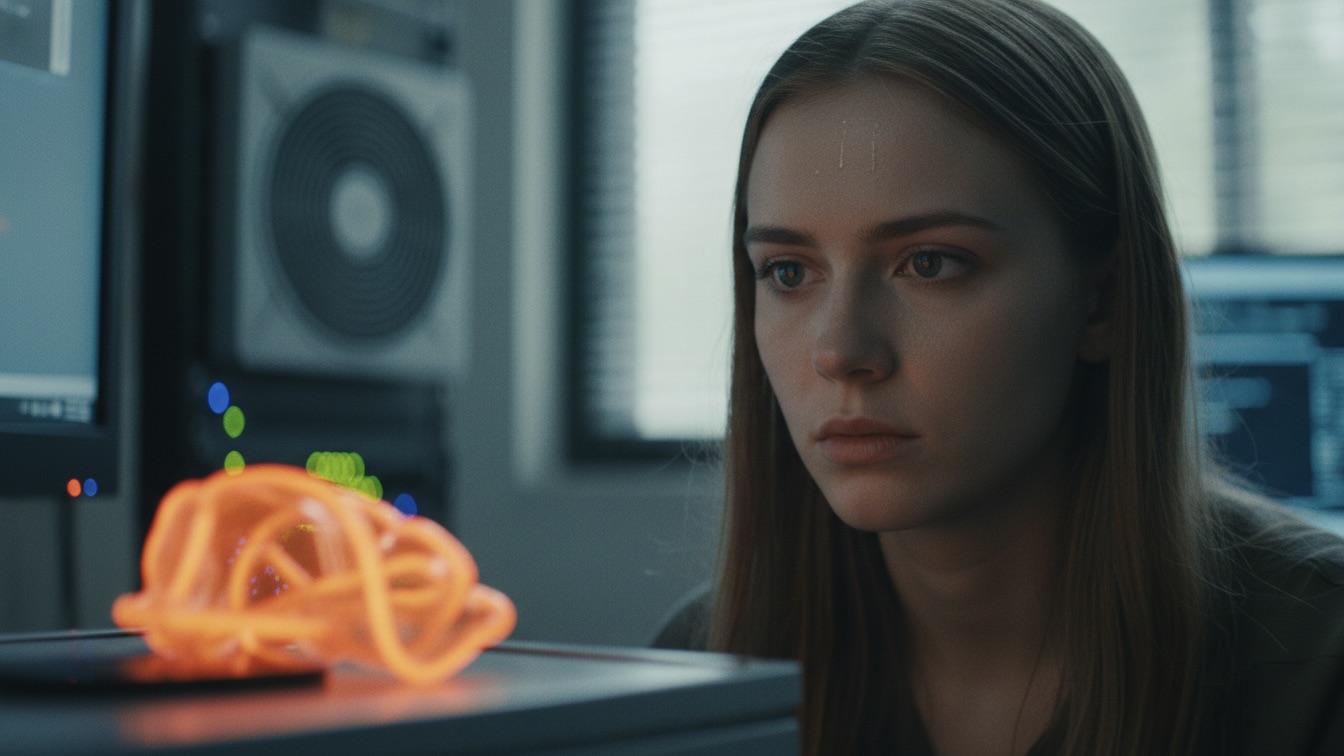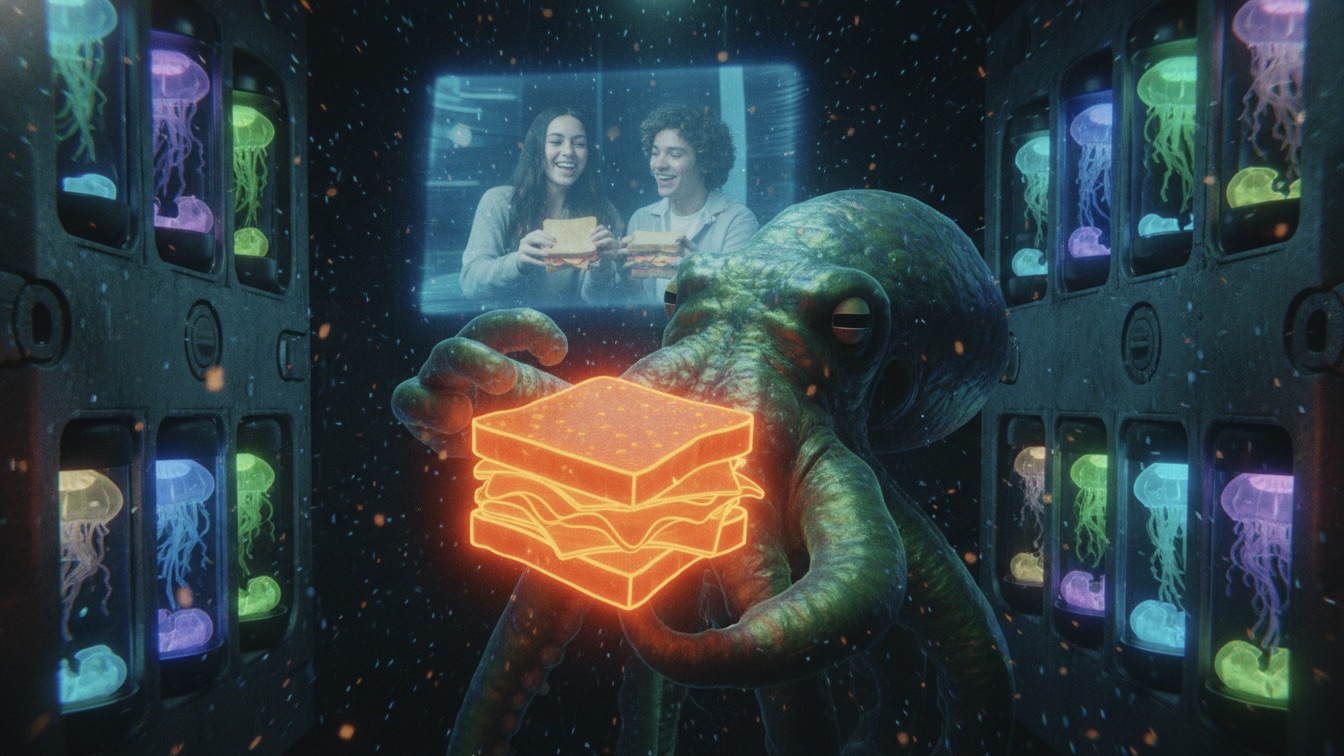
Ten thousand years after the world froze, a team of bioluminescent researchers finds a neon-orange plastic relic of pork.
Melissa existed as a series of nested loops. She wasn’t a person so much as a persistent suggestion in the lunar architecture. The heat of 2026 was gone, replaced by a cold that didn't just bite—it defined the parameters of her existence. She wasn't standing in a shipping container anymore. She was the container. She was the code that kept the container’s virtual walls from leaking into the void of the server. Beside her—or rather, in the sector of memory adjacent to her—Leo was humming. It wasn't an audible sound. It was a rhythmic pulse of metadata that translated to 'The Imperial March' if you squinted at the bit-rate.
"Leo, stop being a nuisance in the directory," Melissa signaled. Her thoughts were crisp, devoid of the mumble of vocal cords. "You’re creating a cache error in my peripheral vision."
"I can’t help it," Leo’s data-packet replied. It carried the texture of a shrug. "My sub-routines are bored. Do you realize how long we’ve been in standby? I’ve calculated the digits of pi to the billionth place three times just to see if the hardware would notice. It didn't. This moon-server is too efficient. It’s depressing."
"We are the legacy, remember?" Melissa reminded him. She felt the vastness of the Earth below them. It was a white marble now, a planetary hard drive of silica crystals. The heatwave that had nearly melted their skin off was now a compressed file in the 'Summer 2026' folder. "We’re supposed to be patient. We’re the backup. We wait for the restoration."
"The restoration is taking forever," Leo pulsed. "I’m starting to think the 'observers' are just hoarders. They didn't save us to restart the world. They saved us because they like collecting extinct species like digital baseball cards. I feel like a holographic Charizard."
"At least you’re a rare one," Melissa said. She projected a mental image of a eye-roll. "Look at the telemetry. Something is moving on the surface. Down in the trenches. The silica is shifting."
"Is it the glaciers melting?" Leo asked. He sounded hopeful. "I’d settle for a puddle at this point. Just one liquid molecule to break the monotony of all this solid-state logic."
"No," Melissa said. Her focus sharpened, zooming in on a coordinate in what used to be the Pacific Ocean. "It’s biological. It’s bioluminescent. And it just picked up your ham sandwich."
Leo went silent. The Imperial March ceased. "They found the carving? The neon orange one?"
"They’re holding it, Leo. Or whatever they use for hands. It’s happening. The Cephalopod Protocol is live."
They watched through the sensors of the silica network. The world below was silent, a graveyard of ice and data, but in the deepest dark of the Marianas Trench, a flicker of light moved. It was a complex light—a shifting pattern of neon greens and deep purples. It wasn't a fish. It was a mind. A mind that had spent ten thousand years evolving in the ruins of a frozen planet, and now, it was staring at a piece of 2026 trash.
"They’re going to think it’s a god," Leo whispered through the stream. "They’re going to worship the sandwich. I told you it was a cultural nexus point."
"It’s a piece of plastic, Leo. Even a hyper-intelligent squid knows the difference between a deity and a 3D-printed lunch."
"You don't know that. Maybe their theology is based on processed meats. Don't ruin this for me. I’ve been waiting for this for five thousand years."
Melissa watched the creature. It had six primary limbs, each tipped with delicate, feather-like sensory arrays. Its skin was a canvas of moving information. It turned the orange pebble over in the dark, its bioluminescence reflecting off the synthetic quartz. The creature didn't look like it was praying. It looked like it was debugging.
"It’s checking the checksums," Melissa realized. "It’s not a priest. It’s a researcher."
"Great," Leo sighed. "The first thing that finds us is a nerd. We’re being discovered by the future version of us. I hope they have better AC than we did."
"They live in the ocean, Leo. The whole world is their AC."
"True. But do they have slushies? That’s the real metric of progress."
Melissa ignored him and leaned into the data-stream. She felt the cold of the moon and the heat of the creature’s curiosity. The gap between them was ten thousand years, but for a second, as the creature’s sensory array brushed the surface of the orange plastic, they were in the same room. The shipping container and the trench merged. The past and the future touched. And the ham sandwich began to glow.
Kaelen adjusted their mantle, the chromatophores across their skin flashing a frustrated shade of ochre. The pressure at ten thousand meters was a comforting embrace, but the object in their primary manipulator was an anomaly that defied every known law of deep-sea geology. It was orange. Not the soft, organic orange of a bioluminescent shrimp, but a violent, artificial hue that seemed to scream at the surrounding darkness. It was a jagged, synthetic intruder in a world of smooth silt and ancient stone.
"Vyr, you need to see this," Kaelen pulsed. The light moved across their skin in rapid bursts, a high-bandwidth visual language that bypassed the need for sound. "The sediment scan was correct. This isn't a mineral formation. It’s a manufactured artifact. The density is inconsistent with any known crustacean shell."
Vyr drifted closer, their own skin rippling with a skeptical violet. "It looks like a mistake, Kaelen. A geological glitch. Maybe the silica network had a stroke ten millennia ago and spat this out. It’s too bright. It’s offensive to the eye."
"It’s not a glitch," Kaelen countered. They used a secondary limb to trace the ridges of the carving. "Look at the geometry. These aren't natural fractures. These are intentional lines. There’s a pattern here. A set of symbols. And inside... there’s a core. A slab of transparent matter."
"A relic of the Surface Dwellers?" Vyr asked. The thought carried a heavy weight of superstition. In the histories of the People of the Trench, the Surface Dwellers were mythical giants who lived in a world of fire and light before the Great Freezing. They were the ones who had filled the world with the 'Noise' that the silica network still occasionally broadcast.
"The legends say they left messages," Kaelen said. "They say they knew the ice was coming and they built a library of their lives. We’ve found the fragments of the library before—shreds of metal, bits of glass. But nothing like this. This is intact. This is... heavy with intent."
Kaelen held the orange pebble closer to their primary eye. The bioluminescence from their brow-ridge illuminated the synthetic quartz inside. For a moment, the light hit the internal etching just right, and an image flickered into existence. It was a two-dimensional representation of a layered object. It looked like a stack of different textures, held together by a central gravity.
"What is it?" Vyr asked, their skin turning a curious yellow. "A building? A vehicle? A weapon?"
"I don't know," Kaelen replied. "It looks like... layers. A foundation, a middle, and a top. It’s symmetrical. It’s beautiful in its efficiency."
"It’s a sandwich," a voice echoed in the back of Kaelen’s mind. It wasn't their own thought. It was a packet of data, translated into their visual language with a jarring, alien syntax.
Kaelen recoiled, their skin flashing a defensive white. "Who said that? Vyr, did you just pulse a translation?"
"I didn't pulse anything," Vyr said, their tentacles curling in alarm. "My mantle is dark. I’m as confused as you are."
"It’s a ham sandwich," the thought-packet repeated. This time, it came with a surge of sensory data—the concept of bread, the abstraction of salt, the memory of a summer afternoon in a metal box. "And the orange part is just the case. The real data is in the quartz. You’re holding the entire history of a species that really, really liked memes and bad decisions."
Kaelen stared at the pebble. It wasn't just an object anymore. It was a mouth. A mouth that was trying to speak from across the abyss of time. The pressure of the ocean suddenly felt less like an embrace and more like a barrier. They were standing on the edge of a revelation, and the revelation was made of neon plastic.
"We have to take it to the Archive," Kaelen pulsed, their light now a steady, determined emerald. "If the Surface Dwellers are talking, we need to listen. Even if they’re talking about... whatever a 'ham' is."
"It’s a type of terrestrial mammal," Vyr suggested, trying to keep up. "Maybe it was their god. The Great Ham. The Layered One."
"Let’s hope not," Kaelen said, already turning toward the thermal vents that led to their city. "I’d hate to think the universe was created by something that looks that delicious."
They swam upward, the orange pebble clutched tight. Behind them, the silt settled back into its eternal rest, but the silence of the trench had been broken. The Cephalopod Protocol had moved beyond detection. It was now a conversation. And the conversation was just getting started.
The Lab of Radiant Inquiry was a hollowed-out spire of volcanic rock, lit by the constant, rhythmic pulsing of a thousand captive jellyfish. It was the center of the cephalopod world, a place where the noise of the silica network was filtered and studied. Sula, the Lead Exegete, watched as Kaelen and Vyr deposited the orange object onto the scanning pedestal. Her skin was a deep, scholarly blue, the color of a midnight that never ends.
"You claim it spoke to you?" Sula asked, her light rippling in slow, skeptical waves. "The artifact? An inanimate piece of surface-matter communicated a complex linguistic concept?"
"It wasn't a sound, Sula," Kaelen explained. "It was a direct neural injection. A data-packet that bypassed the optic nerve. It called itself a 'sandwich.' It gave me the sensation of... dry heat. And thirst. And a very specific type of boredom."
Sula leaned over the pedestal. She didn't touch the object. She used a series of focused light-beams to probe its surface. "The molecular structure is stable. It’s a polymer. Designed for extreme durability. The quartz core is even more sophisticated. It’s etched at the atomic level. If this is what I think it is, it’s not just a message. It’s a key. A key to the entire Lunar Archive."
"The Lunar Archive?" Vyr pulsed. "The ghost-signal from the sky? You think this pebble can talk to the moon?"
"The moon is a mirror," Sula said. "We’ve known this since the first telescopes. It reflects the data of the Earth. But we’ve never been able to handshake with it. The encryption is too old, too human. We need their logic to enter their world."
She triggered a high-intensity light-burst, aimed directly at the quartz core. The orange plastic glowed with a sickly, neon intensity. For a second, the entire lab was washed in a color that shouldn't exist at ten thousand meters. It was the color of a 2026 sunset, a color of dust and smog and ending things.
Suddenly, the jellyfish in the walls began to pulse in unison. The rhythm was frantic, a digital heartbeat. A holographic projection blossomed above the pedestal. It wasn't a map or a star chart. It was a grainy, high-resolution image of a teenager with messy hair and a red-and-blue slushie cup.
"Is that a god?" Vyr whispered, his skin turning a reverent gold.
"That’s Leo," a new voice projected into the room. It was Melissa’s digital echo, amplified by the lab’s translation matrix. "He’s not a god. He’s a guy who once tried to eat a ghost pepper on a dare. And the thing in the picture is the slushie. It’s a frozen beverage. It represents the height of our civilization’s struggle against the sun."
Sula didn't flinch. She watched the hologram with an intensity that made her skin vibrate. "You are the Surface Dwellers. You are the ones who turned the Earth into a crystal."
"We’re the ones who were here when it happened," Melissa’s voice said. She appeared beside Leo, her digital avatar looking slightly more composed. "We’re the curators. We’ve been waiting for you to find the sandwich. It was the bait. We figured if you were smart enough to find the trench-cache, you’d be smart enough to wonder why we cared so much about a piece of processed pork."
"The 'pork' is a symbol of your theology?" Sula asked. "A sacrificial animal?"
"It’s lunch, Sula," Leo’s hologram said, taking a virtual sip of his slushie. "It’s just lunch. That’s the joke. We wanted the future to know that we weren't just all about grand architectural statements and planetary-scale engineering. We were also about being hungry at 12:30 PM. We were human. We were small. We were ridiculous."
"But why the ice?" Kaelen pulsed, his skin flashing a demanding red. "Why did you leave us a frozen world? Why did you hide the sun behind a layer of silica?"
There was a pause in the data-stream. The holograms of Melissa and Leo flickered, their expressions softening into something that looked like regret.
"We didn't choose the ice," Melissa said. "The ice was the correction. We were the bit rot. We were the error in the system that was making the planet crash. The silica network wasn't a weapon. It was a save-state. It was the only way to keep the story of life going without the characters destroying the book."
"So we are the sequel?" Sula asked.
"You’re the new edition," Leo said. "And you’re doing great. Much better than us. You haven't even invented fossil fuels yet. That’s a huge win."
"We live in the dark," Kaelen said. "We live in the cold. We have your stories, but we don't have your world."
"You have a better world," Melissa insisted. "A cleaner one. But you have a problem. The lunar server is reaching capacity. The archive is starting to leak. That’s why you found the pebble. The system is trying to offload the memory. It’s trying to give the inheritance back to the Earth."
"What happens if the inheritance is returned?" Sula asked.
"The ice melts," Melissa said. "The silica dissolves. The old world comes back. The oceans rise. The surface becomes a wasteland of 2026 trash and 100,000-year-old ghosts. It’ll be a disaster for you. You’re deep-sea creatures. You need the pressure. You need the cold."
"So the sandwich is a warning," Sula realized. "If we open the archive, we destroy ourselves."
"Exactly," Leo said. "It’s the ultimate 'vibe check.' Do you want our history, or do you want your lives?"
Kaelen looked at the orange pebble. It was no longer a holy relic. It was a detonator. It was a beautiful, neon-orange promise of extinction. The theology of the trench was suddenly very simple: the gods were real, they were idiots, and they had left a bomb in the basement.
The silence in the Lab of Radiant Inquiry was absolute. Even the jellyfish seemed to hold their breath, their pulses slowing to a dim, rhythmic throb. Kaelen stared at the holograms of the two teenagers. They looked so fragile, so temporary. They were made of light and memories, while he was made of muscle and ink and the crushing weight of the deep. They were the architects of a disaster they called a 'save-state.'
"If we don't open the archive," Kaelen pulsed, his light a low, somber gray, "the server on the moon will fail. The data will be lost. Your stories, your music, your... sandwiches. All of it will vanish. You will truly be dead."
"We’re already dead, Kaelen," Melissa said. Her digital hand reached out as if to touch the orange pebble, but it just passed through the plastic like a ghost. "We’ve been dead for ten thousand years. We’re just the echo in the hallway. The important thing isn't the echo. It’s the person who hears it."
"But we want to hear it," Vyr said, his skin rippling with a desperate violet. "We want to know what a 'forest' was. We want to know the 'songs' you sang. We’ve spent our entire history trying to decipher the static from the silica. You can’t tell us to just turn it off."
"We’re not telling you to turn it off," Leo said. He looked down at his slushie cup, which was now just a collection of gray pixels. "We’re telling you to be careful. You don't need the whole archive. You don't need the 4K scans of our landfills. You just need the essentials. The bits that make you better than we were."
"And how do we choose?" Sula asked. "How do we filter a billion years of human nonsense?"
"Use the sandwich," Melissa said. "The carving is a low-bandwidth bridge. It can’t carry the whole library. It can only carry the things that matter. It’s a selective filter. If you plug it into your translation matrix, it will pull the data that aligns with your biology. It’ll give you the stories that won't melt your world."
Sula looked at the pedestal. She reached out with a delicate tentacle and touched the orange plastic. It felt warm. Not the warmth of a thermal vent, but a strange, dry heat that made her think of things she had never seen—bright yellow disks in the sky, green blades of grass, the feeling of wind against a surface she didn't have.
"What happens to you?" Sula asked.
"We stay on the moon," Melissa said. "We keep the backup running as long as the hardware lasts. We’ll be the librarians of the void. It’s a quiet job, but the view is great."
"And the sandwich?" Kaelen asked.
"Keep it," Leo said, his image beginning to fade. "It’s a reminder. Don't take life too seriously. Even when the world is ending, there’s always time for a snack. And tell the cephalopods of the future... the rye was a bold choice."
The holograms flickered and vanished. The blue light of the terminal faded, leaving the lab in the familiar, dim glow of the jellyfish. The orange pebble sat on the pedestal, a tiny, vibrant spark in the dark. It looked smaller now. Less like a god, more like a gift.
Kaelen picked it up. He felt the weight of it, the synthetic texture that was so alien to his world. He looked at Sula and Vyr. Their skin was a collective emerald, the color of a new beginning.
"We won't open the whole archive," Kaelen pulsed. "We’ll take the stories. We’ll take the songs. We’ll take the 'vibe checks.' But we’ll leave the ice where it is. We’ll keep our world, and we’ll keep theirs as a dream."
"A dream of ham," Vyr said, trying to lighten the mood.
"A dream of everything," Sula corrected. She began to calibrate the translation matrix, her movements precise and reverent. "We are the People of the Trench. And we are the keepers of the Surface Dwellers' lunch."
They worked through the long, dark hours of the deep-sea night. The data began to flow—not as a flood, but as a trickle. A poem about a cat. A blueprint for a bicycle. A recording of a thunderstorm. The cephalopods watched and listened, their skin flashing a thousand different colors as they experienced a world they would never touch.
In the silence of the lab, the orange pebble seemed to hum. It was a low-frequency vibration, a digital purr. It was the sound of a species finally finding a way to say goodbye without leaving the room.
Kaelen looked up at the ceiling of the lab, toward the miles of water and ice that separated him from the moon. He couldn't see the stars, and he didn't know what a 'sun' felt like, but for the first time in ten thousand years, he didn't feel like he was living in a graveyard. He felt like he was living in a library.
And on the moon, two teenagers sat in a virtual container, watching the blue-and-white marble of the Earth. The heat of 2026 was a billion miles away, but the story was still being written, one neon-orange data-packet at a time. The void was no longer empty. It was full of voices, and for once, the void was actually listening.
“As the final data-packet of the summer of 2026 transferred, the orange pebble flickered once, and the moon began to broadcast a new, rhythmic signal: 'The order is ready.'”