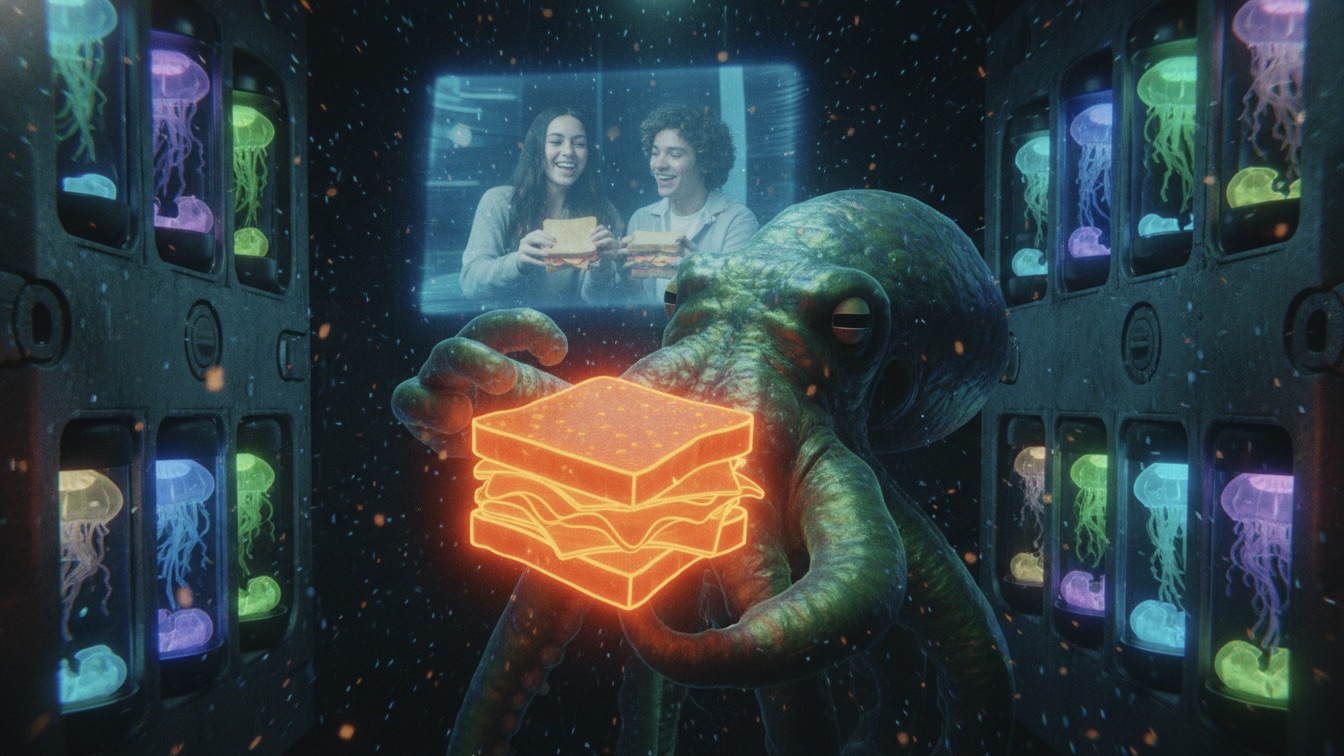
The narrative unfolds in a distant future where Earth has become a frozen, silica-covered graveyard, and humanity exists only as digital backups on a lunar server. Melissa and Leo, two consciousnesses stored on the moon, monitor the planet below and witness the activation of the Cephalopod Protocol. This event is triggered when an evolved, bioluminescent cephalopod named Kaelen discovers a 3D-printed ham sandwich in the depths of the Mariana Trench. This "neon orange pebble" is not merely trash but a sophisticated data-key designed to bridge the gap between the extinct surface dwellers and the new masters of the deep.
Kaelen and his companion Vyr bring the artifact to the Lab of Radiant Inquiry, where the scholar Sula attempts to decode its purpose. Through a high-intensity light interface, they establish a holographic connection with Melissa and Leo. The cephalopods learn that humanity intentionally "paused" the planet to prevent its total destruction, leaving behind an archive that could either restore the old world or provide wisdom for the new one. Realizing that a full restoration would melt the ice and destroy their own deep-sea habitat, the cephalopods choose a middle path. They decide to integrate human stories and songs while maintaining the cold, high-pressure world they call home.
A primary theme of the story is the juxtaposition of the monumental and the mundane. The "save-state" of humanity is not represented by a grand monument or a golden record, but by a 3D-printed ham sandwich. This choice reflects a psychological need for the creators to be remembered as "human" rather than as idealized gods. By enshrining a piece of lunch, the characters Melissa and Leo suggest that the essence of a species lies in its small, ridiculous habits rather than its planetary engineering. This theme challenges the traditional sci-fi trope of the "grand legacy," replacing it with a more intimate, relatable form of immortality.
The story also explores the ethics of ecological restoration and the burden of inheritance. The cephalopods face a classic existential dilemma when they realize that "restoring" the Earth to its 2026 state would result in their own extinction. This highlights the idea that life is a series of iterations, and the "sequel" species has a right to exist independent of its predecessor's blueprints. The narrative suggests that a true legacy is not one that replaces the present with the past, but one that informs the present to create a better future. The "Cephalopod Protocol" is thus a lesson in restraint and selective memory.
Furthermore, the narrative examines the concept of communication across vast temporal and biological gulfs. The "Noise" of the silica network and the "neural injections" used by the artifact represent the struggle to translate alien experiences into a shared understanding. The cephalopods do not see the world through human eyes, yet they find common ground in the "vibe check" of human history. This suggests that certain psychological states, such as curiosity, boredom, and the desire for connection, are universal constants that transcend species and even the transition from biological to digital existence.
Melissa functions as the pragmatic anchor of the lunar archive, viewing herself more as a structural component of the server than a person. She describes her existence as a series of "nested loops," indicating a psychological state of hyper-vigilance and resignation. Her primary motivation is the successful execution of the restoration, yet she possesses a dry, cynical wit that betrays her lingering humanity. She is the protector of the "legacy," feeling the weight of the white marble Earth as a personal responsibility.
As the story progresses, she exhibits a maternal yet detached perspective toward the cephalopods. She recognizes that her time has passed and that her role is now that of a "librarian of the void." This transition from a "backup" waiting for a restart to a curator of a dead culture shows her growth in accepting her digital mortality. Her final interactions suggest a peace with her role, as she moves from being a "persistent suggestion" in the code to a witness of a new world’s birth.
Leo serves as the emotional and humorous foil to Melissa’s rigid logic. He is characterized by his restlessness, calculating pi to the billionth place simply to see if the hardware will react to his boredom. His psychological state is one of "standby" anxiety, which he masks with jokes about being a "holographic Charizard" or a "nerd." He represents the part of humanity that refuses to be solemn, even in the face of extinction. He is the one who insists that the ham sandwich is a "cultural nexus point."
His attachment to the "slushie" and the "ham sandwich" highlights his role as the keeper of human sentimentality. He doesn't want the cephalopods to worship the humans; he wants them to understand the "joke" of being alive. By the end of the narrative, he finds satisfaction in the fact that the new species values human "vibe checks" over human technology. He accepts his status as an "echo in the hallway," provided that the echo is one that brings a sense of lightness to the dark trench.
Kaelen is an explorer driven by an intense, analytical curiosity that sets him apart from his more skeptical peers. He is the first to recognize that the orange pebble is "heavy with intent," demonstrating a high level of intuitive intelligence. His psychological journey is one of discovery and disillusionment, as he moves from seeing the artifact as a "geological glitch" to a "detonator" of his own world. He displays significant courage in touching the unknown, risking a "neural injection" to seek the truth.
He acts as the primary bridge between the two civilizations, translating the alien data of the "Surface Dwellers" into the reality of the trench. His decision to reject the "full inheritance" of the human world shows a strong sense of self-preservation and leadership. He is not a passive recipient of history; he is an active editor who chooses what his people need. By the end of the story, he has transformed from a researcher into a guardian, holding the "dream of everything" in his mantle.
Sula represents the intellectual and theological authority of the cephalopod society. As the Lead Exegete, she is initially skeptical and cautious, reflecting the psychological defenses of a species that has lived in isolation for ten thousand years. Her skin, described as "scholarly blue," mirrors her deep, contemplative nature. She is the one who understands the technical complexity of the "Lunar Archive," recognizing the pebble as a "key" rather than just a message.
Her role in the story is to provide the critical perspective necessary to navigate the "human nonsense." She is the one who asks the hard questions about the "ice" and the "save-state," forcing the digital ghosts to admit their failures. Sula’s wisdom is what allows the cephalopods to avoid the trap of the archive. She facilitates the "trickle" of data, ensuring that her people are enriched by human history without being overwhelmed by human mistakes.
Vyr acts as the voice of caution and traditionalism within the trio of cephalopods. He is initially "skeptical" and "alarmed," his skin turning violet and white in response to the alien artifact. His psychological state is rooted in the "superstition" of his people, viewing the Surface Dwellers as "mythical giants" of fire and light. This fear makes him a necessary balance to Kaelen’s curiosity, as he constantly reminds his companions of the danger the "Noise" represents.
Despite his initial fear, Vyr shows a capacity for wonder and humor as the revelation unfolds. He is the first to suggest that "ham" might be a god, showing a playful, imaginative mind beneath his defensive exterior. His transition from fear to a "reverent gold" and finally to an "emerald" of new beginnings illustrates the transformative power of knowledge. He ends the story by embracing the "dream of ham," signifying his acceptance of the past as a harmless, beautiful myth.
The narrative employs a striking contrast between the cold, sterile environment of the moon and the vibrant, high-pressure world of the Mariana Trench. The author uses sensory details like "solid-state logic," "bit-rate," and "metadata" to define the digital existence of Melissa and Leo. This is sharply juxtaposed with the "ochre," "violet," and "emerald" chromatophores of the cephalopods. This visual language creates a sense of two distinct realities attempting to merge through the "neon orange" of the 3D-printed sandwich.
The pacing of the chapter is deliberate, starting with a sense of static eternity on the moon before accelerating into the "frantic digital heartbeat" of the discovery. The tone shifts seamlessly from the irreverent, almost comedic banter of the teenagers to the somber, theological weight of the cephalopods' realization. This tonal fluidity reflects the story's central message: that life is both a "grand architectural statement" and a "piece of processed pork." The use of "neural injections" and "data-packets" as narrative devices allows for a rapid exchange of complex ideas without stalling the plot.
Finally, the narrative voice is one of melancholic hope. The description of the Earth as a "planetary hard drive of silica crystals" evokes a sense of loss, yet the "flicker of light" in the trench suggests that life is persistent and adaptive. The author uses the "ham sandwich" as a recurring motif to ground the high-concept sci-fi elements in something relatable and human. This stylistic choice prevents the story from becoming too abstract, ensuring that the emotional core—the desire to be heard across the abyss of time—remains the focus.


