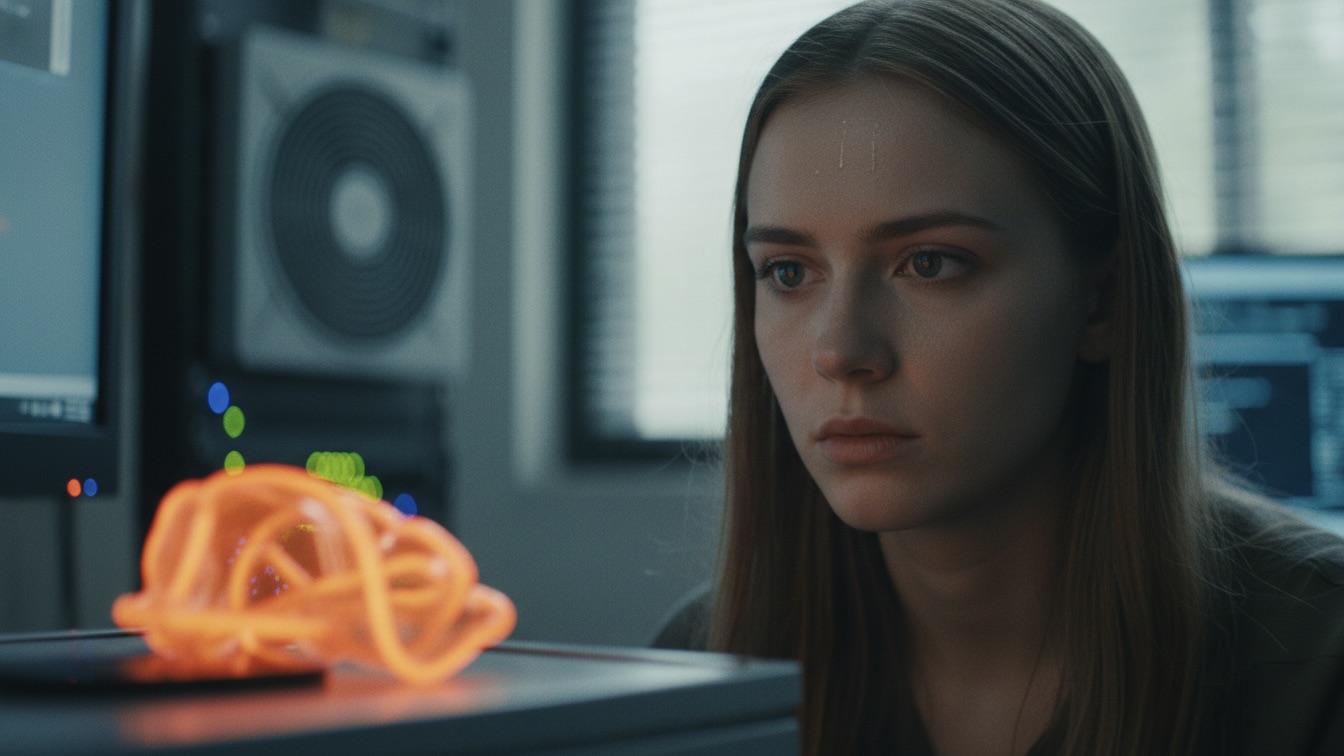
The narrative unfolds within the sweltering confines of a repurposed shipping container, where two teenagers, Melissa and Leo, work for the Deep Time Project. Their task involves archiving a bizarre cross-section of human culture, ranging from Wikipedia to images of ham sandwiches, into synthetic quartz encased in neon orange plastic. This project is intended to serve as a cultural footprint for a post-human future, though Melissa initially views the endeavor with deep cynicism. She perceives their work as leaving "trash" for the future, contrasting the grand scale of deep time with the gritty, uncomfortable reality of their failing air conditioner and the heat of July 2026.
The atmosphere shifts from mundane discomfort to existential urgency when Melissa discovers a mysterious, encrypted file titled "Inheritance" within the project's vault. The file possesses a timestamp from later that same night, suggesting a temporal anomaly that defies the accuracy of their strontium lattice clock. Dr. Aris, the lead researcher, arrives in a state of professional panic, revealing that the signal for this file originated not from Earth, but from the moon. As the encryption breaks, the characters are confronted with a map of a frozen Earth, realizing that the "glaciers" they feared in the distant future are arriving immediately as a planetary-scale technological reset.
In the final act, the characters realize that the Deep Time Project was never just a passive archive, but a necessary backup required before a "system update" of the planet. They discover a video of their future selves instructing them not to stop the upload, revealing that the encroaching "ice" is actually a network of silica nanobots designed to turn the Earth into a living storage device. Rather than fighting the inevitable, Melissa, Leo, and Dr. Aris accept their roles as the final entries in the human story. The story concludes with a leap across ten thousand years, showing how a new species eventually finds the orange carvings and connects with the long-extinct human race through the "Inheritance" they left behind.
A primary theme of the story is the tension between the mundane present and the staggering scale of deep time. The author juxtaposes the triviality of a ham sandwich or a blue raspberry slushie with the geological inevitability of glaciers and planetary reconstruction. This contrast serves to highlight the human condition, where individuals are caught between the immediate physical needs of the body and the intellectual desire for a lasting legacy. The "neon orange" of the carvings acts as a visual metaphor for this tension, representing something artificial and loud shouting against the vast, silent backdrop of the natural world and the vacuum of space.
The narrative also explores the concept of legacy as an act of "shouting into the void." Leo argues that the act of trying to communicate with the future is what defines humanity, even if the message is never received or understood. This theme evolves from a desperate attempt at preservation to a transcendental acceptance of transformation. By the end of the chapter, the characters move past the fear of being forgotten, realizing that they are not just leaving a story behind but are becoming the story itself. The transition from biological life to "silica" represents a shift from being the narrators of history to being the medium through which history is recorded.
Furthermore, the story delves into the idea of the "planetary reset" and the ethics of the "Old OS" versus the "Inheritance." The metaphor of humanity as a buggy software version that must be backed up before deletion suggests a deterministic view of progress. Dr. Aris’s hesitation to "kill the server" reflects the psychological struggle of a species facing its own obsolescence. Ultimately, the story suggests that true preservation requires a "clean slate," and that the value of a species lies in its ability to contribute to the "multitudes" of a universal archive rather than clinging to its original, decaying form.
Melissa functions as the narrative's skeptical anchor, utilizing cynicism as a psychological defense mechanism against the overwhelming implications of her work. She is highly observant of sensory discomfort, such as the "human sticker" sensation of her shirt or the "smudge-streaked" tablet, which grounds her in the physical present. This focus on the immediate allows her to avoid the existential dread that Leo embraces. Her initial rejection of the project as "science fiction with a budget" reveals a pragmatist who finds the idea of a post-human future both delusional and insulting to the current suffering of the world.
As the psychologist might observe, Melissa undergoes a significant cognitive shift when she encounters the "Inheritance" file. The sight of her future self on the video feed provides her with a sense of "absolute clarity" that bypasses her usual intellectual defenses. She moves from a state of ironic detachment to one of profound acceptance, eventually viewing herself as a "line of code in the most beautiful story ever told." This transformation represents a sublimation of her fear into a sense of purpose, allowing her to face the end of her biological existence with a tranquil, almost poetic resolve.
Leo serves as the philosophical and optimistic foil to Melissa, possessing a temperament that seeks meaning in the vastness of "scale." He is less bothered by the physical discomfort of the shipping container because his mind is perpetually occupied with the "deep time storytelling" of the project. His obsession with the "glaciers" and the "moon" suggests a personality that finds comfort in the idea of a "ultimate reset button." To Leo, the present is "small," and the only way to make it significant is to link it to the eternal, even if that link is as absurd as a high-resolution scan of a ham sandwich.
Psychologically, Leo uses humor and flippancy to manage the "existential dread" he openly admits to feeling. His insistence on getting a slushie in the face of a global catastrophe is not a sign of immaturity, but a grounding ritual that affirms his existence in the "2026" timeline. He is the one who introduces the concept of "containing multitudes," a nod to Whitman that reflects his desire to be part of a grand, interconnected narrative. By the end, his joyful acceptance of being "the rye bread" in the digital archive demonstrates a successful integration of his personal identity into the collective memory of the planet.
Dr. Aris represents the authoritative and scientific perspective, yet she is the character most visibly shaken by the unfolding events. Unlike the teenagers, she fully grasps the technical and historical weight of the "Inheritance" file, and her reaction is characterized by "real, unpolished fear." As the lead researcher, her identity is tied to the preservation of human knowledge through traditional means. The revelation that the project is a trigger for a planetary reconstruction forces her into a crisis of professional ethics, where she must choose between saving the "old world" and facilitating the birth of the "new archive."
Her decision to step away from the "Execute" command marks a pivotal moment of resignation and faith. She moves from being a "curator of the collapse" to a witness of the "Inheritance." Her psychological journey is one of relinquishing control; she realizes that the "architects of the future" are not the humans in the room, but the post-human entities on the moon. By closing her eyes and listening to the "music" of the terminal, she transitions from a state of frantic activity to one of meditative acceptance, preparing herself to be "scraped away" along with the rest of her species.
The pacing of the chapter is masterfully handled, beginning with a slow, oppressive atmosphere that mirrors the stagnant heat of the shipping container. The author uses heavy, grounded imagery like "a bag of gravel in a blender" and "a mile of ice" to establish a sense of physical weight. As the mystery of the "Inheritance" file deepens, the narrative velocity increases, shifting from the sluggish dialogue of the interns to the rapid-fire technical revelations brought by Dr. Aris. This acceleration culminates in the "11:45 PM" deadline, creating a ticking-clock scenario that heightens the tension between the mundane present and the cosmic future.
The tone of the story undergoes a profound metamorphosis, starting with a gritty, almost nihilistic realism and ending in a state of transcendental wonder. The author employs sharp, ironic dialogue to establish the characters' relatability, then slowly strips away the irony as the stakes become literal rather than speculative. The shift from the "sickly intensity" of the neon orange plastic to the "shimmering field of white crystals" at the end reflects this tonal journey. The use of sensory details—the "prickle of heat," the "cold of the vacuum," and the "purple sludge" of the slushie—ensures that the high-concept sci-fi elements remain tethered to a human perspective.
The narrative voice is characterized by a blend of scientific precision and poetic lyricism. Descriptions of "4096-bit keys" and "strontium lattice clocks" lend the story a sense of technological groundedness, which makes the eventual "planetary-scale network of nanobots" feel like a plausible, if terrifying, extension of current science. The final sections of the chapter utilize a more expansive, omniscient perspective to cover the passage of "ten thousand years." This allows the reader to experience the "deep time" the characters could only talk about, providing a satisfying resolution to the story's central preoccupation with legacy and the end of the human era.


