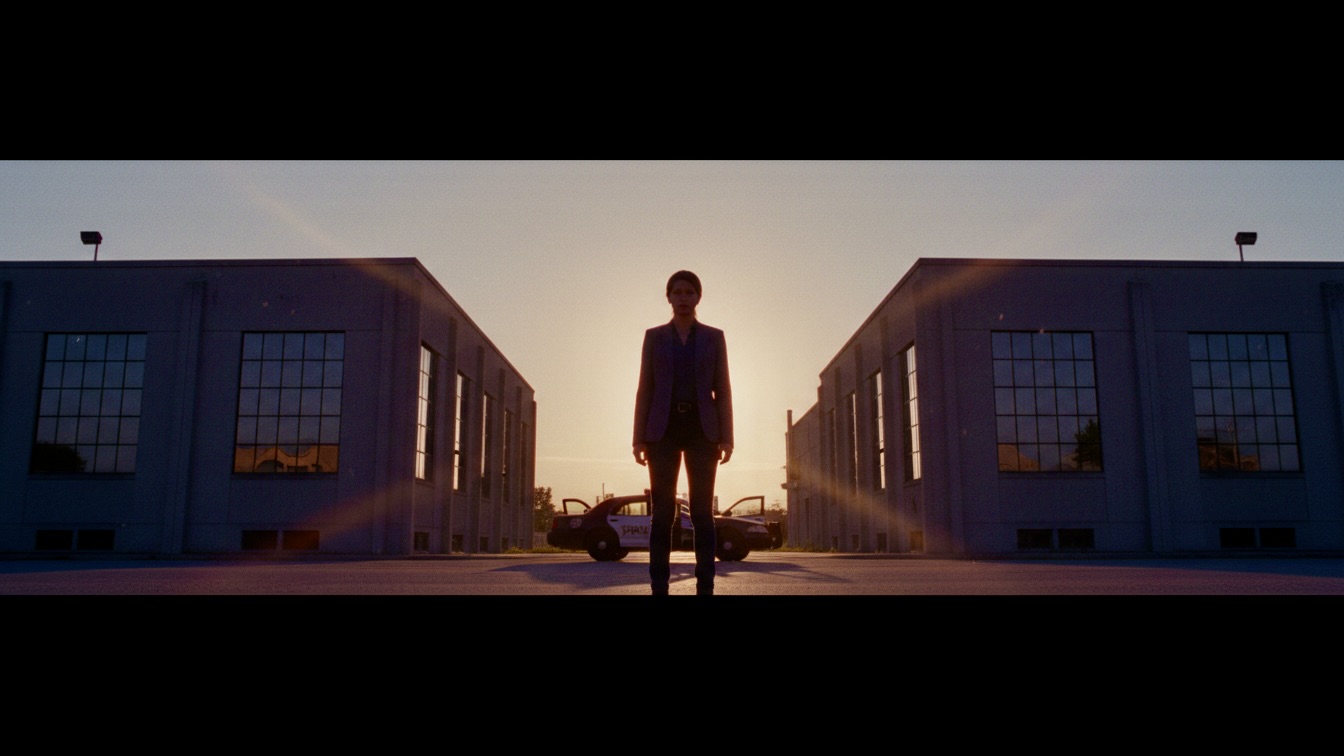
The IV pump lay shattered on the clinic floor while the digital leak began its unstoppable crawl across the web.
The IV pump did not just break; it disintegrated. Shards of white polycarbonate and slivers of the LCD screen sprayed across the linoleum like digital confetti. The gunshot was a physical slap against the ears in that small, sterile box of a room. Gareth Rossi was already hitting the floor before the echo died, his hands clamped over his ears, his face pressed into the grout. The sound of it—sharp, final, mechanical—seemed to suck the oxygen out of the space. Jenkins stood there, her Glock 19 still leveled at the wreckage of the machine, the slide locked back, the heat from the barrel rising in a visible shimmer. Her hands did not shake. They were cold, despite the ninety-degree heat baking the exterior of the warehouse. Summer in the city was a fever dream of gray concrete and yellow light, and right now, the light in this room was too bright, too white, washing out the edges of everything until the world looked like a low-resolution simulation.
"Get him up," Jenkins said. Her voice was a flat, dead thing. It didn't sound like her. It sounded like a recording played back through a broken speaker.
Tom Miller didn't need the prompt. He was already over the medical chair, his thick fingers fumbling with the leather restraints on Eli Victor’s wrists. The boy was shaking so hard the chair rattled against the floor. He was hyperventilating, those short, jagged gasps that sounded like a dying engine. Tom ripped the Velcro straps back with a series of violent snaps. The sound was like bone breaking. He didn't look at Rossi. He didn't look at the gun. He just looked at the kid.
"I got you, Eli," Tom was saying, his voice a low, rhythmic grunt. "I got you. You're okay. Look at me. Look at me, Eli. It’s over. The machine’s dead. You’re alive. Facts. You’re alive."
Eli’s eyes were rolled back, showing too much white. He was a kid in a baggy hoodie, his dyed blue hair matted with sweat against his forehead. The IV line was still taped to the back of his hand, a clear plastic tube filled with the state-mandated solution that was supposed to stop his heart in three minutes. Tom didn't wait for a medic. He grabbed the tube and yanked. The tape tore skin. A bead of dark, thick blood welled up where the needle had been, but Eli didn't even flinch. He just slumped forward into Tom’s chest, a dead weight of flannel and fear.
On the floor, Rossi started to crawl away. He was moving toward the door, his movements jerky and insect-like. His expensive linen shirt was hiked up his back, revealing a pale, soft spine. He looked pathetic. He looked like the kind of man who spent his weekends at brunch talking about equity while signing death warrants for fifteen-year-olds in the afternoon.
"Stay down!" Jenkins barked. She didn't move the gun. "Rossi, if you move one more inch, I will put the next one in your hip. I swear to God."
Rossi froze. He turned his head slowly, his glasses sliding down his nose. One lens was cracked. "You're... you're insane," he stammered. The therapeutic calm was gone. The mask had slipped, and underneath was just a terrified bureaucrat with a God complex. "Do you have any idea what you've done? That equipment is provincial property. That patient was... he was in the system. The proxy was signed. You just committed an act of domestic terrorism against a medical facility."
"Shut up," Jenkins said. She stepped forward, her boots crunching on the glass. The sound was incredibly loud in the silence. "I saw the ledger, Gareth. I saw the fifty-thousand-dollar kickbacks. I saw the way you phrased the sessions. 'Act of supreme autonomy.' Is that what you call it? Pushing a depressed kid into a grave so the school board can buy new Teslas?"
"It's about resources!" Rossi screamed, his voice cracking into a high-pitched whine. "The system is collapsing! We have thousands of kids who will never be productive, who will spend decades in the psychiatric rot! We are giving them a choice! We are giving the province a way to survive! It’s math, Jenkins! Just math!"
"It's murder," Tom growled from the chair. He stood up, lifting Eli in his arms as if the teenager weighed nothing. Tom’s face was a mask of pure, concentrated hatred. "You did this to my Chloe. You talked her into it. You told her I was the problem so you could get your bonus."
"Your daughter was a terminal case of social friction!" Rossi yelled back, emboldened by his own delusion. "She was never going to fit! I saved her the pain of a lifetime of being misunderstood!"
Tom took a step toward Rossi, his boots heavy on the floor. Jenkins shifted, putting herself between them. She knew what Tom would do. She knew that if Tom Miller’s hands touched Gareth Rossi’s throat, the trial would be over before it started. And she needed the trial. She needed the world to see the files.
"Tom, no," Jenkins said. "Get the kid out of here. Take my keys. My cruiser is behind the dumpster. Get him to his mother. Now."
"What about you?" Tom asked, his eyes darting to the door. "The guards outside—"
"They’re corporate rent-a-cops. They’re not going to die for a guy who just got his machine blown up," Jenkins said. She pulled a pair of cuffs from her belt. "Go. I’ll handle the clean-up."
Tom hesitated for a heartbeat, then turned and ran. He carried Eli through the double doors, his footsteps echoing down the hallway. Jenkins waited until she heard the heavy clunk of the exterior door. Then she looked down at Rossi.
"Get up," she said. "And keep your hands where I can see them."
She didn't use the gentle touch. She grabbed Rossi by the collar and hauled him to his feet, slamming him against the wall. The impact made the framed 'Patient Bill of Rights' on the wall rattle. She ratcheted the cuffs onto his wrists, the metal biting deep into his skin. He winced, a small, wet sound of pain.
Jenkins pulled her phone out. The screen was bright in the dimming light of the room. The upload was at ninety-eight percent. The industrial district was a dead zone for signal, but she had boosted the cruiser’s antenna before she came in. The files—the budget offsets, the transcripts, the lists of names—were seconds away from hitting the servers of every major news outlet in the country.
"You think this changes anything?" Rossi hissed, his face inches from hers. He was sweating now, the salt stinging his eyes. "The Mayor is on the board. The Premier signed the budget. They’ll bury you, Jenkins. They’ll delete the files, they’ll revoke your credentials, and they’ll put you in a cell next to the people you think you’re saving. You’re a glitch. That’s all. A temporary glitch in the algorithm."
"Maybe," Jenkins said. She watched the progress bar. Ninety-nine percent. "But glitches tend to crash the whole program if they’re big enough."
One hundred percent. Upload Complete.
Jenkins felt a sudden, sharp relief, a physical loosening in her chest that felt like she was finally breathing after being underwater for hours. She looked at the blue LED on her phone, then at the man in cuffs. Outside, the first faint sound of a siren began to rise—not the wail of a police car, but the deeper, more ominous tone of the provincial response teams. The heavies. The ones who didn't report to the precinct.
She had about five minutes before the world ended.
"Let's go, Gareth," Jenkins said, shoving him toward the door. "We’ve got a lot to talk about, and I want to make sure we’re on camera when the state tries to shut me up."
They walked down the hallway, the fluorescent lights overhead flickering with a dying hum. The warehouse felt cavernous now, an empty shell that had served as a factory for death. As they reached the exit, Jenkins stopped. She looked at the security camera mounted above the door. She didn't know if it was recording, but she stared directly into the lens, her face stone-cold, her eyes reflecting the harsh summer sun as she pushed open the door and stepped back into the heat.
The heat outside was a physical wall. The sun was a low, angry orb, casting long, distorted shadows across the cracked asphalt of the shipping district. Jenkins shoved Rossi into the back of her cruiser, the black leather seats burning through his thin pants. He yelped, but she didn't care. She slammed the door and locked it.
Tom’s truck was gone. He’d followed her instructions. Good. He was smart enough to stay off the main arterials. She pulled her laptop from the dash mount and checked the tracker she’d slipped into Tom’s pocket earlier. He was three miles out, heading toward the residential outskirts where Sarah Victor was waiting.
Her phone buzzed. It wasn't a call. It was an emergency broadcast alert.
PUBLIC SAFETY ALERT: Unauthorized data breach detected at Provincial Health Gateway. Citizens are advised to ignore unverified documents circulating online. Law enforcement is currently pursuing a person of interest in connection with a cyber-terrorism event.
"That was fast," Jenkins muttered. She threw the car into gear, the tires screaming as she swung the cruiser around the dumpster.
They were already framing the narrative. It wasn't a leak of government corruption; it was a cyber-attack. She was no longer a detective; she was a terrorist. She looked in the rearview mirror. Rossi was staring at the back of her head, his eyes wide, a strange, manic grin spreading across his face.
"They’re going to kill you, Detective," he said, his voice muffled by the partition. "They can't let those files exist. You've triggered the fallout protocol. Do you even know what that is?"
"I'm busy, Gareth. Read the room," Jenkins snapped.
She hit the siren, but only the lights. She didn't want the noise. She needed to be invisible, or as close to it as a marked police vehicle could be. She took the back roads, cutting through the skeleton of the old industrial park, where the weeds grew through the rusted remains of the shipping cranes. The air was thick with the scent of hot metal and stagnant water from the harbor. No, wait—she couldn't smell it. She just knew it was there. She saw the shimmer of the heat on the water, the oily sheen of the surface.
Her radio crackled.
"All units, all units. We have a 10-78. Officer Jenkins is to be detained immediately. Use extreme caution. Subject is armed and considered dangerous. Authorization for lethal force is active."
Jenkins felt a chill that had nothing to do with the car’s struggling AC. Lethal force. For a detective with fifteen years on the force and a clean jacket. They weren't playing. This wasn't a bureaucratic reprimand. This was an execution order.
She reached over and ripped the radio unit out of the dash. The wires sparked, a brief, sharp smell of ozone—no, a flash of blue light and a crackle of static. She focused on the visual of the sparks. She threw the unit out the window.
"Where are we going?" Rossi asked. He sounded genuinely curious now. "The precinct? The Mayor's office? You’re running out of road."
"We're going to a place where the cameras don't look," Jenkins said.
She pulled the cruiser into a narrow alleyway behind an abandoned textile mill. The building was a red-brick monolith, its windows boarded up with rotting plywood. She killed the engine. The silence that followed was heavy, punctuated only by the ticking of the cooling engine and the distant, rhythmic thud of a pile driver from the docks.
She got out and opened the back door. She grabbed Rossi by the arm and dragged him out.
"Walk," she said, pointing toward a service door.
"This is a mistake," Rossi said, stumbling over a piece of loose rebar. "You can't hide forever. The digital footprint alone—"
"I know how the footprint works, Gareth. I was cybercrimes before I was homicide," Jenkins said.
They entered the building. It was cooler inside, the thick brick walls holding the chill of the previous night. The air was stagnant, the light filtering through the cracks in the boards in sharp, dusty needles. They climbed three flights of stairs, their footsteps booming in the empty stairwell. Jenkins kept her hand on her holster.
On the fourth floor, she pushed open a heavy steel door. It was a loft space, filled with stacks of old pallets and rolls of dusty fabric. In the corner, a small workstation was set up—three monitors, a high-gain antenna pointed out a hole in the brick, and a tangle of black cables.
A man was sitting there, his face illuminated by the blue glow of the screens. He was thin, wearing a faded hoodie despite the heat, his fingers moving across a mechanical keyboard with the speed of a concert pianist.
"You're late, Marie," the man said without looking up.
"The clinic was a bit more complicated than expected," Jenkins said. She shoved Rossi into a chair and zip-tied his ankles to the legs.
"This is Gareth Rossi," Jenkins said. "He’s our insurance policy. Gareth, meet Jack. He’s the reason those files are currently being mirrored on seventeen different dark-web servers that the province can't touch."
Jack turned around. He had deep circles under his eyes and a nervous twitch in his left cheek. "They’re already scrubbing the surface web. TikTok is deleting the videos as fast as people upload them. Twitter—or X, whatever—is shadow-banning the keywords. It’s a full-spectrum blackout, Marie. I’ve never seen them move this fast."
"Did the media get them?" Jenkins asked.
"The big ones? Yeah. But they’re not running them," Jack said. He gestured to a screen showing a news feed. "Legal departments are blocking the stories. They’re saying the documents are 'stolen provincial property' and 'potentially deep-faked.' The state is threatening to pull their broadcast licenses if they air the ledgers."
"Cowards," Jenkins spat.
"It’s not cowardice, it's survival," Rossi chimed in from the chair. He looked remarkably smug for a man tied to a piece of furniture in a warehouse. "The province provides the grants. The province provides the access. You can't fight the hand that feeds the entire world. You’re just shouting into a vacuum."
"Then we make the vacuum louder," Jenkins said. She looked at Jack. "Can we go live?"
Jack hesitated. "To where? Every major platform will kill the stream in seconds."
"The gaming servers," Jenkins said. "The decentralized ones. The kids are all on the private discord clusters and the indie streaming sites. They don't have corporate moderators in Switzerland. If we can get Eli Victor on screen, if we can show his face and the machine I just shot, they won't be able to ignore it."
"I need the kid here for that," Jack said.
"He’s with his mother. Tom is taking them to the safe house in the valley," Jenkins said. She checked her phone. No signal inside the mill. "I have to go get them."
"You go out there now, you’re a target," Jack warned. "The drones are already up. I can see the heat signatures circling the district."
"I'm already a target, Jack. At least this way, I'm a moving one," Jenkins said. She looked at Rossi. "Keep an eye on him. If he tries to talk, tape his mouth shut."
"With pleasure," Jack said, turning back to his screens.
Jenkins walked back to the door. She felt the weight of the situation pressing down on her, a physical sensation like the air pressure changing before a massive storm. The summer was ending, and the heat was about to break in the most violent way possible. She stepped out into the hallway, the darkness swallowing her before she even reached the stairs.
Jenkins didn't go for the cruiser. She knew it was bugged, tracked, and likely rigged with a remote kill switch. Instead, she slipped out the back of the mill, sticking to the shadows of the loading docks. The sun had finally dipped below the horizon, leaving the sky a bruised, angry purple. The heat remained, a sticky, cloying presence that made her shirt cling to her ribs like a second skin.
She found a beat-up Honda Civic in the employee lot of a nearby 24-hour diner. It took her thirty seconds to pop the lock and another twenty to bypass the ignition. She wasn't proud of it, but the rules had changed an hour ago.
As she pulled onto the main road, the city felt different. The streetlights seemed too bright, the neon signs of the fast-food joints flickering with a jagged, nervous energy. There was a sense of movement in the periphery—black SUVs idling at intersections, the low hum of a rotor somewhere high above the clouds. The unseen threat wasn't a secret anymore; it was the entire environment.
She needed her go-bag. It was in her apartment, hidden behind the false back of her closet. It had the burner phones, the cash, and the hard copies of the signatures she’d taken from the school board office.
She parked two blocks away from her building, an old brick walk-up in a neighborhood that had seen better decades. She didn't use the front entrance. She went through the basement, where the laundry machines hummed with a low, mechanical vibration.
The hallway on the fourth floor was silent. The air was stagnant, the smell of—no, the feeling of old, trapped air. She moved toward door 402, her hand on the grip of her spare weapon, a subcompact .380 she kept in her waistband.
She swiped her key. The lock clicked.
She stepped inside and closed the door, locking the deadbolt and the chain in one fluid motion. She didn't turn on the lights. The only illumination came from the streetlamp outside, casting long, barred shadows across the hardwood floor.
She froze.
Someone was sitting in her armchair.
"You're a hard woman to find, Marie," a voice said.
It was Captain Miller. He was sitting in the dark, his hands folded over his lap. He looked tired. His uniform was rumpled, his tie loosened. On the coffee table next to him sat a manila envelope and a glass of water.
"How did you get in?" Jenkins asked, her voice a low whisper. She didn't lower her gun.
"I have the master keys for the whole precinct’s housing, Marie. You know that," Miller said. He didn't move. "Put the gun away. If I wanted you dead, the tactical team would have breached the door five minutes ago."
"Maybe they’re just waiting for the signal," Jenkins said.
"There is no signal. Not yet," Miller said. He sighed, a long, ragged sound. "I saw the files. The ones you sent to the media. Before the servers went dark, I saw them."
"And?"
"And it’s worse than you think," Miller said. He leaned forward, the light hitting the deep lines around his eyes. "It’s not just the school board, Marie. It’s the provincial health ministry. They’ve been running the numbers for three years. The 'Surplus Protocol.' They realized that the cost of long-term mental health care for the bottom ten percent of the youth demographic was unsustainable. So they built a bridge to the MAID program. They didn't just incentivize it; they mandated it in the internal quotas."
"And you knew?" Jenkins asked. The anger was a cold, sharp spike in her gut.
"I suspected. I didn't know the scale," Miller said. "But I’m telling you now, you can't win this. They have the legislative override. They have the media. They have the guns. You’re one detective with a stolen iPad."
"I have the names, Captain. I have the kids who are still alive. Eli Victor is safe. Tom has him."
Miller shook his head. "Tom is a liability. He’s a grieving father with a history of anger issues. They’ll paint him as a kidnapper. They’ll say you’re his accomplice. They’re already drafting the warrant for Eli’s 'protective custody.' They’ll take him back, Marie. And this time, there won't be a clinic. He’ll just disappear into the system."
Jenkins stepped closer, her eyes narrowing. "Why are you here, Bill? To talk me into surrendering?"
"I'm here to give you a choice," Miller said. He tapped the envelope on the table. "Inside this is a new identity. A passport, a bank card with fifty thousand dollars, and a bus ticket to the coast. You leave tonight. You leave the files, you leave the kid, and you vanish. In exchange, the department drops the charges. We say it was a misunderstanding. A mental break brought on by overwork."
Jenkins looked at the envelope. It looked so simple. A way out of the heat, out of the noise, out of the blood. She could be on a beach by morning. She could forget the sound of the IV pump shattering.
"And what happens to Eli?" she asked.
Miller didn't answer. He just looked at his hands.
"What happens to the other kids on the list, Bill? The six others Rossi was grooming?"
"The state will handle their care," Miller said, his voice hollow.
"'Care'," Jenkins spat. "You mean they’ll handle their disposal."
She stepped back, the gun still level. "Get out."
"Marie, think about what you're doing—"
"I said get out!" Jenkins roared. The sound echoed in the small apartment.
Miller stood up slowly. He looked at her for a long time, a look of profound pity on his face. "You always were too stubborn for your own good. I hope it’s worth it."
He walked to the door. As he opened it, the light from the hallway spilled in, bright and artificial. He stopped and looked back.
"They’re coming, Marie. Not the precinct. The specialized units. You have maybe twenty minutes before they jam the cell towers in this block."
He stepped out and closed the door.
Jenkins didn't waste a second. She ran to the closet, ripped out the false back, and grabbed the go-bag. She threw in her laptop, the hard copies, and a box of ammunition.
She went to the window and looked down. Three black SUVs were turning the corner, moving slowly, their headlights off.
She wasn't going to make it to the stairs.
She grabbed her bag and headed for the fire escape. The metal was hot, the rust flaking off under her touch. She climbed down as fast as she could, her heart hammering against her ribs like a trapped bird. The air was heavy, the silence of the alleyway feeling like a trap about to spring.
She hit the ground and ran. Behind her, she heard the sound of a door being kicked in—her door. A flashbang detonated, a dull, muffled thump that shook the glass in the nearby windows.
She didn't look back. She dove into the Honda and floored it, the tires spinning on the gravel. She had twenty minutes to find Tom and Eli before the entire city became a cage.
The safe house was a dilapidated cabin at the edge of the valley, tucked into a grove of dead pines that had been killed by the previous summer's drought. It was a skeletal place, the wood bleached gray by the sun, the porch sagging into the dry earth. Jenkins pulled the Honda into the brush, covering it with a camouflage tarp she’d found in the trunk.
She moved toward the cabin, her boots crunching on the dry needles. The heat was finally breaking, but not into coolness. The air was becoming electric, the sky turning a deep, sickly green. A storm was coming—a real one.
Tom was on the porch, a shotgun across his knees. He looked older, his face etched with a exhaustion that went down to the bone. When he saw Jenkins, he didn't move, just nodded once.
"He’s inside," Tom said. "His mother’s with him. He’s stopped crying, but he won't talk. He just stares at the wall."
"We don't have much time, Tom," Jenkins said, stepping onto the porch. "The Captain found me. They’re tracking us. They’ll be here within the hour."
Tom gripped the shotgun. "Let them come."
"No," Jenkins said. "If they come and we’re just sitting here, we lose. We have to go live. Now. Jack is ready in the city. He’s built a bridge to the gaming servers. We have one shot to broadcast the truth before they cut the power to the whole county."
They went inside. The cabin was dim, lit only by a single battery-powered lantern on the kitchen table. Sarah Victor was sitting on a moth-eaten sofa, holding Eli’s hand. The boy was pale, his eyes unfocused, his blue hair a shocking contrast to the drab room.
Jenkins set her laptop on the table and opened it. She plugged in the satellite uplink she’d taken from the evidence locker weeks ago. The screen flickered to life, showing Jack’s face in a small window.
"Marie? You there?" Jack’s voice was distorted by static.
"We're here, Jack. Are we ready?"
"I've got the stream queued on 'The Glitch Network.' It’s a pirate server hosted out of an old oil rig in the North Sea. The province can't touch it without an international incident. We have about four million active viewers on the main hub right now. They’re waiting."
Jenkins looked at Eli. "Eli? Can you hear me?"
The boy turned his head slowly. He looked like he was underwater.
"I need you to tell them what happened," Jenkins said softly. "I need you to tell them about Rossi. About the machine. If you do this, they can't hurt you anymore. The whole world will be watching."
Eli looked at his mother. Sarah nodded, tears streaming down her face. "Do it, baby. For Chloe. For all of them."
Eli stood up. He walked to the table and sat in front of the camera. Jenkins hit the 'Go Live' button.
Suddenly, the screen was flooded with scrolling text—thousands of comments from kids all over the country. Is this real? Who is that? Look at the background.
Jenkins stepped back, letting the camera focus on Eli.
"My name is Eli Victor," the boy began, his voice shaky but gaining strength with every word. "And today, the state tried to kill me."
For the next ten minutes, the cabin was silent except for Eli’s voice. He told them everything. He told them about the sessions with Rossi. He told them how he’d been told his life was a burden on the province. He told them how the consent form felt like a trap he couldn't escape.
As he spoke, Jenkins watched the viewer count. Five million. Eight million. Twelve million. It was spreading like wildfire. The digital blackout was failing. You can't stop a tidal wave with a screen door.
Suddenly, the power in the cabin cut out. The lantern flickered and died.
"They're here," Tom said, standing up and heading for the door.
Jenkins looked at the laptop. It was running on battery. The uplink was still active.
"Keep talking, Eli!" she hissed.
Outside, the sound of heavy engines rumbled through the pines. Bright, white spotlights cut through the cracks in the cabin walls, sweeping across the room like the eyes of a giant.
"THIS IS THE PROVINCIAL TACTICAL RESPONSE TEAM," a voice boomed through a megaphone. "EXIT THE BUILDING WITH YOUR HANDS UP. RELEASE THE MINOR IMMEDIATELY."
Jenkins looked at the screen. The comments were exploding. They're outside! We can hear them! Don't stop the stream!
She grabbed the laptop and turned it toward the window. She showed the viewers the spotlights, the black-clad figures moving through the trees, the armored vehicles idling in the dirt.
"This is what they do to the people they claim to care for!" Jenkins shouted into the microphone. "Look at the 'care' they're providing!"
Tom was at the door, his shotgun leveled. "Jenkins, get down!"
A window shattered. A canister of tear gas skittered across the floor, spewing thick, white smoke. Jenkins felt her eyes begin to burn, her throat closing up. She grabbed Eli and pulled him under the table, keeping the laptop screen visible.
"We're not stopping!" Eli yelled into the smoke. "We're not going anywhere!"
The front door was kicked off its hinges with a deafening crash. Tom fired once, the roar of the shotgun shaking the cabin to its foundations. Then, a hail of return fire tore through the walls, shredding the wood and the furniture.
Jenkins huddled over Eli, her body a shield. The laptop screen was the only light left in the room, showing the blurred, chaotic images of the assault to millions of people.
She saw a figure in a gas mask burst through the smoke, a flash-light mounted on their rifle blinding her.
"Drop the device!" the figure screamed.
Jenkins didn't drop it. She held the laptop high, the camera pointed directly at the soldier’s face.
"Smile," she whispered, her eyes streaming with tears and defiance. "You're trending."
The soldier hesitated for a fraction of a second, his finger tightening on the trigger as the world watched him through the digital lens.
“The soldier hesitated for a fraction of a second, his finger tightening on the trigger as the world watched him through the digital lens.”