A sweltering heatwave forces three broke activists to fix a server while uncovering a corporate conspiracy in a basement.
The thermometer on the wall was stuck at ninety-six. It had been there since noon. I watched a bead of sweat crawl down the side of the server rack, a slow, shimmering line against the matte black metal. If that moisture hit the intake, we were done. Not just for the day. For good. We didn't have the budget for a replacement. We didn't even have the budget for a proper fan. I had a box fan I’d found in a dumpster three weeks ago, its plastic casing cracked and rattling like a dying throat. It sat on the floor, pushing the thick, humid air in a useless circle. My jaw was locked. I could feel the tension radiating from my neck down to my shoulder blades. Every time the fan clicked, my eyelid twitched.
Joanie was across the room, hunched over a laptop that looked like it had been through a war. Her fingers moved in short, violent bursts. She didn't look up when I shifted my weight. She didn't look up when the power grid outside hummed with that low-frequency drone that meant a brownout was coming. We were in the basement of a defunct laundromat. The walls were weeping. Actual moisture was seeping through the foundation because the city’s drainage system was a joke. It was mid-July, and the air felt like wet wool. I wiped my palms on my jeans. The denim was damp. Everything was damp.
"The intake is peaking," I said. My voice sounded flat, stripped of any energy. I didn't have the breath for a full sentence.
Joanie didn't stop typing. "I see it, Edgar. I’m rerouting the load to the secondary core. Give me a second."
"We don’t have a second," I muttered. I walked over to the rack. The heat coming off the processors was a physical wall. It smelled like toasted dust and ozone. This was our entire infrastructure. Six salvaged blades, a mess of Cat6 cables that looked like a plastic nest of snakes, and a dream of a decentralized network that didn't sell your soul to a company like Aura. People think revolution happens in the streets with flags. It doesn't. It happens in basements while you’re trying not to pass out from heatstroke.
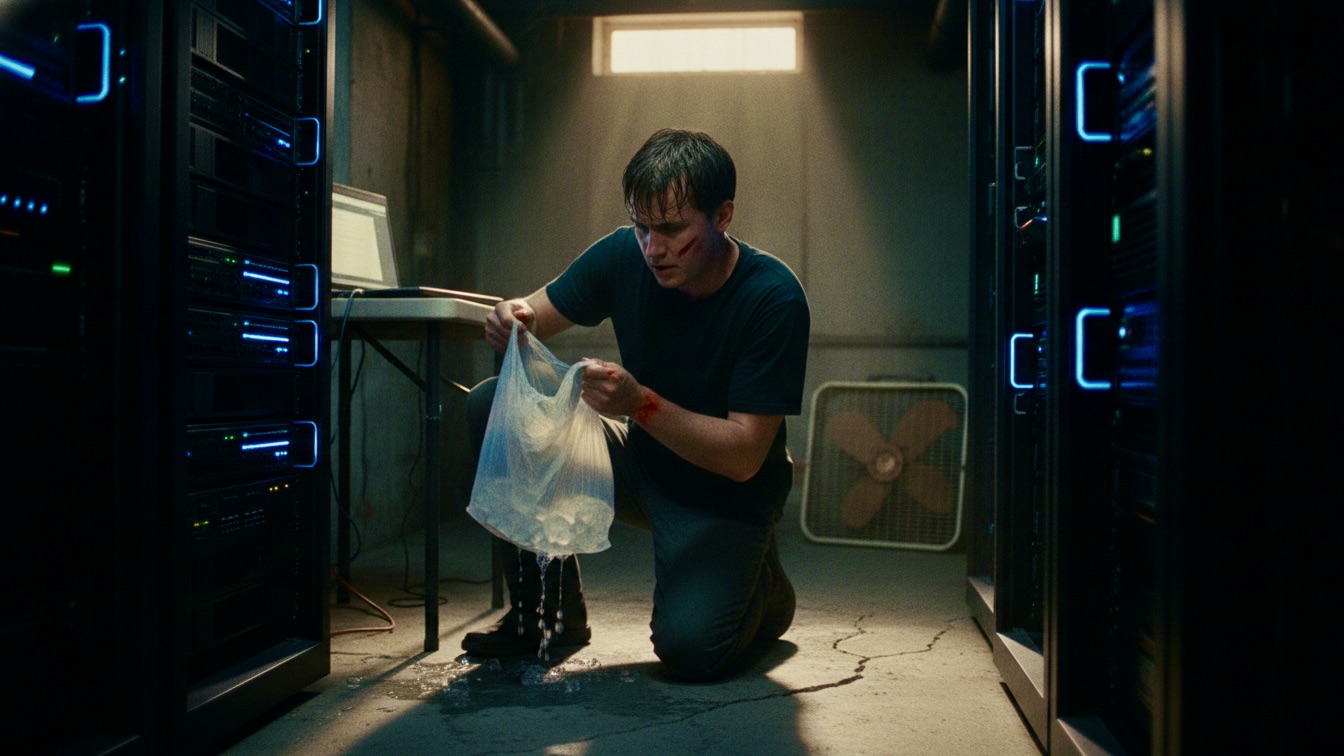
Tariq came through the heavy metal door, carrying a plastic bag that clinked. He looked as bad as I felt. His shirt was stuck to his chest, and his eyes were bloodshot. He didn't say anything at first. He just walked over to the small table we used as a desk and dropped the bag. Inside were three lukewarm Gatorades and a bag of ice that was already mostly water.
"The corner store is out of everything cold," Tariq said. He cracked a blue Gatorade and downed half of it in one go. "People are fighting over the bags of ice in the freezer. I had to pay ten bucks for this."
"Ten bucks?" Joanie finally looked up. Her eyes were sharp, scanning the bag like it was a crime scene. "We have thirty dollars in the account, Tariq. Total."
"The server was going to melt, Joanie," Tariq replied, his voice rising just a notch. "The ice is for the intake, not us. Relax."
I took the bag of ice. It was heavy and leaking. I looked at the server rack, then back at the bag. We weren't a big organization. We didn't have a HR department to mediate this. We didn't have a team-building retreat scheduled at a mountain resort to 'align our goals.' We just had this. A bag of melting ice and a server that was about to scream its last breath. If I didn't trust Tariq to get that ice, and if I didn't trust Joanie to keep the data moving, the whole thing would collapse. The trust wasn't in the words. It was in the fact that he went out into a hundred-degree heatwave to fight for a bag of frozen water.
I started draping the ice bag over the top of the rack, making sure the plastic was thick enough not to leak through the vents. It was a temporary fix. A desperate one. "How's the decrypt coming?" I asked.
Joanie turned her screen toward me. It was a mess of scrolling logs. "Aura’s encryption is layered. It’s not just a password. It’s a behavioral lock. It expects a certain rhythm of typing, a certain mouse latency. I’m trying to spoof the biometric signature now."
"If we get in, what do we find?" Tariq asked, leaning against the damp wall. He looked exhausted, his energy spent from the walk.
"The manifest for the New Haven project," I said. "Evidence that they’re testing the neural interface on unhoused kids. If we get that, we don't need a budget. We get the public on our side. We get real leverage."
"If we don't fry the hardware first," Joanie added. She went back to the keys. The sound was rhythmic. Tap-tap-tap. Pause. Tap-tap.
I sat back down on my milk crate. My feet were tapping a nervous beat on the concrete. I felt like my skin was too tight for my body. This was the snap point. The moment where people usually quit. They realize they could be working at a coffee shop with AC, or coding for a firm that pays six figures and gives them free snacks. But we were here. We were here because we didn't want the snacks. We wanted the truth. And the truth was currently locked behind a heat-sensitive server in a basement that smelled like old laundry detergent.
"Edgar," Joanie said. Her voice was different now. Lower. "The load isn't dropping. The ice isn't doing enough."
I stood up. I could feel my heart hammering against my ribs. "Shut down the non-essentials. Kill the backup nodes. Put everything into the decrypt."
"If I kill the backups and the power drops, we lose the whole sequence," she warned.
"Do it," I said. I looked at Tariq. He nodded once. That was the trust. No long debate. No 'let's circle back to this.' Just a look and a decision. We were too small for bureaucracy. We were just big enough for survival.
The air in the basement reached a point where it felt like a physical weight on my lungs. Every breath was a struggle against the humidity. I could feel the heat radiating from the server rack, a shimmering distortion in the air that made the room look like it was underwater. We were past the point of discomfort. This was physiological. My brain felt foggy, my thoughts drifting like smoke. I kept checking the internal temperature of the CPUs on my tablet. One hundred and two degrees Celsius. We were redlining. If we hit one hundred and five, the emergency shut-off would trigger, and we’d be locked out for twenty-four hours while the hardware cooled. By then, Aura would have patched the hole in their firewall.
"Talk to me, Joanie," I said, my voice cracking. I grabbed a lukewarm Gatorade and forced myself to swallow. It tasted like chemicals and salt.
"The biometric spoof is at eighty percent," she said. She didn't look back. Her shoulders were hunched, her spine a sharp curve under her sweat-soaked tank top. "The latency is the problem. Our ping is too high because the router is overheating. I need more bandwidth, or I need the heat to drop. Choose one."
I looked at Tariq. He was already moving. He’d found a piece of cardboard and was using it to manually fan the router. It was a pathetic sight—a grown man fanning a piece of plastic with a piece of trash—but it was all we had. There was no 'innovative solution' from a textbook here. Just manual labor and desperation. This was the work. The stuff they don't show you in the movies. It wasn't sleek. It wasn't cool. It was just miserable.
"I can try to underclock the processors," I suggested. "It'll slow the decrypt, but it'll buy us time."
"No," Joanie snapped. "If we slow down now, their AI will catch the anomaly. We have to push. We have to go faster."
I wiped my forehead. The sweat was stinging my eyes. I felt a surge of irritation. Who was she to tell me how to run my hardware? I’d built those racks. I’d wired the cooling system. But then I saw the way her hands were shaking. She wasn't being arrogant. She was terrified. We were all terrified. The irritation vanished, replaced by a hollow feeling in my gut. We weren't a team because we liked each other. We were a team because we were the only three people crazy enough to think this would work. That was the bond. It wasn't a 'culture.' It was a shared delusion that we were making a difference.
"Tariq, keep fanning," I said. "Joanie, give me the terminal. I’m going to bridge the cooling fans manually. I can bypass the internal governor and make them spin faster."
"You'll burn out the motors," Tariq said, his arm moving back and forth in a steady, tiring rhythm.
"They’re already dying, Tariq. Let’s give them a glorious end."
I knelt on the floor, the concrete grit digging into my knees. I pulled the front panel off the server. The heat hit me like a physical blow. I felt my skin flush. I reached into the guts of the machine, my fingers fumbling with the tiny connectors. My hands were slick with sweat, making it hard to get a grip. I needed a screwdriver, but I didn't want to stand up and lose the momentum. I used my thumbnail to pry a wire loose. It hurt. The sharp edge of the metal casing sliced into my thumb, a small, bright red line appearing instantly. I didn't care. I couldn't afford to care.
I twisted two wires together. A spark jumped, stinging my skin. The fans suddenly screamed, a high-pitched whine that sounded like a jet engine taking off in a closet. The air began to move. It wasn't cold, but it was fast. The temperature on the tablet dropped by two degrees.
"There," I panted. "That’s all I can give you."
"It’s enough," Joanie said. Her typing speed doubled. The room was filled with the roar of the fans and the clatter of the keys. It was a cacophony of failing technology. We were holding it together with spit and wire.
Tariq didn't stop fanning the router. His face was set in a grim mask of concentration. I realized then that this was what trust looked like. It wasn't a conversation. It was Tariq fanning a router for twenty minutes without being asked to continue. It was Joanie trusting me not to electrocute her while she was connected to the system. It was the silence between us, filled only by the sounds of the struggle.
I sat on the floor, leaning my head against the cool-ish metal of the server rack. My thumb was throbbing. The blood was starting to dry, mixing with the dust on the floor. I looked at the ceiling, at the exposed pipes and the peeling paint. I wondered what the people in the office buildings uptown were doing. They were probably sitting in sixty-eight-degree offices, drinking artisanal coffee, and talking about 'synergy.' They had no idea that their world was being picked apart by three sweaty kids in a basement.
"Ninety percent," Joanie whispered. "Edgar, it’s working. The biometric spoof is holding."
I didn't move. I didn't want to jinx it. I just watched the shadows on the wall, cast by the flickering lights of the server. The summer sun was setting outside, I assumed. The light coming through the small, high window was turning a bruised purple. The longest day of our lives was finally starting to tilt toward night. But the heat wasn't leaving. It was trapped in the concrete, radiating back at us. We were in a slow cooker, and the timer was still ticking.
The fans were screaming now, a mechanical wail that felt like it was drilling into my skull. I checked the tablet again. One hundred and four degrees. We were on the edge of the cliff. One more degree and the system would kill itself to save the silicon. I looked at Joanie. She was staring at the screen with an intensity that made her look like a statue. Her eyes didn't blink. Her mouth was a thin line. She was in the zone, that weird mental space where the code becomes a physical landscape. I’d seen her like this before, but never with this much at stake.
"The firewall is reacting," she said, her voice barely audible over the fans. "It’s starting a counter-trace. They know someone is knocking."
"Can you mask the IP?" Tariq asked. He hadn't stopped fanning the router. His movements were slower now, his shoulder clearly aching, but he didn't quit. He was the anchor. He didn't have the technical skills Joanie had, but he had the endurance. He was the one who kept us grounded when the digital world started to feel too real.
"I’m trying to bounce the signal through a series of dead nodes in Singapore," Joanie replied. "But the latency is killing me. The heat is slowing the packet processing. Edgar, I need more speed."
I looked at the server. I’d already bypassed the governors. There was nothing left to tweak. I looked at the bag of ice. It was a puddle now, just a few small cubes floating in gray water. I grabbed the bag and dumped the water into a bucket, then took the remaining ice and pressed it directly against the metal housing of the primary CPU. The metal hissed. A tiny wisp of steam rose into the air.
"Don't get it wet," Tariq warned. "If you short that board, we’re dead."
"I know, I know," I snapped. My nerves were frayed. I was vibrating with a mix of caffeine and adrenaline. I held the ice with a rag, my hand cramping from the cold against the heat. It was a bizarre sensation—freezing and burning at the same time.
"Ninety-five percent," Joanie shouted. "Almost there. Come on, you piece of junk. Open up."
I watched the progress bar on her screen. It was moving at a crawl. Each percentage point felt like an hour. I could feel the heat from the CPU through the rag. It was intense. The ice was melting fast, the water running down the rag. I had to be careful. If a single drop hit the motherboard, it was game over. I was hyper-aware of everything—the sound of Tariq’s breathing, the hum of the city outside, the smell of the basement. It was a sensory overload.
"Ninety-six... ninety-seven..."
Suddenly, the fans stuttered. The high-pitched whine dropped an octave, then sputtered. One of the motors had given out. The temperature on the tablet spiked instantly. One hundred and five.
"No!" I yelled. I reached in and manually spun the fan blade with my finger, trying to jumpstart it. It caught for a second, then stopped again. The heat was too much. The plastic housing had warped.
"Edgar! The system is initiating a shutdown!" Joanie’s voice was panicked now. "I’m losing the connection!"
"Override it!" I screamed. "Type the kill command for the thermal monitor!"
"I can't! It’s hardcoded!"
I didn't think. I just acted. I grabbed the backup power supply—a heavy, lead-acid battery we used for emergencies—and shoved it against the server rack. I ripped the power cable from the wall and jammed it into the battery’s inverter. There was a massive spark, a blue flash that blinded me for a second. The smell of burning plastic filled the room. But the server stayed on. The sudden surge of unregulated power had bypassed the thermal shut-off circuit. It was dangerous. It was stupid. It was the only thing left to do.
"Go!" I yelled, my eyes watering from the smoke. "Finish it!"
Joanie’s fingers were a blur. "Ninety-eight... ninety-nine..."
The screen flashed white. For a heartbeat, I thought we’d blown the whole thing. I thought the battery had fried the boards and we’d lost everything. I stood there, frozen, the smoke curling around my head. The silence in the room was deafening now that the fans had stopped. The only sound was the drip of water from the ice bag hitting the concrete floor.
Then, a soft beep.
Joanie slumped back in her chair. She didn't say anything. She just pointed at the screen.
A folder had opened. It was full of PDF files, spreadsheets, and video logs. The manifest. We were in.
Tariq dropped the cardboard fan. He leaned over, his hands on his knees, gasping for air. "Did we... did we get it?"
"We got it," Joanie whispered. She looked at me, her face streaked with soot and sweat. She looked like she’d been in a tunnel collapse. "You absolute idiot, Edgar. You almost killed us."
"But I didn't," I said, a weak smile tugging at the corners of my mouth. I felt a sudden rush of relief so strong it made my knees weak. I sat down on the floor, right in the puddle of ice water. I didn't care. It was cold. It was the best thing I’d felt all day.
We sat there in the dark, the only light coming from the laptop screen. The heat was still there, but it didn't feel as heavy anymore. We’d done the work. We hadn't needed a budget. We hadn't needed a mission statement or a corporate retreat. We just needed to not fail each other. And we hadn't.
"We need to copy this and get out of here," Tariq said, his voice regaining some of its strength. "Before the power grid completely fails or Aura tracks the surge."
"I’m already uploading it to the cloud," Joanie said. "Five minutes and we’re clear."
I looked at my team. They weren't just people I worked with. They were the only people who knew what this felt like. This specific brand of exhaustion. This specific brand of victory. It was a private language, written in sweat and scorched electronics. We were a grassroots organization. We were broke. We were dirty. And we were the most powerful people in the city right now.
The upload progress bar was a thin blue line that felt like it was moving through molasses. We were all staring at it, the three of us huddled around the laptop like it was a campfire. The basement felt different now. The tension hadn't vanished, but it had shifted. It was no longer the jagged, frantic energy of a crisis; it was the quiet, vibrating hum of a successful heist. My body felt like it was made of lead. The adrenaline was draining out of me, leaving a hollow, shaky fatigue in its wake.
"Sixty percent," Joanie muttered. She was chewing on her thumbnail, a habit she only had when she was truly on edge. "The node in Singapore is flickering. I might have to jump to a Swiss server."
"Do what you have to do," I said. I looked at the server rack. It was a graveyard of parts now. The wires I’d twisted together were charred, and the smell of ozone was still thick in the air. We’d probably never get those blades to boot again. It was a sacrifice. Five thousand dollars worth of salvaged gear, gone in a single afternoon. To a corporate entity, that’s a rounding error. To us, it was everything.
"Was it worth it?" Tariq asked. He was sitting on the floor next to me, his back against the damp concrete. He was looking at his hands, which were shaking slightly.
"Ask me again when the news breaks," I said. "If we actually change something, then yeah. It was worth it."
"We will," Joanie said, her voice firm. "This isn't just data, Edgar. It’s names. It’s dates. It’s the kind of thing they can't PR their way out of. We’re going to burn their house down with this."
I watched her. She was twenty-one. She should have been at a music festival or a beach. She should have been worrying about her grades or her social media feed. Instead, she was here, hacking a multi-billion dollar corporation in a basement that smelled like mold. I felt a sudden, sharp pang of affection for her. And for Tariq. We were the rejects. The ones who didn't fit into the sleek, optimized world Aura was building.
"Eighty percent," she announced.
The light in the room flickered. The brownout was finally hitting. The overhead bulb dimmed to a dull orange glow, then pulsed back to life. My heart skipped a beat.
"Joanie, hurry," I whispered.
"I’m going as fast as the laws of physics allow!" she snapped, but there was no heat in it. It was just the stress talking.
I reached out and put my hand on the floor. The concrete was cool now. The sun had finally gone down, and the earth was starting to soak up the heat. A breeze—a real, honest-to-god breeze—whistled through the cracks in the foundation. It smelled like rain. A summer storm was coming. I closed my eyes for a second, letting the cool air hit my face. It felt like a benediction.
This was the secret to the whole thing. The corporate world tries to manufacture this feeling. They spend millions on consultants and 'culture officers' to try and build this kind of trust. They want people to feel like a 'family.' But you can't buy this. You can't schedule it. You can't put it in a handbook. You only get it when you’re in the trenches together, when you’re failing and desperate and the only thing standing between you and total collapse is the person sitting next to you. Trust isn't a workshop. It’s a byproduct of the work itself.
"Done," Joanie said. She closed the laptop with a definitive thud. "It’s out. It’s everywhere. Mirror sites, journalists, the dark web. It’s gone. They can't kill it now."
She looked at us, and for the first time all day, she smiled. It was a small, tired smile, but it was real.
"We did it," Tariq said. He stood up, offering a hand to me. I took it, and he pulled me to my feet. My legs felt like jelly. We stood there for a moment, the three of us, in the middle of our ruined basement.
"We need to clear out," I said, regaining my focus. "Aura will have the authorities here within the hour. They’ll track the surge to this block."
"I already wiped the local drives," Joanie said. "There’s nothing left for them to find but some burnt-out silicon and a bag of melted ice."
We started moving, grabbing our personal bags and the few pieces of gear that were still functional. We moved with a silent efficiency. No one had to tell anyone what to do. We just knew. We were a single organism now, moving in sync.
I took one last look at the room. The server rack looked like a skeleton in the dim light. It was a messy, ugly, beautiful thing. It was the place where we’d become a team. Not through a retreat or a dinner, but through the simple, grueling act of refusing to quit.
We climbed the stairs to the street. The air outside was electric. The clouds were heavy and black, lit from within by flashes of lightning. The first fat drops of rain were starting to hit the pavement, turning the dust into a metallic scent. The heatwave was breaking.
We walked to the corner, where we’d go our separate ways for the night. We’d meet up tomorrow at a new location, start the process all over again. The work was never done.
"See you tomorrow?" Tariq asked, adjusting his backpack.
"Tomorrow," Joanie agreed.
They walked off into the rain, their figures blurring in the downpour. I stood there for a second, letting the water soak through my shirt. It was cold and sharp. I felt alive. I felt like I could do this forever.
I reached into my pocket and felt the encrypted thumb drive, the physical backup of the manifest. It was a small, solid weight against my leg. We were small. We were broke. We were just three people in a city of millions. But we were the only ones who knew the truth, and we were the only ones who knew how to keep it safe.
“I realized the data wasn't just a file; it was a live feed of the tests, and the person on the screen was looking directly at the camera.”


