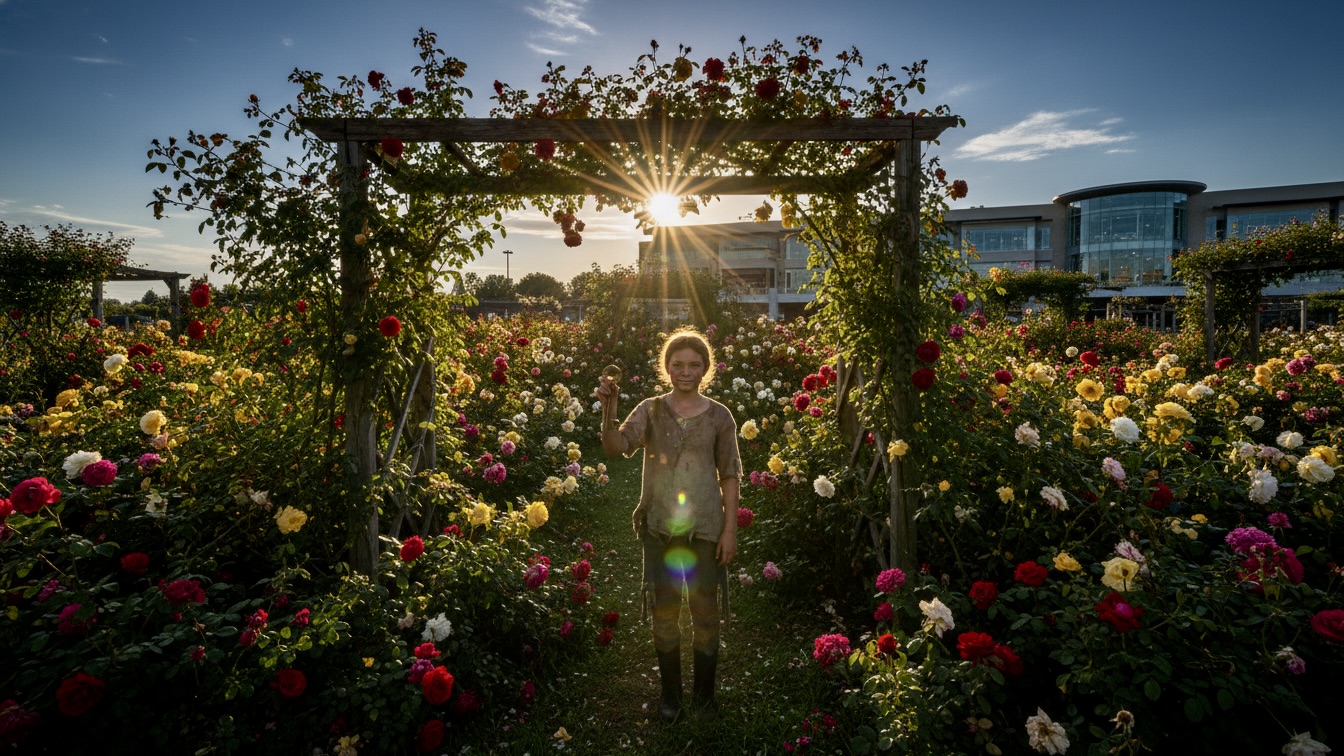
A buried brass key leads Trudy from her grandmother's garden to a dark secret under a modern shopping plaza.
The heat doesn't just sit on you in July. It weighs. It has a physical mass, like a wet wool blanket thrown over your head while you're trying to breathe. I wiped my forehead with the back of my glove, leaving a smear of dark, damp Missouri soil across my skin. My grandmother’s rose garden was a graveyard of things that used to be beautiful. Now, it was just a tangle of thorns and yellowed leaves, the kind of mess that takes days to clear. My back ached. My hamstrings were tight. Every time I moved the shovel, the dry earth groaned. I wasn't doing this for fun. I was doing it because my mother, Helen, couldn't stand looking at the decay anymore. She said it reminded her of things slipping away. I think she just hated the reminder that Grandma wasn't here to prune them herself.
I shoved the spade into a particularly stubborn patch near the old trellis. The wood of the trellis was rotted, crumbling into grey flakes that looked like fish scales. As the blade bit into the dirt, it hit something hard. Not a rock. Rocks have a dull, thudding sound. This was a metallic clink. High-pitched. Sharp. I stopped, my breath catching in the humid air. I dropped to my knees, the grit of the garden bed pressing into my jeans. I started digging with my hands, clawing at the dirt like an animal. My nails filled with grit. My pulse was a steady, fast drum in my ears. The paranoia of the neighborhood always felt like eyes on your neck, but right now, the only thing that mattered was whatever was screaming under the soil.
It was brass. Heavy. I pulled it out, shaking the clumps of dirt free. It was a key, but not a house key. It was long, maybe five inches, with a complex series of teeth and a circular head stamped with a fading star. It felt cold despite the ninety-degree sun. I rubbed the face of it against my shirt, revealing the words etched into the metal: Sky-High Flyer. My stomach did a slow, sickening roll. I knew that name. Everyone in this town knew that name, even if they pretended they didn’t. It was the centerpiece of the Starlight Carnival. The ride that had been the last place anyone saw Sarah Jenkins back in 2008. The carnival hadn't survived the investigation. It had folded, its bones left to rust until the developers came in with their bulldozers and their vision for a 'revitalized' downtown.
I stood up, the key heavy in my palm. The garden felt different now. The shadows under the oak trees looked longer, darker. The wind chime on the porch clattered, a sudden, jagged sound that made me jump. I looked toward the house. My mother was standing at the kitchen window. She wasn't moving. She was just watching me, her silhouette blurred by the screen. I shoved the key into my pocket, the metal biting into my thigh. I didn't want her to see it. I didn't want to explain why I was shaking. I picked up the shovel and tried to go back to work, but the rhythm was gone. The ground felt like it was hiding a thousand more things, all of them waiting to be stepped on.
"Trudy?" my mother called out. Her voice was thin, cutting through the heavy air. She opened the screen door, the hinge screaming. "You’ve been out there for three hours. Come inside. You’re going to get heatstroke."
"I'm fine," I said. I didn't look at her. I kept my eyes on the dirt. "Just finishing this row."
"Leave it," she said. She was on the porch now, wiping her hands on a dish towel. Her face was tight, the way it always got when we talked about this house. "The roses are dead, Trudy. You can't save them. Just bag the debris and come in."
I looked up at her. She looked tired. Not just 'end of the day' tired, but the kind of tired that lives in your bones for a decade. I felt the weight of the key in my pocket. It felt like it was glowing, like it was burning a hole through my denim. I wondered if she knew. I wondered if Grandma had buried it there on purpose, or if it had just fallen. No. You don't accidentally bury a five-inch brass key under a trellis. That was a burial. That was a secret.
"Mom?" I asked, my voice cracking slightly. I stood up and walked toward the porch. "What happened to the old carnival equipment? When they built the plaza?"
She froze. It was subtle—a tightening of her shoulders, a pause in the way she was folding the towel—but I saw it. She didn't look at me. She looked past me, at the overgrown fence line. "They sold it for scrap. Or they buried it. I don't know. Why would you ask that?"
"Just thinking," I lied. "I found something."
I pulled the key out. I shouldn't have. I knew the second I did that I should have kept it hidden. The color drained from her face so fast I thought she might faint. She reached out, her hand trembling, then pulled it back as if the metal were white-hot. "Where did you get that?"
"Under the trellis," I said. "It says Sky-High Flyer. That was the—"
"I know what it was," she snapped. Her voice was harsh, a sudden jagged edge that sliced through the afternoon quiet. "Give it to me."
"No," I said, stepping back. "Why was it in Grandma's garden?"
"It doesn't matter," Helen said. She was moving toward me now, her eyes wide and frantic. "It’s junk, Trudy. It’s trash from a bad time. Throw it away. Right now. Throw it in the bin."
"Mom, you're shaking."
"Throw it away!" she shouted. The sound echoed off the neighbor's siding. A dog started barking three houses down. She looked around, her paranoia flaring, checking to see if anyone had heard. She lowered her voice to a hissed whisper. "You don't know what you're playing with. That girl... that family... they ruined people. Just get rid of it."
She turned and went back inside, slamming the screen door. I stood there in the heat, the key clutched in my hand. My heart was thumping against my ribs. She wasn't just angry. She was terrified. And for the first time in my seventeen years, I realized my mother wasn't just a person who forgot things. She was a person who was hiding them. I looked down at the key. The star on the head seemed to mock me. It wasn't junk. It was a map. And I knew exactly where I had to go.
The Starlight Plaza was a monument to the kind of corporate 'authenticity' that makes me want to scream. It was built on the exact footprint of the old carnival, and the architects had leaned into the history with a sickening enthusiasm. There were 'vintage' popcorn stands that sold seven-dollar artisanal salts, and the light fixtures were shaped like old-fashioned Edison bulbs. They called it 'The Midway.' It was a high-end shopping district for people who wanted to feel nostalgic for a tragedy they weren't around to witness. I walked through the main thoroughfare, my sneakers squeaking on the polished concrete. The summer sun was still high, making the glass storefronts glint like knives.
I felt exposed. Every security camera felt like it was tracking the bulge of the key in my pocket. I kept my head down, my hair falling over my face. I needed to find someone who knew the real layout, not the sanitized version on the directory map. I headed toward the back of the plaza, where the 'History Nook' was located. It was a small, cramped office tucked between a Lululemon and a high-end stationary store. This was where Mrs. Morrison lived. Well, she didn't live there, but she spent enough time there that she might as well have. She was the town’s unofficial historian, a woman who remembered the name of every dog that had lived on Main Street since 1970.
I pushed the door open. A bell chimed—a real bell, not a digital recording. The air inside was cooler, smelling of old paper and peppermint. Mrs. Morrison was sitting behind a mahogany desk that looked like it belonged in a museum. She was wearing a floral blouse and glasses on a gold chain. She looked up, her eyes sharpening as they landed on me. "Trudy. You look like you've been digging in the dirt."
"I have," I said, leaning against the desk. "I need to ask you about the Sky-High Flyer."
The silence that followed was heavy. Mrs. Morrison didn't flinch, but she did go very still. She set her pen down. "That's a heavy name for a Tuesday afternoon, dear."
"I found something in my grandmother’s garden," I said. I placed the brass key on the desk. It looked out of place against the polished wood, a dirty relic in a clean room. "My mom freaked out. She told me to throw it away. She said the Jenkins family ruined people."
Mrs. Morrison picked up the key, her fingers tracing the etched letters. She didn't look surprised. She looked tired, the same way my mother had. "Your grandmother was a good woman, Trudy. But she had a hard time keeping her nose out of other people's business when she thought someone was hurting."
"What does that mean?"
"It means that Sarah Jenkins didn't just vanish into thin air," Mrs. Morrison whispered. She leaned forward, the gold chain of her glasses clinking against the desk. "The official story is that she ran away or was snatched by a transient. But the Sky-High Flyer... that ride was owned by the mayor’s brother. It had mechanical issues. Safety violations that were buried under a pile of campaign donations. When Sarah disappeared, the investigation was a joke. They didn't want to find her. They wanted to protect the brand."
"Protect the brand?" I felt a surge of cold anger. "A girl died."
"Or she was hidden," Mrs. Morrison said. She slid the key back to me. "There are parts of this plaza that the public doesn't see. The old maintenance tunnels were never filled in. They just built the foundation over them. If you want to know why your grandmother had that key, you need to go down. Not in the stores. Under them."
"Where?"
"The loading docks behind the cinema," she said, her voice barely audible. "There’s a service elevator. If you have that key, you might find what you're looking for. But Trudy? Be careful. The people who run this town now... they're the children of the people who ran it then. They don't like the dirt being moved."
I left the office with my head spinning. The 'localized paranoia' I’d felt in the garden was now a full-blown roar. Every person in a suit, every security guard with a radio, felt like a threat. I walked toward the cinema, my heart hammering. The loading dock area was shielded by a high concrete wall. I slipped through a gap in the gate, the smell of rotting garbage and hot asphalt hitting me. It was a stark contrast to the 'Midway' just a few hundred yards away. Here, the reality of the town was visible. Rust, grime, and the silence of things forgotten.
I found the service elevator. It was an old, industrial beast with a sliding metal gate. Beside it was a small, inconspicuous door with a heavy brass lock. My hand shook as I pulled the key from my pocket. It fit perfectly. The lock groaned, a sound like a bone snapping, and then it turned. I pushed the door open. A wave of cool, damp air hit me, smelling of oil and ancient dust. I stepped inside and pulled the door shut behind me. Darkness swallowed me whole, save for the thin beam of my phone's flashlight. I was under the plaza. I was inside the ghost.
I started down the stairs. They were metal, vibrating with the distant hum of the mall’s HVAC system. My footsteps echoed, a hollow sound that seemed to travel for miles. I reached the bottom and saw the tunnel. It was wide, lined with thick pipes and bundles of wires. But it wasn't just a maintenance crawl space. There were things here. Piles of crates, old carnival signs leaning against the walls, and the rusted remains of a ticket booth. It was a tomb for the Starlight Carnival. I walked deeper, the beam of my light dancing over the debris. I saw a flash of color in the corner. I moved toward it, my breath hitching. It was a striped vest, the kind the ride operators used to wear. It was covered in a thick layer of dust, the red and white fabric faded to pink and grey.
I reached out and touched it. The fabric was stiff. Beside it lay a pile of personal effects. A pink Motorola Razr flip phone, its screen cracked into a spiderweb. A handful of glitter pens. A scrunchie. These weren't just artifacts. These were Sarah’s. I felt a sudden, sharp sense of intrusion, like I was standing in someone's bedroom without their permission. But I couldn't stop. I looked further back into the shadows and saw a wooden crate with my grandmother's name scrawled on it in black marker. My stomach dropped. I knelt beside it, my hands fumbling with the latch. Inside, wrapped in an old wool blanket, was a leather-bound journal. I opened it to the first page. The handwriting was unmistakable. It was Grandma's. June 12, 2008. She came to me tonight. Her face was bruised. She can't go home. If they find her, he'll kill her. I have to hide the light.
I sat on the cold concrete floor, the journal heavy in my lap. The hum of the mall above me felt like a heartbeat. A secret heartbeat. I wasn't just looking at a cold case. I was looking at a conspiracy of silence that my own family had been part of. And then, I heard it. The sound of a door opening far down the tunnel. The heavy thud of boots on metal. I clicked off my flashlight. The darkness was absolute. My heart was a frantic bird in my chest. Someone was down here with me. And they weren't looking for a journal.
I pressed my back against the cold, sweating concrete wall. The boots were rhythmic. Deliberate. They weren't the footsteps of someone lost; they were the footsteps of someone patrolling. I squeezed the journal to my chest, the leather biting into my skin. The darkness felt like it was pressing into my eyes. I held my breath until my lungs burned, trying to minimize any sound. A beam of light cut through the gloom, a powerful, clinical LED white that made my phone's flashlight look like a candle. It swept across the rusted machinery, illuminating the striped vest and the old flip phone. I saw the light pause on the open crate. My heart stopped.
"I know you're down here," a voice said. It was deep, professional, and entirely devoid of emotion. "This is private property. You're trespassing on a restricted construction zone. Come out now and we can make this easy."
I didn't move. I couldn't. My legs felt like lead. The light moved again, inches from my boots. I looked around, desperate. To my left, the tunnel branched off into a smaller crawlspace, barely three feet high. I dropped to my stomach, sliding into the opening. The floor was covered in a layer of oily silt that ruined my shirt instantly. I crawled, my elbows scraping against the rough floor, the journal tucked under my arm. I could hear the man moving closer to where I’d been standing. He was muttering into a radio.
"Yeah, we've got a breach. Basement Level 4. Looks like a kid. I'm tracking now."
A breach. Not a person. A breach. The way he talked made my skin crawl. This wasn't just a mall security guard. This was something else. A 'security firm' hired to keep the town's secrets buried under the high-end boutiques. I kept crawling, the space getting tighter. The air was thin and smelled of copper. I reached a dead end—a heavy steel grate. I pushed against it. It didn't budge. I was trapped. I rolled onto my back, staring up at the low ceiling, my breath coming in short, jagged gasps. I looked at the journal. I had to know what was in it. I had to know if Sarah was still alive.
I flipped through the pages, the paper dry and brittle. June 20, 2008. The Mayor’s brother followed her to the gates. He thinks he owns the girl because he owns the ride. I've moved her to the maintenance sub-level. He doesn't know about the old tunnels. No one does except the builders. I'm bringing her food tonight. She's terrified.
July 4, 2008. The fireworks are a good distraction. We're moving her tonight. Out of the county. I've contacted the sister in Illinois. If we can get her past the precinct, she’s safe. But they’re watching the roads. Helen is scared. She saw me with the key. I told her it was nothing. I hope she believes me.
My mother. She knew. She didn't just know about the carnival; she knew Sarah was being hidden. She wasn't agitated because of the tragedy; she was agitated because she had been a witness to the escape. She had lived in fear for eighteen years that the truth would come out and destroy what little peace we had left. I felt a wave of nausea. The 'summer of silence' wasn't just a town legend. It was my family's legacy.
The light hit the grate. I flinched, shielding my eyes. "There you are," the voice said. I heard the sound of a heavy latch being thrown. The man was on the other side of the grate. I saw his face—square-jawed, mid-forties, wearing a black tactical vest with a logo I didn't recognize. A hawk with a key in its beak. Subversive and subtle. "Hand over the book, kid. It's not yours."
"It’s my grandmother's," I said, my voice shaking but loud. "And this is all evidence. Sarah Jenkins didn't run away. You guys hid what happened to her."
"Nobody hid anything," he said, his tone flat. "We’re just managing the narrative. The plaza is the future of this town. We don't need old ghosts ruining the property value. Now, give me the journal and I'll walk you out of here. No police. No charges."
"You're lying," I said. I looked past him. There was a second door, a smaller one used for pipe access. It was unlocked. I scrambled backward, out of the crawlspace and toward the pipe door. He shouted, the sound echoing like a gunshot in the confined space. I threw myself through the door and slammed it shut, sliding the bolt just as he hit the other side. The metal groaned under his weight. I didn't wait. I ran.
I was in a maze of pipes and steam valves. I followed the slope of the floor, heading upward. My lungs were screaming. I burst through a final door and found myself in the back hallway of the cinema, right behind the screen playing a noisy action movie. The contrast was jarring—the loud, fake explosions of the movie and the terrifying silence of the tunnel. I didn't stop. I ran through the lobby, past the startled teenagers selling popcorn, and out into the humid summer night. I didn't go home. I knew where the power was. I knew where they were all meeting tonight. The Town Hall was having its monthly session, and the main agenda was the expansion of the Starlight Plaza.
I stood on the sidewalk, my clothes covered in oil and dirt, the journal clutched in my hands. People were staring. I looked like a ghost. Maybe that was appropriate. I was carrying the words of a dead woman and the truth about a girl who had been erased. I started walking toward the center of town. Every step felt like I was breaking a law. Every car that passed felt like it was the security guard coming to finish the job. But the adrenaline was a cold, steady hum in my veins now. I wasn't just Trudy from the rose garden anymore. I was the person who was going to make them look at the dirt.
The Town Hall was a red-brick building that smelled of floor wax and old wood. The air conditioning was cranked so high it felt like a refrigerator. I pushed through the heavy double doors of the assembly room. The meeting was already in progress. Mayor Sampson was at the podium, a man with silver hair and a smile that never quite reached his eyes. He was talking about 'growth' and 'synergy' and 'the next chapter for our community.' My mother was sitting in the third row, her head down, her hands knotted in her lap. When the doors thudded shut behind me, she looked up. Her eyes went wide. She saw the dirt on my face. She saw the journal.
"And so, with the new phase of the Midway," the Mayor continued, "we expect to see a twenty percent increase in—"
"The Midway is built on a lie!" I shouted. My voice sounded alien in the quiet room. It was high and sharp, cutting through the droning bureaucracy. The room went silent. A hundred heads turned toward me. I walked down the center aisle, my heart thumping so hard I could feel it in my teeth. "You didn't scrap the carnival. You buried it. And you tried to bury the girl who was hurt there."
"Trudy, stop!" my mother cried out, standing up. She looked terrified, but for the first time, I saw a flicker of something else in her eyes. It was relief.
"Who is this?" the Mayor asked, his smile faltering. He looked toward the back of the room, where two of the 'security' men in black vests were already moving toward me. "Security, please escort this young lady out. She’s clearly distressed."
"I have my grandmother’s journal!" I yelled, holding the book high. I reached the front of the room and slammed it onto the mahogany railing. "She helped Sarah Jenkins escape. Not from a stranger. From your brother, Mr. Mayor. She hid her in the tunnels you're now turning into a parking garage. My grandmother spent years keeping this secret because she knew you'd destroy anyone who spoke up."
One of the security guards grabbed my arm. His grip was like iron. "Let’s go, kid."
"Let her go!" It wasn't me who yelled. It was my mother. She stepped into the aisle, her face flushed, her eyes burning. "Let my daughter go. She’s telling the truth. I saw the bruises on Sarah. I saw the way you all looked the other way because the carnival was making the town rich. My mother was the only one with a backbone, and I’ve been a coward for eighteen years. No more."
The room erupted. People were standing, shouting. Mrs. Morrison was there, too, standing in the back with her arms crossed, a grim look of satisfaction on her face. The Mayor’s face turned a mottled shade of purple. He tried to speak, but the noise drowned him out. I felt the guard’s grip loosen. He looked at the Mayor, then at the crowd, and he stepped back. The power was shifting. The 'localized paranoia' that had held this town in a chokehold for two decades was evaporating under the fluorescent lights.
I looked at my mother. She walked toward me and took the journal from the railing. She didn't look at the Mayor. She looked at me. "I'm sorry, Trudy," she whispered. "I should have told you. I was so scared that if we dug it up, it would kill us both."
"The truth doesn't rot, Mom," I said. My voice was steadier now. "It just waits."
The meeting was adjourned in chaos. The police were called—not for me, but for the records. The journal was handed over to a state investigator who had been tipped off by Mrs. Morrison weeks ago. It turned out the historian hadn't just been waiting for me; she’d been waiting for the key. My grandmother had told her where it was hidden before she died, but she’d left it to me to find. A test of character, maybe. Or maybe she just knew that a seventeen-year-old with a shovel was more dangerous than a historian with a filing cabinet.
Later that night, the heat finally broke. A summer storm rolled in, the kind that turns the sky a deep, bruised purple and makes the air smell like ozone and wet pavement. My mother and I sat on the porch, watching the rain wash the dust off the rose bushes. The garden looked different now. It didn't look like a graveyard anymore. It just looked like a place that needed work.
"Sarah is in Oregon," my mother said quietly. She was holding a mug of tea, the steam curling around her face. "She has a family. She’s a teacher. My mother kept in touch with her sister. I... I talked to her on the phone tonight. For the first time."
"Is she okay?" I asked.
"She’s safe," Mom said. She reached over and took my hand. Her palm was warm. No more shaking. "She thanked us. She said she’s been waiting for the day she didn't have to look over her shoulder anymore."
I leaned back in the wicker chair, listening to the rain drum on the tin roof. The weight was gone. The 'Sky-High Flyer' was still a tragedy, but it wasn't a haunting. We had taken the key and opened the door, and the air was finally moving again. I looked down at my hands. The dirt was gone, but my nails were still stained a little bit brown. I didn't mind. It was a reminder that some things are worth digging for, even if they're buried deep. The town would change. The plaza would probably still be there, but the 'vintage' signs wouldn't feel so heavy anymore. The truth was out in the light, and for the first time all summer, I felt like I could finally breathe.
“As the rain poured down, I realized that while one secret was out, the journal had one last page glued shut, and the name written on the seal wasn't Sarah’s—it was my father’s.”


