Format: Short Film / Anthology Episode | Est. Length: 10-12 minutes
Imagine The Buckled Steel as a standout episode in an anthology series titled Permafrost, which explores the collapse of the Arctic frontier as the ground literally liquefies. The series follows the "essential workers" of the North—drivers, engineers, and medics—navigating a world where the rules of physics and geography are being rewritten by climate change. This episode serves as a high-tension entry focusing on the logistical nightmares of infrastructure failure, where every delivery is a battle against a landscape that has transformed from a solid foundation into a predatory, hungry trap.
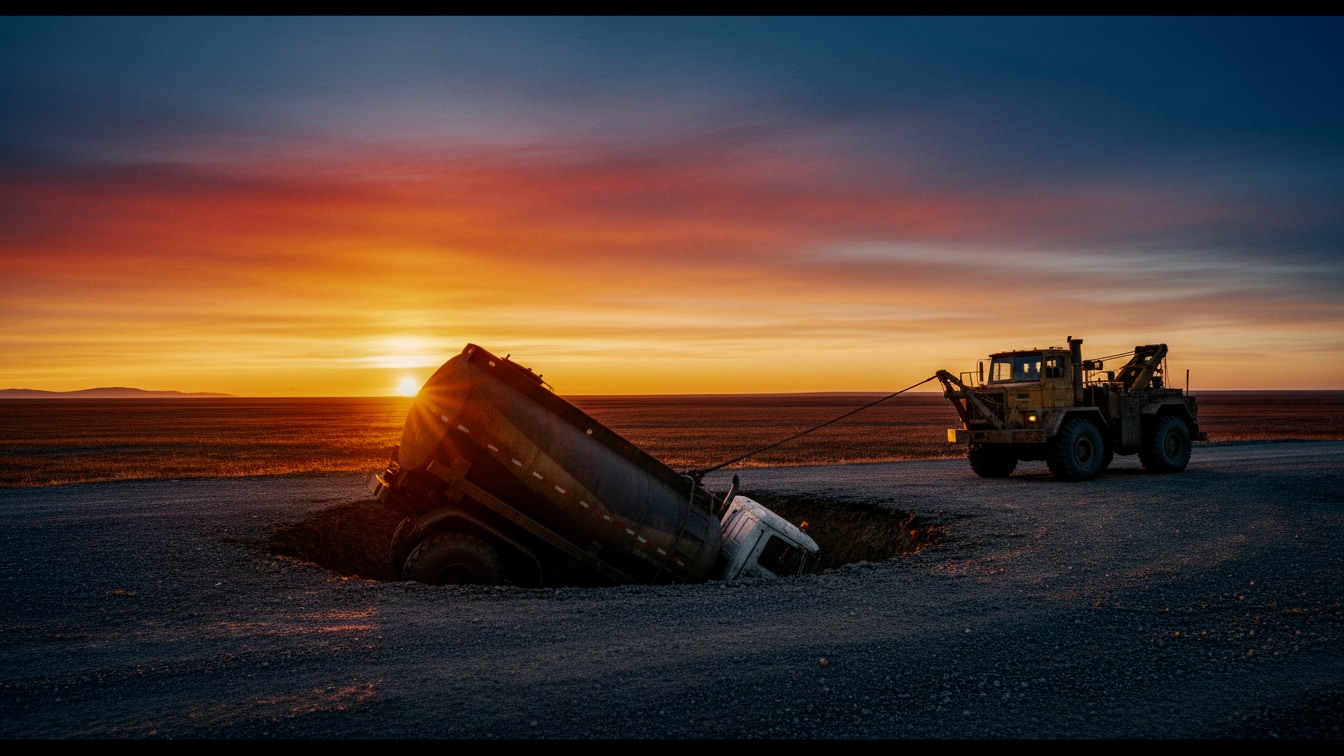
Paul’s ten-thousand-gallon water tanker suddenly sags into a hidden void in the road, the windshield shattering as the frame twists under the weight of the shifting load. He realizes he isn't just stuck; he is sinking into a prehistoric slurry of ancient peat and silt that shouldn't exist in the middle of July.
A veteran water hauler must survive a catastrophic road collapse and a hemorrhaging tank to save a remote Arctic town from a total water crisis. As the permafrost melts into a vacuum-like trap, he and his cynical dispatcher must perform a desperate mechanical miracle before the truck is swallowed by the mud.
The primary theme is the fragility of human infrastructure against the overwhelming force of environmental decay. It explores the "slow-motion apocalypse" of climate change, where the threat isn't a sudden storm but the literal liquefaction of the ground we stand on. The narrative highlights the resilience and stubbornness of the human spirit, personified by characters who refuse to abandon a dying frontier even as the earth opens its mouth to swallow their efforts.
Secondary themes include the "theatricality of survival" and the professional bond forged through shared hardship. Paul and Stacey’s relationship is built on a foundation of technical competence and dry wit, serving as a defense mechanism against the existential dread of their environment. Their struggle reflects the broader human condition of trying to maintain order and "keep the taps running" even as the world becomes unrecognizable and the air itself tries to boil them.
For Paul, the stakes are immediate physical survival and his professional identity; a total loss of the tanker would be a career-ending catastrophe that leaves him as stranded as the landscape. For the town, the stakes are existential, as losing this specific load means immediate emergency rationing and the potential for civil unrest in a community already pushed to the brink. For Stacey, the stakes involve the logistical integrity of the entire region, where one failed delivery can trigger a domino effect of infrastructure collapse and total isolation.
The primary antagonist is the environment itself—the melting permafrost that acts as a sentient, hungry trap, creating vacuums and sinkholes that defy traditional recovery methods. Internal conflict stems from Paul’s aging body and his growing realization that the world he knows is disappearing, leading to a sense of "logistics of despair." External conflict is provided by the ticking clock of the 95-degree heatwave and the mechanical failures of the aging equipment, which struggle to handle the unprecedented environmental stress of the thawing North.
In the sweltering heat of an Arctic July, veteran driver Paul is navigating a crucial water delivery when the permafrost beneath his tanker liquefies, sending the vehicle into a deep sinkhole. The impact shatters his windshield and ruptures a main valve, causing precious water to spray into the mud and carving a new river that threatens to undermine the entire road. Stacey, his sharp-tongued dispatcher, arrives with a recovery rig, but they quickly discover that the mud has created a powerful vacuum suction that threatens to rip the tank from the chassis if they pull too hard.
Working in 95-degree heat, Paul and Stacey use steel grates and air bladders to displace the pressure while Paul performs a dangerous underwater repair on the valve using epoxy and a pressure clamp. As the ground continues to collapse and methane gas bubbles up from the ancient peat, they manage to stabilize the tanker just as reinforcements arrive from the town. They successfully extract the vehicle and deliver the remaining water, acknowledging that while they won this battle, the melting landscape ensures that the next catastrophe is only a matter of time.
Paul: A veteran driver in his late 50s, Paul is a man of "theatrical" stoicism who masks his exhaustion with high-register vocabulary and dry wit. At the start, he is a man going through the motions of a dying trade, but by the end, he is revitalized by a hard-won victory over the elements, even as he accepts his own physical limitations. He views his work as a "mission" and his truck as a "shipwreck," reflecting his deep-seated feeling of being a relic in a changing world.
Stacey: The logistics coordinator and recovery specialist, Stacey is younger, fiercely competent, and uses professional fury as a shield against the chaos of her job. She begins the episode as a harsh critic of Paul’s "heroism," but her arc reveals a deep respect for his resilience and a shared commitment to the town's survival. She is the pragmatic anchor to Paul’s philosophical drifting, providing the engineering solutions necessary to overcome the "vacuum" of the melting earth.
The Sink: Paul is driving through a shimmering heat distortion when the road suddenly vanishes beneath his front tire, causing the tanker to lurch into a twenty-degree tilt. The internal baffles of the water tank slam like cannons, and the windshield spiderwebs as the frame twists under the immense weight of the shifting load. Paul realizes he is no longer driving but navigating a "shipwreck" as the clear, precious water begins to spray from a sheared valve into the dark mud.
The Assessment: Stacey arrives in a cloud of dust, and the two engage in a sharp verbal sparring match that masks the terror of the situation. They realize the truck is being held by a vacuum of liquefied silt, and any attempt to tow it directly will result in the tank being ripped off the frame. Paul is forced to descend into the foul-smelling, warm mud to assess the structural damage, discovering that the permafrost is failing in real-time beneath his feet.
The Repair: Under the blistering sun, Paul and Stacey lay steel grates to create a temporary platform so Paul can reach the ruptured valve. Paul fights through numbing water and thick epoxy to clamp the leak while Stacey uses the winch to prevent the tanker from rolling over entirely. The tension peaks when the winch motor begins to smoke and the ground vibrates with a subterranean collapse, forcing Paul to finish the repair seconds before a total structural failure.
The Extraction: Stacey returns with reinforcements and heavy-duty air bladders, which they slide under the tanker’s belly to break the suction of the mud. The compressors roar as the truck is lifted on a bed of air, and Paul manhandles the broken steering column as the tow trucks roar into life. The tanker finally breaks free of the "earth’s mouth" with a bone-jarring thud, reaching solid ground just as the sun begins to dip below the horizon.
The Delivery: The battered tanker limps into the town gates, where the local brewer and residents watch in silent acknowledgment of the "beautiful mess" that saved their supply. Paul and Stacey hook up the hoses, and the sound of rushing water serves as a temporary anthem of survival against the encroaching heat. In the quiet aftermath, they acknowledge that the ground is permanently changing and that their next "miracle" will require even more grit.
The episode begins with a jolt of high-intensity panic, transitioning into a period of grinding, claustrophobic frustration as the heat and mud take their toll. The middle section is defined by a "logistics of despair," where the characters feel small and insignificant against the melting landscape. The climax provides a surge of adrenaline and mechanical triumph, ending on a note of "exhausted grace"—a bittersweet realization that while they won the day, the environment is an adversary that cannot be truly defeated.
If expanded, the season would track the "Summer of the Great Thaw," with each episode focusing on a different infrastructure failure—a collapsing bridge, a burst pipeline, or a forest fire in the tundra. The overarching narrative would follow Paul and Stacey as they realize the town may eventually need to be abandoned, forcing them to transition from "maintenance" to "evacuation" logistics.
Thematic escalation would involve the discovery of ancient pathogens or artifacts released by the melting ice, adding a layer of "prehistoric horror" to the logistical drama. Character arcs would focus on the tension between those who want to stay and fight for the town and those who recognize that the "buckled steel" of their lives can no longer hold the weight of the changing world.
The visual style is "Industrial Grit meets Arctic Surrealism," characterized by high-contrast lighting that emphasizes the oppressive July sun and the shimmering heat waves. The camera work should be intimate and handheld during the mud-digging sequences to create a sense of claustrophobia, contrasting with wide, sweeping shots of the vast, buckled tundra to show the characters' isolation.
The tone is a blend of Ice Road Truckers realism and the existential dread of Chernobyl. Tonal comparables include the high-stakes mechanical tension of The Wages of Fear and the gritty, character-driven survivalism of The Grey.
The target audience includes fans of high-stakes procedural dramas, environmental thrillers, and "man vs. nature" survival stories. It appeals to viewers aged 25-55 who appreciate technical detail, dry humor, and narratives that address contemporary climate anxieties through a grounded, human lens.
The 10-12 minute runtime demands a "Real-Time" pacing feel, where the heat and the ticking clock are palpable. The structure follows a rapid three-act format: Act I (The Accident), Act II (The Repair/The Vacuum), and Act III (The Extraction/The Aftermath). The tempo should be relentless, with the only moments of quiet occurring in the final minute of the episode.
Practical effects are paramount; the "mud" must have a specific, viscous consistency to sell the vacuum effect on camera. The production will require a specialized "stunt" tanker with a reinforced frame that can be safely tilted and submerged without actual structural failure.
Sound design is a critical component, requiring a "metallic vocabulary" for the truck—groans, pings, and screams of tortured steel—to make the vehicle feel like a living character. Thermal distortion and "heat haze" visual effects will be used to emphasize the 95-degree Arctic environment, making the heat a physical presence on screen.


