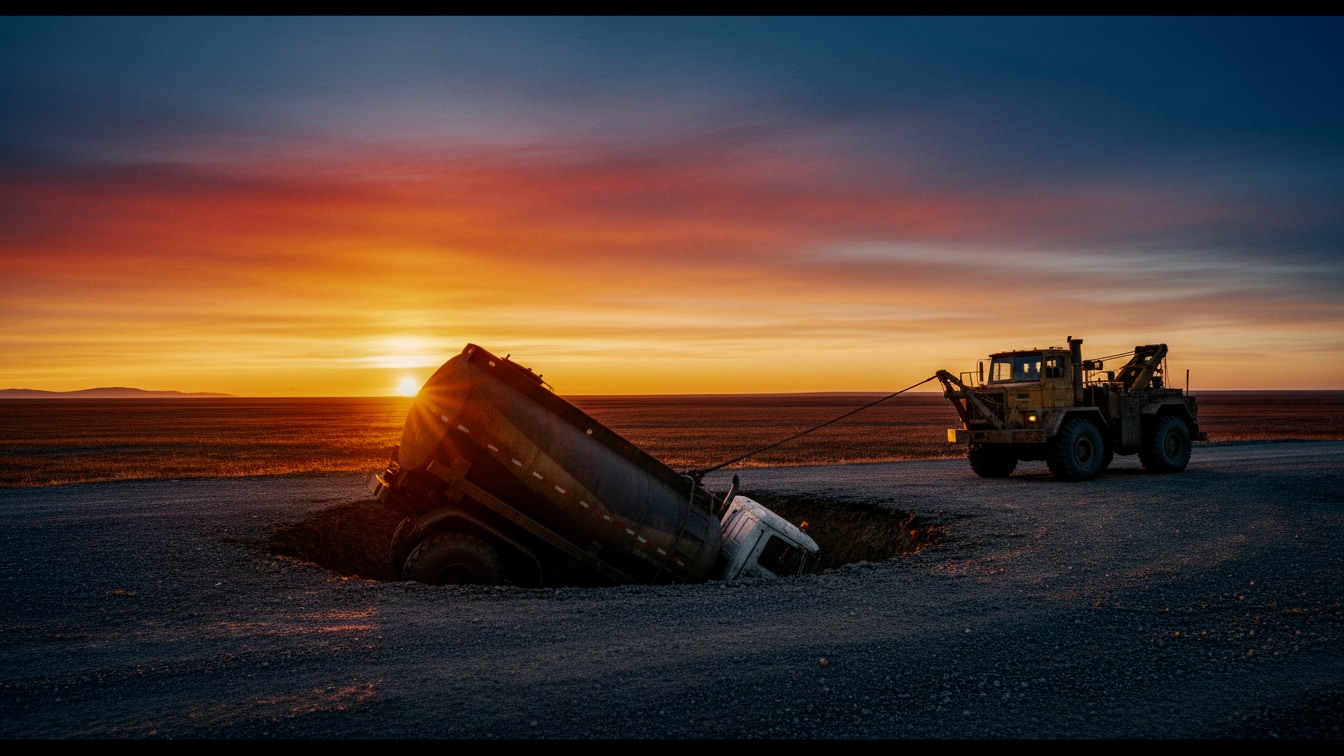
The story follows Paul, a seasoned driver transporting a vital ten-thousand-gallon water tanker across the melting Arctic landscape. As record-breaking heat turns the permafrost into a treacherous slurry, the ground collapses beneath his vehicle, leaving him trapped in a burgeoning sinkhole. His colleague Stacey arrives with a recovery rig, and together they engage in a desperate struggle to patch a leaking valve and stabilize the tilting truck. The stakes are immense, as the local town faces immediate water rationing if the cargo is lost to the mud.
After an initial attempt to tow the tanker fails due to the immense suction of the earth, Stacey fetches industrial airbags to lift the vehicle. Paul remains alone with the sinking truck for a period, forced to dump a portion of the load to prevent a total rollover as the ground continues to shift. With the help of town reinforcements, they eventually manage to extract the tanker and deliver the remaining water. The chapter concludes with the characters acknowledging the grim reality of their changing world, where the once-solid ground is no longer a reliable foundation for their survival.
The primary theme of the narrative is the terrifying instability of a world undergoing rapid ecological collapse. The melting permafrost serves as a literal and metaphorical foundation that is failing, transforming a predictable environment into a "slurry of ancient peat and silt." This environmental decay forces the characters to confront the fragility of human infrastructure when faced with a planet that is "waking up" in an angry, thawed state. The "buckled steel" of the title represents not just the physical damage to the truck, but the strain on the systems built to sustain life in the North.
Duty and communal responsibility also emerge as central themes, highlighted by the desperate need to deliver water to a thirsty town. Paul and Stacey view their cargo as a "currency" that cannot be devalued, illustrating how basic resources become precious in extreme environments. Their labor is a form of quiet heroism, defined not by grand gestures but by the grueling, filthy work of bending copper pipes and digging through clay. This sense of duty provides them with a sense of purpose even as the ground literally disappears beneath their feet.
Finally, the story explores the theme of human resilience and the necessity of partnership in the face of disaster. The friction between Paul’s philosophical detachment and Stacey’s rigid pragmatism creates a functional synergy required for survival. They represent two different ways of processing trauma: one through the lens of theatrical narrative and the other through the lens of mechanical logistics. Their ability to work in a "frantic, sweating rhythm" despite their personal differences suggests that human connection is the only thing that remains solid when the earth itself turns to liquid.
Paul is a man who employs a defensive sort of theatricality to cope with the overwhelming pressures of his environment. He describes his predicament as "navigating a shipwreck" and speaks of the earth "opening its mouth," using these metaphors to distance himself from the raw terror of the situation. This psychological shielding allows him to maintain a sense of self-importance and agency even when he is physically helpless. He is acutely aware of his own mortality and the physical toll of his profession, feeling the impact of the elements in his very bones and spine.
His internal conflict is driven by a weary stoicism that clashes with the reality of a world he no longer recognizes. He questions the logic of staying in a place where the "air hurts your face," yet he is clearly tethered to the land by a deep-seated pride in his work. Paul finds a grim beauty in the struggle, viewing the successful repair of the tanker as a "triumph of will over matter." He is a character defined by his endurance, a man who continues to "turn the taps" even as the world he serves begins to melt away.
Stacey serves as the narrative’s pragmatic anchor, a woman who relies on professional fury and logistical precision to navigate chaos. She views the world through the lens of structural integrity and "acceptable margins," using technical language to keep her emotions at bay. Her critique of Paul’s "heroism" reveals her preference for calculated engineering over impulsive bravery. For Stacey, survival is a matter of physics and persistence, and she has little patience for the theatricality that Paul uses to process his stress.
Despite her cold exterior and sharp tongue, Stacey exhibits a profound level of dedication and loyalty. She drives "like she was in a rally race" to reach Paul, demonstrating that her rigid adherence to protocol is a tool used to protect her partner and her community. Her refusal to "sacrifice the half to save the whole" shows a fierce, uncompromising spirit that refuses to yield to the "vacuum" of the mud. Stacey represents the essential force of order in a disintegrating world, providing the "formidable patience" required to keep the town hydrated.
The author utilizes a visceral and sensory-rich prose style to convey the oppressive atmosphere of the Arctic summer. Descriptions of the "stagnant weight" of the heat and the "bitter dregs" of coffee create an immediate sense of discomfort and exhaustion. The mud is described with repulsive detail as a "warm, foul-smelling soup," which heightens the reader's awareness of the characters' physical degradation. These sensory details ground the story in a gritty realism that makes the mechanical failures feel personal and high-stakes.
Pacing is managed through a careful balance of high-octane action and moments of quiet, existential dread. The frantic energy of the initial crash and the "discordant symphony" of the compressors provides a sense of urgency that drives the plot forward. These sequences are punctuated by Paul’s solitary reflections in the cab, where the "ticking of cooling metal" emphasizes the isolation of the tundra. This rhythmic shifting between external conflict and internal processing allows for deep character development without losing the narrative's momentum.
The narrative voice is characterized by a blend of technical precision and poetic melancholy. By focusing on specific details like "internal baffles" and "hydraulic lines," the author establishes an authentic mechanical world. This technicality is then contrasted with evocative imagery, such as the "ghosts of mammoths" and the "violent shades of orange" in the sky. This stylistic choice reflects the duality of the characters themselves, capturing the intersection of the mundane labor of survival and the epic scale of the environmental changes they are witnessing.


