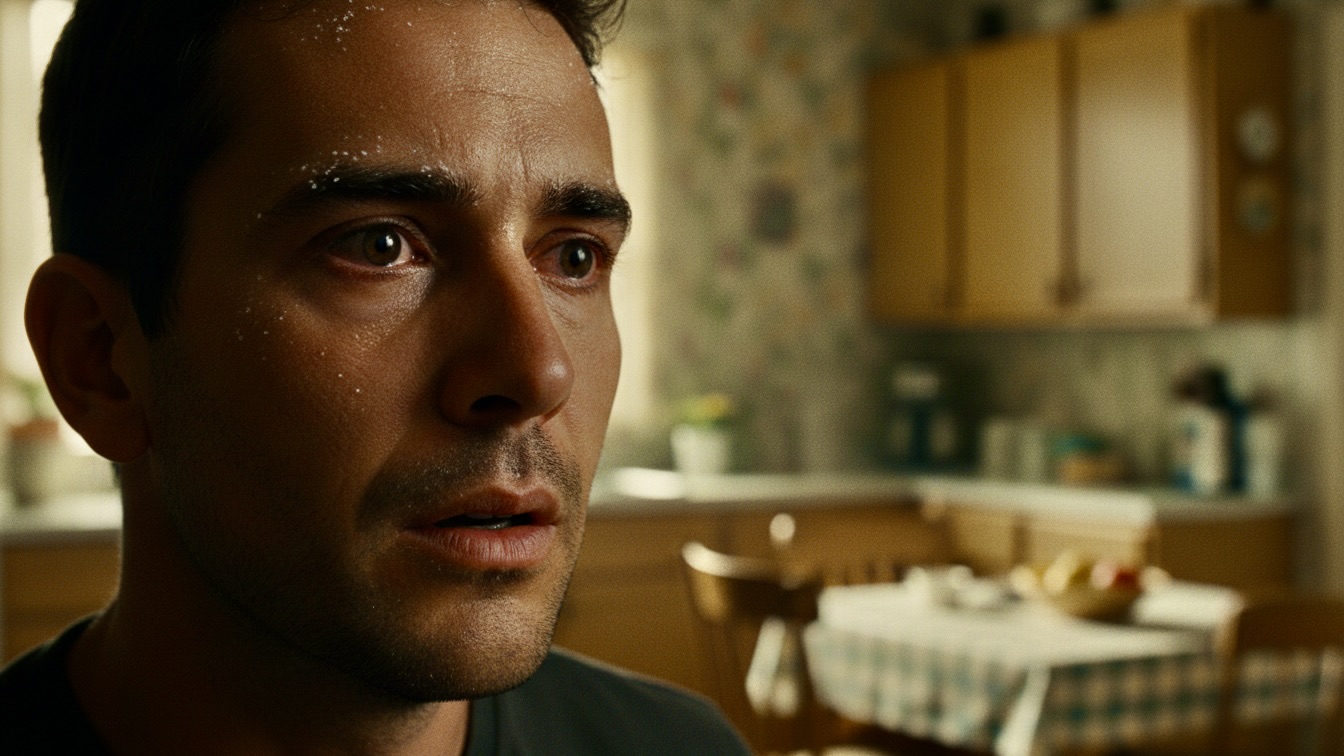
Norm Thomas confronts a reality glitch where a frisbee hovers indefinitely, challenging his corporate duty to erase a memory.
The frisbee didn't fall. It sat there, three feet above the manicured grass of Sector 7, vibrating with the low, angry hum of an overworked refrigerator. It was a bright, neon-orange disc, the kind you buy at a gas station for five dollars, but here it was, defying the fundamental laws of Newtonian physics with a stubbornness that felt almost personal. Around it, the summer heat didn't just shimmer; it vibrated. The air looked like it had been put through a paper shredder and taped back together by someone with a trembling hand. I wiped a bead of sweat from my eyebrow, watching it hang in the air for a second before it finally succumbed to gravity and splashed onto the dry, brittle earth. The grass didn't feel like grass anymore. It felt like stiff, plastic bristles, the kind you'd find on an industrial doormat. It was July, and the sun was a screaming white eye in a sky that had turned the color of a bruised plum.
I checked the readout on my Calibration Spanner. The screen was cracked, a jagged line of dead pixels cutting across the reality-constant metrics. "We have a localized gravity dip of point-four-five," I muttered into my collar-mic. "It's localized to a three-meter radius. The frisbee is currently acting as a temporary anchor for a low-level temporal leak. It’s annoying. My coffee is currently floating in my stomach, and I don't like the sensation."
"Fix it, Norm," Sarah's voice crackled in my ear. She sounded like she was chewing on gravel. "The Board is hosting a donor luncheon in that sector in forty minutes. We can't have the donors seeing the laws of nature as a mere suggestion. It makes the company look like we’re losing our grip on the simulation."
"The simulation is fine, Sarah. It’s just the heat. The cooling fans in the basement of the reality engine are probably clogged with dead moths again. I’ve told maintenance a dozen times that the moths in this reality are unnaturally attracted to high-voltage existential processors."
"Just use the spanner, Norm. Stop being a philosopher and start being a janitor."
I sighed, the sound lost in the high-pitched whine of the hovering disc. I stepped closer to the frisbee. The air grew colder, but not in a refreshing way. It was a sterile, metallic cold that felt like touching a frozen flagpole with your tongue. I reached out and tapped the orange plastic. It didn't move. It felt as solid as a granite boulder. The vibrations traveled up my arm, making my teeth ache. This wasn't just a gravity dip. It was a structural failure in the local narrative. I adjusted the dials on the spanner, the haptic feedback clicking against my palm like a series of tiny, rhythmic heartbeats. The device began to glow a soft, sickly green.
"I’m initiating a hard reset on the local coordinates," I said. "If any of the donors lose their hair or their sense of irony, don't blame me."
"Just do it," Sarah snapped.
I pulled the trigger. A ripple moved through the air, a visible wave of distortion that looked like a clear sheet of plastic being snapped taut. The frisbee suddenly remembered how to be a frisbee. It dropped to the grass with a pathetic thud. The silence that followed was heavy, broken only by the distant, rhythmic clicking of a cicada that sounded suspiciously like a Geiger counter. I picked up the disc. It was warm now, uncomfortably so. The orange plastic was slightly translucent, and for a second, I thought I saw a face looking back at me from inside the material. A face I hadn't seen in five years. I blinked, and it was gone. Just a cheap piece of plastic.
"Problem solved," I said, my voice sounding thin even to my own ears. "Sector 7 is back to being boring. You can bring on the donors. Make sure they wear sunscreen. The UV levels in this quadrant are currently tuned to 'Skin Cancer Speedrun'."
"Good work, Norm. Report to the hub. We have a Level 8 anomaly in the residential district. And try to look less like a hobo. Your jumpsuit is covered in salt."
I looked down at my chest. The sweat had dried into intricate, crystalline patterns of white salt, looking like a topographical map of a mountain range I’d never visited. I brushed at it, but it was stuck fast. I felt a sudden, sharp pain in my chest, a physical tightening that had nothing to do with gravity. It was the weight of the day, the weight of the summer, the weight of being the only person who noticed when the world started to fray at the edges. I turned away from the park, my boots crunching on the synthetic gravel path. The sun continued to scream, and for a moment, I wondered if I was the one who was glitching.
The walk back to the hub was a marathon through a landscape that was trying too hard to be perfect. The trees were too green, the sky too blue, the shadows too sharp. It was the kind of aesthetic perfection that usually preceded a total system crash. I entered the hub through the side airlock, the hiss of the equalizing pressure sounding like a long, disappointed sigh. The interior of the hub was a brutalist's dream: raw concrete, exposed conduits, and flickering fluorescent lights that hummed at exactly sixty hertz. It was the only place in the city where I felt like I could breathe, mostly because the air was filtered through three layers of industrial-grade carbon and recycled so many times it tasted like static.
Jack was waiting for me at the calibration station. He was a thin man with a nervous twitch in his left eyelid and a penchant for wearing vintage Hawaiian shirts that were three sizes too large. Today's shirt featured pineapples that looked like they were screaming in agony.
"The spanner's drifting again, isn't it?" Jack asked, not looking up from a motherboard he was disemboweling with a pair of surgical tweezers.
"It’s more than a drift, Jack. It’s a full-blown existential crisis," I said, tossing the device onto the workbench. It landed with a metallic clang that echoed through the room. "I saw something in Sector 7. A facial imprint in a frisbee. I think the temporal bleed is getting worse."
Jack stopped his work and looked at me, his twitching eyelid going into overdrive. "Don't tell Sarah that. She’ll have you in 're-education' faster than you can say 'object permanence'. To her, a glitch is just a line of bad code. To us, it’s... well, it’s the ghost in the machine."
"I'm not crazy, Jack. I know what I saw. It was Lenny."
Jack sighed and went back to the motherboard. "Lenny’s gone, Norm. Five years. The company scrubbed that timeline. You were there. You signed the NDA. You took the payout. You can’t go seeing him in sporting goods. It’s bad for the brand."
"The brand can kiss my ass," I said, leaning against the cold concrete wall. The coolness was a relief against the salt-crusted skin of my back. "The physics are failing. The summer is too long. We’ve been in July for eighty-four days, Jack. Doesn't that bother you?"
"I like summer," Jack said, his voice devoid of any conviction. "I like the way the light hits the glitches. It makes them look like diamonds. Besides, the company says the extended season is good for the agricultural sector. More corn, more happiness."
"We don't even have an agricultural sector. We have a department that synthesizes starch into the shape of vegetables. There’s a difference."
"Details, details," Jack muttered. He picked up my spanner and began to run a diagnostic. The screen flickered to life, casting a pale blue glow over his face. "You’ve got a massive buildup of chronons on the primary sensor. No wonder you’re seeing things. You’re practically walking around with a portal to 2021 in your pocket. I’ll flush the system, but you need to stay away from Sector 7 for a while. The reality there is thin. Like, wet-toilet-paper thin."
I watched him work, his fingers moving with a mechanical precision that I both envied and loathed. He was part of the machine now, a cog that knew it was a cog and didn't mind the grease. I was a cog that kept trying to turn in the opposite direction.
"Sarah wants me in the residential district," I said. "Level 8 anomaly. Any idea what it is?"
Jack paused, his tweezers hovering over a capacitor. "Anomaly 88. That’s what the ticket says. It’s a big one, Norm. High-priority. They’ve cleared three blocks around the epicenter. Even the drones are staying away. Something about a 'non-linear domestic event'."
"A non-linear domestic event? What, a toaster that’s making bread from the future?"
"Worse," Jack said, his voice dropping to a whisper. "They say the house is breathing. Not like a metaphor. Like, the walls are expanding and contracting. The windows are sweating. And there’s a sound coming from inside. A voice."
My heart did a slow, heavy roll in my chest. "Whose voice?"
Jack looked at me, and for the first time, his eyelid was still. "Yours, Norm. It sounds like you. But younger. And happier."
I felt a sudden chill that had nothing to do with the hub’s air conditioning. The salt on my skin felt like it was biting into me, a thousand tiny needles of reality asserting themselves. I grabbed the spanner from the workbench before Jack could finish the flush.
"Hey! It’s not ready!" Jack shouted as I headed for the door.
"It’s ready enough," I yelled back.
I stepped back out into the screaming sun. The light was so bright it felt like a physical assault. I pulled my goggles down, the world turning a dull, amber hue. I didn't head for the residential district immediately. I stood by the airlock, watching a crow land on a nearby power line. The crow didn't caw. It made the sound of a dial-up modem connecting to the internet. Then it turned into a puff of black smoke and vanished.
"Just a line of bad code," I whispered to myself. "Just a janitor doing his job."
I started walking toward the residential district, my boots clicking against the pavement in a rhythm that felt like a countdown. The city around me was a masterpiece of artificiality. The storefronts were filled with mannequins that looked too human, their plastic eyes following me as I passed. The sky was a perfect, unmoving blue, with clouds that looked like they had been painted on with a broad, lazy brush. Everything was a lie, and the lie was starting to peel.
As I reached the perimeter of the residential district, the atmosphere changed. The heat didn't dissipate, but it became more... dense. It felt like walking through a vat of warm syrup. The silence was absolute. No traffic, no drones, no simulated birds. Just the sound of my own breathing, which sounded unnaturally loud in the amber-tinted world of my goggles.
I saw the house from a block away. It was a standard-issue suburban box, two stories of beige siding and white trim. But it was moving. The siding was rippling like the surface of a lake. The roof was bowing upward, then sinking back down in a slow, rhythmic motion. It looked like a giant, grounded lung.
I stopped at the yellow caution tape that cordoned off the street. A drone hovered nearby, its red eye blinking in a steady, accusatory pattern. I ignored it and ducked under the tape. My spanner began to vibrate in my hand, a high-frequency hum that made my bones feel like they were made of glass.
"Sarah, I’m at the site," I said.
There was no answer. Just static. The kind of static that sounded like a thousand voices whispering at once. I took a step toward the house, and the pavement beneath my feet softened, turning into something with the consistency of raw dough. I kept going. I had to. Because if that voice inside was really mine, I needed to know what it was saying. I needed to know if it was a villain's voice or a fool's.
And most of all, I needed to know if it was real.
The front door of the house was currently the size of a postage stamp, then it would swell until it was wide enough to accommodate a freight train. It was a rhythmic, nauseating pulse. I waited for the 'normal' phase of the cycle, a split-second window of architectural stability, and threw myself through the threshold.
The interior was a sensory nightmare. The laws of perspective had been discarded. The hallway stretched out for miles, then snapped back until the far wall was inches from my nose. The wallpaper—a hideous floral pattern from the late nineties—was blooming. The printed roses were actually growing out of the paper, their petals made of thin, brittle parchment that disintegrated the moment they touched the air. I kept my back to the wall, trying to ignore the way the plaster felt like warm skin beneath my jumpsuit.
"Norm? Is that you?"
I froze. The voice came from the kitchen. It was me. It was my voice from before the scrub, before the grief had turned my vocal cords into rusted wire. It was light, airy, and filled with a casual confidence I hadn't felt in half a decade.
"Who’s there?" I shouted, my hand tightening around the Calibration Spanner. I adjusted the setting to 'Level 5 Structural Reinforcement'. I needed to solidify the air around me before I suffocated on the shifting geometry.
"It’s just me, man. I’m making sandwiches. Do you want the crusts cut off? I know how you get about the crusts."
I stepped into the kitchen. The room was a kaleidoscope of domesticity. A toaster was floating in the center of the room, rhythmically ejecting slices of bread that turned into white butterflies and fluttered away toward the ceiling. The sink was overflowing with a thick, silver liquid that looked like liquid mercury but sounded like a babbling brook. And standing at the counter was a man.
He was wearing a faded t-shirt with a band logo I hadn't thought about in years. His hair was longer, unkempt, and he was smiling at a jar of peanut butter like it was the funniest thing in the world. He was me. He was twenty-five-year-old Norm, the one who thought he was going to change the world with a degree in temporal mechanics.
"You're not real," I said, the words feeling like stones in my mouth.
The younger Norm turned around. His eyes were bright, unfiltered by the amber goggles I wore. He looked at me with a mixture of confusion and amusement. "Whoa. Nice outfit. Is the future all about jumpsuits and salt? You look like you just lost a fight with a margarita glass."
"You're a temporal echo," I said, my voice trembling. "An Anomaly 88. You’re a localized breakdown of the reality-constant. I’m here to patch you."
Younger Norm leaned against the counter, which groaned like a living thing. "Patch me? That sounds aggressive. I’m just making lunch. Lenny’s coming over, remember? We’re going to the lake. The water’s supposed to be perfect today."
Lenny. The name was a physical blow. I felt the air leave my lungs. "Lenny... Lenny isn't coming."
"Sure he is. He called ten minutes ago. He’s bringing the cooler. Why are you looking at me like I just told you gravity is a lie? I mean, I know it is a lie, but we don't usually talk about it over sandwiches."
I looked at the spanner in my hand. The green light was pulsing rapidly now, a warning that the reality in this room was reaching a critical state of instability. The walls were starting to translucent, revealing the dark, oily void of the sub-reality engine beneath the floorboards.
"Listen to me," I said, stepping closer. "You’re in a glitch. This house, this day... it’s a fragment of a timeline that was deleted. You were supposed to be deleted with it."
Younger Norm laughed, a sound that was so genuinely happy it made me want to scream. "Deleted? I’m right here, buddy. I can feel the peanut butter on my fingers. I can feel the heat from the window. It’s summer. It’s the best summer we’ve ever had. Why would anyone want to delete this?"
"Because it’s not real!" I shouted. "It’s a ghost! You’re a ghost! And if I don't patch this, the whole sector is going to collapse. People will die, Norm. Real people. Not echoes."
He stopped smiling. His expression shifted to something more somber, more observant. He looked at me—really looked at me—and I saw the moment he realized I wasn't just a stranger in a weird suit. He saw the grief in my eyes, the lines on my face, the way I carried myself like a man who was constantly waiting for the ground to give way.
"What happened to us?" he asked softly.
"Life happened. Reality happened. The company happened."
"And Lenny?"
I couldn't look at him. I looked at the floating toaster instead. "He didn't make it to the lake. There was a glitch. A real one. Not like this. A sudden, violent tear in the fabric. He was in the wrong place at the wrong time. The company... they offered to fix it. They said they could rewrite the day. But they didn't fix it. They just erased him. They erased the memory of him from everyone but the primary witnesses. And they gave us jobs to keep us quiet."
Younger Norm was quiet for a long time. The house’s breathing slowed, becoming a shallow, ragged panting. The silver liquid in the sink began to solidify into lead.
"So, you’re the guy who cleans up the messes," he said finally. "The guy who makes sure the lies stay pretty."
"I’m the guy who keeps the world from falling apart," I countered. "There’s a difference."
"Is there? You’re standing there with a tool in your hand, ready to erase the only version of your brother that still exists. Even if it is just a memory. Even if it is just a glitch. If you do this, he’s gone forever. Truly gone."
"He’s already gone!" I screamed. My goggles were fogging up from my own breath. I ripped them off, the raw, blinding light of the anomalous kitchen searing my retinas. "I’m living in a world of salt and concrete, and you’re in here playing house with a corpse!"
"I’m not the one living in a lie, Norm," the echo said. He held out a hand. It was solid. Real. I could see the fine hairs on his arm, the small scar on his knuckle from when we’d built that treehouse. "You have a choice. You can be the villain in Sarah’s story and let this glitch stay. Or you can be a fool in yours and keep pretending that the world you’re 'protecting' is worth a damn."
"I have a job to do," I whispered.
"Then do it. But don't tell yourself you’re doing it for the greater good. You’re doing it because you’re afraid of the dark."
I raised the Calibration Spanner. The green light was so bright now it was washing out the colors of the room. The younger version of me didn't flinch. He just stood there, waiting. He looked like he was at peace.
I felt a sudden, violent surge of nausea. The house gave one final, massive heave, and the floorboards beneath me turned into liquid. I began to sink, the cold, oily void of the sub-reality licking at my ankles.
"Norm! Answer me!" Sarah's voice finally broke through the static. It was loud, distorted, and filled with a corporate-approved panic. "The anomaly is reaching critical mass. Use the spanner! Use the spanner now or we’ll initiate a remote purge!"
"A remote purge will kill everything in the sector!" I yelled into the mic.
"A small price to pay for structural integrity! Do your job, Thomas!"
I looked at the younger Norm. He was fading now, becoming translucent as the house struggled to maintain its form. Beyond him, through the shimmering kitchen window, I saw a figure walking up the driveway. A man with a cooler. A man with a familiar, lopsided grin.
Lenny.
My finger hovered over the trigger. The choice wasn't about physics or stock prices or the greater good. It was about whether I was willing to let the world burn just to see my brother one more time.
I closed my eyes. The heat of the summer sun felt like a brand on my skin. I could hear the cicadas, the dial-up modem sound growing louder and louder until it was a deafening roar.
"I’m sorry," I whispered.
I didn't pull the trigger. Not on the anomaly.
Instead, I turned the spanner on myself. I adjusted the dials to 'Inversion' and aimed the nozzle at the base of my own skull, where the neural-link was embedded. It was a move that shouldn't have been possible. The spanner was designed to fix the world, not the user. But I knew the code. I knew where the safety protocols were hidden, tucked away in sub-directories of bureaucratic laziness.
"What are you doing?" the younger Norm asked, his voice sounding like it was coming from the bottom of a well.
"I'm opting out," I said.
I pulled the trigger.
A bolt of white-hot agony shot through my nervous system. It felt like my brain was being scrubbed with steel wool. My vision exploded into a million shimmering shards of light. The hub, Sarah, the salt-crusted jumpsuit, the screaming sun—it all began to dissolve. I was falling, not into the void, but into the glitch. I was letting the reality-constant go. I was becoming the anomaly.
I hit the floor of the kitchen, but it wasn't liquid anymore. It was hard, sun-warmed linoleum. The breathing of the house had stopped. Everything was still. The air was no longer metallic and sterile. It was still, quiet, and warm. I couldn't smell anything—my anosmia was a physical constant that even a reality collapse couldn't fix—but I could feel the quality of the air change. It was soft. It felt like home.
I opened my eyes. The younger Norm was gone. The kitchen was no longer a kaleidoscope. It was just a kitchen. A bit messy, with a half-made peanut butter sandwich on the counter and a toaster that was definitely not floating.
I stood up, my joints popping. I wasn't wearing the jumpsuit anymore. I was wearing a faded t-shirt and shorts. My skin was smooth, free of salt and scars. I felt light. I felt like I was ten pounds lighter than I had been a moment ago.
"Norm? You okay, man? You look like you just saw a ghost."
I turned around. Lenny was standing in the doorway. He was holding a blue plastic cooler that was dripping condensation onto the floor. He looked exactly the same. The same messy hair, the same lopsided grin, the same blue eyes that always seemed to be looking for the next adventure.
"Lenny," I said, my voice cracking.
"The one and only. Come on, the car’s packed. If we don't leave now, we’re going to hit all that traffic on the bridge. And I am not spending the first day of vacation stuck behind a minivan full of crying toddlers."
I walked over to him, my legs feeling like they belonged to someone else. I reached out and touched his shoulder. He was solid. He was warm. He was real.
"You're here," I said.
"I’m here. Where else would I be?" Lenny frowned, his brow furrowing in genuine concern. "Are you sure you’re okay? You’re acting weird. Did you spend too much time in the sun?"
"Yeah," I said, a slow smile spreading across my face. "Too much time in the sun. But I’m fine now. I’m better than fine."
We walked out of the house together. The street was lined with trees that were perfectly green, and the sky was a deep, honest blue. There was no caution tape. There were no drones. There was just the sound of a neighbor’s lawnmower and the distant shout of children playing. It was a perfect summer day.
But as we walked toward the car, I noticed something. A small detail that would have been invisible to anyone else.
The shadow of the car wasn't quite right. It was lagging behind the vehicle by a fraction of a second. And the leaves on the trees weren't moving with the wind; they were moving in a pre-recorded loop, every fifth leaf twitching in exactly the same way.
I looked up at the sun. It was no longer screaming. It was a warm, golden orb. But if I squinted, I could see the faint, rhythmic flicker of sixty hertz.
I wasn't in reality. I was in a deeper, more stable version of the glitch. I had traded the world for a memory, and I had used the company’s own technology to lock the door behind me. To Sarah and the Board, I was a dead man, a casualty of a Level 8 anomaly. I was the villain who had sabotaged their precious structural integrity.
But as Lenny opened the passenger door and tossed me the keys, I didn't feel like a villain. And I certainly didn't feel like a fool.
"You're driving," Lenny said. "I’m in charge of the playlist. And I’m warning you, it’s ninety percent synth-wave."
"I can live with that," I said, getting into the driver’s seat.
The steering wheel felt real. The ignition clicked with a satisfying mechanical snap. The engine roared to life, a sound that was far more honest than the hum of the hub. I shifted the car into gear and looked at my brother.
He was looking out the window, tapping his fingers on the dashboard. He was happy. He was alive.
I drove away from the house, leaving the flickering shadows and the looping leaves behind. I knew that eventually, the company would find a way in. They would send someone like me—a man with a spanner and a heart full of salt—to patch the leak. They would try to reclaim this fragment of lost time.
But until then, it was summer. The water at the lake would be perfect. And for the first time in five years, I didn't care if the world was a lie.
I looked in the rearview mirror as we turned the corner. For a split second, I saw the image of my older self—the one in the salt-crusted jumpsuit—standing on the sidewalk, watching us go. He looked tired. He looked lonely.
Then he flickered and vanished, replaced by a perfectly manicured lawn and a bright, neon-orange frisbee that sat motionless on the grass, finally having found its place in the world.
I turned up the music, the synth-wave beats filling the car, and stepped on the gas. The road ahead was long, shimmering with a heat haze that didn't look like cracked glass anymore. It just looked like the future.
And even if that future was only sixty hertz deep, it was mine.
I glanced at the dashboard clock. The time was 12:01 PM. It stayed 12:01 PM for three minutes, then jumped to 12:05.
Lenny didn't notice. He was too busy singing along to a song about neon lights and fast cars.
I reached out and adjusted the rearview mirror, making sure I could see him clearly. The reflection was stable. His smile was steady.
"Hey, Norm?" Lenny asked, turning to me.
"Yeah?"
"Did you remember to bring the sunscreen?"
I laughed, a sound that felt foreign and wonderful in my throat. "No, Lenny. I think we’ve had enough of the sun for one day."
He laughed too, and for a moment, the car seemed to lift off the pavement, hovering just an inch above the asphalt before settling back down with a gentle bounce.
We kept driving, two ghosts in a machine, heading toward a lake that didn't exist in a world that had forgotten we ever did.
Behind us, the neighborhood began to pixelate at the edges, the beige houses dissolving into a fine, white mist. The screaming sun finally went silent, replaced by a quiet, digital peace.
But I didn't look back. I just kept my eyes on the road and my hand on the wheel, waiting for the next glitch to happen.
“I reached out to touch the dashboard, but my fingers passed straight through the plastic as the car began to hum at a perfect, terrifying sixty hertz.”


