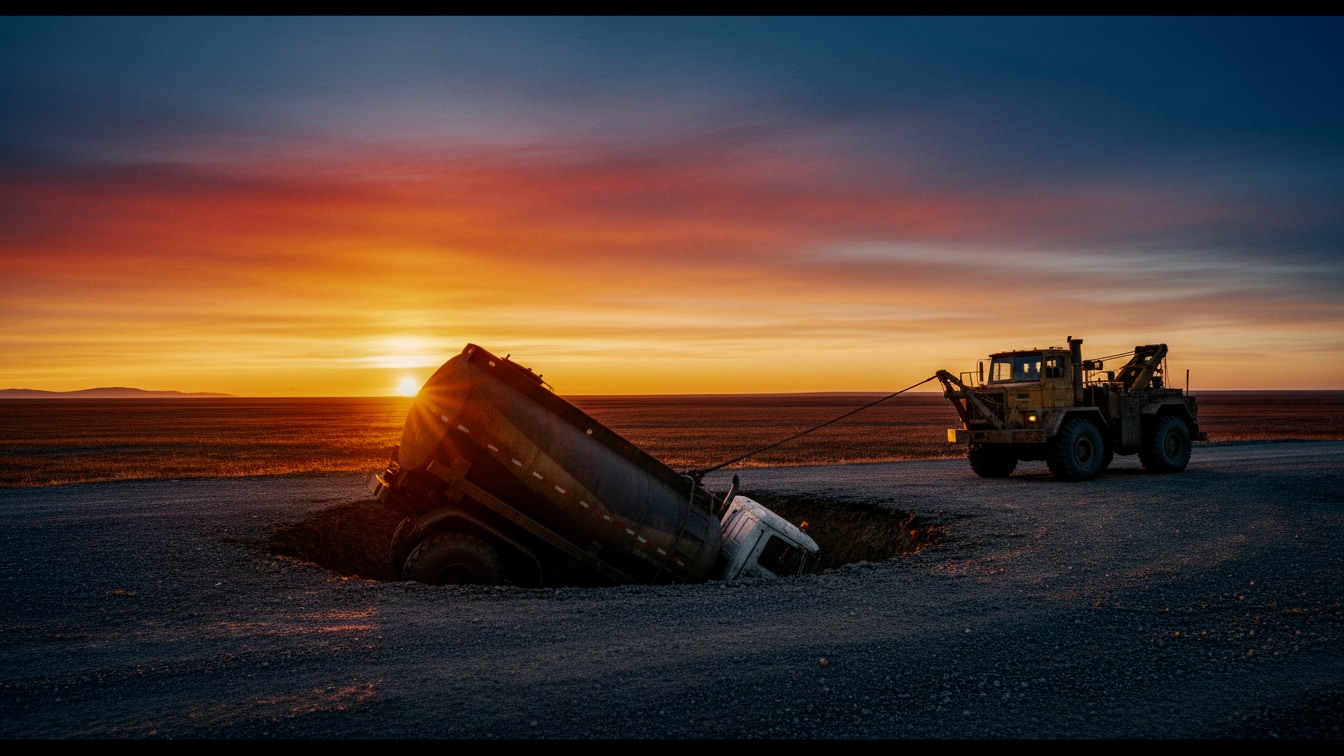
A water tanker crashes into a summer sinkhole, threatening a northern town's survival as the permafrost turns to mud.
"You are drifting, Paul," the radio crackled, Stacey’s voice sounding like gravel being ground in a blender. "Correct your heading immediately or you will lose the shoulder."
Paul gripped the wheel, his knuckles white against the black leather. The heat inside the cab was oppressive, a thick, stagnant weight that smelled of sun-baked vinyl and the bitter dregs of a fourth cup of coffee. Outside, the world was a blur of dusty green and the shimmering distortion of heat rising from the gravel road. The permafrost wasn't supposed to act like this. It was July, and the ground was turning into a slurry of ancient peat and silt. He felt the truck lurch. It wasn't a bounce; it was a sag. The front right tire didn't hit a rock; it hit a void.
"The earth is departing, Stacey," Paul said, his voice tight. "I am no longer driving. I am navigating a shipwreck."
He slammed his foot onto the brake, but the pedal felt spongy, a terrifying lack of resistance that sent a jolt of adrenaline through his chest. The ten-thousand-gallon tank behind him surged, the momentum of the water slamming against the internal baffles with a sound like a distant cannon blast. The truck groaned, a deep, metallic scream that vibrated through Paul’s seat and into his very bones. He was tipped at a twenty-degree angle, the horizon tilting crazily out the windshield.
"Paul! Respond!" Stacey shouted. "The GPS shows you have stopped. You are blocking the only vein to the reservoir."
"I am currently becoming one with the landscape," Paul replied. He braced his arms as the truck gave another sickening lurch. The windshield shattered, a spiderweb of cracks blooming from the bottom right corner as the frame twisted. The sound was deafening—a physical collision of steel against the yielding, hungry earth. His head snapped forward, his forehead clipping the sun visor before he was thrown back into the seat.
He sat there for a second, the engine still idling with a ragged, uneven chug. The silence that followed the crash was worse than the noise. It was the silence of a town about to go thirsty. He could hear the hiss of steam from the radiator and the rhythmic, terrifying drip of something heavy and wet. He looked in the side mirror. A plume of clear, precious water was spraying from a ruptured valve, catching the sunlight and turning into a mocking rainbow against the dark mud.
"I have a breach," Paul said, his voice dropping to a theatrical whisper. "The tank is hemorrhaging. The town will have no coffee this evening, Stacey. They will have nothing at all."
He pushed the door open. It resisted, the hinges screaming as they fought the distorted frame. He kicked it, once, twice, until it gave way with a bang. He stepped out and immediately sank to his mid-calf in a warm, foul-smelling soup of thawed earth. The heat hit him like a physical blow. It was ninety-five degrees in the Arctic Circle, and the very foundation of his world was melting. He looked at the front wheel. It was buried up to the axle in a hole that hadn't been there ten minutes ago. The road had simply vanished.
"Stacey, the logistics of this recovery are going to be significant," he said into his shoulder mic. "Bring the winch. Bring the welding kit. Bring your most formidable patience."
He walked to the back of the truck, his boots making wet, sucking sounds in the mud. The leak was worse than he thought. The main discharge valve had been sheared clean off when the truck settled onto a buried rock. Water was gushing out at a rate of fifty gallons a minute. It was carving a new river through the mud, accelerating the erosion of the road. If he didn't stop it, the truck would tip over entirely, and the spill would take the rest of the embankment with it.
"I am three minutes out," Stacey’s voice returned. "Do not attempt to be a hero, Paul. Your history with heroism is paved with expensive repair bills."
"My heroism is the only thing keeping this chassis from a total inversion," Paul snapped. He grabbed a heavy rubber mallet from the side toolbox and began to hammer at the mangled valve, trying to crimp the copper pipe. Each blow sent a spray of cold water into his face, a jarring contrast to the baking sun. The metal was stubborn. The truck shifted again, another two inches of tilt. Paul felt the ground vibrate under his feet. The permafrost was failing in real-time, a slow-motion collapse of the Arctic infrastructure.
He looked up as a cloud of dust appeared on the horizon. Stacey was coming, driving the heavy recovery rig like she was in a rally race. The dust hung in the air, a long, tan tail that refused to settle in the stagnant summer heat. She braked hard, the tires of her rig spitting gravel as she skidded to a halt twenty feet from the sinkhole. She jumped out before the engine had even stopped, her face a mask of professional fury.
"Look at this," she said, gesturing to the tilting tanker. "This is a catastrophe of your own making."
"The earth opened its mouth and swallowed me, Stacey," Paul said, wiping water and grit from his eyes. "Unless you have influence over the tectonic plates of the North, I suggest you limit your critiques to the mechanical."
"The town is at thirty percent capacity," Stacey said, her voice formal and cold. "If we lose this load, we go to emergency rationing by midnight. Do you understand the theatricality of the riot that will ensue when the local brewery runs dry?"
"I am well aware of the stakes," Paul replied. "Now, attach the primary cable to the rear axle. We must arrest the tilt before we can address the leak. The physics of the situation are currently against us."
Stacey didn't move. She stared at the water gushing into the mud. "If I pull you now, the shear force will rip the tank right off the frame. The structural integrity is compromised, Paul. Look at the weld points on the secondary supports. They are stressed to the point of failure."
Paul looked. She was right. The heat had softened the metal, and the weight of the water was pulling the tank away from the chassis. "Then we must drain it partially. We sacrifice the half to save the whole."
"We sacrifice nothing!" Stacey shouted over the roar of the water. "Every gallon is a currency we cannot afford to devalue. We will patch it in situ."
"In this mud?" Paul asked, incredulous. "I am sinking as I stand here. The truck is sinking. The very concept of 'in situ' is a fluid one today."
"Then we make the ground solid," Stacey said. She turned back to her rig and started hauling out heavy steel grating. "Help me with these. We lay a floor. We build a platform. We act like engineers, not victims of geography."
They worked in a frantic, sweating rhythm. The sun beat down on their backs, a relentless golden hammer. Paul felt the sweat stinging his eyes, mixing with the dust. They threw the steel grates into the mud, creating a temporary, shaky walkway around the ruptured valve. The mud swallowed the first two grates instantly, but the third held. Paul climbed onto it, feeling the metal flex under his weight.
"Hand me the epoxy and the pressure clamp," Paul commanded.
Stacey handed him a heavy plastic case. "You have one chance to set the seal. If the pressure blows the clamp, the valve will shatter, and we lose everything in a matter of seconds."
"Your confidence is a beacon of hope in these dark times," Paul said. He knelt on the grate, his knees pressing into the hard steel. He reached into the freezing stream of water. His hands went numb almost instantly. He fumbled with the epoxy, the thick, grey sludge sticking to his fingers. He smeared it around the jagged edge of the sheared pipe, trying to create a smooth surface for the clamp.
"The truck is shifting!" Stacey yelled.
Paul felt the grate beneath him slide. The tanker was leaning further, the weight of the water moving toward the breach. "Hold the cable! Winch it just enough to counter the lean!"
Stacey ran to her rig. The engine roared, and the winch cable snapped taut with a sound like a violin string breaking. The tanker groaned, a sound of tortured metal that made Paul’s teeth ache. The tilt stopped, but the strain on the rear axle was visible. The steel was bowing.
"I cannot hold it for long, Paul!" Stacey called out. "The winch motor is overheating!"
"Give me thirty seconds!" Paul shouted. He forced the heavy pressure clamp over the epoxy-covered pipe. It wouldn't fit. The pipe was too distorted. He grabbed a pair of pliers and began to bend the copper back into shape, his breath coming in ragged gasps. The water sprayed into his chest, soaking his shirt, but he didn't feel the cold anymore. He felt only the urgency. The clock was ticking in the form of a dying winch motor and a thirsty town.
He slammed the clamp home and tightened the bolts with a ratcheting wrench. The spray diminished to a trickle, then a drip. He tightened it further, his muscles screaming. The leak stopped.
"I have the seal!" he yelled. "Slack the cable! Slowly!"
Stacey eased the tension. The truck settled back into the mud, but the clamp held. For a moment, they both just stood there, breathing hard, the only sound the ticking of cooling metal and the distant hum of a dragonfly.
"That was remarkably ungraceful," Stacey said, wiping her forehead with a greasy sleeve.
"It was a triumph of will over matter," Paul replied. "But the truck is still buried. We are merely a stationary reservoir now."
"We are not stationary," Stacey said, her eyes narrowing as she looked at the road ahead. "We are going to move this beast. But first, we need to address the fact that your front axle is currently serving as an anchor."
"The suspension is likely shattered," Paul noted. "I felt the impact in my spine. The steering column is a suggestion at best."
"Then we do not steer," Stacey said. "We drag. We are twenty miles from the town gates. I will tow you through the mud if I have to. The theatricality of our arrival will be legendary."
"You speak of legends, yet we are covered in the debris of a dead glacier," Paul said. "The irony is not lost on me."
"Irony provides no hydration, Paul. Move the grates. We need to clear a path for the tow."
They began the grueling process of digging out the front tires. The mud was thick and clay-like, clinging to their shovels with a stubborn grip. Every scoop was a battle. The heat continued to rise, the air shimmering in waves across the tundra. Paul felt a dull ache in his lower back, a reminder of his age and the physical toll of a life spent fighting the elements.
"Why do we stay?" Paul asked, his voice low as he tossed a clod of mud aside. "The ground is literally melting beneath our feet. The winter is a freezer and the summer is a swamp."
"We stay because someone has to turn the taps," Stacey said without looking up. "And because you are too stubborn to live anywhere where the air doesn't hurt your face for six months of the year."
"A fair assessment," Paul conceded. "However, today the air is merely trying to boil me."
The digging took hours. By the time they had cleared enough space to even think about moving the truck, the sun had shifted, casting long, dramatic shadows across the buckled road. The heat hadn't dissipated; it had only become more humid, the moisture from the thawing ground hanging in the air like a damp shroud. Paul's hands were blistered, the skin raw from the friction of the shovel handle.
"The tow hooks are submerged," Paul reported, peering into the dark sludge at the front of the tanker. "I shall have to dive."
"Do not be absurd," Stacey said. "You will be sucked in. The silt here is like quicksand."
"If I do not attach the chains, we stay here until the spring thaw," Paul said. "And I have no intention of spending the night in this cab with the ghosts of mammoths."
He lay flat on the steel grates, reaching down into the warm, thick mud. It felt disgusting—a slimy, organic slurry that coated his arms up to the elbows. He groped for the heavy iron hooks, his fingers searching blindly. He found them, slick with grease and grit. He pulled the heavy chains from Stacey's rig toward him, his muscles straining against the weight.
"I have the first hook!" he shouted, his face inches from the mud.
"Secure it to the primary frame, not the bumper!" Stacey warned. "The bumper will peel off like a scab!"
"I am aware of how trucks are constructed, Stacey!" Paul grunted. He felt the chain slide into place, the heavy steel link clicking over the hook. He repeated the process for the second side, his breath hitching as a bubble of methane burst from the mud near his face, smelling of rot and ancient time.
He pulled himself back onto the grates, his clothes ruined, his skin a patchwork of black mud and red sunburn. He looked like a creature crawled from the primordial deep.
"The connection is made," he said, standing up and shaking his arms. "You may proceed with the extraction. But be gentle. The tanker is fragile."
"I am always the soul of gentleness," Stacey said, climbing back into her rig.
She engaged the low-range gears. The heavy diesel engine emitted a cloud of black smoke that hung in the still air. The chains snapped taut, vibrating with the sudden tension. The tanker groaned. It didn't move forward; it seemed to settle deeper, the mud sighing as it compressed.
"More power!" Paul yelled, standing safely to the side.
Stacey gunned the engine. The tires of the recovery rig began to spin, throwing up fountains of gravel and mud. The tanker shivered. A sound like a gunshot echoed across the tundra as a weld on the trailer hitch snapped.
"Stop!" Paul screamed.
Stacey cut the engine. The silence returned, heavier than before. Paul ran to the hitch. The metal had sheared clean through. The tanker was now only connected to the truck by the hydraulic lines and the sheer friction of the mud.
"We have a structural failure," Paul said, his voice trembling with exhaustion. "The hitch is gone. If we pull any harder, we will leave the tank behind."
Stacey climbed out, her face pale. "That hitch was rated for fifty tons. The mud... it has a suction force we didn't account for. It’s not just weight, Paul. It’s a vacuum."
"The earth does not want to let go," Paul said. He sat down on the edge of the road, his legs dangling over the mess. "It has tasted the water and it wants the rest."
"We are not giving it the rest," Stacey said, though her voice lacked its usual theatrical certainty. She looked at the tanker, then at the horizon. "We need to displace the pressure. If we can't pull it out, we have to lift it."
"With what? We have no jacks that can survive this mud," Paul pointed out.
"Airbags," Stacey said. "The emergency recovery bags. We slide them under the tank, inflate them, and break the suction. Then we pull."
"Those bags are in the warehouse," Paul said. "A forty-minute round trip. By then, the truck will be even deeper."
"Then you stay here and keep the pressure stable," Stacey said. "I will drive like the wind. If the truck starts to tip, use the manual release on the secondary tank. Dump enough to level it, but no more."
"You are leaving me with a sinking ship," Paul said, a faint smile touching his mud-streaked face.
"I am leaving you with a mission," Stacey corrected. "Do not fail the town, Paul. And more importantly, do not fail me. I have already filled out the paperwork for this trip, and I hate doing revisions."
She jumped into her rig and sped away, leaving Paul alone in the vast, silent expanse of the melting North. He watched her dust trail vanish. He was alone with the groaning tanker and the heat. He climbed back into the cab, the seat now tilted at an angle that made sitting a chore. He checked the gauges. The water pressure was holding, but the temperature was rising. If the water in the tank got too hot, the internal pressure would increase, stressing the patch he’d just applied.
He sat there, watching the minutes tick by on the cracked dashboard clock. He felt the truck move. A tiny, almost imperceptible shift. He looked out the side mirror. The mud was slowly rising around the wheels. It was like watching a slow-motion drowning. He thought about the town. The people waiting for their showers, the kitchens waiting for water to boil. It was a fragile existence, held together by steel and grit and the stubbornness of people like him and Stacey.
He felt a sudden, sharp vibration. The ground shook. Not a landslide, but a deep, subterranean thud. The permafrost was collapsing further down. The truck lurched violently to the right.
"No, you don't," Paul hissed. He grabbed the manual release lever. He didn't want to dump the water, but if he didn't, the truck would roll. He pulled the lever just an inch. A jet of water shot out from the side, clear and cold, carving a hole in the mud. The truck stabilized. He’d lost maybe five hundred gallons. A drop in the bucket, but a painful one.
He looked at his hands. They were shaking. The adrenaline was wearing off, leaving behind a hollow, aching fatigue. He closed his eyes for a second, the heat making his head swim. He heard a sound—a low, rhythmic thumping. Was it Stacey? No, it was too fast. It was the sound of the earth. The thermal expansion of the peat, the bubbling of ancient gases being released after ten thousand years of frost. The world was waking up, and it was angry.
When Stacey returned, she didn't come alone. Two other trucks followed her, their headlights cutting through the gathering twilight. The town had sent reinforcements. They knew the stakes.
"I see you've decorated the place," Stacey said, stepping out and looking at the new crater Paul had carved with the emergency release.
"It was a necessary aesthetic choice," Paul replied, climbing down from the cab. He felt like he was moving through gelatin. "The bags?"
"We have six," she said. "And enough compressors to wake the dead."
They worked with a new intensity. The other drivers, men and women Paul had known for decades, moved with silent efficiency. They slid the heavy, uninflated rubber bags into the mud beneath the tanker’s belly. It was filthy, dangerous work. One slip and the truck could crush them.
"On my mark," Stacey commanded. "Inflate units one and three!"
The compressors roared to life, a discordant symphony of mechanical power. The bags began to swell, their thick rubber straining against the mud. The tanker groaned, a long, drawn-out sound of protest. The suction didn't want to break. The mud clung to the steel with a wet, slurping sound.
"More pressure!" Stacey yelled.
The truck began to rise. Inch by inch, the heavy chassis lifted out of the mire. The water inside the tank shifted, the sound of the internal waves echoing like thunder.
"Now, units two and four!"
The truck leveled out. It was sitting on a bed of air, a ten-ton beast floating on rubber bladders. It looked ridiculous, a modern machine held up by balloons in the middle of a prehistoric swamp.
"Paul, get in," Stacey said. "You need to steer. I don't care if the column is broken. You manhandle that wheel. We are pulling you out now."
Paul climbed back into the driver's seat. He grabbed the wheel. It was loose, wobbling in his hands. He felt the vibration of the tow trucks as they took up the slack in the chains.
"Ready!" he shouted.
"Pull!" Stacey’s voice came over the radio.
The world exploded into noise and motion. The tow trucks roared, their tires screaming on the gravel. The tanker surged forward, sliding off the airbags and onto the steel grates they’d laid earlier. The grates buckled and flew into the air, but the momentum was there. The truck hit solid ground with a bone-jarring thud. Paul fought the wheel, his muscles straining to keep the truck from veering back into the hole.
He slammed on the brakes as the truck reached the stable section of the road. He sat there, gasping for air, his chest heaving. The truck was vibrating, the engine coughing, but it was on solid ground.
Stacey ran up to his door. She didn't say anything at first. She just looked at him, her face covered in dust and grease, her eyes bright with a mixture of relief and lingering adrenaline.
"The patch?" she asked.
Paul checked the side mirror. "It holds. A few drips, nothing more."
"Then we have a town to hydrate," she said. She reached out and patted the side of the truck. "You are a disaster, Paul. A walking, driving disaster."
"And you are a theatrical tyrant, Stacey," Paul replied, a genuine smile breaking through the grime on his face. "But I suppose the logistics of our partnership are functional."
"Functional?" she scoffed. "We are a miracle. Now move. I’m lead, you’re tail. If you fall into another hole, I’m leaving you there for the archeologists."
They started the slow crawl back to town. The sun was finally dipping below the horizon, painting the sky in violent shades of orange and purple. The heat was finally beginning to break, replaced by a cool, damp breeze that smelled of wet earth and distant rain. Paul watched the back of Stacey’s rig, the red taillights glowing in the dust.
As they approached the town gates, he could see people gathered. They weren't cheering—this was the North, after all—but they were standing there, watching. He saw the local brewer standing on his porch, a look of profound relief on his face. Paul felt a surge of pride. It was a small thing, a truckload of water, but it was everything.
He pulled the truck into the reservoir station, the engine finally giving out and dying with a pathetic wheeze just as he reached the intake valves. He sat in the silence of the cab, his hands still gripped on the wheel. He felt the weight of the day, the weight of the summer, the weight of the changing world.
Stacey appeared at his window. "We lost twelve hundred gallons total. Within acceptable margins."
"I shall strive for zero margins next time," Paul said, his voice cracking with fatigue.
"There will always be a next time," Stacey said, her voice unusually soft. She looked out at the darkening tundra. "The ground is changing. We are going to have to get better at this."
"Or we could move to the coast," Paul suggested.
"And do what? Fish? You’d sink the boat in ten minutes."
"Probably," Paul admitted. He climbed out of the truck, his legs shaking. He looked at the buckled steel of the tanker, the mud-caked wheels, the makeshift patch. It was a mess, but it was a beautiful mess.
They began the process of hooking up the hoses to drain the tank into the town's reservoir. The sound of the water rushing through the pipes was the most beautiful music Paul had ever heard. It was the sound of survival.
He walked over to Stacey, who was leaning against her rig, watching the gauges. The summer stars were beginning to appear, pale and distant in the twilight.
"Stacey," Paul said.
"Yes, Paul?"
"Tomorrow, I think I shall require a very long, very hot bath."
"You've earned it," she said. "But check the weather report first. I hear there’s a heatwave coming."
He looked down at his feet, at the ground that felt solid for the moment, but he knew the truth lay just inches beneath the surface.
“He felt a sharp, sudden crack beneath his boots, and realized the ground wasn't finished moving yet.”


