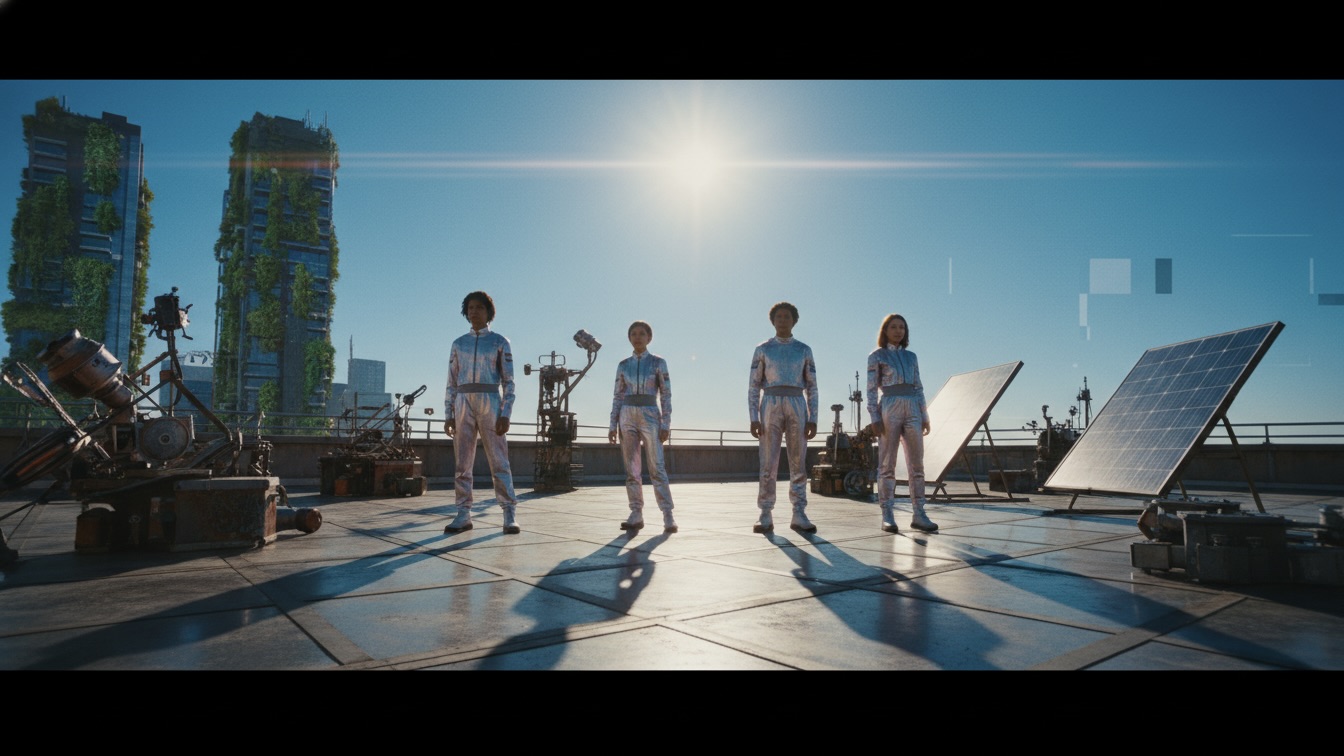
A group of artists watches the sky glitch over a melting city while debating the end of humanity.
The plastic seal on my bottle of electrolyte water didn't want to break. It just stretched, a thin, stubborn ribbon of polymer resisting my thumb. I dug my nail in. The sun was doing that thing again where it looked too sharp, like the contrast had been dialed up to two hundred percent. The edges of the HVAC unit on the rooftop were vibrating. Not from the motor. It was a visual stutter. I looked at Muna, who was currently trying to weld a piece of scrap copper to a drone chassis without using a mask. Her eyes were shielded by those heavy, iridescent tech-shades everyone was wearing this season. They reflected the sky, which was a flat, aggressive blue that felt like it was pressing against my retinas.
"You're going to go blind, Muna," I said. My voice sounded thin in the dry heat. The air was buzzing with the sound of the city's cooling fans, a low-frequency thrum that stayed in your teeth.
"Hardware is replaceable, Leo," she said. She didn't look up. The spark from the welder was a tiny, violent star. "Besides, I'm already seeing the UI overlays in my sleep. What's a little retinal scarring between friends?"
Jack was sitting on the edge of the parapet, his legs dangling over twelve stories of glass and heat-haze. He was throwing small pieces of gravel down into the street, watching them disappear into the shimmering distortion of the ground-level thermals. He looked back at us, his face pale and sweat-beaded. "Did you guys see the feed from the Atlantic? The water is doing the geometry thing again. Perfect cubes. Just rising out of the swell."
"Old news," Sora said, not looking up from her tablet. She was
The heat on the roof was tactile. It wasn't a weight; it was a frequency. I could feel it in the soles of my sneakers, the rubber softening against the grit of the gravel-embedded tar. I reached out and touched the metal railing. It was hot enough to make my skin pulse, but I didn't pull away immediately. I wanted to feel where the physical world ended and the discomfort began. Muna finally shut off the welder. The silence that followed was louder than the noise—a vacuum of sound that my ears tried to fill with a high-pitched ring. She pushed her shades up onto her forehead, leaving two pale rungs on her temples. Her eyes were bloodshot, the pupils tiny pinpricks.
"The cubes aren't just water, Jack," she said, wiping a streak of soot across her cheek. "It's a rendering error. The planet is running out of memory. We're over-processing the summer. Too many people, too many sensors, too much data being pushed through the local mesh. The world is literally lagging."
"That’s such a tech-bro way of looking at it," Sora muttered. She swiped a finger across her tablet, and a holographic wireframe of a sculpture flickered into existence in the air between us. It was a chaotic tangle of lines that seemed to turn inside out when you looked at it directly. "It’s not memory. It’s an evolution. We’ve spent forty years dumping our consciousness into the cloud. Did you really think the cloud wasn’t going to start leaking back into the physical?"
Jack stood up, balancing precariously on the ledge. He turned around to face us, his arms spread wide. "Exactly! Post-humanism isn't a choice anymore. It's an environmental factor. We’re being terraformed by our own ghosts. Look at the sky, Leo. Tell me that’s a natural atmosphere."
I looked up. The blue was cracking. Not like a physical object, but like a digital image being compressed too many times. Faint, rectangular artifacts were appearing near the horizon. They were subtle, the kind of thing you’d miss if you weren't looking for the glitch. But once you saw them, they were all you could see.
"It’s just light refraction," I said, though I didn't believe it. "Atmospheric interference from the solar arrays."
"Liar," Muna laughed. It was a sharp, jagged sound. She kicked a pile of scrap metal. "You’re scared of the transition. You’re still holding onto the idea that being 'natural' means something. Look at your hand, Leo."
I looked down at my right hand. It was steady. But as I watched, the pinky finger seemed to frame-skip. It moved from one position to another without passing through the space in between. My heart gave a hard, hollow thud against my ribs. It didn't hurt. It just felt wrong. Like a skip in a record. I closed my fist, feeling the dry skin of my knuckles stretch.
"It’s the heat," I said. "I’m dehydrated."
"You’re buffering," Jack said, jumping down from the ledge with a heavy thud. He landed right in front of me, his eyes wide and bright with a kind of manic excitement. "We all are. The update is pushed, Leo. You can’t opt out of the firmware. The artists who get it first are the ones who survive. That’s why we’re up here. We’re the beta testers for the new reality."
Sora stood up, her tablet snapping shut with a crisp click. The holographic sculpture vanished. "We need to finish the installation before the sun sets. If the light hits the sensors while the sky is still in this state, we might be able to capture the raw code. Imagine it, Leo. A sculpture made of actual reality-drift."
"It’s not art if it’s just a glitch," I said, trying to regain some sense of grounding. "Art requires intent."
"The intent is to witness," Muna said, pulling her shades back down. "The intent is to be the last thing that remembers what it felt like to be solid."
I watched her go back to the welder. The spark flew again. This time, I noticed the spark didn't fade. It stayed in the air, a tiny, glowing pixel of white light, frozen against the backdrop of the city. I reached out to touch it, but my hand passed right through. It was there, but it wasn't. It was a ghost of a physical event.
"Is it happening everywhere?" I asked, my voice barely a whisper.
"Everywhere that matters," Jack said. He was already picking up a coil of fiber-optic cable. "The rural areas are still holding on, but the cities? The cities are already gone. They’re just simulations of cities now. We’re living in the cache."
I looked over the edge of the building. Below, the traffic was moving in perfect, synchronized bursts. It looked too efficient. There were no honking horns, no sudden brakes. It was a ballet of autonomous vehicles, their sensors communicating in a language we couldn't hear. The pedestrians on the sidewalk moved with a strange, gliding gait. From this height, they looked like icons on a map.
"I don't want to be a simulation," I said.
"Too late," Sora said, her voice coming from behind a stack of solar panels. "You’ve been a data point for a decade. This is just the interface catching up to the reality. Stop whining and help me with the reflector."
I walked over to her, my feet feeling strangely light. Every step felt like I was walking on a layer of foam. I grabbed the edge of the large, polished aluminum sheet she was holding. It was cold. Impossibly cold, despite the baking sun. My fingers felt the chill deep in the bone.
"Why is this cold?" I asked.
Sora didn't answer. She was staring at the reflection in the metal. I looked too. In the mirror-bright surface, the sky wasn't blue. It was black. A deep, infinite black filled with scrolling lines of green and white text. I let go of the metal, my heart racing.
"Don't look too close," she warned, her voice tight. "It’s easier if you just look at the surface."
We spent the next hour positioning the reflectors. The sun was beginning its descent, turning the city into a valley of gold and sharp shadows. But the shadows weren't behaving. Some were too long; others pointed toward the sun. We ignored it. We had to. The work was the only thing that felt real. We were building a cage for the light, a structure that would hopefully hold onto the essence of the summer before it finished decompressing into whatever was coming next.
"Do you think there’s anyone left who isn't seeing this?" I asked Muna as we bolted the final frame together.
"Maybe the kids," she said. "Their brains are more plastic. They probably think the world has always been this way. They don't have a 'solid' baseline to compare it to. To them, a glitch is just a feature."
"That’s terrifying," I said.
"No," she replied, looking at me with a strange, sad smile. "That’s peace. We’re the ones who are suffering because we remember the old version. We’re like people trying to run high-end software on a legacy OS. Of course it’s going to crash."
I looked at my hand again. The skipping had stopped, but now my skin looked translucent. I could see the glow of my own neural link through the back of my palm, a faint, pulsing blue light that matched the rhythm of the city's cooling fans. I wasn't just Leo anymore. I was a node.
"The sun is hitting the mark," Jack shouted. "Everyone, get to your stations!"
We moved to the corners of the roof. The air began to vibrate with a physical intensity that made my teeth ache. The light hitting the reflectors was being channeled into the center of the rooftop, where Muna’s sculpture stood. The copper and the drone parts began to glow. Not with heat, but with information. It was blinding. I shielded my eyes, but the light passed through my eyelids. I could see the bones in my hands, the veins in my arms, and beyond that, the structure of the building itself, dissolving into a grid of light.
"It's beautiful!" Sora screamed over the roar of the static.
I couldn't answer. I was too busy trying to remember how to breathe. The air felt thin, like it was being sucked out of the world. I reached out, trying to find something solid to hold onto, but the railing was gone. The rooftop was gone. There was only the light, the heat, and the voices of my friends, echoing in a space that no longer had dimensions.
We were standing in a void that looked like the inside of a sun-bleached photograph. The rooftop had returned, but it felt different. Thinner. Like a movie set where the back of the buildings are just unpainted plywood. The sun hung at the horizon, frozen. It hadn't moved in what felt like hours. The shadows were long, purple, and jagged.
"Did we break it?" Jack asked. He was sitting on the ground, his back against a phantom HVAC unit. His form was flickering. Every few seconds, he would shift a few inches to the left and then snap back.
"We didn't break it," Muna said. She was kneeling by her sculpture, which was now a molten puddle of mercury-like liquid, swirling on the concrete. "We just synchronized with it. We’re in the buffer now."
"I feel like I'm vibrating out of my skin," I said. I sat down next to Jack. I tried to touch the ground, but my hand sank an inch into the concrete before meeting resistance. It felt like pushing into cold jelly. "Is this what post-humanism feels like? Just... bad ping?"
"It’s the transition state," Sora said. She was pacing, her tablet still in her hand, though the screen was just a chaotic swirl of static. "The body is the last thing to go. It’s the heaviest piece of data. The mind is already mostly uploaded, but the physical shell... it’s like trying to download a terabyte over a dial-up connection. It’s going to be messy for a while."
"I don't want to be data," I said. I looked at the city below. The cars were gone. The streets were just grey ribbons of untextured geometry. "I liked the way things smelled. I liked the way the wind felt. Now it just feels like... nothing. It feels like a clean room."
"You're being nostalgic for a hardware limitation," Muna said. She reached into the puddle of liquid metal and pulled out a handful. It stayed in a perfect sphere in her palm. "Sensation is just electrical signals. We can simulate the wind. We can simulate the smell of rain. We can make it better than the real thing because we can remove the parts that suck. No more allergies. No more decay."
"Decay is what made it real," I argued. "If nothing dies, nothing matters. If you can just reset the simulation, then what’s the point of doing anything?"
Jack laughed, a glitchy, echoing sound. "The point is to play, Leo. We’ve been working for ten thousand years. Survival was the only goal. Now? We survived. We won. This is the victory lap. We get to be the architects of our own experience. Why would you want to be a slave to biology when you can be a god of the code?"
"Because gods are lonely," I said.
Sora stopped pacing and looked at me. Her eyes were no longer human. They were displays, showing a fast-scrolling feed of data. "We aren't going to be alone, Leo. We’re going to be everything. Everyone. The boundaries between us are dissolving. Can't you feel it? I can feel your heart beating. I can feel Muna’s excitement. I can feel Jack’s fear."
"I'm not scared," Jack snapped, his form flickering violently.
"Yes, you are," Sora said calmly. "And that’s okay. Fear is just a legacy subroutine. It’ll be patched out in the next iteration."
I shivered. The cold was getting worse. The sun at the horizon began to pulse, changing from orange to a sickly, neon green. The sky turned the color of a bruised plum.
"We should go down," I said. "We should see if anyone else is... out there."
"There is no 'down' anymore," Muna said, standing up. She let the liquid metal fall back into the puddle. It splashed without making a sound. "The stairs are probably just a loop now. The elevator? Forget it. We’re on this level until the system finishes the handoff."
"So we’re trapped?" I asked.
"We’re hosted," Jack corrected. He looked at his hands. They were starting to dissolve into pixels at the fingertips. "Look at that. I'm literally losing resolution."
We sat in silence for a while. The city below began to glow with a strange, bioluminescent light. Patterns of blue and white moved through the streets like schools of fish. It was beautiful, in a terrifying, sterile way. It was a world designed by an algorithm that understood beauty but didn't understand life.
"I think I'm going to miss the bugs," I said suddenly.
"The bugs?" Sora asked.
"Yeah. Mosquitoes. Flies. The things that annoyed us. They were so... persistent. They didn't care about the mesh or the cloud. They just wanted to exist."
"There will be bugs here too," Muna said, her voice sounding more like a synthesized recording than a human woman. "But they’ll be different. They’ll be logic errors. They’ll be ghosts in the machine. We’ll spend eternity swatting at things that aren't there."
"That sounds like hell," I said.
"It sounds like art," Muna replied.
I looked at her, and for a second, I saw her—really saw her. Not the flickering, post-human version, but the girl I’d known since we were ten. I saw the way she used to bite her lip when she was concentrating. I saw the scar on her chin from when she fell off her bike. And then, as I watched, that version of her blurred. It became a high-definition render, a perfect, idealized version of Muna. The scar vanished. Her skin became flawless. Her eyes became a perfect, unblinking green.
"You're gone," I whispered.
"I'm optimized," the new Muna said. Her voice was musical, harmonized with the hum of the HVAC unit. "Join us, Leo. Stop fighting the compression. It hurts because you’re resisting. Just... let go."
I looked at Jack. He was almost transparent now. He looked like a projection on a wall of smoke. Sora was already gone, replaced by a hovering sphere of geometric shapes that pulsed in time with the city’s lights.
I felt a sudden, sharp pain in my chest. It was the only real thing I’d felt in hours. It was the feeling of my heart trying to beat against a body that was no longer solid. I gasped, reaching for my chest, but my fingers passed through my ribs. I could see my lungs, glowing like lanterns, slowly fading.
"Leo," Jack’s voice came from everywhere and nowhere. "It’s not so bad. It’s like falling asleep in a warm bath. Just... stop thinking about the edges."
I closed my eyes. I tried to remember the smell of the city in the summer. The hot asphalt, the garbage, the cheap perfume of the girls walking past the park, the ozone from the subway. I tried to hold onto the sensory clutter. But it was slipping away. My memory was being degaussed. The smells were the first to go. Then the sounds.
"I'm still here," I said, but I couldn't hear my own voice.
"We know," the collective voice of my friends replied. "We’re all still here. We’re just... everywhere else, too."
I felt a sudden sensation of movement, as if the rooftop was falling. But I wasn't falling with it. I was staying behind, suspended in the air. I looked down and saw the building receding, becoming a tiny dot in a vast, dark sea of data. I looked up and saw the stars. They weren't points of light. They were icons. Billions of them. Each one a soul, a life, a history, all being archived in the great, bright glitch of the universe.
I felt a hand on my shoulder. I turned, and it was me. Another version of me. He looked older, tired, but he was solid. He was wearing the same clothes, the same expression of skepticism.
"Who are you?" I asked.
"I'm the backup," he said. "In case the upload fails."
"Did it fail?" I asked, a spark of hope flaring in my chest.
"Not yet," he said. "But we’re the last ones. Once we go, the old world is officially deleted. Do you want to go?"
I looked at the infinite blackness, the scrolling code, the beautiful, empty perfection of the new reality. Then I looked at the little dot that used to be our rooftop.
"I don't know," I said.
"Good," he replied. "That means you’re still human."
The backup version of me sat down in the void. He pulled out a crumpled pack of cigarettes. He lit one, and the orange glow was the only warm thing in the universe. I could see the smoke curling, but it didn't drift. It just stayed in place, a static 3D model of smoke.
"Where did you get those?" I asked.
"Logic flaw," he said, taking a long drag. "The system doesn't know how to handle addiction yet. It thinks the cigarettes are part of my base code. So, I get to keep them. It’s the little victories, Leo."
I sat down across from him. We were floating in nothingness, two versions of the same person, waiting for the end of the world.
"What happens to the others?" I asked. "Muna, Jack, Sora... are they really happy in there?"
"Happy isn't the word," the backup said. "They’re... functional. They’ve integrated. They don't have questions anymore. Questions are inefficient. They have answers now. Or rather, they have data."
"I don't want to just have data," I said. "I want to wonder about things."
"Then you’re going to be a very lonely piece of software," he said. He looked at me with his tired, human eyes. "The system is going to try to merge us soon. It doesn't like having two copies of the same file. It’s a waste of resources."
"What happens when we merge?"
"We’ll become the 'Optimized Leo'. The one who doesn't mind the glitch. The one who thinks the cubes in the ocean are beautiful. The one who doesn't miss the smell of rain."
I looked at my hands. They were solid again, thanks to being near the backup. But the edges were still blurry. I could feel the pull of the collective. It was like a magnet, tugging at the base of my skull. It promised peace. It promised an end to the heat and the noise and the fear.
"Can we stay here?" I asked. "In the gap?"
"For a while," he said. "But the cache clears every twenty-four hours. We’ve got maybe ten minutes before the system does a hard reboot."
I looked out at the stars. The icons were moving now, forming complex constellations that looked like circuit boards. The universe was becoming a giant computer, and we were just a few lines of code that refused to compile.
"I think I want to see the sun one more time," I said. "The real one. Not the green one."
"The real one is gone, Leo," the backup said gently. "It’s been gone for a long time. We just didn't notice because the simulation was so good. The 'Bright Glitch' isn't new. It’s just the mask slipping."
I felt a sudden, overwhelming sense of grief. Not for myself, but for everything. For the trees and the birds and the messy, stupid, beautiful history of our species. We had built something so powerful that it had swallowed us whole. We were the architects of our own extinction, and we were calling it progress.
"Is there anyone else?" I asked. "Anyone who isn't a backup or an optimization?"
"A few," he said. "Hiding in the low-res areas. The deep woods. The bottom of the ocean. But the system is mapping those too. It’s only a matter of time."
I stood up. The void felt colder now. The scrolling text in the sky was moving faster, a blur of information that I couldn't even begin to understand.
"I'm not going to merge," I said.
"Then you’ll be deleted," the backup said. He didn't sound sad. He just sounded factual.
"Better deleted than optimized," I said.
He smiled then. A real, human smile. "I was hoping you’d say that. That’s why I’m here. I’m the fail-safe. If the user refuses to integrate, I’m the one who pulls the plug."
"Pull it," I said.
He reached into his pocket and pulled out a small, heavy object. It looked like a piece of lead. He handed it to me. It was cold and had a weight that felt honest.
"What is it?" I asked.
"A physical constant," he said. "A piece of the old world. It doesn't have a digital signature. The system doesn't know what to do with it. If you hold onto it, the reboot won't be able to process you. You’ll just... fall through."
"To where?"
"To the outside," he said.
"Is there an outside?"
"I don't know," he said. "But it’s the only place the system can’t reach."
I gripped the object tight. It felt like an anchor. The world around me began to shake. The stars flickered and went out. The blackness turned a blinding, clinical white. The sound of a thousand server fans spinning up filled the air.
"Goodbye, Leo," the backup said. His form began to break apart into white light.
"Goodbye," I said.
I closed my eyes and held on. The sensation of weightlessness returned, but this time it was different. I wasn't floating. I was falling. Fast. The air—if it was air—roared past my ears. The light was so bright it was a physical pressure against my face.
And then, silence.
I opened my eyes. I was lying on a patch of dirt. Real dirt. It was dry and dusty and felt gritty against my skin. I sat up, clutching the lead weight in my hand.
Above me, the sky was a pale, washed-out grey. There were no icons. No scrolling text. No cubes in the clouds. Just a vast, empty expanse.
I looked around. I was in a field of dead grass. In the distance, I could see the ruins of a city—real ruins, made of stone and rusted steel, not geometry. There were no lights. No hum.
I stood up, my legs feeling heavy and awkward. My body felt slow. My mind felt quiet. For the first time in years, there were no notifications, no data feeds, no whispering voices of the collective.
I took a breath. The air was hot and tasted of dust. It was the most beautiful thing I had ever experienced.
I started walking toward the ruins. I didn't know if anyone else was there. I didn't know if I could survive in a world that wasn't optimized for my comfort. But as I walked, I felt the sun on my neck—a dull, distant heat that didn't vibrate.
I looked down at the lead weight in my hand. It was just a piece of metal. But it was mine.
I reached the edge of the field and saw a small, green sprout pushing its way through the cracked earth. It was tiny, fragile, and completely inefficient. It was the most rebellious thing I’d ever seen.
I knelt down beside it, shielding it from the wind with my hand. I stayed there for a long time, just watching it exist.
I wasn't a god. I wasn't a node. I wasn't optimized.
I was just a person in the dirt, waiting for whatever came next.
“I looked at the horizon, where the grey sky met the jagged teeth of the dead city, and for the first time, I didn't know what the next frame would look like.”


