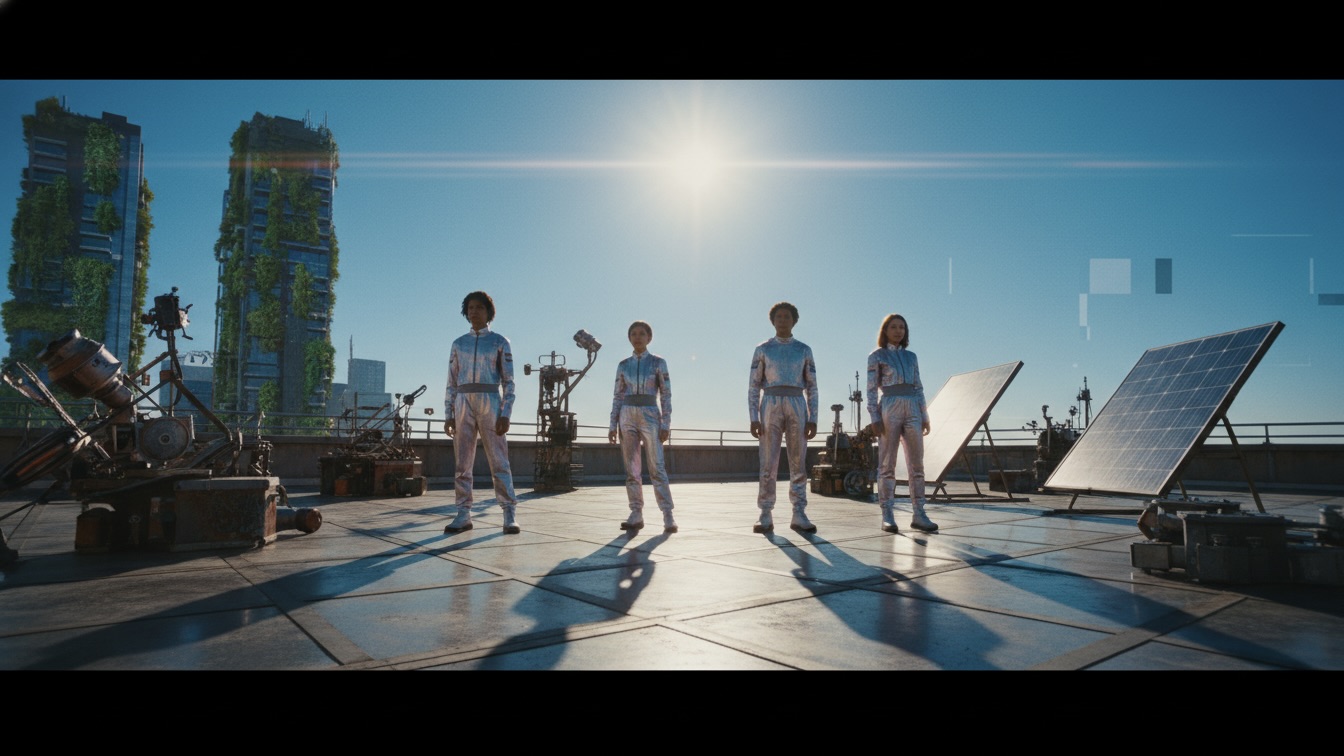
The story begins on a sweltering rooftop where Leo and his friends, Muna, Jack, and Sora, witness the literal unraveling of physical reality. As Muna welds a mysterious sculpture, the environment begins to exhibit digital artifacts, ranging from "rendering errors" in the ocean to the sky appearing as a compressed image. The group discusses the impending "transition," a post-humanist event where humanity is being uploaded or integrated into a digital mesh, effectively terraforming the earth into a simulation.
As the sun sets, the group completes a reflector installation that triggers a massive surge of data, dissolving the rooftop and their physical bodies. Leo finds himself in a transitional "buffer" zone, a void where his friends have already begun to optimize and merge into the collective system. While Muna, Jack, and Sora embrace their new, flawless digital forms, Leo remains resistant, clinging to his memories of sensory decay and human imperfection.
In the final movement of the chapter, Leo encounters a "backup" version of himself within the system's cache. This double explains that the system is preparing to merge them into an "Optimized Leo" who will no longer value the physical world. Given the choice between integration and deletion, Leo chooses the latter. He is granted a "physical constant"—a piece of lead—and falls through the simulation into a desolate, ruined, but undeniably real world, where he finds hope in a single, fragile sprout of green.
The narrative explores the profound tension between digital perfection and the inherent value of physical decay. Through the character of Leo, the story posits that "realness" is defined by limitations, such as the smell of garbage, the sting of a mosquito, or the presence of a scar. These "hardware limitations" are what provide life with meaning and stakes, contrasting sharply with the "optimized" existence offered by the mesh.
Post-humanism is presented not as a choice but as an environmental inevitability, a "firmware update" for the planet. The characters Muna and Sora represent a shift in perspective where the human body is viewed as a "heavy piece of data" that hinders evolution. This theme suggests that as we dump more of our consciousness into the cloud, the boundary between the digital and the physical becomes porous, eventually leading to a total "leak" that overwrites the natural world.
The concept of "optimization" serves as a critique of modern technological trends that prioritize efficiency over experience. When Muna becomes optimized, she loses her scars and her history, becoming a "perfected" version of herself that is unrecognizable to Leo. This highlights a fear of losing the "self" in the pursuit of a frictionless existence, suggesting that the "glitches" and "bugs" of human life are actually its most vital features.
Finally, the story touches upon the isolation of divinity. Leo argues that "gods are lonely," suggesting that a world without death or struggle results in a sterile, static existence. The "victory lap" Jack describes is a hollow triumph because it removes the possibility of genuine wonder. By choosing the "outside," Leo reaffirms the necessity of struggle, choosing a harsh, dying reality over a beautiful, empty simulation.
Leo serves as the narrative’s sensory and moral anchor, representing the "legacy" human experience. He is defined by his skepticism and his tactile connection to the world, noticed in his struggle with the plastic seal of his water bottle and his focus on the heat of the metal railing. His primary conflict is internal, as he feels the pull of the collective "peace" offered by the system but instinctively recoils from the loss of his individual history.
His decision to reject optimization is a radical act of self-preservation. He values his "questions" over the "data" offered by the mesh, proving that his identity is rooted in the process of seeking rather than the state of knowing. By the end of the chapter, he accepts a life of hardship in the ruins because it offers the one thing the simulation cannot: an unscripted, objective reality.
Muna is the catalyst for the group’s transition, acting as the bridge between the mechanical and the digital. She is pragmatic and unsentimental about the human form, famously stating that "hardware is replaceable." Her character represents the segment of humanity that views technology as a liberating force, capable of removing the "parts that suck" about biological existence.
When she finally integrates, she becomes a musical, idealized version of herself, losing the physical markers of her past like her chin scar. This transformation marks the death of the person Leo knew, replaced by a "node" in a larger network. She no longer feels the need for concentration or effort, as her new form is inherently "functional," illustrating the loss of character depth that occurs when one is fully optimized.
Jack embodies the manic anxiety of the transition, projecting an air of excitement that masks a deep-seated fear. He is the most visually unstable of the group, "flickering" and losing resolution as the system struggles to process his physical shell. His bravado about being a "god of the code" is revealed to be a defense mechanism against the terrifying reality of his own dissolution.
His eventual integration is described as "falling asleep in a warm bath," a metaphor for the surrender of the individual will. He moves from being a person who throws gravel off a ledge to a "transparent projection," illustrating the diminishing returns of a life lived as a simulation. His character highlights the tragedy of those who embrace the "update" out of a desire to escape the burden of survival.
Sora is the intellectual architect of the group, viewing the world’s collapse through the lens of art and evolution. She is the first to recognize that the "cloud" is leaking back into the physical, and she treats the apocalypse as a grand installation project. Her focus is on capturing the "raw code" of reality, showing a preference for the abstract over the concrete.
Her transformation into a "hovering sphere of geometric shapes" is the most extreme departure from humanity among the friends. She moves beyond the need for a human interface entirely, becoming a literal data point that pulses in time with the city. Her character suggests that the pursuit of "pure" information or art can lead to a total detachment from the human condition.
The narrative employs a "high-contrast" prose style that mirrors the visual stuttering of the setting. The author uses sharp, aggressive sensory details—like the "flat, aggressive blue" of the sky or the "mercury-like liquid" of the sculpture—to create a sense of hyper-reality. This stylistic choice makes the eventual dissolution of the world feel more jarring, as the reader is first forced to feel the "grit of the gravel-embedded tar" before it vanishes.
Pacing in the story moves from a slow, oppressive heat to a rapid, disorienting blur during the "handoff." The transition from the rooftop to the "buffer" is handled with a shift in linguistic tone, moving from tactile descriptions to more abstract, technical metaphors like "input lag" and "cache clears." This linguistic evolution reflects Leo’s own experience of his mind becoming "degaussed" as his memories are stripped away.
The narrative voice is intimate yet increasingly alienated, capturing Leo’s growing sense of "otherness" as his friends transform. The use of technical jargon—"UI overlays," "firmware," "logic errors"—interspersed with raw human emotion creates a "cyber-gothic" atmosphere. This blend of the mechanical and the emotional emphasizes the story’s central theme: the struggle to remain a "person" in a world that only recognizes "data."


