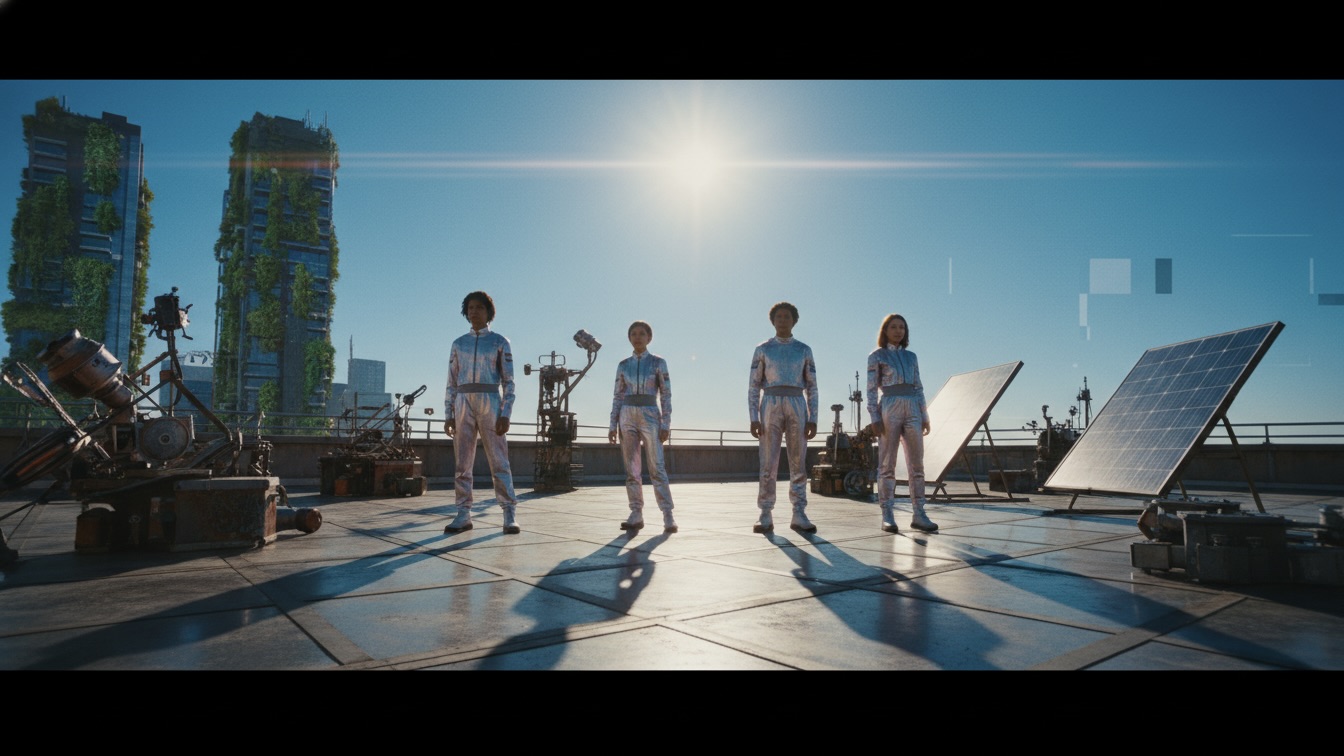
Leo wanders through the sun-bleached ruins of a shopping mall, searching for people who haven't been digitally optimized.
The dirt was the first thing. It wasn't the clean, simulated grit of the rooftop. It was messy. It was uneven. I rolled onto my stomach and felt a sharp pebble dig into my solar plexus. I didn't move. I just let it hurt. The pain was a sharp, localized spike that didn't vibrate or frame-skip. It stayed right there, a constant signal. I opened my eyes and saw a beetle. It was brown and ugly and had one leg that seemed to be dragging. It wasn't a logic error. It was just injured. I watched it struggle over a clump of dry grass for three minutes. My watch was gone. My neural link was a dead weight in the back of my skull, a silent passenger that no longer whispered data into my visual cortex.
I sat up. The heat was different here. On the roof, the sun felt like a spotlight, a focused beam of render-intensity. Here, it was just a broad, indifferent bake. It came from the sky, which was a pale, dusty grey, and it reflected off the cracked asphalt of a parking lot that stretched out forever. The lot was a graveyard of cars that looked like they’d been stripped by locusts. No tires. No glass. Just rusted skeletons of steel. I gripped the lead weight in my pocket. It was the only thing that felt heavy enough to keep me from floating away into the grey.
I stood up. My knees popped. The sound was loud in the absolute silence. There was no hum of HVAC units. No distant traffic. Just the sound of the wind moving through the hollowed-out husks of the cars. It sounded like a long, low whistle. I started walking. Every step felt like an achievement. My muscles were used to the assisted gait of the mesh, the way the system smoothed out your movements to save energy. Here, I had to do all the work. I felt the strain in my calves immediately. I felt the sweat starting to itch under my collar. I didn't wipe it away. It felt too real to disturb.
In the distance, a structure rose out of the heat-haze. It was a massive, sprawling box of concrete and glass. A shopping mall. The signage was gone, just the rusted metal frames where neon letters used to live. It looked like a tomb. I headed toward it because it was the only thing that wasn't flat. My shadow was a long, distorted shape on the asphalt. It didn't flicker. It didn't snap to a grid. It just followed me, a dark companion in the dust.
I reached the entrance. The sliding glass doors were gone, replaced by sheets of plywood that had been reinforced with rebar. Someone had painted a symbol on the wood—a circle with a line through it. An 'O' for Optimized, crossed out. This was it. The low-res colony. I stopped a few feet away. My heart was thumping against my ribs. It felt like a trapped bird. I hadn't seen another person since the backup version of myself dissolved into light. I didn't know if I was ready for company.
"Don't move," a voice said.
It came from above. I looked up. A girl was sitting on the ledge of the second-story overhang. She was holding a crossbow. It looked homemade, a mess of car springs and wire. She wasn't wearing tech-shades. Her eyes were wide and focused, the pupils reacting to the sunlight. She looked like she hadn't slept in a week.
"I'm not a ghost," I said. My voice was hoarse. It felt like it was scraping against my throat.
"That’s what a ghost would say," she replied. She didn't lower the bow. "Show me your hands. Slowly."
I pulled my hands out of my pockets. I kept the lead weight in my palm, showing it to her like a badge. She squinted, leaning forward over the ledge. The sun caught the metal, making it flash.
"Is that lead?" she asked.
"Yeah. A physical constant. My backup gave it to me."
She stayed silent for a long time. I could hear the wind whistling through the rebar. She looked at my face, then back at the weight. Finally, she stood up and disappeared from the ledge. A minute later, a small door cut into the plywood swung open with a screech of metal on metal.
"Get inside," she said. "The sky is starting to pulse. You don't want to be caught out here when the refresh hits."
I didn't argue. I stepped into the darkness of the mall. The transition from the bright sunlight was jarring. I was blind for a second, my retinas screaming. I felt a hand grab my arm and pull me further in. The grip was hard and calloused. It didn't feel like the soft, optimized skin of my friends. It felt like sandpaper. It felt like life.
The interior of the mall was a cavern of shadows. As my eyes adjusted, I saw that the grand atrium, which once probably housed a fountain or a palm tree, was now a communal living space. There were tents made of faded tarp, small fire pits that were currently cold, and stacks of crates. The air was still. It felt like being inside a lung that had forgotten how to exhale. The girl with the crossbow led me toward the center. She walked with a limp that she didn't try to hide.
"I'm Silas," a man said, stepping out from behind a pile of old mattresses. He was older than me, maybe thirty, with a beard that was matted with dust. He was wearing a grease-stained jumpsuit. He didn't look at me; he looked at the lead weight I was still holding. "You're from the high-res zones. I can tell by the way you hold your shoulders. You're waiting for the UI to tell you where to go."
"I'm Leo," I said. I tucked the weight back into my pocket. "The UI is dead. The whole system is dead for me. I fell through."
"Fell through, or were pushed?" Silas asked. He walked around me, inspecting me like a piece of salvaged tech. He stopped behind me and poked the back of my neck, right where the neural link was buried. "Still in there. It’s dormant. If the signal gets strong enough, it might try to reboot. That’s why we stay in the mall. The concrete and the lead shielding in the roof keep the mesh out."
"Is it safe here?" I asked, looking around the dim atrium.
"Safe is a relative term, Leo," the girl with the crossbow said. She sat down on a crate and started tinkering with the trigger mechanism of her weapon. "I'm Jade. And no, it’s not safe. It’s just slow. The system doesn't like dead zones. It treats us like a corrupted sector. Every few days, it tries to run a defrag. That’s the pulse I was talking about."
"What happens during the pulse?"
"Everything gets weird," Jade said without looking up. "The physics go soft. You might wake up and find your feet are fused to the floor. Or the air might turn into glass for ten seconds. You just have to hold onto something solid and pray your code doesn't get rewritten."
Silas nodded. "We’re the leftovers. The stuff the algorithm couldn't figure out how to optimize. We collect the things it missed. The analog stuff. Come here."
He led me toward the back of the atrium, past a cluster of tents where a few other people were sitting. They looked at me with a mixture of pity and suspicion. They were all thin, their skin pale and marked by the harsh reality of living without medical nanites. Silas stopped in front of what used to be a high-end department store. The glass windows were long gone, but the interior was filled with rows of shelves.
"We call it the Museum of the Real," Silas said. He gestured toward the shelves. "Everything here is analog. No chips. No sensors. No wireless connectivity. Just matter."
I walked along the rows. There were old books with yellowed pages. There were manual typewriters. There were kitchen utensils made of heavy cast iron. I reached out and touched a wooden bowl. It was rough. It had a grain that felt like a landscape under my fingertips. It didn't have a tooltip. It didn't tell me its history or its carbon footprint. It just was.
"Why keep all this?" I asked.
"Because it reminds us of the baseline," Silas said. His voice was low. "The further we get from the old world, the easier it is for the system to convince us that the simulation is better. But you can't simulate the weight of that bowl. Not really. You can't simulate the way a page feels when it tears. Those are the errors that make us human, Leo."
I picked up a small, rusted pocketknife. I flicked the blade out. It resisted, the hinge stiff with age. The metal was dull. I ran my thumb along the edge. It didn't cut me, but I could feel the potential.
"You're lagging," Jade said, appearing at my shoulder. She was watching my hand. "You're still moving like you're in the buffer. You need to sharpen your senses. Out here, a half-second delay is the difference between breathing and being archived."
"I'm trying," I said. "It’s just... it’s quiet. My head is too quiet."
"That's the best part," she said, a small smile ghosting across her lips. "The silence is where you find yourself. Or what’s left of you."
Suddenly, the air in the mall groaned. It wasn't a sound; it was a vibration that I felt in my teeth. The shadows in the corners of the department store began to stretch and warp, turning into long, jagged triangles. The wooden bowl in my hand felt like it was vibrating, its molecules trying to drift apart.
"Here it comes," Silas said, his face tightening. "The summer refresh. Everyone, grab a rail!"
I dived for a heavy metal display rack. My fingers clamped onto the cold steel just as the world began to tilt. It wasn't that the floor was moving; it was that gravity was suddenly an opinion rather than a law. I felt my feet lift off the ground. The department store started to look like a low-resolution jpeg being stretched beyond its limits. The colors bled into one another. The rows of books became blocks of solid grey. Silas and Jade were huddled near a structural pillar, their eyes shut tight.
"Don't look at the sky!" Jade screamed over the sound of static that was now filling the atrium.
I looked up anyway. Through the shattered skylight of the mall, I saw the grey sky rip open. A vein of neon green light pulsed across the horizon. It looked like a crack in a screen. Down in the mall, the air began to crystallize into floating cubes of light. They drifted through the space like digital dust motes. One of them passed through my arm. It didn't hurt, but for a second, I couldn't feel my hand. I looked down and saw that my forearm was transparent, filled with scrolling lines of white text.
"Leo!"
A voice called out from the center of the atrium. It wasn't Silas or Jade. It was a voice I knew. A voice that belonged to a version of the world I’d left behind.
I turned my head, fighting the nausea of the shifting gravity. Standing in the middle of the empty fountain basin was Muna. She looked perfect. Her skin was glowing with that idealized, optimized sheen. Her hair moved in a way that defied the stagnant air of the mall. She wasn't real. She was a projection, a ghost in the machine that had found a way to bleed through the shielding.
"Muna?" I gasped. The word felt like it was made of lead in my mouth.
"You're missing the update, Leo," she said. Her voice was musical, multi-tonal, echoing off the concrete walls. "The world is so much better now. The ocean is finished. The stars have been re-mapped. Why are you hiding in the trash?"
"It’s not trash," I said, my grip on the rack tightening. "It's... it's real."
"Real is a hardware limitation," she said, stepping toward me. Her feet didn't make a sound on the dusty floor. Behind her, Jack and Sora appeared. They were flickering, their forms less stable than hers, but they had the same terrifyingly perfect eyes. "We’ve moved past the dirt. We’ve moved past the pain. Come back to the roof, Leo. We can still integrate you. The system kept a copy of your base code."
"I don't want to be a copy!" I shouted.
The green light from the sky intensified. The mall began to moan again, a deep, metallic sound of protest. The display rack I was holding onto started to dissolve into pixels. I felt myself slipping. The gravity pull was getting stronger, trying to drag me toward the center of the atrium, toward the ghosts of my friends.
"Look at yourself," Jack said, his voice glitching. "You’re... you’re... low res. You’re becoming... ugly. There’s... there’s... grit... on your... face."
"I like the grit!" I yelled. I reached into my pocket and grabbed the lead weight. I threw it at Muna's image.
The weight passed right through her chest and hit the floor with a heavy, satisfying thud. The sound of the impact seemed to ripple through the air, shattering the digital cubes of light. For a second, the projection of Muna flickered. Her perfect skin turned into a mesh of wireframes. Her green eyes became black voids.
"You're... hurting... us," she whispered, the musicality gone from her voice.
"Get out of my head!" I scrambled toward the lead weight, my fingers clawing at the dusty floor. I grabbed it and held it against my chest. The solid weight of it felt like a shield.
The green light in the sky suddenly snapped shut. The static sound died instantly. Gravity returned with a brutal force, slamming me back down onto the concrete. I gasped, the air knocked out of my lungs. My forearm was solid again. The scrolling text was gone.
I looked around. Muna, Jack, and Sora were gone. The mall was silent again, the shadows returning to their normal, messy shapes. Silas and Jade were standing up, shaking off the dust.
"That was a bad one," Silas said, his voice trembling. He looked at me, then at the spot where the ghosts had been. "They’re getting closer. The system is starting to map the dead zones."
"They were my friends," I said, still clutching the lead weight.
"They’re not your friends anymore, Leo," Jade said, walking over to me. She offered me a hand. I took it. Her grip was still sandpaper-rough. "They’re just probes. The system uses what you love to get you to lower your firewalls. It’s the oldest trick in the code."
I stood up, my legs feeling like jelly. I looked at the lead weight. It was scratched from the impact with the floor, a tiny silver scar on its surface. It was a physical record of what had just happened.
"We can't stay here," Silas said, looking up at the shattered skylight. "The mall is compromised. The refresh found a way in. We need to move to the deep woods. The resolution there is even lower. The trees... they’re too complex for the system to render properly. It’s the only place left where we can disappear."
"The deep woods?" I asked.
"It’s a three-day walk," Jade said, already picking up her crossbow. "And the heat is going to be brutal. But it’s better than being optimized."
I looked back at the Museum of the Real. The rows of books, the wooden bowl, the rusted knife. I felt a sudden, sharp pang of loss. We were the last of our kind, scavenging the leftovers of a world that didn't want us anymore.
"Can we take the books?" I asked.
"Only what you can carry," Silas said. "Weight is the enemy on the road. But it’s also the only thing that keeps you real."
I walked over to the shelf and grabbed an old, thick magazine. The cover was faded, showing a picture of a beach from a world where the water didn't turn into cubes. I tucked it into my waistband. The glossy paper felt cool against my skin.
"Okay," I said. "Let's go."
We left the mall through a rear exit that led to a loading dock. The sun was lower in the sky, turning the dusty grey into a bruised purple. The heat hadn't let up. If anything, it felt more oppressive, a thick, dry presence that made every breath feel like a chore. We were a small group—Silas, Jade, myself, and four others I hadn't met properly. We moved in a single file line, keeping to the shadows of the rusted cars.
"Watch your step," Silas whispered. "The ground is soft here. The textures haven't loaded in properly since the last patch."
He was right. In some places, the asphalt felt like wet clay. In others, it was as hard as diamond. It was a minefield of inconsistent physics. I kept my eyes on the back of Jade’s boots. She moved with a strange, rhythmic hop, testing the ground before committing her full weight.
"How do you know where to go?" I asked her during a brief pause under the skeleton of an old billboard.
"I look for the glitches," she said, wiping sweat from her forehead with the back of her hand. "The system tries to make the world look perfect. The more perfect it looks, the more dangerous it is. We follow the ugly parts. The parts that don't make sense. That’s where the system isn't looking."
We walked for hours. The city ruins began to thin out, replaced by a vast expanse of scrubland. The bushes were grey and brittle, their leaves clicking against each other in the hot wind. There were no birds. No insects. Just the sound of our own breathing and the crunch of our boots on the uneven ground.
As the sun touched the horizon, the sky didn't turn orange. It turned a flat, clinical white.
"Wait," Silas said, raising a hand.
We all stopped. Ahead of us, the landscape was beginning to flicker. It wasn't a pulse like the one in the mall. It was a slow, steady crawl of pixels. A wall of high-resolution reality was moving across the scrubland, replacing the low-res bushes with perfect, vibrant green ones. The ground behind the wall was a smooth, textured brown. It looked beautiful. It looked like a postcard.
"It's an edge-map," Jade hissed. "They're expanding the high-res zone. They're trying to close the gap."
"We have to run," Silas said. "If that wall catches us, we'll be integrated on the spot. It won't even be a choice."
We started to run. My lungs burned. The heat felt like it was trying to cook me from the inside out. I could feel the lead weight bouncing against my thigh. The magazine in my waistband was slipping, the glossy pages slick with my sweat. I didn't care. I just kept my eyes on the dark line of trees in the distance—the deep woods.
The wall of light was gaining on us. It moved with a terrifying, silent efficiency. I looked back and saw one of the people in our group—a young man I didn't know—trip. He fell into the high-res zone.
He didn't scream. He didn't even hit the ground. As soon as the light touched him, his ragged clothes turned into a clean, white jumpsuit. His dirty face became flawless. He stood up, his eyes turning that bright, unblinking green. He didn't look at us. He just looked at the sky and smiled.
"Don't look back!" Silas roared.
I pushed myself harder. My vision was starting to blur at the edges. Not from the glitch, but from exhaustion. The trees were closer now. They looked messy. They looked chaotic. Their branches were tangled and irregular, their leaves a hundred different shades of brown and green. They were beautiful in their ugliness.
We reached the tree line just as the wall of light was a dozen feet away. I dived into the shadows of the first oak tree. The ground here was covered in real dead leaves. I felt them crunch under me. The air was suddenly cooler, protected by the dense canopy.
Silas and Jade tumbled in after me. We lay there, panting, watching the wall of light stop. It hit the edge of the woods and stayed there, a shimmering curtain of perfection. It couldn't seem to figure out how to process the complexity of the forest. The trees were too ancient, their patterns too fractal for the current algorithm to simplify.
"We... we made it," Jade gasped. She was covered in dust, her face streaked with sweat. She looked exhausted, broken, and completely real.
I sat up and pulled the magazine from my waistband. It was crumpled and damp, the cover half-torn. I looked at the picture of the beach. It seemed so far away now. A different universe.
"Is there anyone else in here?" I asked, looking deeper into the dark, tangled woods.
"Thousands," Silas said, his voice a rasp. He was leaning against the trunk of the oak tree. "Hiding in the shadows. Waiting for the system to crash. Or for the summer to end."
"Does the summer ever end?" I asked.
Silas didn't answer. He just looked out at the wall of light, which was now reflecting the white sky. The world outside was a perfect, silent cage. Inside the woods, a branch snapped. Somewhere, deep in the darkness, I heard the sound of a real, living creature moving through the brush.
I gripped the lead weight in my hand. It was still hot from the sun, but it was cooling down. I looked at Silas and Jade, their forms shadowed and imperfect in the dim light.
"What now?" I asked.
"Now," Jade said, her eyes meeting mine, "we figure out how to fight back."
I looked at the wall of light one last time. In the reflection, I saw a version of myself. He was clean. He was happy. He was optimized. He was everything I was supposed to be.
I turned my back on him and walked into the dark.
“I turned my back on him and walked into the dark.”