I woke up to a steamroller in my driveway and a city councillor who had gone completely off grid.
The floorboards were vibrating. It wasn't the gentle hum of the window AC unit or the low-frequency thrum of a passing bus. This was structural. It was the kind of vibration that makes your teeth feel loose in your gums. I rolled off my mattress, my skin peeling away from the damp sheets with a sound like a slow-motion Band-Aid removal. The heat was already a physical presence in the room, thick and stagnant, despite the early hour. I didn't check the time. I didn't need to. The sun was hitting the peeling grey paint of my dresser at that specific angle that meant it was 7:15 AM and the world was already too loud.
I stumbled to the window, kicking an empty Gatorade bottle across the hardwood. Outside, Maryland Street was a war zone of productivity. Three yellow dump trucks were idling, their diesel engines sending ripples through the air. A crew of men in high-visibility vests moved with a mechanical, frantic energy. They weren't just patching the potholes I’d blackmailed Van Klint about. They were stripping the entire surface of the street down to the base layer. It was overkill. It was the civic equivalent of using a flamethrower to kill a spider.
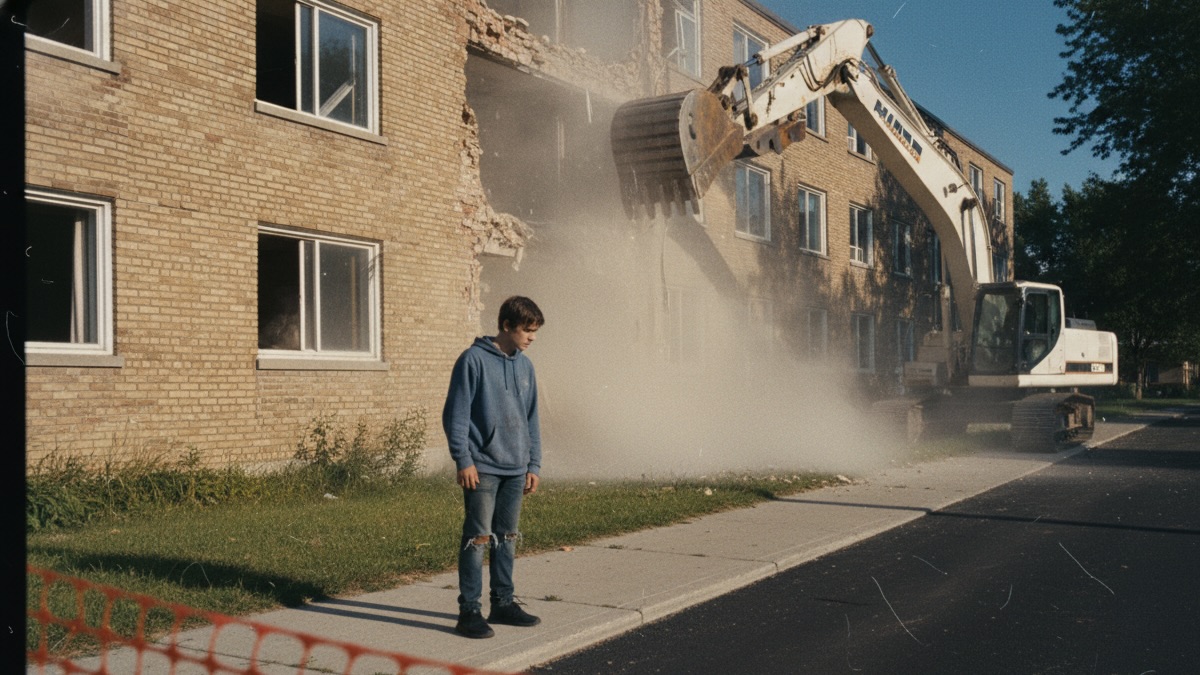
I leaned my forehead against the glass. It was hot. Then I saw the steamroller. It wasn't on the street. It was backed halfway into my private driveway, the heavy metal drum crushing the gravel and the few tufts of stubborn weeds that had managed to survive the July drought. A man with a clipboard was standing next to my porch, pointing at the cracked concrete of my walkway. He looked like he was giving orders for a full excavation.
"What are you doing?" I yelled, shoving the window up. The latch caught, scraping a line of rust across my palm. The noise from the street rushed in—the grinding of gears, the beep-beep-beep of reversing trucks, the shouting of the crew. It was a wall of sound that felt like it was trying to push me back into the apartment.
The guy with the clipboard didn't look up. He just made a notation and gestured for the steamroller to move further in. The vibration intensified. A glass of water on my nightstand rattled toward the edge of the coaster. This was wrong. This was the result of a man panicking. Van Klint hadn't just followed my instructions; he’d overcompensated to the point of absurdity. He was trying to bury the evidence of his corruption under six inches of fresh, industrial-grade asphalt.
I grabbed my phone from the floor. The screen was smeared with thumbprints. I found Van Klint’s contact and hit dial. I expected the usual three rings followed by his overly polished, slightly desperate voicemail greeting. Instead, I got a flat, digital tone.
"The number you have dialed is no longer in service," a recorded voice said. It was calm. Indifferent. "Please check the number and try again."
I tried again. Same result. The man who had been throwing city infrastructure into the Assiniboine River for TikTok clout had disconnected his life. I felt a cold spike of genuine anxiety through the layer of morning brain fog. Blackmail only works if the person you're squeezing stays in the vice. If they disappear, you're just a guy with a recording of a ghost.
I looked back out the window. The steamroller was now inches from my front steps. The driver was a kid, maybe twenty, wearing wraparound sunglasses and a bored expression. He didn't look like he cared about the legality of repaving private property on the taxpayer's dime. He just looked like he wanted to finish the shift and get a Slurpee.
I pulled on a t-shirt that was slightly less wrinkled than the others and headed for the door. I needed to stop this before my front door was sealed shut by a layer of steaming tar. I needed to find Van Klint before he did something even more erratic than disappearing. As I hit the stairs, my phone buzzed in my hand. It wasn't a call. It was a notification from TikTok.
@TrafficConeKing has just posted a video.
I stopped on the landing. The hallway smelled like old dust and the lingering ghost of someone's burnt toast. I opened the app. The video started with the familiar shaky camera work. It was night. The lighting was poor, just the orange glow of the streetlights reflecting off the metal girders of the Norwood Bridge.
A pair of hands, recognizable from the previous videos, gripped a bright orange traffic cone. The hands were trembling slightly. With a sudden, violent heave, the hands tossed the cone over the railing. It tumbled through the air, a flash of neon against the black water of the Red River, before disappearing with a distant, hollow splash.
Text crawled across the bottom of the screen: The grid is a lie. We are the flow now. #EngagementDynamics #CivicShift.
I leaned against the banister. The wood was sticky. Van Klint wasn't hiding. He was escalating. He had moved from throwing rocks to throwing equipment. He was rebranding. And I was the only one who knew that the city's infrastructure budget was literally sinking to the bottom of the river, one orange cone at a time.
I pushed through the front door of the apartment building and was immediately hit by a wave of heat that felt like a physical slap. The air didn't move; it just sat there, heavy and vibrating with the roar of the machinery. The steamroller had successfully flattened my driveway into a smooth, grey expanse of fresh gravel, and now a second truck was backing in, its bed tilted up to reveal a steaming pile of black asphalt.
"Hey!" I shouted, waving my arms at the guy with the clipboard. "Hey, stop!"
He finally looked at me. He was wearing a hat with the city logo on it, sweat staining the brim into a darker shade of blue. He didn't look annoyed. He looked like he was executing a high-priority work order signed by the Pope.
"You the owner?" he asked. He had to yell to be heard over the idling dump truck.
"I'm the tenant," I said, stepping onto the fresh gravel. It shifted under my sneakers, unstable and hot. "You can't do this. This is private property. The city doesn't pave private driveways."
The foreman looked down at his clipboard. He flipped through a few pages of carbon-copy forms. "Order says Maryland Street Corridor Enhancement Project. Full resurfacing. Includes all adjacent access points. Special directive from the Councillor's office. Emergency infrastructure stabilization."
"Stabilization?" I looked at my driveway. It was a patch of dirt and cracked concrete. It didn't need stabilization. It needed a lawnmower. "Since when is a driveway an emergency?"
"Look, kid, I just go where the paper tells me to go," the foreman said. He wiped his forehead with the back of a gloved hand. "We're on a clock. Councillor said this block needs to be 'glass smooth' by noon or heads roll. I like my head where it is."
"Where is he?" I asked. "Where's Van Klint?"
"Haven't seen him. His office sent the digital auths through at three in the morning. We've been out here since four. My guys are bagged, but the pay is triple-time emergency rates. We aren't asking questions."
He turned away from me and signaled the dump truck. The tailgate swung open, and the asphalt began to slide out in a thick, viscous heap. The heat coming off it was incredible. It felt like standing in front of an open oven. I backed away, my shoes sticking to the edges of the fresh pour.
I realized then that Van Klint was trying to drown me in service. He was taking the blackmail literally. I'd asked for the potholes to be fixed, so he was paving over the entire world. It was a frantic, clumsy attempt to buy my silence with a few thousand dollars' worth of municipal materials. But the disconnected phone and the new TikTok account suggested that he wasn't just paying me off—he was losing his mind.
I walked back toward the sidewalk, my mind racing. I needed to get to Sheila’s. She was the only one who could track the new account. If Van Klint was at the Norwood Bridge at night, he had to be somewhere during the day. He wouldn't be at City Hall. He was too deep in the 'Traffic Cone King' persona for that.
I pulled out my phone again and tried to record the scene. The camera struggled with the glare of the morning sun hitting the polished chrome of the trucks. The workers looked like ghosts in the shimmering heat.
"Darren!"
I turned. Sheila was standing on the sidewalk, holding a massive iced coffee. She was wearing her 'I Hate Everyone' sunglasses, the ones with the mirrored lenses that made it impossible to see her eyes.
"What the hell is happening to your driveway?" she asked, her voice flat.
"Van Klint is glitching," I said, walking over to her. "He's repaving the whole street. And my driveway. And probably the alleyway too if I don't stop him."
Sheila looked at the pile of steaming asphalt. She didn't look impressed. "Is he paying for it?"
"With the city's money, yeah. But he's gone dark. His phone is disconnected. And he's back on TikTok. He's throwing traffic cones off the Norwood Bridge now."
Sheila took a long, loud sip of her coffee. The ice rattled against the plastic cup. "The Norwood? That's a bold choice. Lots of cameras on that bridge."
"Can you track him again?" I asked. "The new account. @TrafficConeKing. I need to know where he's uploading from."
Sheila sighed. "I'm supposed to be at work in twenty minutes. My boss is already on my case about my 'lack of corporate synergy'."
"Sheila, he's throwing city property into the river. He's using the road budget to pave my personal life. This is going to end with a SWAT team in our lobby if we don't find him."
She looked at the steamroller, then back at me. "Fine. But you're buying me lunch. Something expensive. None of that food court garbage."
"Deal," I said.
We headed toward her apartment building. As we walked, I looked back at the crew. They were moving onto the sidewalk now, the jackhammers starting up with a bone-jarring rhythm. They were tearing up perfectly good concrete just to replace it. It was the most efficient the city had ever been, and it was all built on a foundation of pure, unadulterated terror.
Sheila’s apartment was a sanctuary of cool air and blue light. The shades were drawn tight against the morning sun, and the only sound was the low hum of her custom-built PC. She sat down in her ergonomic chair, which creaked under her weight, and immediately began typing. The clicking of her mechanical keyboard was a sharp, rapid-fire sound that usually calmed me down, but today it just added to the static in my head.
"Okay," she said, her eyes reflecting the scrolling lines of code. "The Traffic Cone King account. It’s using the same proxy as the Pothole King, but the encryption is tighter. Someone told him how to hide better. Or he’s actually learning."
"He’s not learning," I said, pacing the small strip of carpet between her desk and her unmade bed. "He’s panicking. Panicking people don't learn; they just run faster."
"Well, he's running through a very specific set of servers," Sheila muttered. "Wait. Look at this."
I leaned over her shoulder. The screen showed a map of the city with a series of red dots concentrated around the south end.
"Those are the upload pings?" I asked.
"No, those are the city's smart-city sensor nodes," Sheila said. "The ones on the streetlights. They track traffic flow, air quality, that kind of thing. Someone is piggybacking on the municipal mesh network to upload these videos."
"Van Klint has the admin codes," I realized. "He's a councillor. He probably has the master key for the whole infrastructure grid."
"Exactly. He's not using his home internet anymore. He's using the city itself to hide his digital footprint. It's actually kind of clever, in a totally illegal, career-ending way."
She clicked a few more buttons, and a video window popped up. It was a new one. It must have been posted minutes ago.
The video showed the interior of a car. It was dark, but the dashboard lights were visible. The speedometer was hovering around eighty kilometers per hour. The camera panned to the passenger seat, which was piled high with those small, battery-operated LED barricade lights. The ones that blink yellow at night.
One by one, the hands reached over, grabbed a light, and tossed it out the window. The video was edited with a heavy bass-boosted track that made the speakers on Sheila's desk vibrate.
The light is a cage, the text overlay read. We are the darkness between the blinks.
"He's losing it," I whispered. "He's literally throwing the city's safety equipment out of a moving vehicle."
"And he's doing it in the South Osborne area," Sheila said, pointing at the map. "See that cluster? That's where the mesh network is strongest. He's circling the neighborhood like a shark."
My phone rang. It was an unknown number. I hesitated, then answered.
"Darren? It's Dave."
Dave’s voice sounded like it had been dragged through a gravel pit. He sounded more tired than usual, which was impressive.
"Dave, I told you about this yesterday," I said, my voice rising. "Are you seeing what's happening?"
"I'm seeing the reports of the 'Vandal King' or whatever the kids are calling him," Dave said. "The police are getting flooded with calls about missing cones and broken barricades. And my office is getting calls from the Mayor's people asking why there's a crew paving Maryland Street with no budget approval."
"It's Van Klint, Dave. I have the recording. I have the proof."
"The Mayor's office says Van Klint took a sudden leave of absence for 'personal health reasons'," Dave said. "They're trying to contain it. They're saying the Maryland Street project was a clerical error. A miscommunication between departments."
"A forty-thousand-dollar miscommunication?" I yelled. "Dave, he's on the Norwood Bridge throwing stuff into the river!"
"Listen to me, Darren," Dave’s voice was low and urgent. "The city is in damage control mode. If you run this story now, they'll bury you. They'll say you're the one behind the TikToks. They'll say you're harassing a man having a mental breakdown."
"I'm the one who found him!"
"It doesn't matter. The narrative is already shifting. The 'Middle Child' campaign is falling apart, and they need a scapegoat. Don't be the scapegoat."
"So what am I supposed to do? Let him toss the whole city into the Red?"
"Find him," Dave said. "Find him and get him to talk on camera. Not a voice memo. A real interview. If he looks as crazy as you say he is, the city can't hide it. Then we have a story that even the Mayor can't kill."
He hung up before I could argue.
I looked at Sheila. She was watching me, her expression unreadable behind the sunglasses.
"You heard him?" I asked.
"I heard him," she said. "And he's right about one thing. The city's IT department is already trying to patch the holes in the mesh network. They'll find his pings soon. If you want to get to him first, you have to go now."
"Where?" I asked.
She pointed at a specific spot on the map. A small park near the river, tucked behind a row of expensive condos in South Osborne. "There's a maintenance hub there. It's where the primary server for the district’s smart-grid sits. If he wants to keep uploading, he has to stay close to that hub. It's the only one they haven't secured yet."
I grabbed my jacket. The heat outside was calling me, a relentless, humid pressure that I knew would be waiting for me the moment I stepped out of the AC.
"Stay on the line," I told her. "If he moves, tell me."
"I'll be your eye in the sky," Sheila said, her fingers already back on the keyboard. "Just don't get hit by a flying traffic cone. That’s a really embarrassing way to go out."
The bus ride to South Osborne was a slow-motion descent into a humid hell. The AC on the bus was broken, and the passengers were a collection of sweaty, irritable people staring at their phones with glazed eyes. I sat at the back, watching the city pass by. Winnipeg in the summer looks like it's trying to melt and grow at the same time. The weeds in the ditches were six feet high, and the pavement was shimmering with heat haze.
I got off near the park Sheila had identified. It was a strip of green space that looked like it hadn't been watered since the 1990s. The grass was yellow and crunching under my feet. I walked toward the river, the air getting heavier as I approached the water.
I saw the car first.
It was a silver Lexus, parked crookedly in a 'No Parking' zone next to a grey utility box. The windows were tinted, but I could see the glow of a screen inside. The car was idling, the exhaust pipe spitting out a thin cloud of white smoke into the stagnant air.
I approached slowly. My heart was thumping against my ribs, a dull, rhythmic ache. I felt like a character in a bad noir film, the kind of guy who gets shot in the first twenty minutes because he didn't know when to mind his own business.
The driver's side door opened.
Van Klint stepped out. He looked like he had aged ten years in the last twenty-four hours. His suit jacket was gone, his white shirt was stained with sweat and something that looked like orange paint, and his hair was a wild, matted mess. He was holding a large, industrial-sized bolt cutter in one hand and his phone in the other.
"Darren," he said. He didn't sound surprised. He sounded relieved. "You're early. The next drop isn't for another twenty minutes."
"The next drop?" I stopped about ten feet away. "Councillor, look at yourself. This is over. The city is repaving my driveway, and the police are looking for the 'Cone King'. You need to stop."
Van Klint laughed. It was a high, brittle sound that didn't have any humor in it. "Stop? Why would I stop? Look at the numbers, Darren!"
He held up his phone. The screen was cracked, but I could see the TikTok interface. "Ten thousand views in an hour. People love it. They love the chaos. They love seeing the 'Middle Child' push back."
"You're not pushing back," I said. "You're just destroying things. You're throwing forty grand of public money into the river because you're bored and scared of being irrelevant."
"I'm not bored!" he screamed. The bolt cutters clattered to the pavement. "I'm finally visible! Do you know what it's like to spend twenty years in civil service and have the only thing people remember about you be a typo on a zoning permit? I'm the Pothole King! I'm the Traffic Cone King! I'm the only thing in this city that's actually moving!"
He lunged for the utility box, the one Sheila had called the maintenance hub. He swung a heavy, jagged rock at the padlock. The sound of metal on metal echoed through the quiet park.
"Wait!" I stepped forward, reaching out to grab his arm.
He spun around, his eyes wide and bloodshot. He looked completely unhinged. For a second, I thought he was going to swing the rock at me. Instead, he dropped it and grabbed my shirt.
"You want the story, right?" he hissed. "The big corruption scoop? It's not me, Darren. I'm just the one who got caught in the loop."
"What loop?"
"The budget!" he yelled. "The forty grand? That was just the start. The whole 'Middle Child' campaign is a front for a land-development sweep in the north end. They're using the 'engagement' funds to pay off the digital auditors so they don't see the property transfers. I was just supposed to make some noise. I was supposed to be the distraction."
He let go of me and slumped against the utility box. "But I liked it. I liked being the distraction. It was better than being the guy who signs the papers."
I looked at him, really looked at him. He wasn't a mastermind. He was a pawn who had decided to set the board on fire because he didn't like the game. He was a small man in a small city, drowning in his own desperation for a moment of fame.
"Give me the phone, Van Klint," I said softly. "Give me the phone and let's go talk to Dave. We can tell the whole story. The land deals, the auditors, all of it."
Van Klint looked at the phone in his hand. He looked at the river, a dark, slow-moving ribbon of water reflecting the midday sun.
"It's too late for that," he said.
Before I could react, he turned and sprinted toward the riverbank. He wasn't fast, but he had the momentum of a man with nothing left to lose. He reached the edge of the embankment and, with a final, desperate cry, hurled his phone into the center of the Assiniboine.
It made a small, pathetic splash.
He stood there, his chest heaving, looking out at the spot where his digital legacy had just vanished.
"Now what?" I asked, my voice flat.
He turned back to me, a strange, vacant smile on his face. "Now we wait for the next shift. I think there's a crew coming to do the bridge tonight. They'll need more cones."
I looked past him. In the distance, I could see the flashing lights of a police cruiser turning into the park entrance. Sheila must have made the call. Or maybe the city’s mesh network had finally caught up with him.
I felt a strange sense of exhaustion wash over me. The heat, the blackmail, the asphalt, the TikToks—it was all just noise. The city was still broken. My street was smooth, but the foundation was rotten.
I reached into my pocket and felt my own phone. The recording of his confession was still there. The land deals. The auditors. The real story.
Van Klint saw the police car. He didn't run. He just sat down in the yellow grass and waited.
I didn't stay to watch the arrest. I turned and walked back toward the bus stop. I had a long ride ahead of me, and I needed to call Dave. The blackmail was over, but the transaction was just beginning.
“I looked at the flashing lights in the rearview mirror of the bus and realized the asphalt wasn't the only thing Van Klint had tried to bury.”