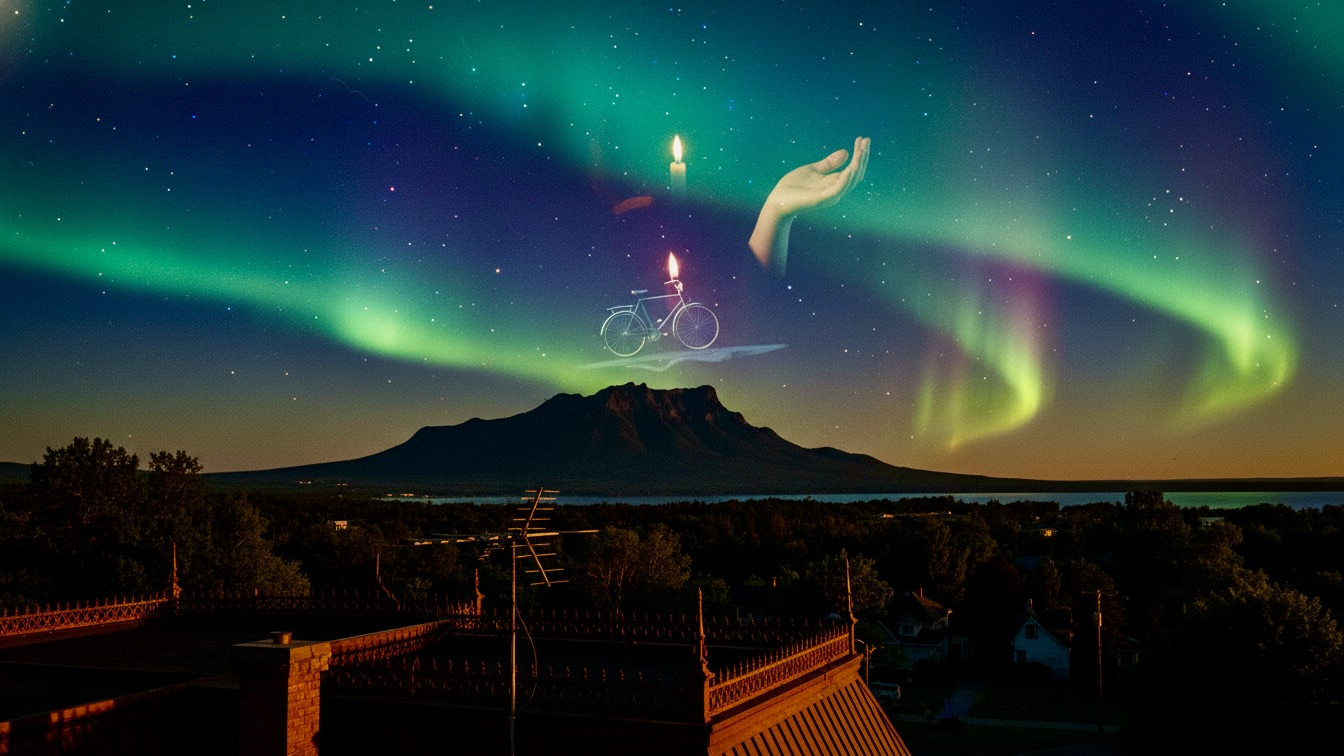
When the sky over Thunder Bay begins projecting the city's collective memories, Melinda hunts for a ghost in the clouds.
The heat in Thunder Bay didn't just sit; it pushed. It was late July, the kind of summer that felt like a physical weight on the back of your neck. Melinda sat on her balcony, her fingers traced the peeling white paint of the railing. The lake was flat, a sheet of hammered lead reflecting a sky that had been too blue for too long. Below her, the traffic on Algoma Street was a slow crawl of dusty SUVs and rusted sedans. People were irritable. You could hear it in the way the car horns sounded—short, aggressive bursts that cut through the humid air. The humidity was a thick veil, making the distant silhouette of the Sleeping Giant look blurred, like a smudge of charcoal on the horizon. Melinda took a sip of her water, but it was lukewarm and tasted of the plastic bottle. She wiped a bead of sweat from her upper lip and looked up, expecting the usual blank expanse of heat-haze.
Then the sky snapped. There was no other word for it. It wasn't a fade or a gradual shift. It was the sharp, jagged jump of a television channel changing. For a fraction of a second, the blue light flickered into a grid of static, a million black and white dots dancing in a frantic, silent swarm. Melinda dropped her water. The plastic bottle hit the wooden slats of the balcony with a hollow thud, spilling the tepid liquid over her bare feet. She didn't move. She couldn't. Above the jagged peaks of the Sleeping Giant, the static began to resolve into shapes. They weren't solid, but they weren't transparent either. They were grainy, washed out, and slightly jittery, possessing the unmistakable texture of a home movie recorded on a handheld camcorder thirty years ago.
A giant toddler appeared. He was thirty stories tall, hovering over the water, wearing a pointed paper hat with polka dots. He was laughing, though no sound came down from the clouds. Around him, the ghostly outlines of a suburban living room materialized. There were streamers hanging from a ceiling that didn't exist, and a birthday cake with three flickering candles that stood as high as the grain elevators on the shore. The tracking lines of an old VHS tape scrolled slowly from the bottom of the sky to the top, distorting the image of a woman’s hand as she reached out to ruffle the boy's hair. It was 1994. Melinda knew it was 1994 because of the specific shade of teal on the walls and the bulky, wood-paneled television set visible in the corner of the projection.
"What the hell?" someone shouted from the street below. Melinda leaned over the railing. A man had stepped out of his truck, his mouth hanging open as he stared at the giant birthday party. Other people were stopping now, spilling out of the cafes and the laundromat. A woman in a floral dress pointed upward, her hand trembling. The city was freezing in place. The toddler in the sky reached for the cake, his massive fingers moving through the air with a slow, dreamlike grace. It was a private moment, a memory of a Tuesday afternoon three decades ago, now broadcasted to twenty thousand people. It felt invasive. It felt like someone had peeled back the skin of the world and was showing the raw nerves underneath.
Melinda felt a sharp ache in her chest. It wasn't her memory, but it felt familiar. The way the light hit the carpet in the projection, the specific grain of the film—it reminded her of the boxes of tapes sitting in her closet, the ones she hadn't been able to watch since the funeral. She searched the flickering images for a face she recognized, a hint of her mother’s profile in the background of someone else's life. Her mother had lived in this city her whole life. She had to be up there somewhere. Every person in Thunder Bay had a story, and now those stories were leaking out, staining the atmosphere with the residue of the past. The toddler blew out his candles, and the image dissolved into a soft, grey mist that hung over the lake like woodsmoke.
"Did you see that?" a voice called out. It was her neighbor, Sarah, leaning out of the window next door. Sarah’s hair was a mess of blonde curls, and she was holding a phone up to the sky. "I got it on video. Tell me I’m not hallucinating, Mel."
"I saw it," Melinda said, her voice sounding thin and distant to her own ears. "It looked like a birthday party."
"It looked like a ghost," Sarah countered. She was tapping frantically at her screen. "My data's gone. No signal. Everything just died when that thing showed up."
Melinda looked at her own phone. The screen was a flat, dead black. She pressed the power button, but nothing happened. The world had gone quiet in a way it hadn't been in years. No pings, no notifications, no hum of the internet. There was just the heat, the smell of the lake, and the lingering sense that the sky was watching them back. The graininess remained, a subtle texture to the air that made everything look slightly out of focus. It was as if the reality of the present was being overwritten by the weight of what had already happened. Melinda gripped the railing, her knuckles white. She didn't know how it was happening, but she knew she couldn't look away. If the sky was playing back the city's life, she would wait. She would wait until she saw the one face that mattered.
By the third day, the novelty had curdled into a heavy, suffocating tension. The 'Sky-Cast,' as the local radio—the only thing still working—called it, had become erratic. It wasn't just old birthday parties anymore. The projections were getting more frequent, triggered by the emotional temperature of the city. When a fight broke out at the grocery store over the last of the bottled water, the sky over the parking lot had turned a jagged, angry red, pulsing like a migraine. It wasn't an image, just a raw expression of fury that made everyone’s teeth ache. The air felt charged, static-heavy, making the hair on Melinda’s arms stand up every time she stepped outside. The summer heat hadn't broken; it had only intensified, trapped under the layer of flickering memories.
Melinda walked up Balsam Street, her shoes crunching on the dry grit of the sidewalk. She was heading toward a house that looked like it had been hit by a scrap metal yard. Old Man Gordon’s place was a Victorian wreck, but the roof was a forest of copper. He had spent the last forty-eight hours bolting antennas, satellite dishes, and long, spiraling rods of copper tubing to his chimney and eaves. He was currently perched on the peak of the roof, looking like a gargoyle in a stained undershirt, clutching a soldering iron. The sun reflected off the copper, creating a blinding halo around him.
"Gordon!" Melinda called out, shielding her eyes. "Are you trying to catch lightning or just burn the neighborhood down?"
Gordon didn't look down immediately. He was focused on a joint between two thick wires. "It’s about frequency, Mel!" he barked, his voice gravelly from years of cheap tobacco. "The sky isn't just showing pictures. It’s broadcasting. We’re the ones who are out of tune. I’m building a receiver. Or a transmitter. Maybe both. Depends on which way the wind blows."
"The sky turned red an hour ago, Gordon. People are losing their minds," Melinda said, leaning against his rusted gate. The metal was hot enough to sting. "They’re saying the memories are coming from us. Like the city's dreaming out loud."
Gordon finally looked down, his eyes bloodshot and wide behind thick glasses. "It’s the collective subconscious, kid. Too much suppressed crap in this town. All those secrets we buried under the snow for eighty years? The heat’s melting the permafrost of the soul. That’s what you’re seeing. It’s a leak."
He climbed down the ladder with surprising agility for a man in his seventies. He smelled of solder and old coffee. He wiped his hands on a greasy rag and gestured to the sky, which was currently a dull, vibrating violet. "I can tune it. I’ve been watching the patterns. When the mood on the street goes south, the sky gets noisy. If I can ground the signal through the copper, I might be able to clear up the image. You still looking for your mother?"
Melinda flinched. Gordon had known her mother; everyone in this part of town had. "I haven't seen her. I’ve seen a guy stealing a car in 1988 and a dog that died in the seventies. I saw a woman crying in a kitchen that looked like mine, but it wasn't her. It’s just noise, Gordon."
"It’s not noise. It’s a library with the shelves knocked over," Gordon said, grabbing a pair of pliers from a workbench on his porch. "You want to see her? You gotta help me. I need someone with a strong connection to the signal. Someone who’s looking for something specific. Most people are just staring at the sky like it’s Netflix. You’re hunting. That’s the energy we need."
"You want me to be a human antenna?" Melinda asked, a dry laugh escaping her throat.
"I want you to focus," Gordon said, his expression suddenly serious. "The sky reacts to the city. If we can concentrate a single intent, we might be able to pierce through the static. But be careful what you wish for, Mel. The sky doesn't have a filter. It shows the stuff we tried to forget for a reason."
As he spoke, a low rumble vibrated through the ground. It wasn't thunder. It was the sound of a thousand people in the downtown core beginning to shout. A protest had formed near City Hall. The sky above them responded instantly, the violet hue sharpening into a series of jagged, black lightning bolts that didn't fall, but stayed suspended in the air, vibrating with the rhythm of the crowd’s anger. The air grew thick with the scent of hot ozone. Melinda felt her stomach churn. The city was a pressure cooker, and the sky was the steam.
"Look at that," Gordon whispered, pointing at the black bolts. "The resonance is peaking. We’re getting close to a break. If we don't ground this soon, the whole damn sky is going to shatter."
Melinda looked at the copper rods on the roof. They were beginning to hum, a low-frequency drone that vibrated in her marrow. She thought about her mother’s voice, the way she used to hum while she painted in the garden during the summer. She tried to hold that sound in her head, to push it up toward the flickering violet. For a second, the black bolts softened. The jagged edges rounded out. Then, a massive surge of red light erupted from the horizon, drowning out everything. The city-wide argument had reached a breaking point. The sky wasn't just a screen anymore; it was a mirror of a community on the edge of a nervous breakdown. Gordon grabbed her arm, his grip surprisingly strong. "Stay focused! Don't let the red in!"
But the red was everywhere. It felt like walking through a cloud of blood. Melinda closed her eyes, trying to find the garden, the smell of peonies, and the sound of the humming. She felt the copper rods above her vibrating so hard the house started to shake. The summer heat was no longer just a temperature; it was a roar. The stubborn spark of her memory was the only thing keeping her from being swallowed by the city’s collective rage.
The red faded by the next morning, replaced by a strange, high-contrast clarity. The sky was now a brilliant, aching white, like a blank canvas stretched tight over the world. The images were gone, but the feeling remained—a sense of being watched by a billion unblinking eyes. Melinda wandered toward the waterfront, her head throbbing from the previous night's static. The streets were quieter now. The anger had burned itself out, leaving behind a hollowed-out exhaustion. People sat on their porches, staring at the white void, waiting for the next broadcast.
Near the old grain elevators, she saw a boy sitting on a concrete pylon. He couldn't have been more than nineteen, wearing a faded hoodie despite the sweltering heat. He was staring at a patch of sky that looked no different from the rest, but his eyes were moving rapidly, as if he were reading lines of text. He had a notebook open on his lap, his hand moving in a frantic, messy scrawl.
"There's nothing there," Melinda said, stopping a few feet away. "It’s just white."
The boy didn't look at her. "You're looking at the pictures. Or where the pictures used to be. You have to look at the edges. The metadata. The stuff they don't want you to see."
Melinda stepped closer. "What are you talking about?"
"The subtitles," the boy said, finally glancing at her. His eyes were a startling, pale blue, and he looked like he hadn't slept in a week. "The sky isn't just showing memories. It’s showing the thoughts behind them. The secrets. The things people were thinking when the camera wasn't rolling. It’s all written there in the grain. You just have to know how to decode the flicker."
He held up his notebook. It was filled with names, dates, and strings of numbers. Melinda squinted at the pages. Councilman Reed. July 14, 2022. 2:14 AM. Account Number 00492-X. Amount: $450,000.
"Where did you get this?" Melinda whispered.
"The Sky-Leak," the boy said, pointing upward. "About an hour ago, the white flickered. For maybe ten seconds, a man’s face appeared. A politician. He was sitting in a dark office, looking terrified. Most people just saw a guy in a suit. I saw the text scrolling underneath him. His bank details. His offshore accounts. His passwords. The sky is tired of holding onto the lies."
Melinda felt a chill that had nothing to do with the weather. "You can see the subtitles?"
"I’ve always seen things a little differently," he said, shrugging. "My name’s Leo. I used to think I was just crazy, but then the sky started doing this, and now I’m the only one who can read the fine print. The world is merging with its own history, Melinda. It’s not just memories. It’s a bridge. We’re being forced to look at the truth because we’ve spent too long looking away."
As they stood there, the white sky suddenly buckled. A massive ripple moved across the horizon, and a giant, translucent image of the local City Hall appeared. It was current, not a memory. It looked like a live feed, but distorted, as if seen through water. Inside the building, the council members were gathered around a table, their faces twisted in panic. Below the image, a series of glowing, white characters began to scroll—the subtitles Leo had described. Even Melinda could see them now. They were jagged and bright, cutting through the haze.
THEY KNOW. THE ENCRYPTION IS BROKEN. THE SKY IS TELLING THEM EVERYTHING.
The scrolling text became a flood. Names of companies, bribe amounts, dates of secret meetings. It was a complete, undeniable confession of decades of local corruption, broadcast to every citizen in the region. In the streets, Melinda could hear the sound of doors opening. People were coming out of their houses again, but this time they weren't angry. They were stunned. They stood in silence, watching the sky dismantle the power structures of their city with the clinical efficiency of a computer program.
"It’s happening," Leo said, his voice trembling with excitement. "The peaceful revolution. You can't lie when the sky is your witness."
By noon, the politician whose bank details had been leaked was seen being escorted from his home by a crowd of citizens. There was no violence. There was only a profound, collective realization that the old ways were over. The sky had stripped away the shadows. The atmosphere was no longer a place for secrets.
"It’s more than just memories," Melinda realized, looking at Leo. "It’s a clearing. A reset."
"But it’s also a bridge," Leo reminded her. "If we can see their secrets, they can see our dreams. We can broadcast back. If the sky is a collective subconscious, we can feed it something better than fear."
He stood up and closed his notebook. "I’m going to Gordon’s. He’s got the copper. I’ve got the code. We’re going to try to send a message. Not a memory, but a hope. You coming?"
Melinda looked at the sky. The City Hall image was fading, replaced by a soft, shimmering gold. It was the color of a summer evening just before the sun dips below the trees. She thought of her mother again. If the sky was a bridge, maybe her mother wasn't just a memory. Maybe she was part of the signal.
"Yeah," Melinda said, her voice firmer. "I'm coming."
They walked back through the city, which felt different now. The tension had lifted, replaced by a strange, fragile optimism. People were talking to each other across fences, sharing stories of what they had seen in the sky. It was as if the shared experience of the projections had woven them into a single, complicated tapestry. The graininess was still there, but it no longer felt like a glitch. It felt like the texture of a new reality, one where the truth was as unavoidable as the weather.
The Memory Storm hit just as they reached Gordon’s house. It started with a sudden drop in pressure that made Melinda’s ears pop. The golden light of the afternoon was sucked away, replaced by a chaotic blur of motion. The sky didn't just show one image; it showed thousands, all layered on top of each other. It was a visual blizzard—weddings, funerals, car crashes, first kisses, and mundane grocery trips, all spinning in a massive, dizzying vortex. The sheer volume of nostalgia was overwhelming. Melinda felt a wave of vertigo and had to grab onto a telephone pole to keep from falling.
"The copper!" Gordon screamed from the porch. "The signal is overflowing! It’s too much at once!"
Leo ran toward the house, but the air was so thick with static it looked like he was moving through grey syrup. Sparking blue light jumped between the antennas on the roof. The humming had become a scream, a high-pitched mechanical wail that vibrated in the teeth of everyone for miles. Melinda forced herself to move, her boots heavy on the pavement. She reached the porch as a bolt of pure memory—a flash of a 1950s parade—struck the main copper rod, sending a shower of orange sparks into the dry grass.
"We have to ground it!" Leo yelled over the roar. "If we don't, the storm will burn out our brains! It’s too much data for the human nervous system!"
Gordon was frantic, trying to connect a thick cable to a massive iron pipe that went into the earth. "I can't get it to stay! The vibration is too strong!"
Melinda didn't think. she lunged forward, grabbing the cable. The static shock was immediate, a sharp, stinging bite that ran up her arms and settled in her chest. Her hair stood on end, and for a second, she didn't see the porch. She saw her mother.
It was the memory she had been hunting for. Her mother was in the kitchen, the sun streaming through the window, hitting the flour dust in the air. She was singing a song Melinda hadn't heard in twenty years, a soft, folk melody about the lake and the wind. Her mother’s face was clear, every wrinkle, every spark of light in her eyes. It was perfect.
But then, the image began to warp. A shadow bled into the kitchen—someone else’s grief. A man Melinda didn't know was crying in the corner of the frame, his sorrow a dark, oily stain that distorted her mother's features. The song began to blend with the sound of a siren from another memory. The kitchen table turned into a hospital bed. The sun became a cold, sterile fluorescent light.
"Let it go, Mel!" Leo’s voice came from a thousand miles away. "You can't hold onto a single thread! The storm is the whole cloth!"
Melinda gripped the cable harder, her muscles locking. She wanted to scream. She wanted to pull her mother out of the noise, to save that one moment from the sea of everyone else's lives. But the more she fought, the more distorted the image became. Her mother’s face was stretching, becoming a mask of collective pain. The stubborn spark of her personal desire was turning the memory into a nightmare.
She looked at Gordon, who was holding the other end of the cable, his face a map of terror and wonder. She looked at Leo, who was staring into the storm, his eyes reflecting a million stories at once. They weren't just individuals anymore. They were part of the circuit.
With a sob, Melinda let go of the specific image. She stopped trying to see her mother and instead opened herself to the roar. She let the song blend with the siren, the kitchen with the hospital, her grief with the city's. She pushed the cable onto the iron pipe with a final, desperate heave.
CLANG.
The connection was made. The copper rods acted as a massive lightning rod for the collective subconscious. A pillar of white light shot from the roof into the heart of the storm. The screaming hum dropped instantly to a low, soothing thrum. The vortex of images slowed, then began to dissolve, not into static, but into a soft, glowing aurora. It wasn't the Northern Lights; it was something new—a shifting curtain of colors that reflected the current mood of Thunder Bay. It was calm. It was resilient. It was the color of a city that had finally stopped lying to itself.
The heat broke. A cool breeze rolled in off Lake Superior, carrying the scent of pine and wet stone. Melinda slumped against the porch railing, her breath coming in ragged gasps. Her hands were scorched, but the ache in her chest had eased. The sky was no longer a screen or a bridge. It was just a sky again, but one that felt alive.
"Did we do it?" Gordon asked, his voice shaking. He sat down on the top step, looking every bit his age.
"We grounded it," Leo said, staring up at the aurora. "The leak is over. The pressure is gone. It’s just... being honest now."
Melinda looked up. She didn't see her mother's face. She didn't see the 1994 birthday party. But as the breeze brushed her cheek, she heard a faint, lingering note of the song her mother used to sing. It wasn't a broadcast. It was just a part of the air, a part of the history of the place, woven into the sound of the leaves and the water. She realized the sky was better as a collective story than a personal photo album. Her mother wasn't a ghost in the clouds; she was part of the atmosphere itself.
The city was glowing. In the distance, the lights of the grain elevators began to flicker on, one by one. People were walking out into the streets, looking up not with fear, but with a quiet, solemn respect. The world wasn't ending. It was just finally telling the truth about how it felt. The summer was long from over, but for the first time in years, Melinda felt like she could breathe the air without choking on the past.
“As the first stars began to pierce through the glowing aurora, Melinda noticed a small, handwritten subtitle appearing in the corner of her own vision: To be continued by the living.”


