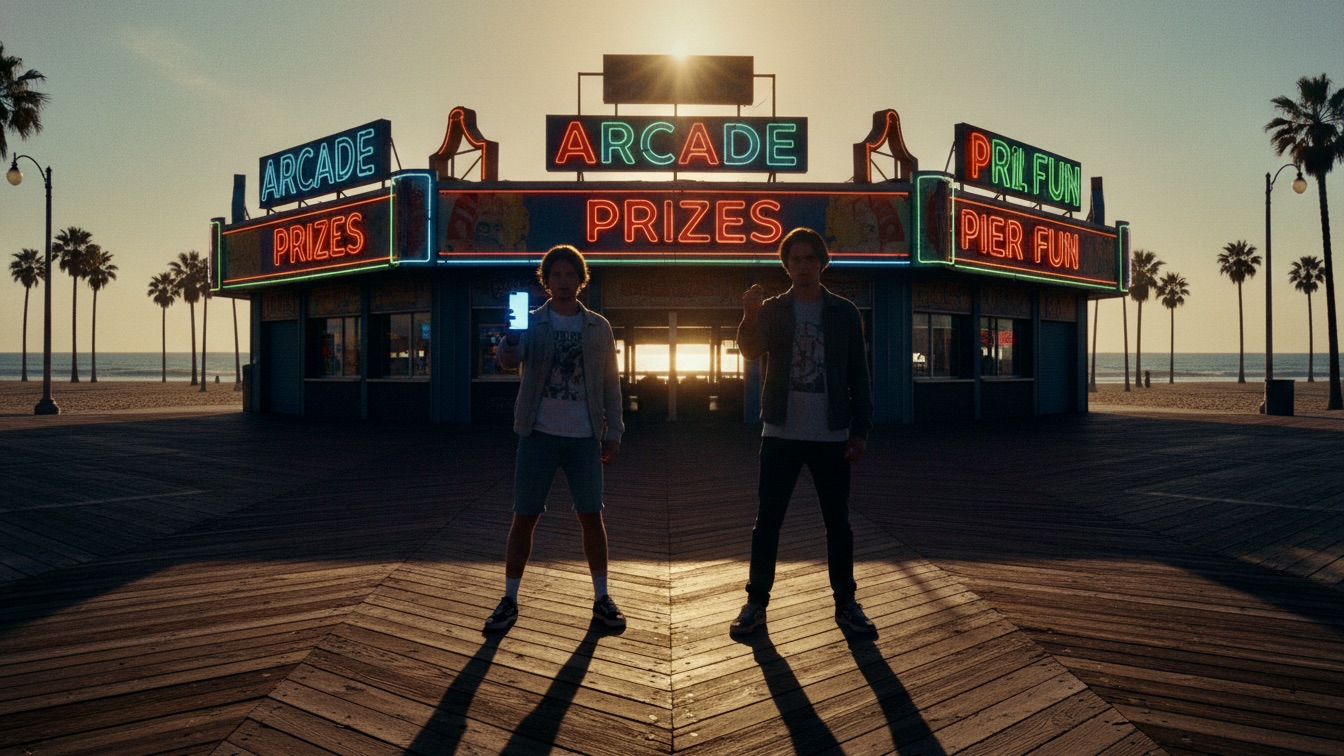
He stared at the brass coin in her hand, the metal warm against the sticky summer air.
The heat was a physical weight pressing down on his shoulders. Ted did not look up. The screen of his phone was cracked in the top left corner, a spiderweb of glass that distorted the green delivery route. His thumb swiped. A drone three miles away adjusted its altitude over the gentrified sprawl of the Santa Cruz coastline.
The device in his hand burned against his palm. The battery was running hot, baking the cheap plastic case. He ignored the sting. He needed ninety percent efficiency for the daily bonus. The app currently displayed eighty-nine.
He stepped forward. His sneakers stuck to the spilled syrup on the wooden planks of the boardwalk. The crowd around him was a blur of sunburns, expensive linen, and identical smart-visors. No one looked at each other. Everyone was looking at their overlays. The summer sun beat down, harsh and unforgiving, turning the air into a thick soup of humidity and fry grease.
"Warning," the app flashed. "Trajectory deviation. Correcting."
Ted tapped the screen twice. His heart rate spiked. A tiny red line in the corner of his vision indicated his stress levels were being logged by the gig platform. If he panicked, his insurance premiums would go up. He took a shallow breath, locking his jaw, and forced his thumb to move with mechanical precision.
He was so focused on the pixelated map that he did not see the figure stepping into his path.
A shoulder slammed hard into his chest.
Ted stumbled backward. The phone slipped from his sweat-slicked fingers. He lunged, catching it with both hands just inches from the sticky wood. His chest heaved. Acid burned the back of his throat.
"Watch your vector," Ted snapped, his eyes still glued to the screen to ensure the drone had not crashed.
"Look at me."
The voice was sharp. It cut through the digital noise of the arcade behind them. It was not a voice filtered through a synthetic translator. It was raw.
Ted dragged his eyes upward.
Rick stood there. She was not wearing her visor. Her face was bare, exposed to the glaring sunlight. Her pupils were dilated. She looked terrified, but her posture was entirely rigid.
"You threw your glass away," Ted said.
"I drowned it," Rick said. Her voice was flat, theatrical in its deadpan delivery. "It is at the bottom of the bay. Sinking."
"They will fine you for littering corporate property."
"They will have to find me first."
Ted shook his head. He looked down at his phone. The drone was hovering. He was wasting time. "I do not have time for a protest today, Rick. I am at eighty-nine percent. One more drop and I can pay my server tax."
"Shut the app down," Rick said.
"No."
"Shut it down, Ted. They are watching everything. The new ordinance went live an hour ago. Every camera, every mic, every transaction. It is a closed loop. They are sealing the city."
"I am working," Ted said. His voice cracked. He hated how weak he sounded.
Rick stepped closer. She grabbed his wrist. Her fingers were freezing cold despite the blazing heat. The physical contact shocked him. Nobody touched anymore.
She opened her other hand. Resting in her palm was a heavy brass coin. It looked like an old arcade token, but the center was hollowed out, replaced with uneven, hand-soldered copper wires.
"What is that," Ted asked, his eyes darting from the coin to her face.
"The way out," Rick said. "It is a physical key. A dead drop for the mesh network. We are building an offline grid, Ted. Splicing the old lines. Bypassing the servers."
Ted stared at the copper. It caught the sunlight, gleaming with an ugly, analog realness. It was not a projection. It was heavy metal.
Suddenly, his phone vibrated so violently it numbed his fingers.
The drone UI vanished. A massive red banner dropped across his screen. An emergency alert override. The device locked out his controls.
A high-resolution image of Rick's face appeared on his screen. It was not an old photo. It was a still frame captured from a boardwalk security camera less than five seconds ago.
The text beneath her face pulsed in bright white letters.
BOUNTY ALERT. TARGET IDENTIFIED. 50,000 CRYPTO-CREDITS FOR CURRENT LOCATION PING.
Ted stopped breathing. Fifty thousand credits. That was a year of rent. That was a ticket out of the gig cycle. That was freedom. All he had to do was press the green button flashing at the bottom of the screen.
He looked at Rick.
Rick looked at the screen. She saw the flashing green button. She did not flinch.
"You have a choice to make, Ted," Rick said.
"They will kill my account if I ignore a priority bounty," Ted whispered.
"They will kill me if you press it."
Ted's thumb hovered over the glass. The heat of the phone was unbearable. The world around them continued to move. Tourists with visors walked past, completely blind to the standoff.
Over Rick's shoulder, fifty yards down the pier, three men cut through the crowd. They wore unmarked grey polo shirts. They had thick necks and earpieces. They moved with aggressive, practiced efficiency. Private security contractors. The conglomerate's physical scrubbers.
"They are here," Ted said.
Rick turned her head. She saw the men in grey. She looked back at Ted.
"Run," she said.
She took off toward the neon facade of the arcade.
Ted stood frozen for a fraction of a second. The green button pulsed. His rating. His life. He looked at the men in grey closing the distance. He looked at the retreating back of his oldest friend.
He shoved the phone into his pocket and ran after her.
The transition from the blazing summer sun to the artificial gloom of the arcade was a physical shock. The air conditioning blasted against Ted's sweat-soaked shirt, raising goosebumps on his arms. The noise was a solid wall of sound. Chiptunes, heavy bass lines, and the rapid-fire clatter of ticket dispensers merged into a deafening roar.
He pushed past a group of teenagers mesmerized by a holographic fighting game. Rick was ten feet ahead, weaving through the narrow aisles of flashing cabinets.
"Keep moving," Rick yelled over the noise.
Ted glanced over his shoulder. The men in grey had entered the arcade. They were not running. They were walking fast, sweeping their eyes over the crowd. One of them tapped his earpiece, his gaze locking onto the back of Ted's head.
"They see us," Ted gasped.
Rick did not slow down. She hooked a hard left past a bank of obsolete pinball machines and threw herself through a curtain of heavy black velvet.
Ted followed her, the thick fabric brushing against his face.
He stumbled into a corridor of glass. The neon sign above the entrance flickered: INFINITY MAZE.
Red and blue LED strips ran along the floorboards, reflecting endlessly into the mirrored walls. Every direction looked identical. A thousand Teds and a thousand Ricks stretched out into infinity.
"Where do we go," Ted asked, his voice bouncing off the glass.
"Follow the scuff marks on the floor," Rick said. "The digital map is randomized, but the physical floorboards never change. Left here."
Ted turned left. He slammed his shoulder into a solid sheet of glass.
Pain flared in his collarbone. He hissed, grabbing his arm.
"I said the floorboards, not the reflection," Rick snapped, grabbing his shirt and pulling him down a different corridor.
Behind them, the velvet curtain ripped open.
Heavy combat boots hit the wooden floor. The men in grey were inside.
"Target acquired. Sector seven. Closing in," a deep voice echoed through the maze.
Ted's pocket began to vibrate again. It was not a steady buzz. It was a frantic, erratic pulse.
He pulled his phone out. The screen was completely red.
PROXIMITY ALERT. TARGET ACQUISITION IMMINENT. TRANSMITTING COORDINATES.
"Rick," Ted said, panic rising in his throat. "My phone. It is broadcasting our location to their local network."
Rick stopped. She turned around. The blue LEDs cast harsh shadows across her face.
"Drop it," she said.
"I cannot," Ted said. "My banking nodes are tied to the hardware ID. My medical records. If I drop it, I am wiped. I become an unverified citizen."
"You are already a target, Ted. Look at the screen. You are an accessory to network treason. Drop the box."
Footsteps echoed around them. The heavy boots were moving faster now, guided by the precise coordinates pinging from Ted's hand.
"Turn it off," Ted muttered, frantically swiping at the screen. "Just turn the power off."
"They locked the hardware switch," Rick said. "You know they did. It is a brick with a tracker. Drop it."
Ted stared at the device. It was his entire life. Every rating, every credit, every digital memory he possessed was locked inside the overheating plastic shell.
He looked down. Next to his feet was a puddle of condensation dripping from a faulty air conditioning vent in the ceiling. The water was grimy, mixed with years of spilled soda and dirt.
The footsteps were one corridor away. A flashlight beam swept across the mirrors, creating a blinding kaleidoscope of white light.
"Now," Rick commanded.
Ted opened his hand.
The phone fell.
It hit the puddle with a dull splash. The cracked glass of the screen spider-webbed further. The red light flickered, sputtered, and died.
The vibration stopped.
The sudden silence in Ted's hand was profound. It felt like a phantom limb had been severed. A massive wave of nausea hit him, followed by a terrifying, absolute emptiness. He was offline.
"Go," Rick said.
She grabbed his shoulder and shoved him forward. They sprinted down the final mirrored corridor and crashed through the exit door, spilling out into a dark, abandoned maintenance hallway behind the arcade.
The air here smelled of dust and old ozone.
Rick slammed the heavy metal door shut behind them and threw the deadbolt.
"They will trace the last ping to the puddle," Rick said, her chest heaving. "We have maybe four minutes before they breach this door."
Ted looked at his empty hands. He rubbed his thumb against his fingers. He felt nothing but his own skin.
"I am dead," Ted whispered.
"You are awake," Rick said. She held up the copper token. "Now we have to finish this."
The maintenance hallway led to a rusted steel grate in the floor. Rick dropped to her knees, hooking her fingers into the metal latticework. She grunted, pulling upward. The grate screamed against its frame, a shrill grinding of metal on metal that made Ted flinch.
"Help me," she demanded.
Ted dropped down beside her. He grabbed the cold steel. The rough texture bit into his palms. He had not done physical labor that did not involve a touchscreen in years. They pulled together. The grate popped loose, revealing a dark, vertical shaft plunging down into the underbelly of the pier.
"Climb down," Rick said.
"I cannot see anything."
"Use your hands. Trust the ladder."
Rick swung her legs over the edge and disappeared into the darkness.
Ted hesitated. The air rising from the shaft smelled of rotting kelp, salt, and damp concrete. It was the smell of the ocean, unscrubbed by the city's air purifiers. He took a breath, the harsh scent burning his lungs, and lowered himself down.
The rungs of the ladder were coated in a slimy layer of sea salt and rust. His sneakers slipped on the third rung. He caught himself, his shoulder slamming into the concrete wall. The pain was sharp, immediate, and entirely real. There was no biometric alert. No warning banner. Just the throb of bruised muscle.
He reached the bottom. His feet hit wet sand.
It was pitch black beneath the boardwalk. Above them, the massive wooden pylons supported the weight of the arcade and the tourist promenade. The rhythmic thumping of footsteps from the crowd above sounded like a distant heartbeat.
"Keep your hand on the wall," Rick whispered from the dark. "Count the concrete pylons. We need to go seven past the main support leg."
Ted pressed his right hand against the damp, barnacle-encrusted concrete. He walked forward blindly. The sand shifted under his weight. Water sloshed against his ankles, cold and shocking.
"One," Ted counted.
He heard the distant wail of a police siren from the city streets above. They were mobilizing. The conglomerate did not mess around with rogue nodes.
"Two."
He scraped his palm against a sharp cluster of barnacles. The skin tore. He felt the warm trickle of blood sliding down his wrist. He did not stop.
"Three."
"They are going to flood the grid with fake updates," Rick said, her voice floating back to him. "Try to isolate our frequency. That is why we need the analog transmitter. It operates on a wavelength they stopped monitoring forty years ago."
"Four," Ted said. "Where is the transmitter."
"The old lighthouse. The one they condemned when they built the new seawall."
"Five."
Ted's eyes were adjusting to the gloom. Thin slivers of sunlight pierced through the cracks in the boardwalk above, cutting through the dusty air like laser beams.
"Six."
He could see Rick's silhouette now. She was moving with purpose, navigating the physical geography of the pier not by an overlay map, but by memory and touch.
"Seven," Ted said.
Rick stopped. She turned to the left.
Looming in the shadows was the base of the old lighthouse. It was a massive structure of weathered stone and rotting timber, completely cut off from the main promenade. The heavy iron door at its base was rusted shut, secured by a thick steel chain.
Rick reached into her pocket and pulled out a heavy pair of bolt cutters.
"Where did you get those," Ted asked.
"The physical world is full of useful things people forget to lock up," Rick said.
She clamped the cutters onto the chain and threw her entire body weight onto the handles. The metal groaned, then snapped with a loud crack.
She pulled the chain loose. The iron door hung slightly ajar.
Suddenly, a bright beam of light swept across the sand fifty yards behind them.
"They are under the pier," a voice shouted over a megaphone.
The men in grey had found the shaft.
"Get inside," Rick screamed.
Ted shoved the heavy iron door open. The hinges screamed in protest. They piled into the darkness of the lighthouse base, slamming the door shut behind them.
The inside of the lighthouse was a cylindrical tomb of brick and dust. A narrow spiral staircase wound its way up into the darkness.
"Barricade the door," Rick ordered, already sprinting up the first flight of iron stairs.
Ted looked around frantically. The room was mostly empty, save for a pile of discarded industrial equipment. He grabbed a heavy steel pipe, at least four feet long, and jammed it through the rusted handle of the iron door, wedging the other end against a gap in the brick floor.
Outside, heavy boots hit the sand.
"Breach it," a muffled voice commanded.
A massive impact hit the door. The iron shuddered. The steel pipe groaned, bending slightly under the pressure.
Ted backed away, his chest heaving. He turned and ran up the stairs.
His legs burned. The air grew hotter and thinner the higher he climbed. He reached the top level, bursting into the glass-enclosed lantern room.
The view was staggering. The entire ocean stretched out before them, blazing under the afternoon sun. But Ted did not look at the water.
In the center of the room, sitting on a makeshift wooden desk, was an ancient, bulky machine. It had physical dials, vacuum tubes, and a heavy brass port. A pirate radio transmitter.
Rick was frantically twisting dials, her fingers flying over the analog interface. Static crackled from a dusty speaker mounted to the wall.
"Is it working," Ted yelled over the static.
"It needs the key," Rick said.
She slammed the copper token into the brass port.
The machine hummed. A low, physical vibration shook the wooden floorboards. A row of green analog bulbs flickered to life one by one.
Downstairs, a massive crash echoed up the shaft. The steel pipe had failed. The door was open.
"They are inside," Ted shouted.
He could hear the heavy boots pounding on the metal stairs, spiraling upward.
Rick grabbed a heavy microphone attached to the transmitter. She flipped a red toggle switch.
"Broadcasting on all open frequencies," Rick said into the mic. Her voice was steady, projecting power. "This is the mesh. We have the logs. The conglomerate is bypassing the privacy charter. We are uploading the unencrypted surveillance data now. Read it yourselves."
She hit a heavy, mechanical button on the console.
A loud, piercing tone blasted from the speaker, followed by a rapid-fire sequence of digital screeches. Data being transmitted over analog soundwaves.
The footsteps on the stairs abruptly stopped.
Ted held his breath.
From the boardwalk outside, a new sound rose up. It started as a murmur, a confused ripple through the crowd. Then, it grew.
Millions of unencrypted files, suddenly flooding every personal device, every smart-visor, every public screen within a ten-mile radius. The truth, raw and undeniable, crashing the system.
"Abort," a voice yelled from the stairwell. It was the security team leader. "The data is out. We are compromised. Fall back."
The heavy boots retreated, clattering rapidly down the stairs and out the door.
Ted stood frozen. The loud tone of the broadcast continued to drone from the machine, a relentless siren of victory.
Rick reached out and flipped the microphone switch off. The room plunged into a ringing silence.
She turned to look at Ted. She was exhausted, covered in sweat and dirt, but she was smiling.
Ted walked over to the shattered glass window of the lighthouse. He looked out at the boardwalk. The orderly flow of the crowd had broken. People were ripping their visors off. They were shouting, pointing at their screens, looking at each other in shock and anger. The perfect, silent loop of the city was shattered.
Ted took a deep breath. For the first time in years, the constant, suffocating anxiety in the center of his chest was gone. There was no app to check. No rating to maintain. No digital tether pulling him back.
He felt the ocean breeze blow through the broken glass, cool and sharp against his bruised face. He tasted the salt on his lips.
Rick walked up beside him. She reached into her pocket.
She pulled out a second brass token and held it out to him.
Ted did not hesitate. He closed his hand around the metal, feeling the hard edges of something real.
“He closed his hand around the metal, feeling the hard edges of something real.”


