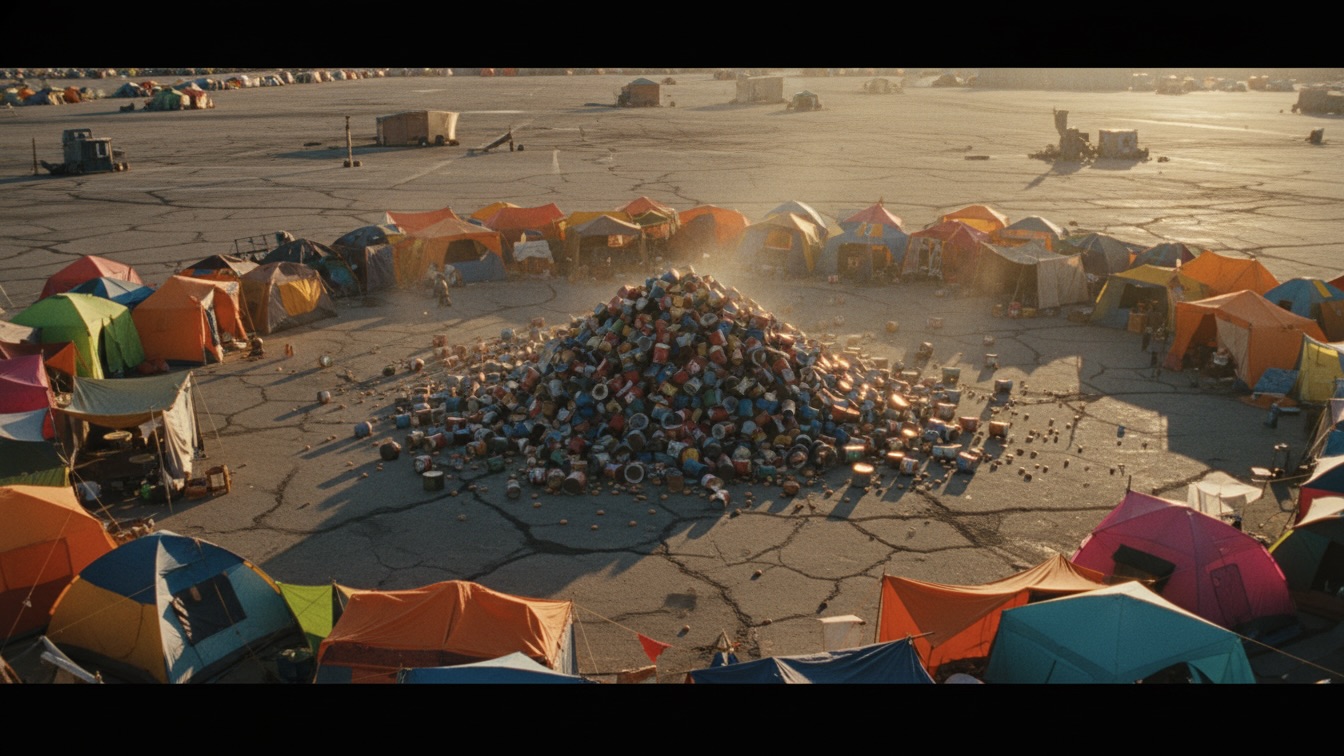
One thousand one hundred and fifty-two cans of peaches do not just evaporate into the July heat.
The warehouse ceiling is corrugated tin, which means by two in the afternoon, the entire building acts like a convection oven. My shirt is glued to my spine. The clipboard in my hands is warping from the humidity. I wipe a bead of sweat out of my left eye with the back of my wrist, smudging ink across my cheek, but I do not stop counting.
Seventeen boxes of generic elbow macaroni. Twelve boxes of instant mashed potatoes. Four flats of crushed tomatoes. The numbers are supposed to be neat. They are supposed to fit into the grid on my spreadsheet, creating a solid, undeniable geometry of survival. But the grid is broken today.
The provincial government cut our operating grant by forty percent last Tuesday. The email arrived at 9:14 AM. Brenda cried in her office for twenty minutes, then came out and told us to ration the peanut butter. Forty percent is a violent number. It means forty percent less food, forty percent more people screaming in the lobby, forty percent more space on the metal shelving units that I am currently staring at.
But the cut does not explain the peaches.
I tap the end of my pen against the metal rack. Tap. Tap. Tap. The rhythm helps filter out the static in my head. The static has been loud lately. It sounds like radio interference, a buzzing hum behind my eyes that flares up when the geometry is wrong.
We received exactly four pallets of Del Monte canned peaches, halves in heavy syrup, on June 1st. I signed for them. I counted them. Forty-eight cases per pallet. Twenty-four cans per case. That is one thousand one hundred and fifty-two cans per pallet.
Pallet 1 is gone, distributed over the last three weeks. Pallet 2 is currently half-empty in the active sorting bin. Pallet 3 is sitting in the overflow corner.
Pallet 4 is missing.
I walk to the exact spot where it should be. The concrete floor here is cleaner than the surrounding area, a perfect square of dust-free gray where a wooden skid used to rest. I crouch down. I press my palm against the concrete. It is warm.
"Evan," a voice says.
I flinch, my shoulder hitting the metal rack. Gary is standing at the end of the aisle. He is holding a clipboard of his own, wearing his usual khaki cargo shorts and a faded polo shirt. He looks like a guy who owns a boat, not a guy who volunteers at a failing food bank.
"You're blocking the tomato paste," Gary says.
I stand up. My knees pop. "Pallet 4B is missing."
Gary frowns, adjusting his glasses. "What?"
"The peaches. We had four pallets. There are only two and a half left. The math is wrong. The math is explicitly, physically wrong."
"Probably just went out in the morning rush," Gary says. He waves his hand like he is swatting a fly. "We had a line around the block today. Heat makes people hungry."
"You do not distribute one thousand one hundred and fifty-two cans of peaches in a single morning," I say, the words coming out faster than I intend. "That is a logistical impossibility. The weight alone requires a forklift, which Brenda sold in May to pay the hydro bill. Someone moved it."
Gary sighs. It is a heavy, tired sound. "Take it up with Brenda, kid. I just need the tomato paste."
I step aside. The static in my head pitches up an octave. I watch Gary load six flats of tomato paste onto a rusted hand truck. He does not look at the empty square on the floor. He does not care that the geometry is broken.
I leave the warehouse and push through the swinging double doors into the administrative hallway. The air conditioning in here is broken, too. Brenda's office door is cracked open. She is sitting behind her desk, staring at a stack of unpaid invoices. A small desk fan oscillates, blowing hot air directly into her face. Her gray hair is frizzy, escaping its messy bun.
I walk in without knocking.
"Brenda. We have a discrepancy."
She does not look up. "Evan, I swear to God, if it's about the expired yogurt again, I told you to just throw it out. I don't care what the date says. If it's swelling, it's garbage."
"It is not the yogurt. It is the peaches."
Now she looks up. Her eyes are red-rimmed. "What about them?"
"An entire pallet is missing. One thousand one hundred and fifty-two cans."
Brenda rubs her temples. "Okay. It's an administrative error. Someone didn't log the outbound load correctly. We'll adjust the spreadsheet."
"You cannot adjust a physical void," I say, my voice rising. "It is not a typo. The physical mass of the food is gone. We are in a deficit. If we do not have the peaches, the caloric output for the week drops by six percent. People will not get their sugar intake. They will crash. The system will fail."
"Evan," she snaps. Her voice is sharp, cutting through the hum of the fan. "Stop. Just stop. I don't have the bandwidth for this today. The city just cut our funding again. I am trying to figure out how to pay the lease on this building so we don't end up on the street with our clients. I do not care about the peaches."
My chest tightens. The air in the room suddenly feels too thick to breathe. "It is a localized anomaly. It means the system is compromised."
"It means someone forgot to write something down," she says, her tone softening just a fraction, shifting into the placating voice she uses when she thinks I am having an episode. "Just go back to the floor. Count the beans. Please."
I stare at her. I look at the fan. I look at the invoices.
"Okay," I say.
I turn around and walk out. I do not go back to the warehouse. I clock out early. The static is deafening now. It is not an administrative error. I know what a glitch looks like. Someone took the peaches. And I am going to find out who.
My apartment is technically a basement, but in July, it functions more like a terrarium. The single window at street level lets in a sliver of blinding sunlight and the constant sound of tires rolling over sticky asphalt. I do not own an air conditioner. I own three box fans, and currently, all three are pointed at the wall in my living room.
The wall is covered in flattened cardboard boxes. I dragged them out of the food bank's recycling dumpster. They smell like old produce and dust. I spent the last four hours pinning them up, creating a massive, blank canvas.
I sit cross-legged on the floor, holding a spool of red heavy-duty sewing thread and a plastic container of thumbtacks. My brain is vibrating.
I place a green thumbtack in the center of the cardboard.
"Pallet 4B," I say aloud.
I place a blue thumbtack to the left. "The Warehouse."
I connect them with a piece of red thread.
I spend the next hour charting the delivery schedule. I pull up the volunteer roster on my phone, ignoring the cracked glass that distorts the names. Gary. Sarah. Mark. The weekend crew. The drivers. I assign them yellow thumbtacks. I string them up.
The logic of the world is broken, which means the solution requires unconventional geometry. The government cut the funding. The peaches disappeared. The correlation is not causation, but the timing is a statistical anomaly. My mind spirals, latching onto fragments of internet forums and late-night doomscrolling. Is it a psy-op? Is the city intentionally starving out the downtown core to justify a real estate sweep? Are the peaches being stockpiled in a bunker in the suburbs?
I shake my head. The physical movement rattles the thoughts loose. Focus on the cans.
I need data.
I leave the apartment. The heat hits me like a physical wall the second I step onto the sidewalk. The pavement is radiating waves of distortion, making the parked cars look like they are vibrating. I walk four blocks toward the shelter.
The usual crowd is outside, seeking whatever narrow strips of shade they can find against the brick buildings. It is too hot to even panhandle. People are just surviving the afternoon.
I approach a man named Steve. He is sitting on a milk crate, trying to fix a broken portable radio. His hands are shaking.
"Steve," I say.
He squints up at me. "Evan. You got water?"
"No. I have this." I pull a single cigarette from my pocket. I do not smoke, but I buy them because they are the most stable currency on this block.
Steve's eyes track the white cylinder. "What do you want?"
"Information regarding the distribution of canned fruit."
He laughs, a dry, hacking sound. "Fruit? Man, I haven't seen fresh fruit since May."
"Not fresh. Canned. Del Monte peaches. Have you seen anyone moving bulk quantities outside of the food bank's standard operating hours?"
Steve takes the cigarette. He tucks it behind his ear. "Nobody is moving bulk anything, kid. Everyone's broke. The clinic has been dry, the shelter is full. It's a ghost town."
"Think. A pallet. Heavy machinery or a large van."
Steve shrugs. "Saw a white van over by the methadone clinic two nights ago. Looked like your food bank van, but it was midnight. Thought you guys parked it."
My heart skips a beat. "The clinic? We do not deliver to the clinic."
"Well, the van was there. Parked by the alley."
I turn and walk away before he finishes his sentence. The methadone clinic is three blocks east, right on the edge of the industrial park. I walk fast, my sneakers sticking slightly to the melting tar on the road.
The clinic is closed for the afternoon. The alley beside it is narrow, choked with garbage bags and broken glass. I step into the shade of the alley. It is cooler here, but the air is stagnant.
I scan the ground. Cigarette butts. Needles. Fast food wrappers.
Then I see it.
Near the back door of the clinic, resting in a sticky, dark puddle that looks alarmingly like dried blood mixed with syrup, is a crushed aluminum can.
I crouch down. I do not touch the puddle. I look at the label.
Del Monte. Halves in heavy syrup.
My breath catches in my throat. I look around the alley. There are tire tracks in the dirt near the puddle. Wide tracks. Delivery van tracks.
Why would the van be here? Why would a single can be crushed in the dirt? The geometry is expanding. The thumbtacks in my mind are multiplying, red string crisscrossing into a chaotic web.
Someone is not just stealing the food. They are moving it through the darkest parts of the city. The static in my head turns into a roar.
The food bank's delivery van is a 2012 Ford Transit. It is white, rusting around the wheel wells, and has a permanent squeak in the rear suspension. Gary is the primary driver.
I wait across the street from the food bank until 5:00 PM. I sit on a bus bench, letting the sun cook my shoulders, watching the front doors. Gary comes out at 5:15. He unlocks the van, climbs in, and pulls out into traffic.
I have my bicycle. I follow him.
Following a van on a bike in rush hour traffic is a specific kind of torture, but the adrenaline keeps my legs moving. I track the white roof of the Transit through the downtown grid, waiting for him to turn toward the shelter or the community center.
He doesn't.
He turns north. He crosses the bridge. He heads into the suburbs.
The environment shifts drastically. The concrete and cracked asphalt give way to wide, smooth roads lined with mature oak trees. The temperature visibly drops as we enter a neighborhood of sprawling houses with manicured lawns and automated sprinkler systems. The water from the sprinklers arcs through the air, catching the late afternoon sun like tiny prisms.
It is a different planet.
Gary pulls the van into a wide driveway belonging to a house with a massive brick facade and a three-car garage. I stop my bike halfway down the block, hiding behind a massive cedar hedge. My chest is heaving. My lungs burn.
I watch as a man in a polo shirt comes out of the house. He shakes Gary's hand. Gary opens the back of the van.
They do not pull out peaches. They pull out boxes of pasta, flats of canned soup, and bags of rice. The premium donations. The stuff we never seem to have enough of downtown. They carry it into the garage.
My brain glitches. The red string snaps.
He isn't dumping it. He is selling it.
I wait until the man hands Gary an envelope. A thick, white envelope. Gary pockets it, gets back in the van, and drives away.
I follow him again. He doesn't go far. He pulls into a massive suburban strip mall and parks near the back of a Tim Hortons lot. He gets out, walks up to the drive-thru window on foot—which is technically against store policy—and grabs a coffee he must have mobile-ordered.
I ride my bike directly into the middle of the parking lot and drop it on the pavement. The metal frame clatters loudly.
Gary turns around. He is holding an iced coffee. He stops when he sees me.
"Evan?" he says. He looks confused, then his face hardens. "What the hell are you doing out here?"
I walk toward him. My hands are balled into fists. The heat radiating off the asphalt is intense.
"You sold the peaches," I say. My voice does not sound like my own. It is flat, robotic.
Gary takes a sip of his coffee. He looks around the empty parking lot. "You followed me."
"You took one thousand one hundred and fifty-two cans of peaches. You took the pasta. You took the rice. You are taking the caloric foundation of the downtown core and you are exchanging it for currency in a high-income postal code. The geometry is corrupt."
"Evan, go home," Gary says, his voice low. "You don't understand what you're looking at."
"I understand math!" I scream. The volume surprises both of us. A seagull on a nearby lamppost takes flight. "I understand that people are starving on the pavement while you are handing boxes of food to a man with a sprinkler system!"
Gary steps toward me. He throws his iced coffee on the ground. The plastic cup shatters, ice cubes skittering across the hot asphalt.
"You think you know everything because you can count cans?" Gary yells back, his face turning red. "You think your little spreadsheet is the whole world?"
"It is the truth! The numbers are the truth!"
"The numbers are garbage!" Gary roars. He grabs his own hair, looking wildly frustrated. "My son is dying, Evan. Do you get that? He's twenty-two and he's strung out on fentanyl. The public rehab program has an eight-month waitlist. Eight months. He'll be dead in two."
I freeze. The data does not compute.
"The private clinic costs four thousand dollars a month," Gary says, his voice breaking, the anger dissolving into a frantic, pathetic desperation. "I don't have it. I fix that damn van for free. I volunteer my time. I do everything right, and the system still let my kid fall through the cracks."
He points a trembling finger at me.
"So yeah. I found a prepper in the suburbs who wants to stock his basement for the apocalypse. I sell him the surplus. I take the cash. And I pay for the bed at the clinic. I'm keeping my son alive."
My stomach turns over. The heat is suffocating. I look at the melted ice on the ground, mixing with the spilled coffee.
"It is our food," I whisper.
"It's survival," Gary says bitterly. "Grow up, Evan. The world isn't a spreadsheet. It's a meat grinder."
I do not remember the bike ride back to the city. My brain is trapped in a loop. The numbers are tainted. The inventory is a lie. If Gary is stealing to save his son, and the people downtown are starving because the food is gone, who is the variable to blame? The geometry of morality is fundamentally broken. There is no straight line.
I walk into the food bank the next morning. The air is already stifling. The line outside wraps around the block. People look exhausted, beaten down by the relentless summer sun.
I walk straight past the sorting bins, past the empty space where Pallet 4B used to be, and into the administrative hallway.
Brenda's door is open. She is on the phone. I walk in and stand in front of her desk. She holds up a finger, finishes her sentence, and hangs up.
"Evan. I need you to count the cereal boxes, we're running low—"
"Gary is selling the inventory," I say.
Brenda stops. She looks at her desk. She does not look surprised. She does not look angry. She just looks impossibly old.
"I know," she says softly.
My throat clicks closed. The static in my head hits a frequency so high it physically hurts behind my eyes. "You know."
"Evan, sit down."
"You know he is stealing the food."
"He is fixing the van, Evan!" Brenda snaps, slamming her hand on the desk. "Do you know what a new transmission costs? Three thousand dollars. We don't have it. The city cut our funding. If the van dies, we can't do pickups from the grocery stores. If we can't do pickups, we lose seventy percent of our weekly intake. We all go under."
She rubs her face, her shoulders slumping.
"Gary keeps the van running. He pays for the parts himself. I look the other way on the surplus. It's a trade. It's the only way to keep the doors open."
"It is corrupt," I say, my voice trembling. "It is a compromise of the foundational directive."
"It's reality!" she yells. "It's broken, and it's ugly, and it's the only thing keeping those people outside from starving completely. We are bailing out a sinking ship with a teacup. Don't you dare come in here and quote directives to me."
My chest is heaving. The walls of the office feel like they are closing in. The fan is blowing hot air on me, but I feel cold. The entire system is held together by misery and theft. The government starves us, Gary steals from us, Brenda lies to us, and the people on the street get nothing.
I turn around and walk out.
"Evan!" Brenda calls after me. "Evan, wait!"
I do not wait. I walk into the warehouse.
Pallet 2 is sitting in the center of the floor. It is stacked with cases of baked beans. Heavily processed, high sodium, dense caloric weight.
I walk over to the rusted hand truck. I kick the brake release. I slide the metal plate under the edge of a stack of six cases. I tilt it back. The weight is massive, straining my arms, but the adrenaline makes me numb.
I roll the hand truck out the back loading dock doors. The morning heat hits me instantly.
I push the truck down the alley. I do not stop at the front doors of the food bank. I do not put the beans on the shelves to be rationed by Brenda or stolen by Gary.
I push the cart three blocks, the wheels clattering violently over the cracked sidewalk. Sweat pours down my face, stinging my eyes.
I reach the intersection near the shelter. The encampment is a sprawl of tents and tarps baking in the sun. Steve is sitting on his milk crate, looking half-dead.
I push the hand truck directly into the center of the asphalt clearing.
I unclip the strap. I push the boxes off the truck. They hit the ground with a heavy, satisfying thud. Cardboard tears. A few cans roll across the street, glinting in the sunlight.
People start to look up from their tents.
"Here," I say, breathless, my voice cracking. "Beans."
Steve stands up slowly. He looks at the cases, then looks at me.
I leave the hand truck in the middle of the street and start walking away. I do not know where I am going. I just know I cannot go back to the spreadsheet. The numbers are meaningless now.
“As I walked away, the sound of tearing cardboard echoed behind me, drowning out the static in my head for the very first time.”


