I watched the fresh tar steam while the city erased the evidence of Van Klint’s final digital breakdown.
The bus didn't have AC. It was a 2012 New Flyer model with the windows that only cracked open three inches at the top, and the air inside was a stagnant soup of recycled breath and body heat. I sat near the back, my thighs sticking to the cracked vinyl seat. Every time the driver hit a pothole—and this was Winnipeg, so he hit one every thirty feet—the frame of the bus groaned like a dying animal. I kept my hand in my pocket, gripping my phone. The metal was hot. I wasn't sure if it was the sun or the recording of Van Klint’s confession burning through the battery. It felt heavy. It felt like a physical weight that was going to drag me through the floor of the bus and onto the melting pavement below.
I looked at the people around me. A woman in a faded nursing uniform was staring at a cracked screen, her thumb moving in a rhythmic, mindless scroll. A guy with a neck tattoo was nodding off, his head lolling with the rhythm of the stops. Nobody cared about the 'Traffic Cone King'. Nobody cared that the guy who decided which streets got plowed in the winter was currently sitting in the yellow grass of a South Osborne park waiting for the handcuffs to click. They just wanted to get to their shifts. They just wanted the heat to break. I felt a surge of that specific teenage nihilism—the realization that you can uncover the biggest conspiracy in the city and it won't change the price of a bus pass.
I got off at Maryland. The stop was right in front of a shuttered pharmacy with 'GOD IS TIRED' spray-painted across the plywood. The construction crew was still there. They had finished the pour. My driveway was a smooth, obsidian-black rectangle that looked completely out of place against the crumbling brick of my apartment building. It looked like a scab. A fresh, expensive scab on a body that was already rotting. The foreman was leaning against the side of his truck, checking a digital tablet. He didn't look at me as I walked past. I was just a ghost in his work order.
I walked into the lobby of my building. The radiator in the corner was clicking, even though it was eighty-five degrees out. The hallway was a tunnel of yellow light and peeling wallpaper. I climbed the stairs, my sneakers squeaking on the linoleum. My head was pounding. The static from the morning—the noise of the steamroller, the shouting, the high-pitched hum of Sheila’s PC—was still vibrating in my skull. I needed a shower, but the water in this building usually came out the color of weak tea and twice as hot as the air.
I reached my door and stopped. There was a sticker on the frame. A bright, neon-orange circle with a QR code in the middle. No text. Just the code. I pulled out my phone and scanned it. My browser opened to a dead link. 404 Error. The page you are looking for has been moved or deleted. I looked down the hallway. The other doors were clean. Just mine. Just the kid who knew too much about the city’s asphalt budget. I peeled the sticker off with my thumbnail. It left a sticky, circular residue on the wood. It felt like a mark. A digital 'X' on my front door.
Inside, the apartment was a furnace. I went straight to the kitchen and drank two glasses of lukewarm tap water. It tasted like metal and old pipes. I sat at the small table by the window and looked out at the street. The crew was packing up. The steamroller was being loaded onto a flatbed. They were moving on to the next 'emergency' project. I opened my laptop and felt the fan kick in immediately, a desperate whirring sound. I plugged in my phone and began the transfer. The file was huge. High-def video of a city councillor admitting to land fraud and using TikTok as a cover for digital money laundering. It should have been a Pulitzer. Instead, it felt like a suicide note.
I called Sheila. She picked up on the first ring. The sound of her mechanical keyboard was a frantic staccato in the background. "Did you see the upload?" she asked. No 'hello'. No 'are you okay?'. Just the data.
"No," I said. "I just got back. What upload?"
"The Traffic Cone King account. It’s gone. Not just banned. Scrubbed. The handle is available again. It’s like it never existed."
"I have the recording, Sheila. He said it all on camera."
"Doesn't matter if the platform is compromised," she said. Her voice was tight. "I’m seeing pings from the Mayor’s office. They’re running a script to flag any mention of the 'Cone King' or the Norwood Bridge incident. They’re calling it a deepfake. A coordinated AI-generated harassment campaign."
"It wasn't AI. I was standing right there!"
"The algorithm doesn't care about your eyes, Darren. It cares about the flags. And right now, you’re flagged as a bad actor."
I looked at the orange residue on my doorframe. "They put a sticker on my door. A QR code."
There was a silence on the other end of the line. The keyboard noise stopped. "What did the code point to?"
"A 404 page."
"That's not a dead link," Sheila said softly. "That's a tracker. If you scanned it, they have your IP. They have your physical location confirmed. Get out of there, Darren. Now."
I didn't argue. I didn't ask questions. I grabbed my charger, a t-shirt, and the laptop. I didn't even lock the door. I just ran.
Sheila’s place was across town, tucked into a neighborhood where the trees were thick enough to hide the sagging power lines. I took three different buses to get there, a paranoid zigzag through the suburbs that felt like a slow-motion escape. By the time I reached her building, the sun was a low, angry orange on the horizon, casting long shadows that looked like bars across the pavement. I didn't use the intercom. I waited for a guy with a grocery bag to walk out and caught the door before it clicked shut. Transactional. That was the only way to move now.
Her apartment was darker than usual. The only light came from the four monitors on her desk, casting a blue, ghostly glow over her face. She looked like she hadn't slept since the first pothole was filled. She was wearing a baggy hoodie despite the heat, the sleeves pushed up to reveal wrists stained with ink. She didn't look up when I came in. She just pointed at the couch, which was covered in tangled cables and empty Soylent bottles.
"I’ve been digging into the metadata of the 'Middle Child' campaign," she said. Her voice was a dry rasp. "The forty grand Van Klint mentioned? That was just the petty cash. The real money is moving through the North End land-development sweep. They’re devaluing property by cutting services—stopping the plows, letting the potholes turn into craters, cutting the streetlights—then buying up the lots through shell companies. Then, they 're-evaluate' the area, sign an emergency infrastructure bill, and the property value triples overnight."
"And Van Klint was the distraction," I said, sitting on the edge of a stack of old hard drives. "The TikToks. The chaos. It was just noise to keep the auditors looking the other way."
"Exactly. But Van Klint got high on his own supply. He started liking the attention. He went off-script. That’s why they’re erasing him. And that’s why they’re looking for you."
She turned one of the monitors toward me. It was a spreadsheet. Thousands of rows of data. Dates, addresses, company names. It looked like a digital ledger of a city being sold piece by piece. "Look at the addresses," Sheila said.
I leaned in. 452 Selkirk. 112 Pritchard. 89 Magnus. All in the North End. Then I saw a familiar set of numbers. 142 Maryland. My building.
"They bought it?" I asked. My stomach felt like it had been filled with cold lead.
"A company called 'FlowState Infrastructure' bought the title three days ago," Sheila said. "The same company that signed the work order for your driveway. The same company that’s currently listed as a primary contractor for the city’s 'Emergency Demolition Initiative'."
"Demolition? The building is fine. It’s old, but it’s not falling down."
"It doesn't have to be falling down. It just has to be 'structurally unsound' on a PDF signed by a city inspector who’s on the FlowState payroll. And according to this document I just pulled from the municipal cache, 142 Maryland is scheduled for 'immediate hazard mitigation' starting at 8:00 AM tomorrow."
"That’s why the driveway was paved," I realized. "Not to be nice. To make sure the heavy machinery has a stable base. They weren't fixing my life. They were preparing my grave."
Sheila started typing again, her fingers moving with a violent speed. "I’m trying to export the ownership chain. If we can link the Mayor’s brother to FlowState, we have a smoking gun. But the server is fighting back. It’s like trying to pull a tooth with a pair of tweezers while someone is punching you in the face."
"Can we leak it?" I asked. "Send it to Dave?"
"Dave is part of the problem," Sheila said, not looking at me. "His paper gets half its ad revenue from the city’s 'Civic Pride' campaign. He won't touch this unless it’s a sure thing. And right now, we’re just two kids with a stolen spreadsheet and a video of a guy who’s currently being processed as a mental health patient."
I stood up and paced the small room. The heat from the computers was making it hard to breathe. The air was thick with the hum of electronics and the dry, static-filled silence of the night. I felt trapped. The city was a machine, and I was just a piece of grit in the gears. They weren't going to stop. They were going to pave over me, literally.
"I need to talk to him," I said.
"To who? Van Klint? He’s in a holding cell at the Remand Centre."
"No. To the guy who signed the paper. The foreman. Or the guy at FlowState. There has to be a human element here. Someone who isn't a line of code."
Sheila finally looked at me. Her eyes were bloodshot, the blue light reflecting in her pupils. "There is no human element, Darren. It’s all transactions. The foreman gets paid to move the truck. The driver gets paid to drop the load. The inspector gets paid to sign the form. Nobody cares about the building. They just care about the flow."
"Then we change the flow," I said. I grabbed my laptop. "Export everything you have. Put it on a physical drive. No cloud. No mesh. Just a stick."
"What are you going to do?"
"I’m going to go back to Maryland Street. If they want to knock that building down, they’re going to have to do it with me inside."
"That’s not a plan, Darren. That’s a tantrum."
"It’s the only leverage I have. They can't demolish a building with a 'vulnerable tenant' inside without a specific set of secondary approvals. It’ll buy us twenty-four hours. Maybe forty-eight. Enough time to get this data to someone who can't be bought."
Sheila stared at me for a long beat. Then she reached into a drawer and pulled out a small, encrypted USB drive. She plugged it into her machine and began the transfer. "You’re an idiot," she said. "A total, unmitigated idiot."
"Yeah," I said. "But the driveway is really smooth. It’d be a shame to waste it."
I met Dave at 3:30 AM at a 24-hour diner on Main Street called 'The Toasted Bun'. It was the kind of place that existed in a permanent state of 1974—greasy yellow booths, a pie case that looked like a museum exhibit, and the constant, low-frequency hum of a refrigerator that was probably older than my parents. The air was heavy with the taste of old frying oil and the thick, humid weight of a summer night that refused to cool down.
Dave was sitting in a corner booth, a cup of black coffee in front of him. He looked terrible. His skin was the color of damp cardboard, and the bags under his eyes were deep enough to hold a week's worth of regret. He didn't look like a journalist. He looked like a man who had just seen the bill for his own funeral.
"You shouldn't have called me," he said before I even sat down. "I told you to find him and get an interview. I didn't tell you to get yourself flagged by the municipal security grid."
"I have the interview, Dave," I said, sliding into the booth. The vinyl was cracked and bit into the backs of my legs. "I have the whole thing. The land deals, FlowState, the 'Middle Child' funding. Everything."
I pushed the USB drive across the table. It sat there on the Formica like a piece of radioactive waste. Dave didn't touch it. He just stared at it, his fingers twitching against his coffee cup.
"They're calling it a deepfake, Darren," he whispered. "The Mayor's office sent out a memo to all the major outlets at midnight. Any 'leaked' footage involving Councillor Van Klint is to be treated as a security threat. They're saying it's part of a foreign influence operation to destabilize the municipal elections."
"Foreign influence?" I almost laughed. "I'm from the North End! My foreign influence is a weekend trip to Grand Forks! Dave, you know me. You know I was there."
"It doesn't matter what I know," Dave said. He finally looked up, and his eyes were full of a weary, transactional fear. "The paper is struggling. We're one lawsuit away from folding. If I run this, and the city pulls its legal notices and its ad budget, we're done. Fifty people out of work. All for a story about a crazy councillor and some asphalt."
"It's not just asphalt!" I hissed, leaning over the table. "They're demolishing my building in five hours. They're stealing land from people who can't fight back. They're using the city's own infrastructure budget to pay for the wrecking balls. Look at the data, Dave. Just look at it."
Dave sighed and reached for the drive. He turned it over in his hand, the small light of the diner reflecting off the metal casing. "If I look at this, I'm complicit. That's the logic they're using now. Information isn't just news anymore; it's a liability."
"Since when?"
"Since the grid became the only thing that matters," Dave said. "Everyone is so caught up in the 'flow' that nobody wants to see the dam. They just want the water to keep running. They want their driveways paved and their TikToks to load in 4K. They don't care if the foundation is built on bodies."
He pocketed the drive, but he didn't look happy about it. "I'll see what I can do. But I'm not promising a front-page splash. Best I might be able to do is a 'Letter to the Editor' or a blind item in the gossip column. Something to start a trail."
"A trail won't stop a bulldozer at 8:00 AM," I said.
"Then don't be there," Dave said. "Go to Sheila's. Go to a park. Just don't be in that building. You're a kid, Darren. You're seventeen. You have your whole life to be a martyr. Don't waste it on a three-story walk-up with a roach problem."
"It's my home," I said. It sounded small. It sounded like a line from a movie I didn't want to be in. "And it's the only thing I have that's real. Everything else—the TikToks, the 'Cone King', the digital pings—it's all fake. The building is real. The asphalt is real."
I stood up. I didn't have any money for the coffee I hadn't ordered, but it didn't matter. The transaction was over. I had given him the only weapon I had, and now I was going back to the front lines with nothing but my own skin.
"Good luck, kid," Dave said. He didn't look at me as I walked away. He was already looking at his phone, probably checking to see if his own digital footprint was still clean.
Outside, the air was starting to turn that pale, pre-dawn grey. It was the coldest part of the night, which meant it was only seventy-five degrees. I started walking back toward Maryland. I didn't take the bus this time. I wanted to feel the pavement under my feet. I wanted to see the city before it woke up and started lying to itself again.
As I walked, I noticed the streetlights. They were flickering in a strange, rhythmic pattern. Not a malfunction. A signal. The mesh network was talking. I wondered if Sheila was still awake, watching the data pulse through the wires. I wondered if she could see me, a single dot moving through the silent streets, heading back toward the obsidian scab in the driveway.
I reached the corner of Maryland and Broadway just as the first hint of pink touched the sky. The city looked beautiful in this light, the way a bruise looks beautiful before it turns yellow. The old brick buildings stood like silent sentinels, unaware that their time was up. I turned the corner and saw my building. It looked small. It looked fragile.
And then I saw the trucks.
They weren't the yellow dump trucks from the morning. These were white, unmarked, with heavy-duty trailers. On the trailers were the excavators, their long, hydraulic arms folded like the legs of giant insects. There were four of them. They were idling, their diesel fumes filling the air with a thick, heavy haze.
I didn't run. I just kept walking, my sneakers hitting the fresh gravel of my driveway with a rhythmic crunch. I walked right past the lead truck, right past the driver who was drinking coffee from a thermos, and right into the front door of my building.
I didn't lock the door behind me. I wanted them to know I was there. I wanted them to have to look me in the eye before they pulled the trigger.
I sat on the floor of my apartment, right in the center of the living room. I didn't turn on the lights. I didn't need to. The morning sun was starting to bleed through the thin curtains, illuminating the dust motes dancing in the stagnant air. The building was quiet, but it wasn't a peaceful quiet. It was the silence of a held breath. The other tenants were gone. I didn't know if they had been paid off, relocated, or if they had just seen the writing on the wall and bolted. I was the only one left in the ribcage of 142 Maryland.
At 7:55 AM, the vibration started.
It wasn't like the steamroller. This was deeper. A low-frequency thrum that seemed to come from the earth itself. The excavators were being unloaded. I could hear the metal tracks grinding against the fresh asphalt of my driveway. The sound was a harsh, scraping shriek that set my teeth on edge. They were moving into position. They were setting the stage for the 'mitigation'.
I pulled out my phone. One bar of service. The mesh network was being throttled in this area. I tried to go live on TikTok, but the app just spun and spun. Connection timed out. Please try again later. The digital world was closed for business.
There was a heavy knock on my door. Not a polite knock. A rhythmic, authoritative pounding that made the wood groan.
"City inspection!" a voice shouted. It was loud, professional, and completely devoid of empathy. "Open up!"
I didn't move. I just sat there, my back against the wall, my knees pulled up to my chest.
"We know you're in there, Darren!" the voice said. It was the foreman from the day before. The guy with the blue-stained hat. "We've got the emergency order. This building is a public safety hazard. You need to evacuate immediately."
"I'm not leaving!" I yelled back. My voice sounded thin and shaky in the empty room. "I'm a legal tenant! You can't demolish a building with people inside!"
"The order says the building is at risk of imminent collapse!" the foreman shouted. I could hear the jingle of keys, the sound of a master lock being turned. "Your presence doesn't stop the order; it just makes you a liability. Don't make this harder than it has to be."
The door swung open. The foreman was standing there, holding a clipboard and a heavy-duty flashlight. Behind him were two guys in white coveralls, their faces obscured by respirators. They looked like they were here to clean up a chemical spill, not talk to a teenager.
"Look, kid," the foreman said, stepping into the room. He didn't look angry. He looked bored. "You had a good run. You got a free driveway out of it. But the clock is at zero. The machines are hot. We have a schedule to keep."
"Where's the inspector?" I asked, standing up. My legs felt like jelly. "I want to see the structural report. I want to see the signed affidavit that says this building is falling down."
The foreman held up the clipboard. "It’s all right here. Signed, sealed, and digitally verified. You want to fight it? Call a lawyer. But you do it from the sidewalk."
One of the guys in coveralls stepped forward. He reached for my arm. I backed away, tripping over an empty Gatorade bottle.
"Don't touch me!" I snapped. "I'm recording this!"
I held up my phone, but the screen was dark. The battery had finally given up, exhausted by the night's data transfers and the heat. The foreman looked at the dead phone and gave a small, cynical smile.
"Nobody’s watching, Darren," he said. "The 'Cone King' is in a padded room. The TikToks are gone. The city is moving on. You should too."
He signaled to the two men. They moved in, their movements practiced and efficient. They didn't hit me. They didn't use unnecessary force. They just grabbed me by the shoulders and started walking me toward the door. I struggled, I kicked, I tried to dead-weight myself, but they were grown men with a job to do. I was just a transaction they needed to complete before lunch.
They carried me down the stairs, my feet dragging across the linoleum I had walked a thousand times. We passed the sticker on the doorframe, the orange residue now covered in dust. We passed the radiator that was still clicking. We hit the lobby, and then we were out in the blinding morning sun.
They set me down on the sidewalk, just past the property line. A crowd of three people had gathered—a curious neighbor, a guy walking a dog, and a kid on a bike. They were all looking at the excavators, their phones out, recording the spectacle.
"Keep back!" the foreman shouted to the crowd. He pulled a roll of yellow tape from his belt and began cordoning off the area.
I stood there, breathing hard, the heat already pressing down on me. I looked at the building. It looked so solid. So permanent.
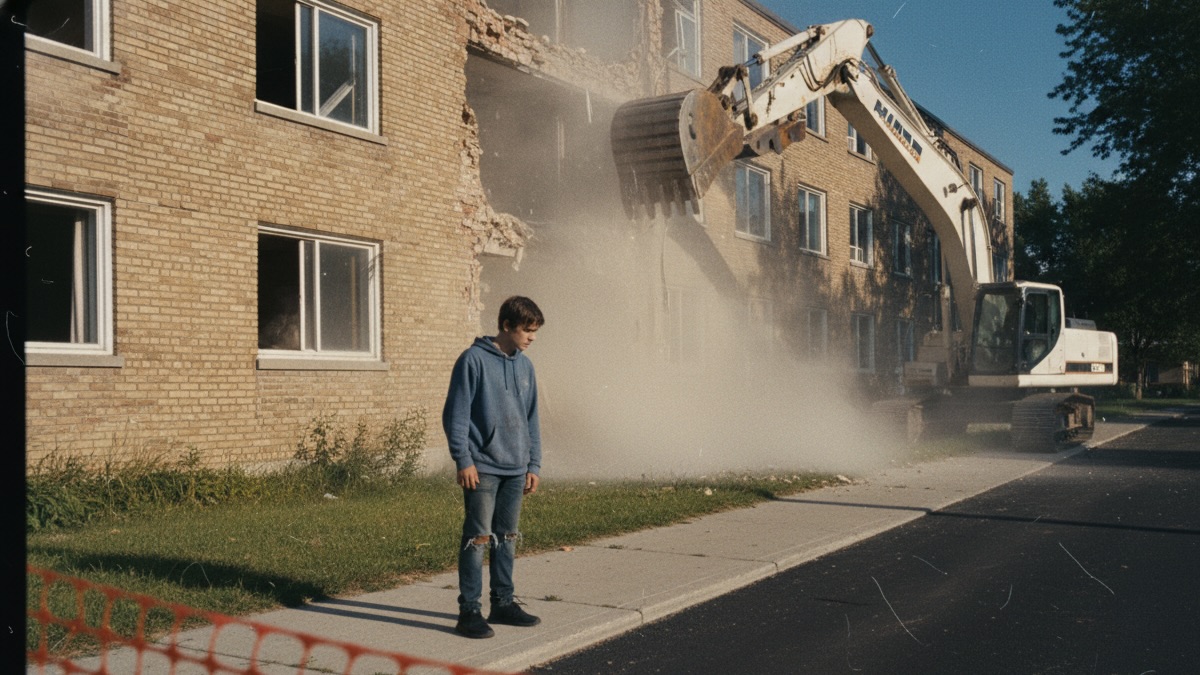
The lead excavator roared to life. A cloud of black smoke erupted from its exhaust pipe, drifting into the clear blue sky. The operator, a guy in wraparound sunglasses, signaled to the foreman. The foreman checked his watch, then his tablet, and finally gave a sharp, downward nod.
The hydraulic arm reached out. It looked like a claw. It moved with a slow, terrifying grace. It reached the roofline of the building, the metal teeth of the bucket catching on the brick.
With a sudden, violent jerk, the arm pulled back.
A section of the parapet crumbled. Bricks fell like rain, bouncing off the fresh, black asphalt of the driveway. The sound was like a thunderclap in the quiet morning. A cloud of white dust billowed up, obscuring the front of the building.
I felt a sharp pain in my chest. It wasn't physical. It was the feeling of a world being erased. The 'Middle Child' campaign wasn't just about land; it was about memory. If you destroy the places where people live, you destroy the people themselves. You turn them into data points. You turn them into ghosts.
The excavator lunged again. This time it went for the third floor. My window. I watched as the bucket smashed through the glass, the frame snapping like a toothpick. My curtains—the ones with the coffee stains and the cigarette burns from the previous tenant—caught on the teeth of the bucket and were dragged out into the air, flapping like a white flag of surrender.
My phone buzzed in my pocket. A ghost vibration. I pulled it out, but the screen was still black.
I looked at the crowd. They were still filming. They were waiting for the 'big' hit, the moment the whole structure collapsed. They weren't horrified. They were engaged. It was content.
I turned away. I couldn't watch it anymore. I started walking toward the bus stop. My driveway was gone, buried under the rubble of my life. The city was smooth again. The flow was restored.
As I reached the corner, I saw a familiar car parked in the shadows of an alleyway. A silver Lexus.
The window rolled down. It wasn't Van Klint. It was a man in a crisp, white shirt and a silk tie. He looked like he belonged in a boardroom, not a demolition site. He was holding a tablet, his eyes tracking the progress of the excavators.
He looked at me. He didn't smile. He didn't frown. He just made a small gesture with his hand—a flick of the wrist, like he was swiping away a notification.
The window rolled up. The car pulled out of the alley and merged into the morning traffic, disappearing into the sea of commuters.
I stood on the corner and waited for the bus. I didn't know where I was going. I didn't have a home, I didn't have a phone, and the only person who believed me was a hacker with a Soylent addiction.
But as the bus pulled up, its brakes squealing in the humid air, I felt a strange, cold clarity. They had destroyed the building, but they hadn't destroyed the drive. The metadata was still out there. Sheila had the stick. Dave had the recording.
The transaction wasn't over. It was just getting expensive.
“I looked at the bus driver and realized that if they wanted to pave the world, I’d have to start digging up the road behind them.”