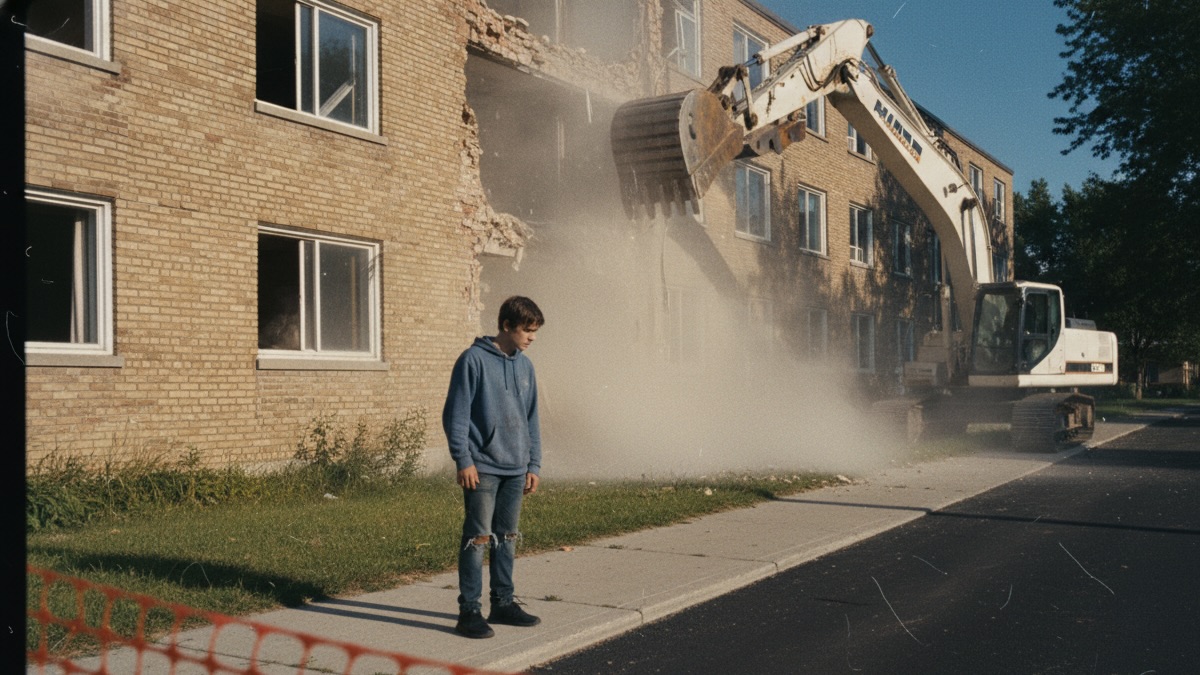
The story follows Darren, a seventeen-year-old living in a decaying apartment building in Winnipeg, who has managed to record a confession of systemic land fraud from a city official known as the "Traffic Cone King." As he travels across a sweltering, pothole-ridden city, he discovers that his apartment building has been marked with a tracking QR code and is slated for immediate demolition under the guise of an emergency safety hazard. He seeks help from his tech-savvy friend Sheila, who reveals that the city is intentionally devaluing properties through service cuts to buy them up cheaply through shell companies like FlowState Infrastructure.
Darren attempts to hand over his evidence to a local journalist named Dave, but finds that the media is too intimidated by the city’s legal and financial influence to publish the story. Driven by a desperate need to save the only "real" thing he has left, Darren returns to his building to stage a one-man protest against the demolition crew. He is ultimately removed by force and watches as an excavator destroys his home, realizing that the conspiracy is far larger and more calculated than he initially imagined. Despite the loss of his residence, he finds a cold sense of resolve, knowing that the digital evidence of the corruption still exists in the hands of his allies.
The central theme of the narrative is the tension between physical reality and digital manipulation. Darren constantly contrasts the "real" world of crumbling bricks, hot asphalt, and sweating bodies with the "fake" world of TikTok algorithms, 404 errors, and scrubbed social media accounts. The city government uses digital tools not just for administration, but as a means of erasure, turning a living person into a "bad actor" or a "ghost in a work order" to justify the destruction of his physical environment. This highlights a modern psychological horror where one's existence and property can be negated by a change in a digital ledger or a "deepfake" accusation.
Another prominent theme is urban decay as a tool of systemic oppression. The "asphalt scab" serves as a potent metaphor for how the city masks its underlying rot with superficial, high-cost infrastructure projects that actually serve to displace the vulnerable. The potholes and lack of snow plowing are not merely signs of incompetence, but are revealed to be deliberate acts of "service cutting" designed to lower property values for private gain. This suggests that the environment itself is being weaponized against its inhabitants, turning the very ground they walk on into a transactional asset for the elite.
The narrative also explores the concept of "the flow," which represents the unstoppable momentum of capital and bureaucracy. Throughout the story, characters like the foreman and Dave the journalist admit that they are merely cogs in a machine that prioritizes the movement of money and resources over human lives. This theme reflects a deep-seated nihilism, where the protagonist realizes that uncovering a conspiracy does not necessarily change the "price of a bus pass." The "flow" acts as a force of nature that paves over history and memory, leaving individuals like Darren to struggle for a foothold in a world that views them as mere friction.
Darren is a protagonist defined by his transition from a cynical observer to a desperate martyr. At seventeen, he possesses a sharp, nihilistic wit that he uses to shield himself from the harsh realities of his environment, yet he remains deeply attached to the physical world. His decision to stay in the building during the demolition is not just a tactical move, but a psychological necessity; he needs to prove to himself that he is more than just a data point in a city official's tablet. By the end of the chapter, his naivety has been stripped away, replaced by a "cold clarity" that suggests he has accepted his role as a disruptor of the system.
Sheila serves as the intellectual and technological backbone of the resistance against the city's corruption. She is portrayed as a hyper-competent, albeit paranoid, individual who understands the digital landscape better than the physical one. Her apartment, filled with monitors and blue light, acts as a sanctuary where the "metadata" of the city’s crimes can be decoded. Unlike Darren, she has no illusions about the "human element" of the conspiracy, viewing the world through the lens of transactions and IP addresses. Her role is to provide the hard evidence that fuels Darren’s emotional crusade, acting as the bridge between the digital truth and the physical consequences.
Dave represents the moral exhaustion and systemic failure of traditional institutions like the press. He is a man who has been broken by the "transactional fear" of economic survival, choosing the safety of his employees over the pursuit of a dangerous truth. His character highlights the difficulty of being a whistleblower in a society where information is treated as a liability rather than a public good. While he is not a villain, his complicity through inaction makes him a tragic figure who illustrates how the "grid" maintains control by making the cost of honesty too high for the average person to pay.
The narrative voice is characterized by a gritty, sensory-heavy realism that mirrors the oppressive atmosphere of a Winnipeg summer. The author uses vivid, often grotesque metaphors—such as the bus groaning like a "dying animal" and the radiator clicking in eighty-five-degree heat—to establish a sense of physical discomfort. These details serve to ground the high-concept digital conspiracy in a tangible, unpleasant reality. The prose is sharp and rhythmic, reflecting the protagonist’s agitation and the mounting tension as the 8:00 AM demolition deadline approaches.
Pacing is managed through a series of "transactions" and movements across the city, creating a feeling of a "slow-motion escape." The story begins with a stagnant, suffocating atmosphere on the bus and gradually accelerates as Darren moves from his apartment to Sheila’s, then to the diner, and finally back to the demolition site. This structure creates a sense of inevitable collision. The use of short, punchy sentences during the confrontation with the foreman heightens the urgency and mirrors the mechanical, uncaring nature of the men who are there to remove him from his home.
The tone of the chapter is one of pervasive disillusionment, yet it is punctuated by moments of dark beauty. The description of the city in the pre-dawn light as looking like a "bruise" before it turns yellow is a striking example of the narrative's aesthetic, which finds poetry in decay. The recurring motif of the "flow" provides a thematic and stylistic anchor, connecting the literal movement of the excavators to the metaphorical movement of data and money. Ultimately, the style reinforces the idea that while the physical world can be demolished, the "metadata" of the struggle remains, leaving a lingering sense of unresolved conflict.


