The ice bird refused to melt in the sweltering heat, its frozen beak locked on the concrete skyline.
The mud at the edge of the Red River smelled of hot iron, baked algae, and dead carp. Martha stood ankle-deep in the sludge, ignoring the heavy summer heat pressing down on her shoulders. She held a long piece of driftwood, using it to poke at the anomaly resting on the muddy bank.
It was a heron, carved entirely of ice.
The temperature was thirty-two degrees Celsius. The air was thick enough to chew. By all laws of physics, the bird should have been a puddle hours ago. Instead, the ice was perfectly clear, refracting the harsh mid-morning sun, completely solid.
Martha tapped the heron's wing with her stick. It made a sharp, clinking sound, like glass hitting glass.
"Stubborn thing," Martha said.
She wiped sweat from her forehead with the back of a dirty hand. Her backyard was already full of Winnipeg oddities. She had a rusted 1920s streetcar sign, a collection of deformed river stones that looked like human teeth, and a stoplight that only ever flashed yellow. But this was different. This was active.
Martha reached down and grabbed the ice bird by its long, frozen neck. It was freezing to the touch, burning her palms with the sudden cold. She twisted it, pointing its sharp beak toward the river.
As soon as she let go, the bird scraped against the mud, rotating on its base until the beak pointed back toward the city. Specifically, toward the old Exchange District.
Martha narrowed her eyes. She picked it up entirely, lifting the heavy block of ice into the hot air. She turned her body a full one hundred and eighty degrees and set the bird down on a flat rock.
Instantly, the bird spun again. The beak locked back onto the same exact vector.
"Alright," Martha said. She pulled her phone from her pocket. The screen was severely cracked, a spiderweb of shattered glass over the display. She dialed a number she knew by heart.
The line rang three times before a breathless voice answered.
"Detectorist Dreams, David speaking. If you are calling about the waterproof coils, they are stuck in customs. I cannot make them arrive faster. If you are calling about rent, please give me until Tuesday."
"David," Martha said.
"Martha? Sorry. I am having a morning. The algorithm changed again. No one is watching my promotional videos. I have three boxes of entry-level metal detectors sitting in the back that I cannot move, and the landlord just drove past the shop twice. What do you need? Did you find another cursed penny?"
"I need you at the riverbank," Martha said. "The spot behind the old water treatment plant."
"Martha, I am currently trying to figure out how to avoid bankruptcy. I cannot look at rocks today."
"It is not a rock," Martha said. "It is a compass. Made of ice. And it refuses to melt."
There was a long pause on the line. Martha could hear the sound of a small desk fan whirring in the background of David's shop.
"Did you say ice?" David asked.
"Yes. And it is thirty degrees out here. Get your car."
Martha hung up. She looked back down at the bird. A bead of condensation formed on the beak, but it did not drip. It just sat there, defying the sun.
Twenty minutes later, a silver Honda Civic with a dented front bumper bumped over the grass and parked near the tree line. David got out. He was twenty-four, looked thirty, and wore a polo shirt that had dark sweat stains under the arms. He carried a clipboard, though Martha had no idea why.
"This better be good," David said, sliding down the muddy bank. He ruined his white sneakers immediately. "I left a sign on the door. I hate leaving a sign on the door. It makes me look closed."
"You are closed," Martha pointed out.
"I am temporarily unavailable," David corrected. He reached the bottom of the bank and adjusted his glasses. He looked at the heron. "Okay. It is a block of ice."
"Watch," Martha said.
She kicked the side of the bird with her boot. The heron slid a few inches in the mud, its orientation disrupted. For a second, nothing happened. Then, with a slow, deliberate grinding noise, the ice shifted. It spun on the wet dirt until the beak was pointing precisely toward the Exchange District again.
David dropped his clipboard.
"What was that?" David asked. His voice was high, tight with sudden panic.
"It wants to go that way," Martha said.
"Things do not want to go anywhere. Things are inanimate. And ice melts. Why is it not melting?" David took a step closer, hovering his hand over the bird. "It is freezing cold. The ambient temperature is sweltering. This violates thermodynamics."
"It is a very focused object," Martha said. She grabbed an old plastic milk crate from the shoreline debris. She tipped it over and placed the ice bird inside. The bird scraped against the plastic, making sure its beak was aligned with the gaps in the crate, pointing strictly northwest.
"What are you doing?" David asked.
"We are following it," Martha said.
"No, we are not," David said. "I have to go back to the shop. I have emails to ignore."
"David, look at me," Martha said. She picked up the crate. It was heavy, and her arms strained, but she held it steady. "You are stressed. You are dying of stress. Your shoulders are touching your ears. You sell metal detectors because you want to find things. When was the last time you actually found something?"
David looked at the muddy river, then at his ruined shoes, and finally at the impossible ice bird.
"Three years ago," David said quietly. "A silver ring. In a sandbox."
"Exactly," Martha said. "Now, grab that side of the crate. We are going for a walk."
The walk up the embankment was brutal. The crate was awkward between them, and the ice bird seemed to grow heavier with every step. David’s hands were cramping. The plastic grid dug into his fingers.
"It keeps shifting," David complained, adjusting his grip. "Every time I turn slightly, the bird tries to rotate inside the box. It is like holding a giant, freezing gyroscope."
"Keep it steady," Martha said. She was breathing hard, but her face was set in a mask of determination.
They reached the pavement of Main Street. The heat radiating off the asphalt was intense, distorting the air above the road in shimmering waves. Cars rushed past, kicking up dust and the smell of exhaust. The noise was a harsh contrast to the quiet of the muddy riverbank.
Martha set the crate down on the sidewalk. Immediately, the ice heron scraped against the plastic, adjusting its angle by a fraction of an inch.
"It wants to cross the street," Martha said.
"We cannot just walk into traffic holding a milk crate," David said. He pulled out his phone. "Let me look at the map. If we follow this trajectory, it points directly through the old railway yard and into the commercial sector. There is nothing over there but abandoned lots and overpriced coffee shops."
"The bird does not care about coffee," Martha said.
A group of three teenagers walked past. They were drinking iced lattes and sweating through vintage band t-shirts. One of them, a girl with bright pink hair and a heavy silver chain around her neck, stopped and stared at the crate.
"Is that ice?" she asked.
"Yes," Martha said.
"Why isn't it melting? It is literally boiling outside," the girl said. She pulled out her phone. The camera app was already open.
"We do not know," David said, stepping in front of the camera. "Please do not film this. I do not want this on the internet. I have a business reputation to maintain."
"Dude, you sell metal detectors," the girl said, stepping around him to get a better angle. "You are not exactly running Apple. This is weird. I am posting this."
"Let her film," Martha said. She picked up her side of the crate. "Come on, David. The light is green."
They crossed the street. The girl with the pink hair followed them, holding her phone steady. Her two friends trailed behind, whispering to each other.
"This is a bad idea," David muttered as they stepped onto the opposite curb. "This is how people end up as memes. 'Local idiot carries ice block'. My landlord will see this. He will think I have lost my mind instead of paying rent."
"Your landlord is a thief who charges too much for a building with bad plumbing," Martha said. She looked down at the bird. "We need to turn left here. Down the alley."
The alleyway was narrow, shadowed by tall brick buildings. It smelled strongly of garbage and wet cardboard. The ground was uneven, cracked concrete giving way to patches of stubborn weeds.
As they walked, David's phone began to vibrate violently in his pocket.
"Hold the crate," David said. He let go with one hand and fished his phone out. He stared at the screen. His eyes widened.
"What is it?" Martha asked.
"I am getting notifications. A lot of them," David said. He tapped the screen. "That girl tagged my shop in her video. It already has four thousand views. People are asking if this is a marketing stunt for waterproof detectors."
"Tell them it is a mystery," Martha said.
"They do not want a mystery. They want content," David said. He looked over his shoulder.
Behind them, the alley was no longer empty. The girl with the pink hair was still there, but now she had been joined by a man holding a delivery bag, a woman in business casual attire who had abandoned her lunch break, and two guys on skateboards.
"Hey!" one of the skateboarders yelled. "Is it true it points north?"
"It does not point north," Martha yelled back. "It points where it wants to go."
The crowd murmured. Phones were out everywhere. The glare of the screens reflected off the brick walls.
"This is escalating," David said. His chest felt tight. The claustrophobia of his failing business was suddenly replaced by the literal claustrophobia of a growing crowd. "We need to put it down. We need to walk away."
"We are not stopping," Martha said. Her voice left no room for argument. She adjusted her grip on the crate. "Look at the ice, David."
David looked down. The heron was completely unchanged. Not a single drop of water had pooled in the bottom of the plastic crate. The beak was sharp enough to cut glass.
"It makes no sense," David whispered.
"Sense is for accountants," Martha said. "We are explorers today. Keep moving."
They pushed out of the alley and onto a wider street. The crowd behind them swelled. What started as five people became twenty. Then fifty. The sheer absurdity of two people carrying an unmelting ice bird through the summer heat was an irresistible magnet for a city bored by the afternoon slump.
People were live-streaming. Someone had started a hashtag. A man with a megaphone, who seemed to have just been carrying it around for no reason, started narrating their progress.
"The Magic Compass Bird continues its journey!" the man shouted.
David buried his face in his shoulder to hide from the cameras. "I am going to have to change my name."
The sky changed fast. One minute it was a flat, glaring blue, and the next, a heavy wall of bruised, dark green clouds rolled over the skyline. The temperature dropped ten degrees in a matter of seconds.
"Storm," Martha said, looking up.
"Great. Perfect. A summer squall to ruin my already ruined shoes," David said.
The wind hit them first. It was violent, whipping down the street, knocking over a trash can and sending loose flyers spiraling into the air. The crowd of followers groaned, shielding their eyes from the sudden dust.
Then came the sound. It started as a distant roar, like a freight train rushing toward them.
"Hail!" someone in the crowd screamed.
The first piece of ice hit the roof of a parked car with a deafening PING. It was the size of a golf ball. Then the sky opened up, dropping thousands of jagged, heavy ice stones.
Panic erupted. The crowd, suddenly realizing the danger, scattered. People screamed, throwing their arms over their heads.
"The bridge!" Martha yelled over the noise. She pointed ahead to a massive, rusted railway overpass that spanned the road. "Run!"
David didn't argue. He grabbed the crate with both hands, adrenaline masking the pain in his fingers, and sprinted alongside Martha. The hail pounded against the concrete, shattering into sharp shards. One piece clipped David's shoulder, leaving a sharp, stinging bruise.
They dove under the deep shadow of the railway bridge.
The space beneath the bridge was wide and smelled intensely of old dirt, pigeon droppings, and damp concrete. Seconds later, the crowd surged in after them. Fifty people packed into the dry space, pressing close together as the hail battered the street outside, creating a deafening white noise.
David set the crate down on the dirt floor. He leaned against the concrete piling, gasping for air. His heart hammered in his throat.
"Is everyone okay?" Martha called out.
A chorus of shaky nods and breathless affirmations rippled through the tightly packed group. The girl with the pink hair was rubbing her elbow, but she still had her phone out.
"No signal," she muttered, tapping the screen aggressively. "The storm killed the network."
Without the digital connection, the energy under the bridge shifted. The frantic, content-hungry vibe dissolved into uneasy silence. People looked at each other, suddenly aware of how ridiculous they looked, huddled under a dirty bridge, following an old woman and an anxious man carrying a milk crate.
The claustrophobia was heavy. The smell of wet dust hung in the air.
David looked at the crate. The ice heron had spun again, its beak pointing toward the far side of the bridge, straight into the wall of falling hail.
"It wants to go back out there," David said.
"It can wait," Martha said. She looked around at the faces in the crowd. Most of them were young, their expressions a mix of irony and genuine confusion. They were disconnected, jittery without their screens.
Martha stepped forward. She didn't yell, but her voice carried perfectly over the roar of the storm outside.
"You know," Martha said, pointing to the ground beneath their feet. "This bridge was built in 1912. But before the concrete was poured, this exact spot was a trading path. My grandfather used to walk this route to trade pelts and beadwork."
The crowd fell silent. The teenager with the skateboard stopped fidgeting.
"The city paved over it. They put up steel and brick. They tried to organize the dirt," Martha continued. She placed a hand on the cold concrete piling. "But the river remembers where it used to flow. The ground remembers what it used to be. You all walk over ghosts every single day to get to your coffee shops and your offices."
David watched her. The tension in his chest began to loosen. The sudden oxygen of the moment, the raw human connection in the dark, dirty space, felt heavier than the storm outside.
"Why is the bird not melting?" the pink-haired girl asked quietly.
"Because it has a job to do," Martha said simply. "Some things refuse to disappear until their work is finished. People are like that, too. You hold onto your stress, your anxiety, your need to be seen on those little screens, because you think it is your job. But it is just noise."
She pointed to the ice heron.
"This bird only cares about one direction. It does not care about the heat. It does not care about the storm. It just knows where it needs to be."
The crowd stared at the bird. In the dim light under the bridge, the ice seemed to glow with a faint, internal clarity.
David looked down at his own hands. They were covered in mud and red indents from the plastic crate. He thought about his spreadsheets, his unpaid bills, his desperate need to go viral to save his shop. It all felt incredibly small compared to the solid, unyielding reality of the ice bird.
"How much longer do you think the storm will last?" David asked.
Martha looked out at the street. The heavy hail was already softening into a torrential summer rain. The sky at the edge of the horizon was brightening.
"Not long," Martha said. "Get ready to walk."
The rain stopped as quickly as it had started. The summer sun broke through the clouds, instantly heating the wet pavement and sending thick clouds of steam rising into the air. The city smelled clean, like ozone and washed leaves.
"Let's go," Martha said.
David picked up his side of the crate. The crowd, quieted by the storm and Martha's words, followed them out from under the bridge. There was no more shouting. No more live-streaming. Just a collective, focused march behind the ice heron.
The bird led them three blocks further, stopping at a high chain-link fence. Behind the fence was a massive, overgrown lot. The ground was choked with weeds and broken concrete. A large, faded sign read: 'Future Site of OmniCorp Luxury Condominiums.'
Martha set the crate down. The bird's beak pointed straight through the fence, aiming at a specific patch of tall thistle in the center of the lot.
"It wants to go in there," David said.
"The gate is chained," a man in the crowd pointed out.
Martha walked up to the gate. The padlock was old and rusted. She grabbed a heavy rock from the curb and brought it down hard on the lock. It didn't break.
"Allow me," David said. He walked to the gate, gripped the chain, and pulled with all his weight. The rusted bracket on the fence post snapped with a sharp crack. The gate swung open.
David looked at his hands, surprised by his own strength. "Huh. Must be the adrenaline."
They carried the crate into the lot. The wet weeds soaked their pants. When they reached the center of the lot, the ice heron suddenly tipped forward inside the crate, its beak pointing straight down into the muddy earth.
"Here," Martha said.
"Right here?" David asked. He looked at the patch of dirt. It looked like every other patch of dirt.
"Do you have your machine?" Martha asked.
David nodded. He slung his backpack off his shoulders and unzipped it. He pulled out the shaft of a premium Minelab metal detector, snapping the pieces together with practiced efficiency. He turned it on. The machine emitted a low, steady hum.
"If this beeps for a rusty soup can, I am going to be very upset," David said.
He swept the coil over the dirt where the heron was pointing. Instantly, the machine let out a high-pitched, solid scream. The display screen spiked.
"Iron," David said. His voice trembled slightly. "Big piece. Not deep. Maybe two feet down."
"Dig," Martha said.
David didn't have a shovel. He dropped the detector and fell to his knees. He dug his bare hands into the wet, muddy earth. The soil was loose from the rain.
"Help him," Martha told the crowd.
Without hesitation, the pink-haired girl dropped to her knees beside David. The skateboarders joined in. The man in the suit rolled up his sleeves and started clawing at the dirt. Ten people, tearing into the earth with their bare hands, unified by the bizarre journey.
Mud flew everywhere. David's fingernails were caked with dirt. He didn't care about his shop. He didn't care about the algorithm. He just needed to know what was under the mud.
"I feel metal!" the skateboarder yelled.
David dug frantically around the edges. His fingers hit cold, hard steel. Together, the group hauled a heavy, rectangular steel box out of the hole. They dropped it onto the flattened weeds.
It was covered in rust, but it was intact. It looked like an old military ammunition box.
David wiped the mud from the latch. It was stiff, but with a hard yank, it popped open.
The crowd held its breath.
Inside, perfectly preserved in a watertight canvas bag, was a time capsule. There was a stack of letters written on thick, yellowed paper, and dozens of small, sealed glass vials.
David picked up the top letter. The handwriting was elegant and faded.
"August 14th, 1950," David read aloud. "To whoever finds this. The city is growing too fast. They are paving over the gardens. We have saved the seeds of the native prairie flowers. Plant them when the concrete cracks. Remember what was here."
David looked at the glass vials. They were full of seeds.
A loud splash made everyone jump.
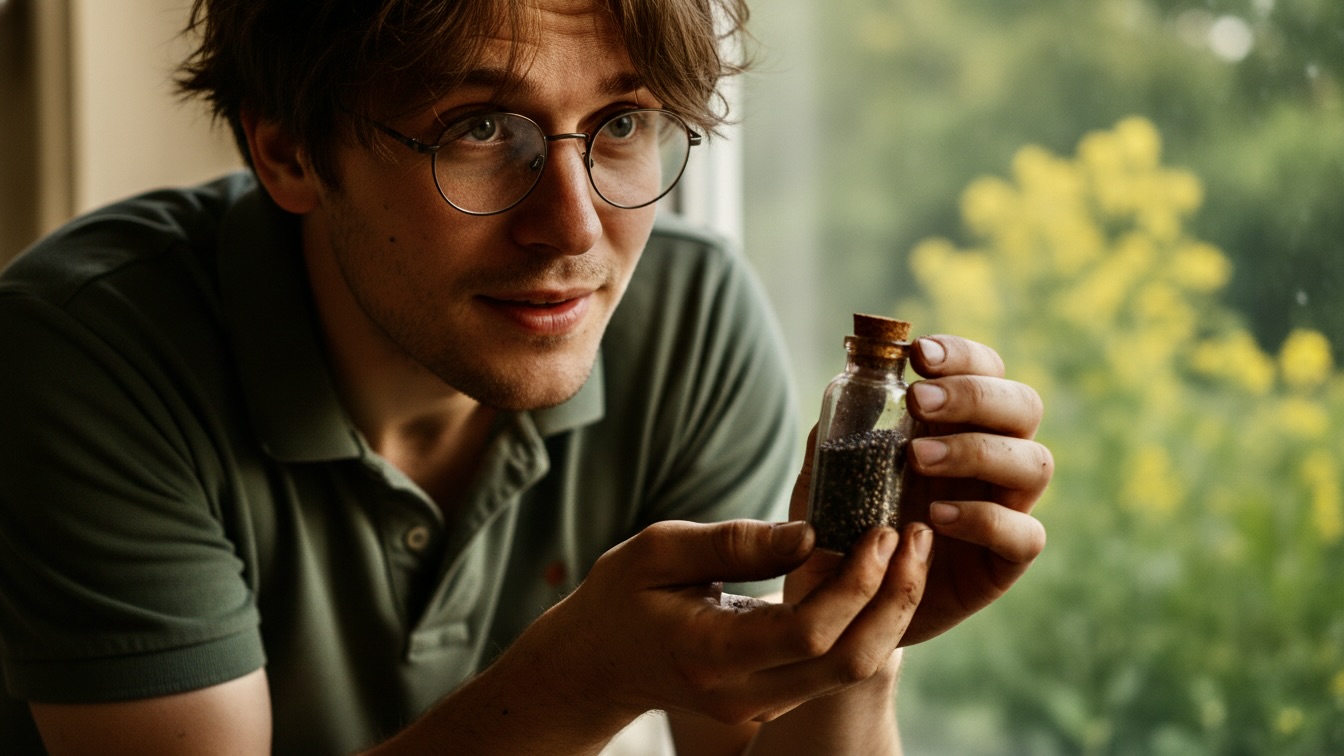
David turned around. The plastic milk crate was empty. The unmelting ice heron, which had survived the sweltering heat, the friction of the crate, and the storm, was gone.
In its place was a puddle of perfectly clear, sweet-smelling water.
"It melted," the pink-haired girl whispered.
"Its work is done," Martha said. She smiled, the deep lines around her eyes crinkling. She looked at the puddle, then at the box of seeds, and finally at David.
David sat back on his heels. His clothes were ruined. His hands were bleeding slightly. He was absolutely exhausted.
He started to laugh. It wasn't a nervous, stressed laugh. It was a deep, genuine sound that echoed across the empty corporate lot. The crowd joined in, laughing and passing the glass vials around, looking at the seeds of a forgotten city.
Martha reached down and picked up the empty steel box. It would look perfect in her backyard, right next to the broken stoplight.
David looked at the puddle in the crate, grabbed a handful of dirt, and threw it into the air.
“The water soaked into the dirt, leaving nothing but the open box and the heavy summer heat.”


