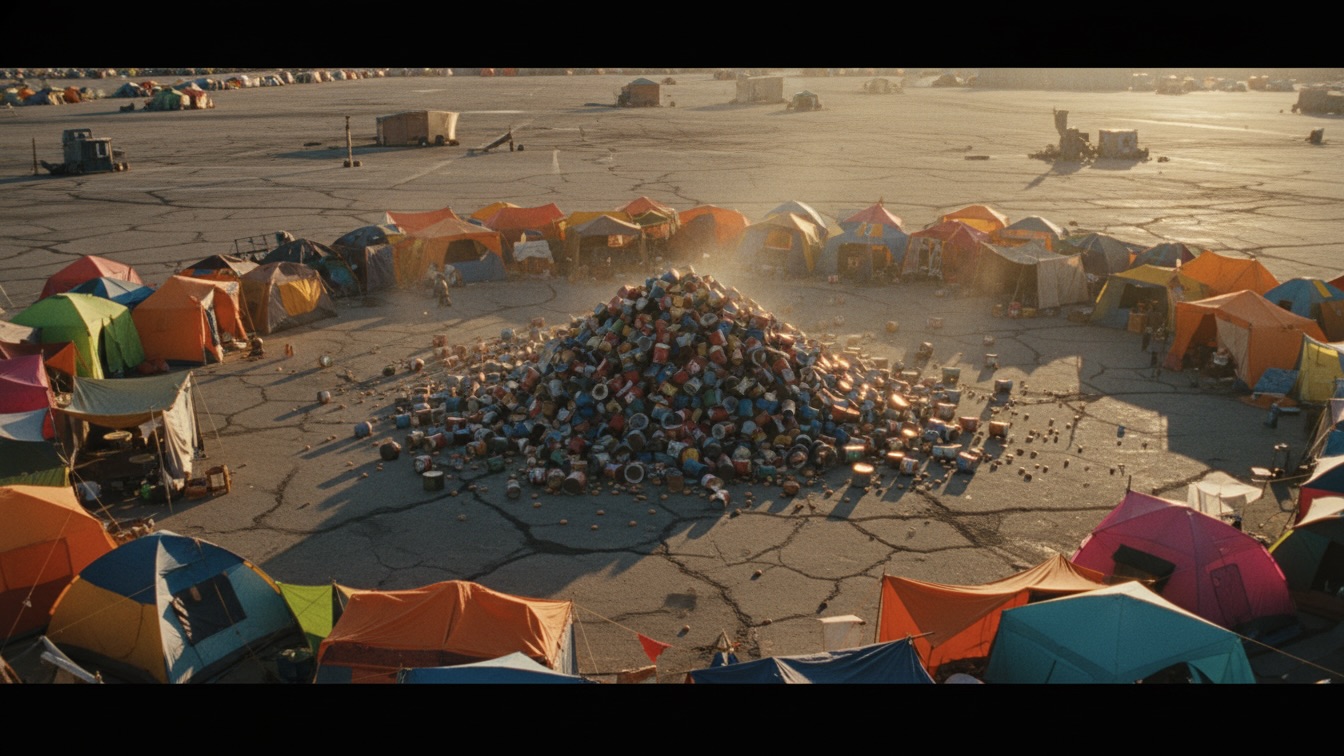
The story follows Evan, a meticulous and likely neurodivergent employee at a struggling food bank, who discovers a significant discrepancy in the inventory. During a record-breaking heatwave, he realizes that an entire pallet of canned peaches has vanished, an impossibility according to his rigid "geometry of survival." When his supervisor, Brenda, dismisses his concerns as an administrative error, Evan’s internal "static" grows deafening, prompting him to investigate the matter himself. He suspects a systemic glitch or a deliberate conspiracy, leading him to track the movement of the food bank's delivery van.
His investigation leads him from the decaying urban core to a wealthy suburb, where he witnesses his coworker, Gary, selling premium food donations to an affluent resident. Upon confronting Gary, Evan learns the devastating truth: Gary is stealing food to fund his son’s private addiction recovery because the public system has failed him. Returning to the food bank, Evan discovers that Brenda is complicit in the scheme because Gary uses the proceeds to maintain the facility's only delivery vehicle. Disillusioned by the realization that the entire system is built on corruption and compromise, Evan abandons his spreadsheets and takes a direct, radical approach to distribution by delivering a hand truck of beans directly to a homeless encampment.
The primary theme of the narrative is the collapse of systemic integrity in the face of scarcity. Evan views the world through a lens of mathematical certainty, believing that "numbers are the truth" and that they provide a shield against the chaos of poverty. However, the story demonstrates that when a system is under-funded and over-stressed, the "geometry" of morality becomes distorted. The forty percent budget cut is described as a "violent number," suggesting that institutional failures are not just abstract figures but physical assaults on the vulnerable.
Another central theme is the conflict between rigid idealism and the "meat grinder" of reality. Evan represents the idealist who believes in the foundational directives of the institution, while Gary and Brenda represent the pragmatists who have abandoned ethics for survival. The story suggests that in a broken society, even the acts of charity are tainted by necessity and theft. This creates a moral vacuum where the only way to keep the "sinking ship" afloat is to engage in the very corruption the institution is meant to combat.
Finally, the story explores the deception of data as a means of understanding human suffering. Evan relies on his spreadsheet to create a sense of control, but he eventually learns that the numbers cannot account for a father’s desperation or a director’s exhaustion. The "missing pallet" is not just a logistical error; it is a symbol of the hidden human costs that are often omitted from official records. By the end of the story, Evan realizes that the only way to reclaim his humanity is to step outside the grid and engage with the physical reality of the people he serves.
Evan is a character defined by his psychological need for order, structure, and numerical consistency. He perceives the world as a series of geometric patterns, and any deviation from these patterns causes him physical and mental distress, manifesting as "static" or a "buzzing hum." This suggests he may be on the autism spectrum or struggle with obsessive-compulsive tendencies, as he uses counting as a grounding mechanism against a sensory-overloaded environment. His identity is entirely tied to his role as a guardian of the inventory, making the discovery of the missing peaches a personal crisis of faith.
Throughout the chapter, he undergoes a painful disillusionment as he realizes that his "solid, undeniable geometry" is a lie. He starts the story believing that the truth can be found in a spreadsheet, but he ends it by abandoning his tools entirely. His final act of dumping the beans in the street is a psychological break from his need for control. He accepts that the system is beyond repair and chooses a chaotic, unmeasured act of kindness over the corrupted order of the food bank.
Gary serves as a complex antagonist who challenges Evan’s black-and-white view of morality. He is initially presented as a lazy or indifferent volunteer, but the revelation of his son’s addiction reframes his actions as those of a desperate father. He is a man who has been abandoned by the public healthcare system, forcing him to become a predator within the very system meant to provide relief. His anger toward Evan stems from the fact that Evan has the luxury of worrying about "math" while Gary is fighting for his son’s life.
His character highlights the tragedy of the "working poor" and the impossible choices they face. He does not steal for personal greed, but to navigate a "meat grinder" that offers no other way out. By selling the food to a "prepper" in the suburbs, he exploits the fears of the wealthy to save the life of the marginalized. He is a man who has lost his faith in the "truth" of the system and has replaced it with a bitter, utilitarian survivalism.
Brenda is the embodiment of institutional exhaustion and the ethical compromises required to lead a failing nonprofit. She is physically and emotionally drained, described with "red-rimmed eyes" and "frizzy hair," signaling her constant state of crisis management. Unlike Evan, she is fully aware of the corruption within her warehouse but chooses to facilitate it because it is the only way to maintain the food bank's infrastructure. Her character represents the "lesser of two evils" philosophy that often dominates underfunded social services.
She is a motherly figure who has been hardened by the "violent numbers" of government austerity. Her confrontation with Evan reveals her deep-seated resentment toward his rigid adherence to rules that she can no longer afford to follow. She views his insistence on "foundational directives" as an insult to the daily sacrifices she makes to keep the doors open. Ultimately, she is a tragic figure who has become a silent partner in theft to prevent a total systemic collapse.
The narrative voice is characterized by a cold, clinical precision that reflects Evan’s internal state. The author uses short, punchy sentences and technical language—such as "logistical impossibility," "caloric output," and "statistical anomaly"—to establish the protagonist's obsession with data. This style creates a sense of detachment that makes the eventual emotional outbursts feel more jarring and significant. The pacing starts with a slow, methodical count of inventory and accelerates into a frantic, heat-induced pursuit, mirroring Evan’s escalating mental instability.
Sensory details are used effectively to create an atmosphere of oppressive decay. The recurring mention of the "convection oven" heat and the "static" in Evan’s head provides a visceral sense of his discomfort. The contrast between the "cracked asphalt" of the city and the "automated sprinkler systems" of the suburbs serves as a powerful visual metaphor for the inequality at the heart of the story. These details ground the abstract themes of systemic failure in the physical reality of sweat, rust, and spilled syrup.
The tone of the story is one of mounting dread and cynicism. Even the descriptions of the food—"heavily processed, high sodium, dense caloric weight"—are stripped of any sense of nourishment or comfort. This reflects a world where food is merely a commodity or a "variable" in a broken equation. The final scene, where the cans "glint in the sunlight" as they roll across the street, offers a rare moment of visual brightness, but it is a chaotic, messy brightness that signifies the end of Evan’s orderly world.


