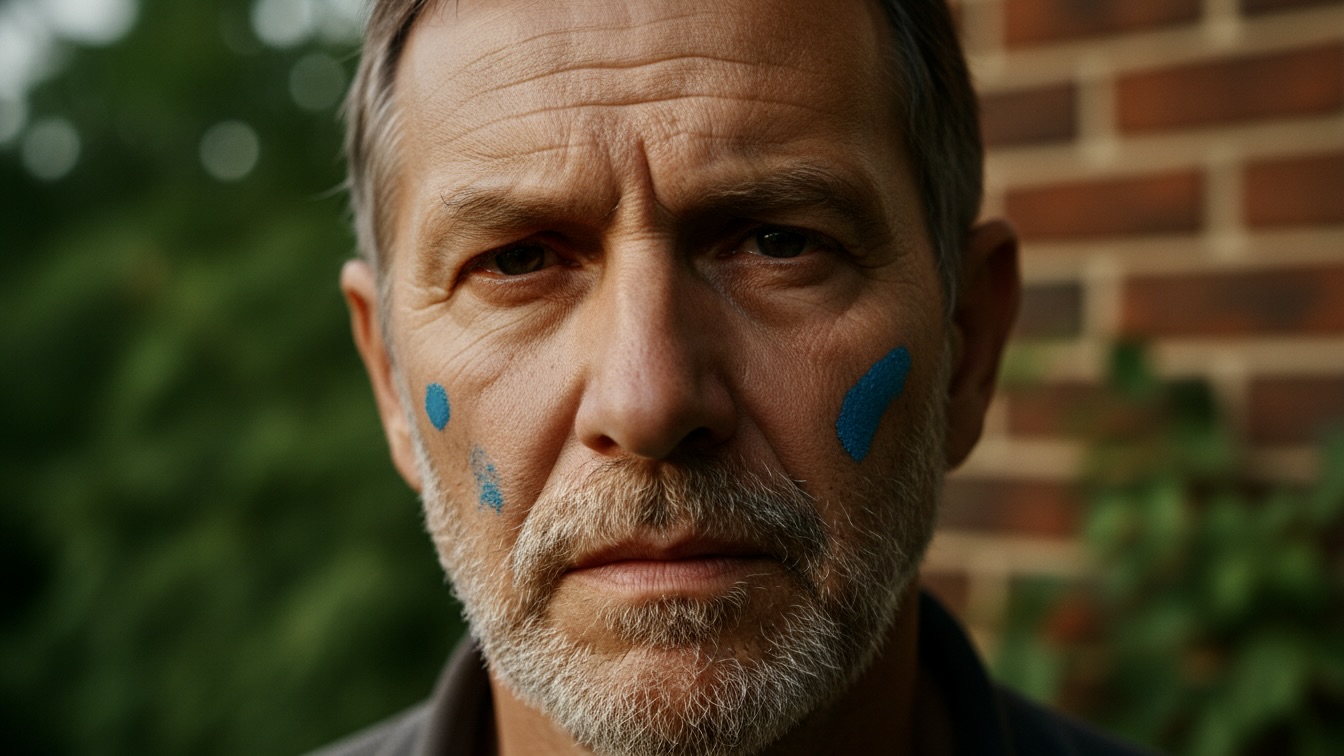
Martin stood before the blank wall, the summer heat pressing against his spine like a heavy, invisible hand.
The heat didn't just sit on the pavement; it vibrated. Martin felt it in the soles of his boots, a low-frequency hum that seemed to sync with the ringing in his ears. It was 7:15 AM. The sun was already a white-hot coin pinned to a pale, hazy sky. He stood on the sidewalk at Borups Corners, staring at the expanse of brick that was supposed to become a mural by the end of July. It looked like too much work. The wall was sixty feet long and twelve feet high, scarred by decades of bad weather and even worse graffiti. He dropped his heavy tool bag. The clink of metal against concrete sounded like a gunshot in the morning quiet. He winced, looking over his shoulder. The street was empty, mostly. A single delivery truck sat idling three blocks down, its exhaust shimmering in the air. Martin wiped sweat from his forehead with the back of a gloved hand. His skin felt like paper—old, dry, and easily torn.
He reached into his bag for the five-in-one tool. He needed to scrape the loose mortar before the primer could go on. It was a simple task, the kind of grunt work he used to delegate back when he was lead scenic on the big historical dramas. Now, he was the grunt. He was sixty-four, his knees were shot, and his lower back felt like it was being held together by rusted staples. But there was something about the weight of the tool. It felt real. It didn't have a touch screen. It didn't require a software update. He jammed the metal edge into a crack and twisted. A chunk of grey dust fell onto his boots. He liked the sound of it. It was a honest sound. Better than the quiet of his apartment, where the only thing he heard was the hum of the refrigerator and the ticking of a clock he forgot to wind.
"You're early," a voice said. Martin jumped, his heart hammering against his ribs like a trapped bird. He turned to see Martha standing there. She was seventy if she was a day, wearing a wide-brimmed straw hat and a tech-fabric shirt that looked too expensive for house painting. She was holding two oversized iced coffees in a cardboard carrier. She looked at him with that squint people get when they’ve spent too long looking at bright lights. "You look like you've seen a ghost, Artie. Relax. It's just me."
"I didn't hear you walk up," Martin said, his voice coming out thinner than he wanted. He took one of the coffees. The plastic cup was slick with condensation. It felt dangerously cold against his palm. He took a long sip. The sugar hit his system instantly, a jagged spike of energy that made his fingers twitch. "The neighborhood is quiet. Too quiet. You see that truck down there? It hasn't moved in ten minutes."
Martha didn't even look. She was busy pulling a roll of blue painter's tape from her pocket. "It's a delivery, Martin. They deliver things. That's what they do. Stop acting like we're in one of those thrillers you used to build sets for. This isn't a movie. It's a wall. We're just painting a wall."
"I'm not acting like anything," Martin muttered. He went back to the wall, scraping harder now. The sound was abrasive, a rhythmic screech that set his teeth on edge. "I just don't like being out in the open like this. People watch. You don't see them, but they watch. They think we're city contractors. Or worse, they think we're 'beautifying' the place so the rent can go up."
"We are beautifying it," Martha said, snapping a length of tape across a window frame. "That’s the whole point of Art Borups Corners. We take the ugly spots and we make them not ugly. It’s for the kids. It’s for the seniors. It’s for us. Now, quit complaining and help me with this tarp. The wind is going to pick up by noon, and I don't want to be chasing plastic down the boulevard."
They worked in silence for a while. The physical labor was a distraction, a way to keep the brain from spiraling into the 'what-ifs' of the day. Martin spread the heavy canvas drop cloths along the base of the wall. He used bricks to weigh down the corners. Every time a car drove by, he paused. He watched the driver's eyes. Most were staring straight ahead, glazed over by the morning commute, but some lingered. A dark sedan slowed down as it passed, the windows tinted so black they looked like mirrors. Martin watched his own reflection crawl across the glass. The car didn't stop, but it didn't speed up either. It just drifted past, a silent, predatory shape in the heat.
"See?" Martin whispered.
"See what?" Martha asked. She was on her knees, taping the bottom edge of the brick.
"That car. It was looking."
"Everyone looks, Martin. We're two old people in bright vests standing in front of a giant wall. It’s a spectacle. If they didn't look, I'd think I was invisible. Now, hand me that stir stick. The primer is starting to settle."
Martin reached for the gallon can. The lid was stuck. He pried at it with his tool, the metal groaning. Suddenly, the lid popped, spraying a few droplets of thick, white liquid onto his vest. He stared at the spots. They looked like milk. Or blood, if blood were white. He felt a sudden, irrational surge of anger. He wasn't supposed to be here. He was supposed to be retired. He was supposed to be sitting on a porch somewhere, reading books about the Civil War. Instead, he was standing in the sun, waiting for something bad to happen. He looked at the primer, a swirling vortex of chemical-smelling white. It was a blank slate. That was the problem with blank slates. You never knew what was going to end up on them.
"Andrew is late," Martin said, checking his watch again. It was 7:45. "He said he’d be here by seven-thirty. He’s never late. He’s a stage manager. Stage managers are never late. It’s against their religion."
"Maybe he slept in," Martha said, though her voice lacked conviction. She stood up, wiping her hands on her thighs. "He’s been having trouble with his hip. Probably just moving slow. Or maybe he’s at the hardware store getting those rollers we forgot."
"I called him," Martin said. "He didn't pick up. It went straight to voicemail."
Martha paused. She looked at Martin, and for a second, the mask of breezy confidence slipped. Her eyes were sharp, scanning the street. The truck three blocks down was gone. In its place was a white van. "Okay," she said. "So he's late. It happens. We start without him. We have the primer. We have the brushes. We have the wall. Let’s just start, Martin. If we don't start, I'm going to start thinking about why we shouldn't."
Martin dipped his brush into the can. The bristles soaked up the white, becoming heavy and limp. He stepped up to the wall. The brick was hot to the touch, radiating a dry, dusty warmth. He made the first stroke. A long, vertical line of white. It looked stark against the red. It looked like a scar. He did it again. Up and down. The rhythm started to take over. The paranoia didn't go away, but it moved to the background, a dull static in the back of his skull. He focused on the texture. The way the paint filled the pores of the brick. The way it bridged the gaps in the mortar. It was a slow process. It was a tedious process. It was exactly what he needed.
By 9:00 AM, the temperature had climbed another ten degrees. The air was thick, tasting of exhaust and the faint, sweet smell of rotting garbage from the alleyway. Martin’s shirt was plastered to his back. He was halfway through the first section of the wall, his arm beginning to throb with a dull, insistent ache. Every time he reached up, a sharp pain shot through his rotator cuff. He ignored it. He had spent years on ladders, years hauling timber and painting backdrops that were meant to look like Parisian streets or Martian deserts. This was just another gig, even if the pay was nonexistent and the audience was just the occasional passerby with a dog.
"Hey, look who decided to show up," Martha shouted over the sound of a passing bus.
Martin turned. Andrew was walking toward them, his gait lopsided and slow. He was carrying a crate of supplies, his face a deep shade of red that looked dangerous. He set the crate down with a heavy thud and leaned against the wall, gasping for air. He was seventy-two, a man who had survived three heart procedures and a divorce that cost him his house in the valley.
"Traffic," Andrew wheezed, waving a hand dismissively. "The whole bridge is backed up. Some idiot dropped a load of gravel across three lanes. Total mess."
"We thought you were dead in a ditch," Martin said, not looking up from his work. "Or kidnapped by the zoning board."
Andrew laughed, a dry, rattling sound. "Kidnapped? Who'd want me? I’m all gristle and bad attitude. Anyway, I got the rollers. And the sealant. And some of those fancy brushes Martha likes. The ones with the angled tips."
"Bless you," Martha said, taking a brush from the crate. "Martin’s been having a minor breakdown over a white van. We need to keep him busy or he’s going to start building a bunker."
"It wasn't just a van," Martin said, his voice tight. "It was the way it was parked. On the sidewalk. Facing the wrong way. You tell me that’s normal."
Andrew looked down the street, squinting into the glare. "Nothing’s normal anymore, Art. That’s the secret. You spend your life looking for patterns, you’re just gonna find ghosts. How’s the wall taking the primer?"
"It’s thirsty," Martin said. "Eating it up. We’re going to need more than three gallons. Maybe six. The brick is old. It’s like painting a sponge."
They worked together now, a three-person assembly line of aging artists. Andrew handled the lower sections, sitting on a low stool that groaned under his weight. Martha took the middle, her movements fluid and practiced. Martin took the top, standing on a two-step ladder that felt increasingly unstable on the uneven sidewalk. They talked in bursts, their voices overlapping, a chaotic symphony of shop talk and old memories.
"Remember that production of 'The Tempest'?" Andrew asked, his roller making a wet, sucking sound against the wall. "The one where the rain machine leaked and flooded the orchestra pit?"
"I remember the producer crying," Martha said. "He thought the insurance wouldn't cover it. I told him, 'Honey, it’s an act of God. God hates bad theater.'"
"He didn't like that," Martin added. "He tried to sue the plumbing contractor. Lost everything. Last I heard, he was selling real estate in Phoenix."
"Phoenix," Martha sighed. "That’s where dreams go to bake. At least here we have the humidity. Keeps the skin moist. Even if it feels like breathing through a wet wool blanket."
They fell into a rhythm. Dip, roll, spread. Dip, roll, spread. The wall was slowly turning into a solid block of white. It was satisfying in a way that digital work never was. There was no 'undo' button here. If you messed up, you lived with it, or you painted over it. It was physical. It was messy. Martin liked the way the paint flecked his forearms, turning his grey hairs white. It made him feel like he was disappearing into the work, becoming part of the landscape.
But the paranoia wouldn't stay buried. A man in a grey tracksuit stopped on the corner. He didn't have a dog. He didn't have a phone out. He just stood there, hands in his pockets, watching them. He stayed for five minutes, then ten. He wasn't smiling. He wasn't frowning. He was just observing, his face a blank mask of indifference.
"Martha," Martin whispered. "Corner. Grey suit."
Martha glanced over, then went back to her painting. "He’s just a neighbor, Martin. Maybe he likes white walls. Maybe he’s waiting for a bus that’s running late."
"There’s no bus stop on that corner," Martin said. "The stop is two blocks up. He’s been there too long."
"So go talk to him," Andrew suggested, wiping sweat from his chin. "Ask him if he wants a brush. People hate being asked to help. He’ll be gone in thirty seconds."
Martin didn't go talk to him. He stayed on his ladder, his heart rate picking up again. He felt exposed. The bright yellow vest he was wearing felt like a target. It said: 'Look at me. I'm doing something different. I'm changing things.' In this neighborhood, changing things wasn't always seen as a virtue. Sometimes it was seen as a threat. Sometimes it was seen as an invitation for trouble. The man in the tracksuit eventually turned and walked away, disappearing down a side street, but the feeling of being watched lingered like the heat. It was everywhere. It was in the windows of the apartments above the bodega. It was in the mirrors of the parked cars. It was in the very air they were breathing.
"We need more water," Martha said, rattling her empty bottle. "I’m parched. Martin, there’s a deli around the corner. Go grab a six-pack of mineral water. And some of those pretzels. The big ones."
"I’m not leaving the wall," Martin said.
"Oh, for God's sake," Martha snapped. "Andrew and I are here. We have rollers. We are armed with heavy-duty acrylics. Go get the water before we all faint from heatstroke. It’s a two-minute walk."
Martin hesitated, looking at the street. It felt like a gauntlet. But his throat was dry, and his head was starting to throb with the first signs of a dehydration headache. He climbed down from the ladder, his joints popping. "Fine. But keep your eyes open. If that van comes back, you call me. Immediately."
"Go," Andrew said, shooing him away. "We’ll be here. The wall isn't going anywhere."
The deli was a cramped, dimly lit cave that smelled of cured meats and floor wax. The air conditioning was humming a desperate, high-pitched tune, struggling against the wall of heat outside. Martin stood in front of the beverage cooler, the cold air hitting his face like a physical relief. He stayed there longer than he should have, staring at the rows of colorful bottles. He felt dizzy. The transition from the blinding white of the wall to the shadows of the deli was too fast. His brain was struggling to adjust.
"You buying or just cooling off?" the man behind the counter asked. He was young, maybe twenty, with a series of silver rings in his ears and a bored expression.
"Both," Martin said. He grabbed two six-packs of water and a bag of pretzels. He set them on the counter. The kid scanned them with a laser that made a cheerful beep. It was the only cheerful thing in the room.
"You the guys painting the wall on the corner?" the kid asked, not looking up.
"Yeah. Community mural. Art Borups Corners project."
"Good luck with that," the kid said. "The guys who live in that building don't like people messing with the brick. They think it draws attention."
"What kind of attention?"
The kid shrugged. "Cops. Developers. Tourists. Take your pick. Nobody likes a spotlight when they're trying to stay in the dark. That'll be twenty-two fifty."
Martin handed over the cash, his hand shaking slightly. "Thanks for the tip."
"It ain't a tip. It’s just how it is. You guys stay safe. It’s gonna be a scorcher today."
Martin stepped back out into the sun. The heat hit him like a hammer. He started walking back, the plastic rings of the water bottles cutting into his fingers. He felt a sudden, sharp spike of anxiety. He had been gone for five minutes. Anything could happen in five minutes. He rounded the corner, his eyes searching for Martha and Andrew. They were still there, still painting, but there was a new addition to the scene.
A black SUV was idling at the curb, right next to their supply crate. The engine was a low, expensive purr. The windows were down just an inch, enough to see the glow of a dashboard screen inside. Martha was standing near the ladder, her brush held at her side like a weapon. Andrew was still on his stool, but he wasn't painting. He was looking at the SUV, his face set in a hard, grim line.
Martin quickened his pace. He didn't run—running invited trouble—but he moved with a purpose. He reached the wall and set the water down with a heavy thud. "What’s going on?"
"They’re just sitting there," Martha said, her voice low. "They pulled up two minutes ago. Haven't said a word. Haven't gotten out."
Martin looked at the SUV. It was clean. Too clean for this neighborhood. The paint was a deep, liquid black that seemed to absorb the sunlight. He couldn't see the driver. He could only see the reflection of the white wall in the side mirror. "Hey!" he called out, his voice cracking. "Can we help you with something?"
There was no response. The SUV just sat there, the exhaust puffing out in rhythmic clouds. The silence was heavy, filled with the unspoken tension of a standoff. Martin felt his skin prickle. He looked at Martha. She looked scared, though she was trying to hide it. Andrew was gripping his roller handle so hard his knuckles were white.
"Maybe they're lost," Andrew said, though he didn't sound like he believed it.
"In this neighborhood? In that car?" Martin shook his head. "No. They're sending a message. Or they're waiting for someone."
Suddenly, the SUV’s engine revved. It was a sharp, aggressive sound that made them all flinch. Then, without a word, the vehicle pulled away, tires chirping against the hot asphalt. It sped down the block, ran a yellow light, and vanished around the corner.
Silence returned, but it was a different kind of silence. It was the silence after a threat.
"Well," Martha said, her voice shaking. "That was delightful. Anyone want a water?"
Martin handed her a bottle. His heart was still racing. "We should call the coordinator. Tell them what's happening."
"And say what?" Andrew asked. "A car stopped? A car looked at us? They didn't do anything, Art. They didn't even speak. The cops would laugh at us. The coordinator would tell us to 'lean into the energy' or some other hippie crap. No. We finish the primer. We do the work. That’s the only way to win."
"Win?" Martin scoffed. "This isn't a game, Andrew. This is real life. People get hurt for less than a mural."
"We’re not giving up," Martha said, her jaw set. "We spent three months planning this. We got the permits. We got the funding. I’m not letting some jerk in a Tahoe scare me off my own project. Open the pretzels, Martin. We need the salt."
They ate in a tense, watchful huddle. The pretzels were dry and hard, but the salt helped. They drank the water, the cold liquid shocking their systems. The sun was directly overhead now, erasing the shadows. The wall was a blinding, brilliant white. It was beautiful, in a sterile, frightening way. It looked like a hospital wing. It looked like a scream.
"We start the color at noon," Martha said, checking her watch. "The blue goes on first. The sky. We need to get the top done before the sun starts to drop and the glare gets too bad."
"I'll do the top," Martin said. "I’m already up there."
"You okay, Artie?" Andrew asked, looking at him closely. "You look a little green around the gills."
"I'm fine," Martin said, though he wasn't. His head was spinning. The white wall was starting to vibrate in his vision. He felt like he was standing on the edge of a cliff. One wrong move, one slip of the foot, and he’d be gone. But he couldn't stop. If he stopped, the paranoia would win. If he stopped, the SUV would win.
He climbed back up the ladder. The metal was hot, burning through his gloves. He reached for the blue paint. It was a deep, rich cerulean, the color of the ocean in a travel brochure. He dipped his brush. He looked out over the neighborhood. From this height, he could see the rooftops, the tangled wires of the power lines, the distant shimmer of the city skyline. It looked fragile. It looked like a set that could be struck in an afternoon.
He pressed the brush to the white. The blue was vibrant, a shock of life against the dead primer. He pulled the brush across the brick. It felt good. It felt like reclaiming something. He did it again. A streak of sky. A streak of hope.
"That’s it," Martha called out from below. "That’s the blue. It’s perfect."
Martin didn't answer. He was too busy looking at the roof of the building across the street. There was a figure there. A man in a dark shirt, standing near the edge, looking down at them. He wasn't moving. He was just watching. Martin froze, the brush dripping blue paint onto his boots.
"Martin?" Martha asked. "What is it?"
"Someone's on the roof," Martin whispered. "Across the street. Don't look. Just... someone's there."
Martha didn't listen. She looked. So did Andrew.
"I don't see anyone," Andrew said.
"He was there," Martin insisted. "Right by the chimney. He just... stepped back."
"It’s the heat, Artie," Andrew said gently. "The light is playing tricks on you. There’s nobody there. Just bricks and pigeons. Come down for a minute. You need to sit in the shade."
"I'm not coming down," Martin said. "I'm finishing the sky."
The afternoon was a grueling marathon of sweat and static. The cerulean blue sky of the mural began to take shape, a vast, hopeful arc that clashed violently with the gritty reality of the street. Martin stayed on the ladder, his muscles screaming, his eyes darting toward the roof every thirty seconds. He saw movement again, or thought he did—a shadow shifting, the glint of a lens, the flutter of a dark garment. But every time he pointed it out, Martha and Andrew saw nothing.
"You're obsessing, Martin," Martha said, her voice strained. She was working on a section of green foliage near the bottom. "You're making yourself sick. Look at the paint. Focus on the brush. That’s all that matters right now."
"How can you say that?" Martin asked, his voice rising. "We're sitting ducks out here. Anyone could do anything. We’re old, Martha. We can't run. We can't fight. We’re just... here."
"And that’s the point," Andrew said, standing up and stretching his back. He looked older than he had that morning, his face lined with deep exhaustion. "Being here is the fight. They want us to be afraid. They want us to stay inside and wait for the end. But we're out here. We're making something. We’re using our hands. That’s the most dangerous thing you can do in a world that wants you to be a consumer."
"I don't feel dangerous," Martin muttered. "I feel like a target."
Around 3:00 PM, a group of teenagers drifted toward them. There were four of them, wearing baggy clothes and expressions of curated boredom. They stopped a few feet away, watching the mural grow. One of them, a tall kid with a mop of bleached hair, stepped forward.
"You guys doing this for the city?" he asked. His voice was deep, scratching at the air.
"For the community," Martha said, not looking up. "Art Borups Corners. You heard of it?"
The kid shook his head. "Nah. Looks okay, I guess. A bit bright. People around here don't usually go for bright."
"Maybe it’s time they did," Andrew said, offering a small smile. "You want to try? I got a spare roller."
The teenagers shared a look. A flicker of something passed between them—surprise, maybe, or a brief moment of vulnerability. Then the tall kid laughed. "Nah. I got stuff to do. But don't be surprised if someone tags over that blue tonight. It’s like a giant 'hit me' sign."
"We'll just paint it again tomorrow," Martin said, his voice surprisingly firm. He looked down at the kid. "And the day after that. And the day after that. We have a lot of paint."
The kid stared at him for a long beat. He didn't look angry; he looked confused. Like he couldn't wrap his head around the idea of someone doing something for no reason, with no payoff, in the face of certain destruction. "Whatever," he said, turning away. "Stay hydrated, old man. You look like you're gonna melt."
The group moved on, their laughter echoing down the street.
"See?" Andrew said. "Not everyone is an assassin, Martin. Some of them are just kids with nothing to do."
"They're the ones who'll come back tonight with the spray cans," Martin said.
"Then we'll have more work to do tomorrow," Martha said. "Keeps us out of the house. Keeps us from watching the news and worrying about the state of the world. I’d rather fight a graffiti artist than a sense of impending doom any day."
As the sun began to dip lower, casting long, distorted shadows across the pavement, the atmosphere shifted. The paranoia that had been a sharp, jagged edge all day softened into a heavy, melancholic weight. The heat broke slightly, replaced by a humid breeze that smelled of the river. The mural was halfway done. The blue sky was finished, and the first few outlines of trees and figures were visible. It looked like a dream beginning to take form in a nightmare.
"I think we've done enough for today," Martha said, dropping her brush into a bucket of water. "My hands are cramped. I can't even close my fist."
"I’m with you," Andrew said. "I need a chair that isn't made of plastic and a drink that isn't lukewarm water."
Martin climbed down the ladder for the last time. His legs felt like lead. He looked at the wall. In the fading light, the white primer seemed to glow, making the blue sky look even deeper, almost infinite. It was a beautiful sight. For a moment, the paranoia vanished. For a moment, he wasn't an old man in a dangerous neighborhood. He was just an artist who had finished his day's work.
They spent the next thirty minutes cleaning up. They sealed the paint cans, washed the brushes, and folded the tarps. They moved with the practiced efficiency of people who had spent their lives on stages, clearing the set before the next act. They packed everything into Martin’s old station wagon, the back of the car sagging under the weight of the supplies.
"Tomorrow at seven?" Martha asked, leaning against the car door.
"Seven," Andrew agreed. "I'll bring the coffee this time. And maybe some donuts. We're gonna need the sugar for the detail work."
"Martin?" Martha looked at him. "You okay to drive?"
"I'm fine," Martin said. He was looking up at the roof across the street. The figure was gone. The chimney stood alone against the darkening sky. "I'm just tired. It’s been a long day."
"Get some sleep," she said, patting his arm. "You did good today, Artie. The sky looks real. I felt like I could walk right into it."
They said their goodbyes and went their separate ways. Martin watched them go, Martha walking toward the subway, Andrew heading for his beat-up truck. He felt a sudden, sharp pang of loneliness. The street was getting darker, the streetlights flickering to life with a buzzing sound. The neighborhood was waking up for the night. Music started blaring from an upstairs window—something loud and rhythmic that he didn't recognize. A motorcycle roared past, its engine screaming.
Martin got into his car and started the engine. He sat there for a moment, hands on the wheel, looking at the mural in the rearview mirror. It was a bright spot in the gloom. A promise of something better. Or a target. He couldn't decide which.
He shifted into gear and began to pull away from the curb. As he reached the end of the block, he glanced at the corner. The black SUV was there again. It was parked in the same spot, its lights off, its engine silent. This time, the driver’s side window was all the way down. A man was sitting there, his arm resting on the door, watching Martin’s car move past.
Martin didn't look away. He kept his eyes on the man until he turned the corner. His heart was beating fast, but his hand was steady on the wheel. He drove home in the gathering dark, the smell of wet acrylic still clinging to his clothes like a second skin. He thought about the wall. He thought about the blue sky. He thought about the man on the roof.
When he reached his apartment, he didn't turn on the lights. He went straight to the window and looked out at the street. It was quiet. The only sound was the ticking of the clock he had forgotten to wind. He sat in the dark, waiting for the morning, waiting for the sun, waiting for the chance to pick up the brush again.
“He sat in the dark, his hand still vibrating from the rhythm of the brush, listening for the sound of a spray can in the distance.”


