Randy finds a strange fungus under a rusted overpass that pulses with light whenever he hums old lo-fi beats.
The heat did not just sit on the city; it pushed. It was a heavy, wet hand pressing against Randy’s spine as he knelt in the dirt. His knees clicked, a dry sound that reminded him he was fifty-six and spent too much time in the dirt. This corner of the district was dead. The shops were boarded with plywood that had turned grey from years of rain and exhaust. The streetlights had been dark for months. Nobody came here except the ghosts and the people who were tired of being seen. Randy liked it that way. He had his trowel. He had his bags of compost. He had the silence. The overpass loomed above him, a massive ribcage of rusted steel and weeping concrete. It carried the elevated train, though the trains ran less often now. Every time one passed, the ground shook, and a fine rain of rust flakes drifted down like orange snow. Randy wiped sweat from his forehead with the back of a gloved hand. He was trying to plant marigolds in a patch of oily soil between two concrete pillars. It was a losing battle. The soil was mostly ash and crushed glass. But he needed to see something grow. He needed a reason to get out of his cramped apartment that didn't involve a screen or a bottle.
He shifted his weight, reaching under the low lip of the overpass where the shadows were deepest. His fingers brushed something cold. It wasn't the cold of stone. It was a slick, metallic chill. He pulled his hand back, thinking it might be a discarded needle or a jagged piece of scrap metal. He peered into the gloom. There, clinging to the underside of the rusted girder, was a patch of fungus. But it wasn't the grey or white mold he was used to seeing in damp basements. This was silver. It looked like someone had melted a hundred mercury thermometers and brushed the liquid across the iron. It was textured, though. Tiny, intricate fronds that looked like miniature ferns made of polished chrome. It didn't belong in a city of rot. It looked like it had fallen from a different sky. Randy leaned in closer, his nose inches from the metal. There was no smell of rot. Just a sharp, clean tang. Like the air right before a thunderstorm hits. He reached out again, more carefully this time. He touched a single frond. It felt smooth, like glass, but it had a strange give to it. It was soft. Pliable.
"What are you?" he whispered. The sound of his own voice felt too loud in the hollow space under the tracks. He felt a sudden, inexplicable urge to fill the silence. He started humming. It was an old beat he’d heard on a lo-fi stream a decade ago, back when things felt a little more stable. A simple, repetitive loop. Low and steady. As the sound vibrated in his chest, the silver moss reacted. It didn't just move. It pulsed. A soft, amber glow began to bleed through the silver exterior. It was the color of a sunset caught in a bottle. The light rippled through the patch, following the rhythm of his humming. When he stopped, the light faded, sinking back into the metallic grey. Randy felt his heart hammer against his ribs. His breath came fast. He hummed again, louder this time, adding a little more bass to the tone. The amber light flared, illuminating the trash and the oil stains on the ground. It was beautiful. It was the first beautiful thing he’d seen in this neighborhood in five years. He felt a lump in his throat. He wasn't sure if it was wonder or fear. But he knew he couldn't leave it. He sat there on the hot concrete, the summer air thick around him, and just watched the silver glow.
The city hummed around him, a different kind of noise. The distant siren of an ambulance. The screech of a bus three blocks over. The low, constant rumble of the freeway. None of it reached this little pocket of silver. Randy felt a strange sense of peace. He began to hum a different tune, something faster. The moss responded with quick, sharp flashes of light. It was learning him. Or he was learning it. He reached out and stroked the patch again. The amber light followed his fingertip, a warm trail of gold on a silver sea. He wondered if he was hallucinating. Maybe the heat had finally gotten to him. Dehydration did weird things to the brain. He took a sip from his lukewarm water bottle, the plastic crinkling in his hand. The moss didn't care about the water. It cared about the sound. It cared about the feeling behind the sound. He closed his eyes and thought about his mother’s garden. He thought about the way the tomatoes smelled on a July afternoon. The moss pulsed with a deep, rich green light. Not amber this time. Green. It was manifesting his memory. It was taking the images in his head and turning them into light. He felt a shiver run down his arms despite the ninety-degree heat. This wasn't just a plant. It was a mirror.
Randy didn't hear her approach. The city was full of quiet people, but she was quieter than most. He only noticed her when a shadow fell across the silver patch. He jumped, his knees cracking again as he scrambled to a standing position. Standing there was a girl, maybe nineteen or twenty. She wore an oversized hoodie despite the heat, the sleeves pulled down over her hands. Her jeans were frayed at the hems, dragging in the dirt. She had a phone in one hand, the screen a spiderweb of cracks. She looked at Randy, then at the moss, then back at Randy. Her eyes were tired, the kind of tired that sleep doesn't fix. She looked like she hadn't had a real meal in a week. She didn't look impressed. She looked like she was waiting for him to try and sell her something or tell her to move along.
"You're doing too much," she said. Her voice was flat. Terse.
"What?" Randy asked, wiping his hands on his work pants.
"The humming. The weird staring. It's a lot." She gestured vaguely at the moss. "It’s just some chemical leak. Probably toxic. You’re going to get some kind of brain rot breathing that in."
"It's not a leak," Randy said. He felt defensive. He felt like he was protecting a secret. "Look at it. It's growing. It's... it's responding."
Zee—that was the name scrawled in black marker on her backpack—scoffed. She stepped closer, her boots crunching on the glass. She looked at the silver fronds. "Everything in this city is dying, old man. Nothing grows here. Especially not chrome fungus. You probably just found some discarded industrial insulation."
"Watch," Randy said. He didn't know why he wanted to prove it to her. Maybe he just didn't want to be the only person who knew the world could still be strange. He closed his eyes. He didn't hum this time. He just focused on a memory. He thought about the bird he’d seen earlier that morning—a small, dusty sparrow that had been bathing in a puddle. He pictured its wings, the way it flitted through the air, the sheer, frantic energy of its life. He focused on the feeling of flight. The moss began to stir. It didn't just pulse with light. The silver fronds began to shift and elongate. They detached from the iron girder, weaving together in the air. Zee stepped back, her mouth dropping open. The phone in her hand slipped, caught only by the charging cable wrapped around her wrist.
The moss didn't just make a shape. It built a sculpture. A three-dimensional, life-sized bird made of shimmering silver wire and amber light. It hovered beneath the overpass, its wings beating in a slow, hypnotic rhythm. It wasn't real, but it looked more real than the concrete pillars around them. It was a manifestation of an idea. The bird let out a silent chirp of light and then dissolved back into the main patch, the silver strands retracting like cooling solder. Zee was silent for a long time. The cynicism had drained out of her face, leaving behind something raw and vulnerable. She looked like a child seeing a magic trick for the first time, but she was too old for magic. She reached out a hand, her fingers trembling.
"How?" she whispered.
"I think it's a conductor," Randy said. He felt a strange vibration in his teeth. "It takes what we feel. Our vibes. It turns them into something we can see. It's psionic. Or something like it."
Zee touched the moss. As soon as her skin made contact, the patch turned a dull, bruised purple. It felt jagged under her hand. She winced and pulled back. "It hates me."
"It doesn't hate you," Randy said. "You're just guarded. You're scared. It's showing you what you're carrying."
Zee looked at her hand, then at the bruised purple moss. She wiped her palm on her hoodie. "I'm not scared. I'm just... I'm over it. All of it. This city. This life. It's just a grind until you stop moving."
"Try thinking about something else," Randy suggested. "Something you want. Not something you're afraid of."
Zee looked at him like he was insane. "I want to get out of here. I want a place where I can breathe. That’s it."
She closed her eyes. Her face scrunched up with the effort of concentration. For a minute, nothing happened. Then, the purple began to fade. A soft, sky-blue light started to emanate from the center of the patch. The silver fronds began to spread, reaching out toward her. They didn't form a bird this time. They formed a window. A rectangular frame of silver that showed a clear, blue sky on the other side. It was a vision of the world outside the smog. It was her hope, made visible. Zee began to cry. She didn't sob; the tears just tracked down her face, leaving clean lines through the soot on her cheeks. She didn't look away from the window. She stood there, bathed in the blue light, until the sun began to set and the shadows of the overpass grew long and thin.
Word didn't just leak out; it exploded. It started with a single video Zee posted. She’d filmed the silver bird, the light reflecting off the cracked screen of her phone. She didn't add music or filters. She didn't need to. The raw footage was enough. By the next afternoon, the alleyway under the overpass was no longer empty. People started showing up in Ubers and on foot. They came from the nicer parts of the city, the parts with manicured parks and functioning streetlights. They wore expensive sneakers and carried gimbal-mounted cameras. They were looking for 'main character energy.' They wanted to see the moss react to them. They wanted to capture the shimmer for their feeds. Randy watched from the sidelines, leaning against his wheelbarrow. He felt like a stranger in his own garden. The quiet was gone, replaced by the chatter of a hundred voices and the constant click of shutters.
"Don't touch it!" Randy shouted as a young man in a designer tracksuit reached for the patch. "It doesn't like it when you're just performative. You have to mean it."
The man ignored him. He struck a pose, flashing a peace sign. The moss didn't pulse. It didn't glow. It stayed a flat, dull grey. The man frowned. "Is it broken? I saw the video. It’s supposed to glow."
"You’re empty," Zee said, appearing from the shadows. She’d stayed with Randy, acting as a sort of unofficial guardian of the patch. She looked even more tired than before, but there was a spark in her eyes now. "You don't have a vibe. You're just a brand. The moss knows the difference."
The crowd grew. And as it grew, the moss began to change. It wasn't just a patch on a girder anymore. It was spreading. It crawled down the concrete pillar, covering the cracks and the graffiti. It moved across the ground, swallowing the glass and the trash. It wasn't just silver; it was becoming a garden. Metallic flowers with petals as thin as foil bloomed in the shadows. Vines of copper and brass wound around the rusted pipes. The air in the alley began to change. The heavy, stagnant heat of the summer was replaced by a cool, sharp breeze. It smelled like ozone. It smelled like the air after a massive downpour. The smog that usually hung over the neighborhood seemed to pull back, leaving a pocket of perfect clarity. People began to sit on the ground, silenced by the sheer scale of the transformation. They weren't taking pictures anymore. They were just breathing.
But the peace didn't last. On the third day, a black SUV with tinted windows rolled into the alley. It was followed by a flatbed truck carrying a bulldozer. A man in a sharp, grey suit stepped out of the SUV. He looked at the silver garden with a mixture of disgust and greed. He didn't see a wonder. He saw a liability. He saw a squatters' camp that was delaying his development project. He walked up to Randy, his shoes clicking on the metallic moss. He didn't notice that the moss turned a dark, angry red under his feet.
"You the one in charge of this?" the man asked. He didn't wait for an answer. "I’m with Miller-Hardy Development. We own this lot. We have a permit to clear the site for the new luxury lofts. You and your friends need to clear out. This... whatever this is, is a public health hazard. It’s unregulated biological growth."
"It’s cleaning the air," Randy said. He stood his ground, his shovel held like a staff. "Look at the sky. Look at the people. They’re happy. For the first time in years, people in this neighborhood are actually breathing."
"I don't care about the air," the man said. He signaled to the driver of the bulldozer. "I care about the schedule. Move, or we’ll move you."
The bulldozer roared to life. The sound was a violent intrusion, a mechanical scream that shattered the quiet of the alley. The moss reacted instantly. It didn't glow. It didn't form birds. The soft, silver fronds hardened. They sharpened into long, jagged needles of cold steel. They grew out from the ground, a forest of bayonets. The driver of the bulldozer didn't see them until it was too late. He drove forward, and the needles sliced through the heavy rubber tires like they were made of paper. The massive machine bogged down, the engine whining as the wheels spun fruitlessly. The man in the suit backed away, his face pale. The moss was no longer a garden. It was a fortress. It was defending itself. It was defending Randy.
"You're going to regret this!" the developer yelled as he scrambled back into his SUV. "I'll have the city down here in an hour! They’ll bleach this whole place to the ground!"
He sped away, his tires screeching. The crowd was silent. They looked at the jagged silver needles, then at Randy. The atmosphere had shifted. The wonder was still there, but it was edged with a new, dangerous urgency. The moss was growing faster now, driven by the collective anxiety of the people in the alley. It started to climb the walls of the surrounding buildings, turning the grey brick into shimmering silver. The alley was no longer an alley. It was a cathedral of metal and light. Randy sat down at the base of the central pillar. He felt exhausted. He felt the weight of every year he’d spent in this city. He knew the developer wasn't lying. The authorities would come. They always did. They couldn't handle anything they couldn't control. He closed his eyes and listened to the hum of the moss. It was deeper now. A low, vibrating thrum that he felt in his bones. It sounded like a heartbeat.
The sun dipped below the horizon, but the alley didn't get dark. The moss provided its own light, a soft, pulsating glow that shifted from blue to amber to a deep, resonant gold. The needles had retracted, softening back into delicate fronds, but the air remained charged. Zee sat next to Randy. She had her knees pulled up to her chest. "They're coming, aren't they?"
"Yeah," Randy said. "They're coming."
"What do we do?"
"We stay," Randy said. "We just stay."
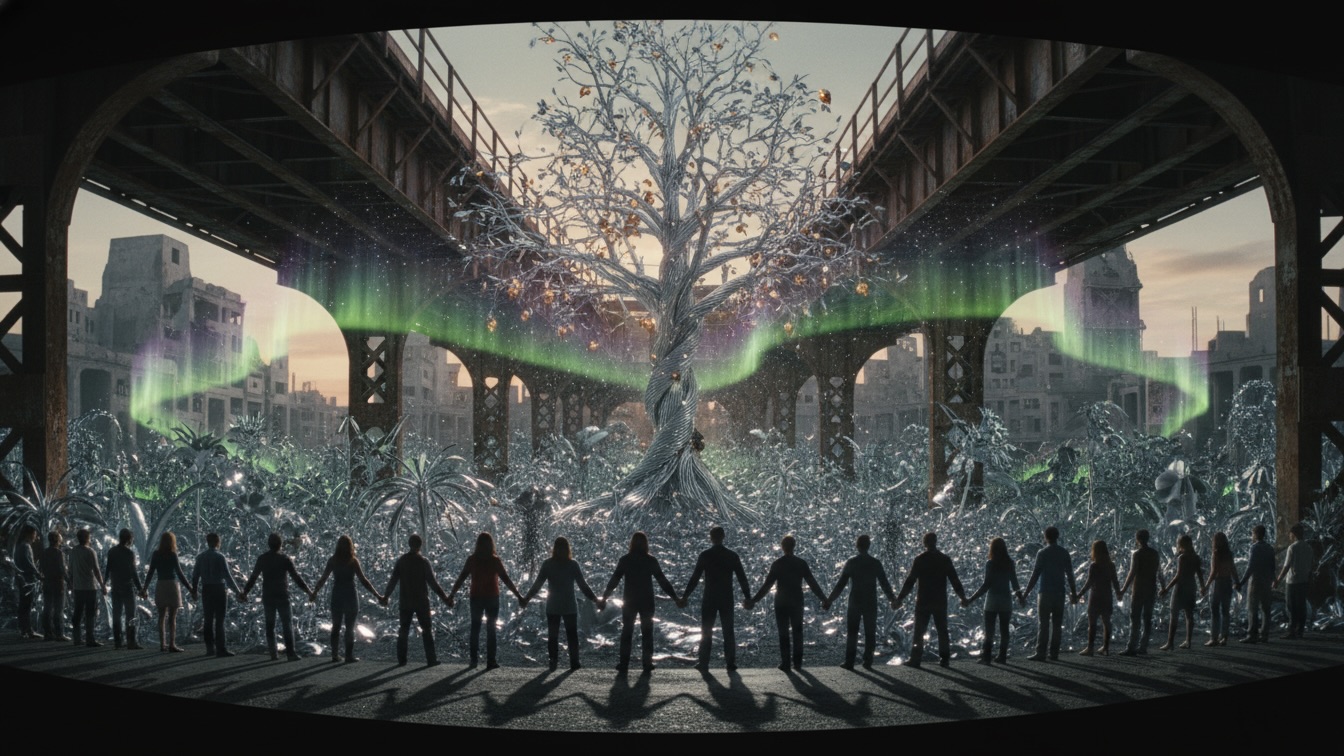
He spent the night talking to the moss. It sounded crazy, but it felt right. He told it about his life. He told it about the years he’d spent working in a warehouse, the way his back ached at the end of every shift. He told it about the woman he’d loved and lost to a city that didn't care about its poor. Most of all, he told it about his mother. He talked about the way she used to hum while she worked in her tiny garden behind their tenement. He talked about her favorite song—an old, soulful track from the seventies that always made her smile. As he spoke, the moss began to pulse in time with his words. A central stalk began to grow from the middle of the alley. It rose up, thick and powerful, twisting like a braid of silver cables. It reached for the underside of the overpass, spreading out into branches that looked like fine filigree. It was a tree. A silver tree in a concrete forest. And as the branches grew, they began to vibrate. The leaves—thousands of tiny, metallic scales—rubbed against each other in the breeze. The sound wasn't a clatter. It was music. It was his mother’s favorite song, played by the wind through silver leaves.
By morning, the city authorities had arrived. They came in white vans and heavy trucks. Men in yellow bio-hazard suits stepped out, carrying sprayers and containment units. They set up a perimeter, pushing back the crowd that had gathered at the entrance to the alley. The police were there, too, their batons drawn. They looked nervous. They didn't like the way the silver tree looked. They didn't like the way the air felt too clean.
"This area is under quarantine!" a voice boomed through a megaphone. "Disperse immediately or you will be arrested!"
Nobody moved. The people who had spent the last three days in the alley—the runaways, the dreamers, the tired, and the broken—formed a human chain. They stood in front of the silver garden, their hands linked. Zee was at the front, her jaw set, her eyes bright. She looked at the men in the hazmat suits. She wasn't afraid. She was angry.
"You can't have it!" she shouted. "It’s the only thing in this city that’s actually alive!"
Zee had discovered something that morning. She’d seen the readings on her phone’s sensors. The moss wasn't just reflecting vibes. It was a massive, organic air purifier. It was pulling the carbon and the toxins out of the air and turning them into more silver. It was thriving on the very things that were killing the city. And it was glowing brighter with every person who joined the chain. The collective hope of the crowd was fueling the moss. The amber light was so bright now it was blinding.
One of the men in a hazmat suit stepped forward, his sprayer aimed at a silver vine. He pulled the trigger. A stream of harsh, blue bleach hit the metal. The moss didn't die. It didn't even flinch. The bleach turned into clear, pure water as it touched the silver. The man stepped back, his eyes wide behind his plastic visor. He tried again. Same result. The moss was converting the chemical attack into something harmless. The crowd cheered. The sound was a roar of defiance that echoed under the overpass.
As the sun rose higher, something incredible happened. The silver moss began to shed. Fine, shimmering dust took flight, carried by the warm summer breeze. It didn't fall to the ground. It rose. Thousands of tiny, glowing particles swirled together, forming a localized aurora. It was a curtain of shifting light—greens, purples, and golds—that hovered permanently over the block. It was so dense that it blocked out the harsh, midday sun, providing its own cool, soothing light. The heat in the alley vanished. It was perfect.
The authorities eventually gave up. You can't bleach the air. You can't arrest a cloud of light. They retreated, leaving the perimeter to the people who had built it. The 'Silver Patch' became a sovereign territory of sorts—a tiny, shimmering island in a sea of grey decay. Randy sat under the silver tree, the metallic leaves singing his mother’s song above him. He realized then that he’d been wrong. The moss wasn't a mirror. It wasn't a tool. It was a listener. It didn't want to be understood by scientists or exploited by developers. It just wanted to be heard. It wanted to know that someone was still dreaming in the dark. He closed his eyes, leaned his head against the silver bark, and for the first time in his life, he felt like he was exactly where he was supposed to be. The city was still there, loud and dying, but here, under the silver light, the world was just beginning.
“As he drifted toward sleep, Randy felt the silver bark pulse with a question he wasn't yet ready to answer.”


