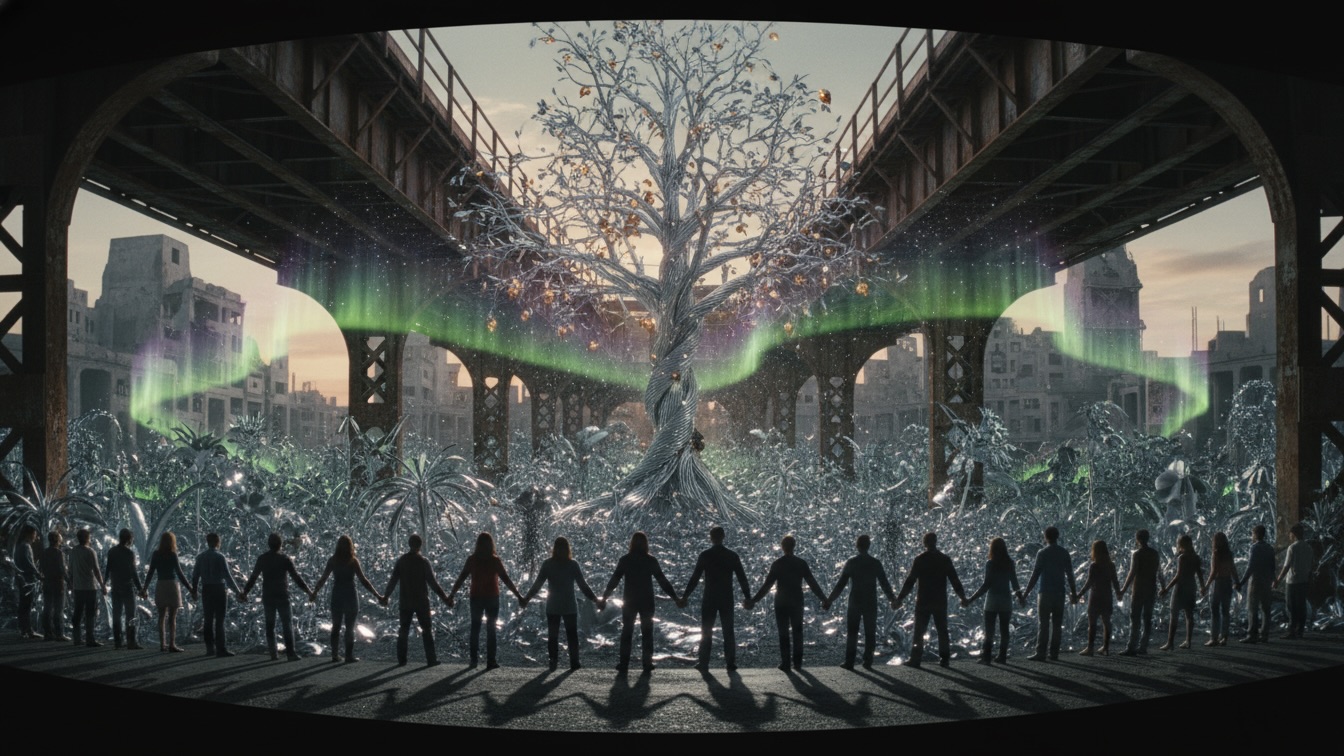
The narrative follows Randy, a fifty-six-year-old man seeking a sense of purpose amidst the oppressive heat and urban decay of a dying district. While attempting to plant marigolds in a barren patch of soil beneath a rusted overpass, he discovers a sentient, metallic fungus that reacts to his humming and emotional state. This "silver dust" manifests his memories and feelings as light and physical forms, transforming the bleak environment into a shimmering sanctuary.
A cynical young woman named Zee soon joins him, initially skeptical but eventually moved to tears when the moss visualizes her deep-seated longing for a cleaner, more hopeful world. As Zee’s video of the phenomenon goes viral, the alley is flooded with spectators and eventually a hostile developer seeking to clear the site for luxury lofts. The moss, sensing the collective anxiety and the physical threat of a bulldozer, hardens into a defensive fortress, protecting the people and the space.
In the final confrontation, the authorities attempt to chemically eradicate the growth, but the moss converts the toxins into pure water and oxygen. It eventually sheds a shimmering, permanent aurora of dust that creates a localized paradise, shielding the inhabitants from the harsh sun and pollution. Randy finds a sense of belonging and peace under the silver tree, realizing that the organism is a listener that thrives on the dreams of those who have been silenced by the city.
The central theme of the story is the transformative power of hope and its ability to overwrite systemic decay. The silver moss acts as a literal and metaphorical conductor, taking the "vibes" of a broken population and manifesting them into something tangible and beautiful. This suggests that even in an environment defined by "grey plywood" and "oily soil," the human spirit retains a creative spark that can reshape reality when given a medium.
Another prominent theme is the conflict between organic connection and industrial exploitation. The developer views the silver patch as a "public health hazard" and a "liability," seeing only the disruption of a schedule rather than the healing of a community. The story positions the moss not just as a biological anomaly, but as a form of resistance against the dehumanizing forces of gentrification and corporate greed.
The narrative also explores the concept of collective consciousness and the somatic experience of emotion. The moss does not just mirror individual thoughts; it responds to the "collective anxiety" and "collective hope" of the crowd. This suggests that the characters' internal states are not isolated experiences but are part of a larger, interconnected web. The silver dust becomes a physical manifestation of the shared human condition, proving that vulnerability can be a source of immense strength.
Finally, the story touches on the idea of ecological adaptation and redemption. The moss is an "organic air purifier" that thrives on carbon and toxins, essentially turning the city’s waste into beauty. This offers a vision of nature that is not fragile, but resilient and proactive. It implies that the solution to urban rot is not to bleach it away, but to find a way to listen to the environment and allow it to evolve alongside human needs.
Randy is a man defined by his weariness and a quiet, desperate need for connection. At fifty-six, he feels "spent," a psychological state reflected in his physical environment of "crushed glass" and "rusted steel." His gardening is a therapeutic attempt to reclaim agency in a world that has largely discarded him. He is the archetypal "wounded healer," seeking to grow life in a dead place to justify his own existence beyond a "screen or a bottle."
From a psychological perspective, Randy exhibits a high degree of emotional intelligence and openness to experience. He is the first to recognize the moss’s sentience because he is already primed for listening, having spent years in the silence of the district. His humming of a "lo-fi stream" from a decade ago signals a nostalgia for stability, which the moss uses as a foundation for its initial growth. He moves from a state of isolation to a state of leadership, becoming the guardian of a new world.
His motivation is not fame or profit, but a search for "the first beautiful thing" he has seen in years. This suggests a soul that has been starved of aesthetic and emotional nourishment. By the end of the narrative, his internal conflict—the feeling of being "spent"—is resolved as he finds his place under the silver tree. He achieves a sense of self-actualization, no longer a stranger in his own garden but a vital part of a living ecosystem.
Zee represents the psychological toll of the modern urban grind on the younger generation. She is characterized by a "protective cynicism," using her flat, terse voice and oversized hoodie as armor against a world she perceives as a "grind until you stop moving." Her initial reaction to the moss as a "chemical leak" or "industrial insulation" is a defense mechanism intended to prevent disappointment. She is "too old for magic," suggesting a premature loss of innocence.
Her transformation is the emotional core of the story. When the moss creates a "window" of blue sky, it bypasses her intellectual defenses and speaks directly to her repressed hope. This moment of vulnerability, where she cries "clean lines through the soot," marks a psychological breakthrough. She shifts from a passive observer of decay to an active defender of the silver patch, reclaiming her voice to shout down the authorities.
Zee’s role as the "unofficial guardian" and the one who records the moss highlights her transition from alienation to engagement. She uses the very technology that often isolates people—the phone with the "cracked screen"—to spread a message of wonder. Her journey is one of rediscovering her "vibe," moving from a state of bruised purple anxiety to a bright, defiant light. She finds that her "anger" is a productive force when it is used to protect what is "actually alive."
The narrative voice is grounded in a gritty, sensory realism that makes the transition into magical realism feel earned rather than jarring. The author uses oppressive tactile imagery, such as the "heavy, wet hand" of the heat and the "massive ribcage" of the overpass, to establish a suffocating atmosphere. This makes the introduction of the "silver fronds" and "mercury" textures feel like a breath of fresh air, providing a sharp contrast between the rot of the city and the "clean tang" of the moss.
Pacing in the chapter is masterfully handled, moving from the slow, rhythmic labor of Randy’s gardening to the frenetic, viral explosion of the crowd. The tension builds steadily with the arrival of the developer, shifting the tone from one of quiet wonder to one of "dangerous urgency." The mechanical "scream" of the bulldozer serves as a violent auditory intrusion that heightens the stakes, leading to the final, triumphant transformation of the alley into a "cathedral of metal and light."
The use of color serves as a vital narrative tool, reflecting the emotional shifts of the characters. The transition from "oily soil" and "grey plywood" to "amber light," "bruised purple," and finally "resonant gold" creates a visual arc for the story. These shifts are not merely decorative; they provide a psychological map of the characters' internal states. The "localized aurora" at the end serves as a stylistic culmination, blending the industrial and the ethereal into a single, cohesive image of hope.
The narrative voice remains empathetic throughout, focusing on the "runaways, the dreamers, the tired, and the broken." By centering the story on those at the margins of society, the author imbues the magical elements with a sense of social justice. The final paragraphs shift into a more lyrical, almost mythic tone, as the silver tree sings a "mother’s song." This stylistic choice reinforces the idea that the moss has transcended its biological nature to become a vessel for human memory and love.


