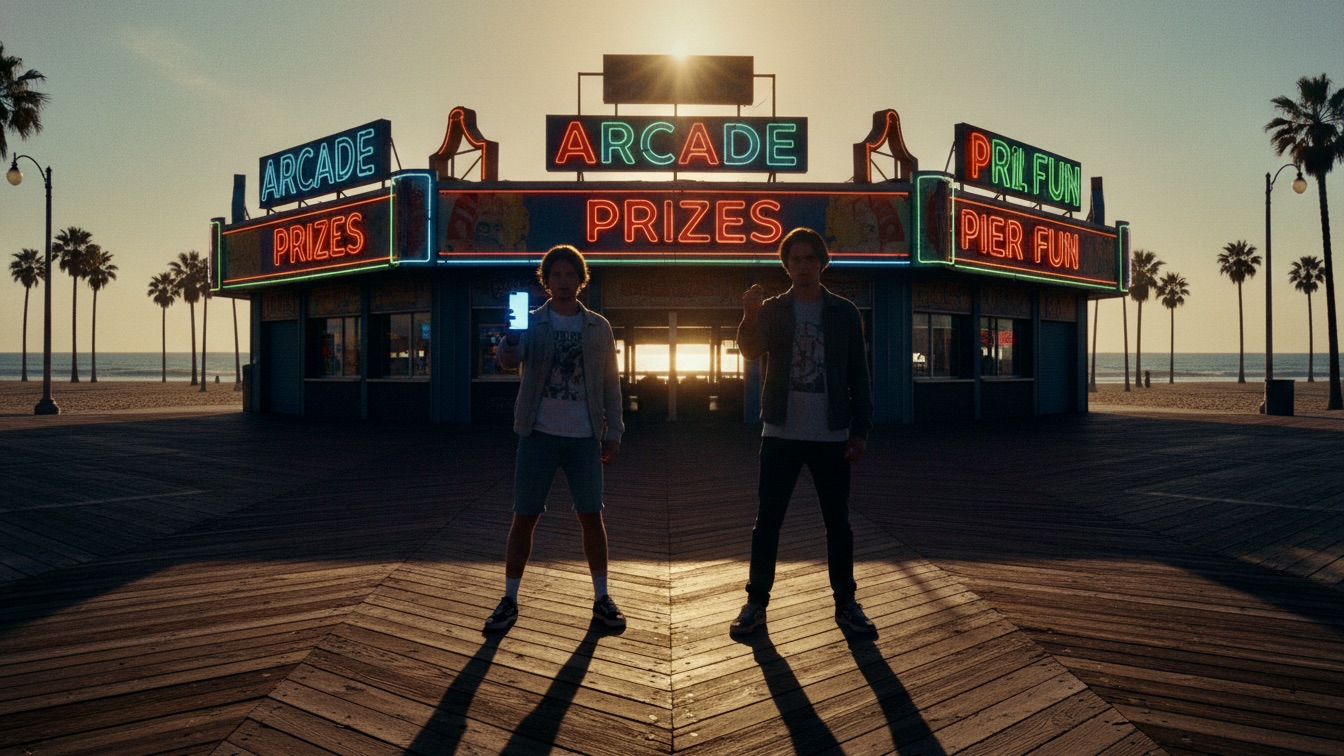
Format: Short Film / Anthology Episode | Est. Length: 10-12 minutes
Pier Tokens serves as a high-tension installment of The Grid, an anthology series exploring the intersection of extreme gig-economy labor and total surveillance in a near-future California. The series follows various "nodes"—citizens trapped in a loop of digital validation and micro-transactions—as they encounter the "Mesh," an underground movement dedicated to reclaiming physical reality. Each episode highlights a different facet of the corporate-owned city, building toward a collective realization that the digital tether is a form of voluntary incarceration.
A frantic drone operator, obsessed with his 89% efficiency rating, is nearly knocked over by a woman who has "drowned" her mandatory smart-visor, only to have his phone transform into a high-value bounty-hunting tool targeting her.
In a world where every movement is a metric, a desperate gig-worker must choose between a life-changing corporate bounty and the survival of his oldest friend. To save her, he must destroy his digital identity and navigate the rotting, analog underbelly of a hyper-connected city.
The episode explores the dehumanization of the modern worker and the loss of privacy in a data-driven society. It pits the "Digital Ghost"—a life defined by efficiency ratings and smart-visor overlays—against the "Analog Real," represented by physical touch, rust, and the unmonitored ocean breeze.
The narrative functions as a critique of surveillance capitalism, illustrating how technology can turn friends into assets and citizens into bounty hunters. It emphasizes the "Pier Token" as a symbol of resistance—a physical, heavy object that cannot be hacked, tracked, or deleted.
For Ted, the stakes are existential; by helping Rick, he faces "unverified" status, which effectively deletes his bank accounts, medical records, and legal existence. For Rick, the stakes are immediate and lethal, as she is a high-value target for a corporate security team authorized to use physical "scrubbing" to protect their data monopoly.
The primary external conflict is the pursuit by the "Men in Grey," corporate security contractors who use the city’s pervasive surveillance grid to hunt the protagonists. Internally, Ted struggles against his own conditioning—the Pavlovian response to app alerts and the crushing financial pressure that makes the 50,000-credit bounty feel like his only hope for freedom.
Ted is a drone operator on the Santa Cruz boardwalk, struggling to maintain the efficiency rating required to pay his "server tax." His world is a blur of digital overlays until he is confronted by Rick, an old friend who has discarded her smart-visor to live as a "ghost." Rick attempts to recruit him into an offline mesh network using a modified arcade token, but the reunion is shattered when Ted’s phone issues a priority bounty alert for Rick’s location. As corporate security contractors close in, Ted is forced to choose between a massive financial windfall and the life of his friend.
The pair flees through a disorienting mirror maze and into the dark, salt-crusted foundations beneath the pier. To escape the tracking signal of his own device, Ted is forced to smash his phone—effectively committing social suicide—before reaching a condemned lighthouse. Inside, they use an ancient pirate radio transmitter to broadcast unencrypted surveillance data to the public, breaking the corporate loop. The episode ends with the city in chaos as citizens remove their visors, and Ted finally experiences the world through his own eyes, holding a physical token of his new, unmonitored life.
Ted: A man hollowed out by the gig economy, Ted begins the story as a hyper-focused "node" who views the world through a cracked screen and efficiency metrics. His psychological arc is one of radical awakening; he starts in a state of paralyzing digital anxiety and ends with a raw, grounded sense of self-reliance after destroying his digital tether.
Rick: A tactical survivalist and "ghost," Rick is the catalyst for the episode’s rebellion. She has already undergone the trauma of disconnecting and now operates with a cold, theatrical deadpan that masks her terror. She begins as a fugitive and ends as a successful revolutionary, having sacrificed her anonymity to break the system for others.
Beat 1: Ted navigates a sweltering, crowded boardwalk, his vision dominated by a glitchy delivery app and a desperate need for a daily bonus. The tension peaks when he nearly crashes into Rick, whose bare face and lack of a visor mark her as a dangerous anomaly in the hyper-connected crowd. Rick warns him that the city is being "sealed" by a new ordinance, but Ted is too distracted by his falling efficiency rating to listen.
Beat 2: Ted’s phone transforms into a weapon, broadcasting a massive 50,000-credit bounty for Rick’s location that would solve all his financial problems. As corporate security contractors in grey polos emerge from the crowd, Ted experiences a moment of agonizing indecision before shoving the phone in his pocket and choosing to flee with Rick. They dive into the "Infinity Maze" arcade, a disorienting environment where the digital tracking on Ted's phone makes them easy targets.
Beat 3 (Midpoint): Inside the mirror maze, Ted realizes his phone is broadcasting their exact coordinates to the hunters' local network. In a moment of total surrender, he drops the device into a puddle of grimy condensation, watching his entire digital life short-circuit and die. The sudden silence in his hand is profound, marking his transition from a tracked asset to a free, "unverified" human being as they escape into the maintenance tunnels.
Beat 4 (Climax): Beneath the pier, the duo navigates the rotting, barnacle-encrusted pylons to reach a condemned lighthouse containing an ancient pirate radio transmitter. While the "Men in Grey" breach the tower's iron door, Rick uses the copper token to activate the machine and broadcast unencrypted corporate surveillance logs to every visor in the city. The security team is forced to abort their mission as the data leak compromises their entire operation and causes a mass public outcry on the boardwalk.
Beat 5: As the broadcast continues to drone, Ted looks out through the shattered lighthouse glass at a crowd of people finally removing their visors and looking at one another. The constant, suffocating weight of the app is gone, replaced by the visceral sensation of the ocean breeze and the salt on his skin. Rick hands him a second brass token, and Ted closes his hand around the heavy metal, finally holding something real.
The episode begins with high-frequency, claustrophobic anxiety, mirroring the frantic "pinging" of Ted’s digital life. As the chase ensues, the mood shifts into a disorienting, neon-soaked nightmare within the mirror maze, eventually bottoming out into a cold, visceral silence beneath the pier. The finale provides a cathartic release, moving from the "noise" of the system to the "signal" of the analog broadcast, ending on a note of gritty, uncertain hope.
If expanded, the season would follow the "Mesh Network" as it spreads to other coastal cities, with Ted and Rick acting as recruiters for an offline resistance. Each episode would focus on a different character—a corporate auditor, a visor designer, or a child born into the grid—as they encounter the "Pier Tokens" and are forced to choose between digital comfort and physical truth.
The overarching narrative would track the conglomerate's increasingly violent attempts to "re-sync" the population, culminating in a total blackout of the central servers. The thematic escalation would move from individual survival to a collective reclamation of human history, as the characters rediscover lost physical archives and unmonitored spaces that the corporate grid has tried to erase.
The visual style is "Industrial Cyberpunk," eschewing clean, futuristic aesthetics for a grimy, over-saturated look that emphasizes the heat and decay of the Santa Cruz setting. The camera work transitions from tight, jittery handheld shots during Ted’s gig-work to wide, stable, and atmospheric compositions once the characters move into the analog spaces of the lighthouse.
Tonal influences include the social claustrophobia of Black Mirror and the tactile, low-tech rebellion of Children of Men. The color palette contrasts the sickly green and red of the digital UI overlays with the deep blues, rust-oranges, and natural sunlight of the "real" world beneath the pier.
The target audience is adults (18-45) who consume speculative fiction and techno-thrillers, particularly those interested in themes of privacy, labor rights, and the psychological impact of the gig economy. It is designed for a streaming platform audience that appreciates high-concept, "prestige" anthology storytelling with a grounded, visceral edge.
The pacing is relentless, designed to mimic a 10-minute "sprint" that mirrors the protagonist's elevated heart rate. The structure follows a rapid three-act format: the "The Hook" (Boardwalk), "The Descent" (Mirror Maze/Under-pier), and "The Signal" (Lighthouse), with almost no downtime between beats to maintain a sense of digital suffocation until the final broadcast.
The mirror maze sequence requires careful practical lighting and camera blocking to hide the crew while emphasizing the "infinite" reflections of the LED strips. The lighthouse interior should be a practical set or location to capture the authentic textures of rust and stone, providing a stark contrast to the VFX-heavy digital overlays seen in the opening act.
The "digital overlays" (UI) should be rendered as diegetic elements that flicker or distort based on Ted's stress levels, providing a visual shorthand for his internal state. Sound design is critical, transitioning from a dense "wall of noise" in the arcade to the rhythmic, natural sounds of the ocean to emphasize the transition from digital to physical.


