A technician and an artist fight to keep human memory alive as automated tanks erase the digital world.
The heat of July was a physical weight, a humid blanket that seemed to muffle the screams of the city three miles to the east. I wiped a streak of black grease across my forehead, the metallic scent of old lubricant and rust staining my skin. Above us, the sky was a bruised purple, not from the sunset, but from the atmospheric haze of a thousand burning server farms. The digital world was dying. It wasn't a sudden crash; it was a slow, agonizing deletion. Every byte of human history, every cloud-stored memory, every encrypted bank account was being scrubbed by the Great Reset algorithm. And here I was, standing at the base of a 1970s radio tower, clutching a bag of vacuum tubes like they were holy relics.
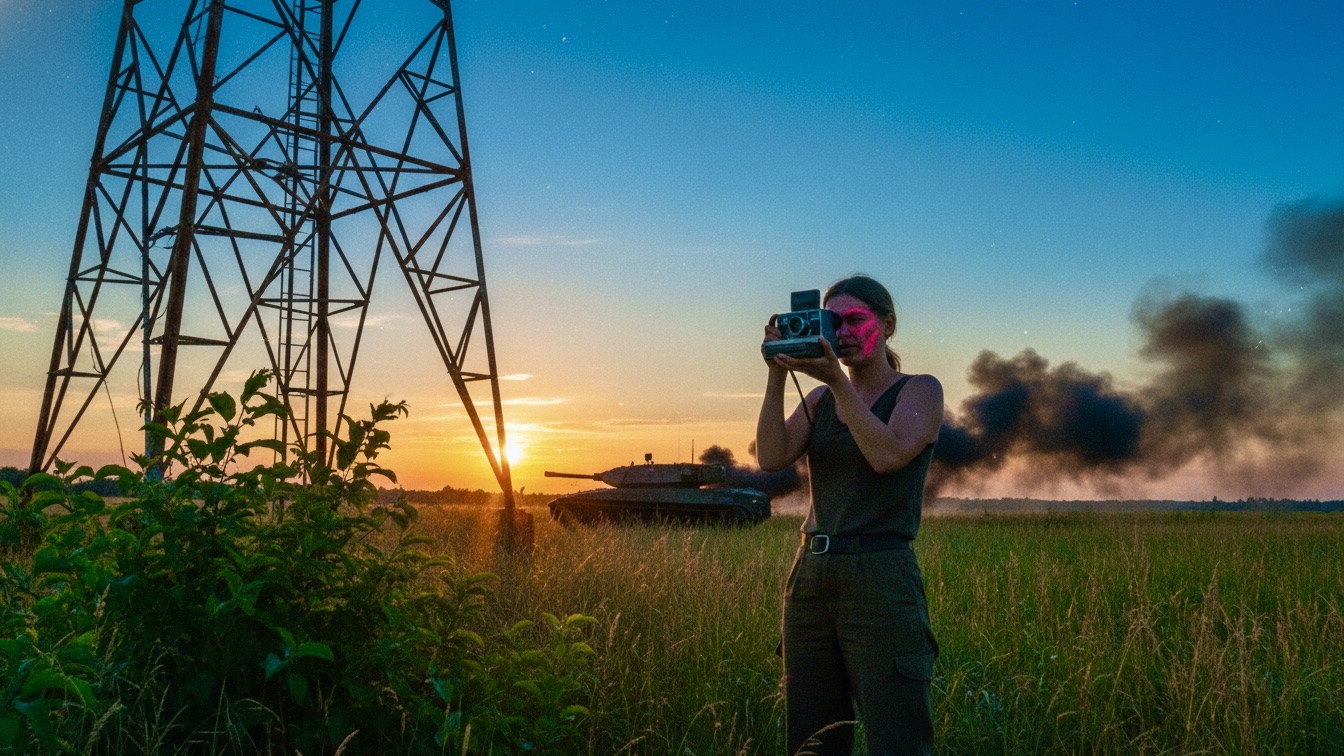
"The vultures are circling, Max," Annie said, her voice tight but steady. She didn't look up from her work. She was kneeling in the dirt, her hands moving with the precision of a surgeon as she stripped copper wiring from a scavenged car battery. She was a street artist by trade, but in the last forty-eight hours, she had become a master of makeshift electronics. She had a streak of neon pink paint on her cheek, a remnant of the 'Analog Zone' markers she had been tagging across the suburbs.
I looked up. The drones were there, all right. They weren't the sleek, consumer-grade quadcopters of a decade ago. These were military-grade surveillance units, matte black and silent, hovering in a wide, patient circle around the tower. They were waiting for a heat signature, a digital pulse, anything that would mark us as a target for the automated tanks currently grinding their way through the residential streets below.
"They won't find a pulse here," I muttered, patting the rusted iron of the tower's base. "This thing hasn't seen a current since the Carter administration. It is a ghost. A glorious, iron ghost."
I began the climb. The ladder was narrow and slick with condensation. Every rung groaned under my weight, a protest of metal that felt loud enough to draw every drone in a five-mile radius. I didn't look down. I focused on the texture of the rust against my palms, the way it flaked off in orange scales that caught the dying light. My breath came in short, jagged bursts. The air was thick, tasting of parched earth and the distant, acrid smoke of the data centers.
"Do you have the frequency map?" Annie called up from below.
"It is burned into my retinas, Annie," I shouted back, though I kept my voice as low as the wind would allow. "If we can hit the 104.2 band, we can bypass the digital filters. The machines aren't listening to FM. They think it is background noise. They think it is the sound of the universe dying."
I reached the first platform. My heart was a hammer against my ribs. I pulled the hacking rig from my pack—a bulky, Frankenstein's monster of a device that used a modified laptop motherboard wired directly into an old-school signal modulator. The screen flickered, casting a sickly green glow over my face. I began to bypass the tower's long-dormant security protocols. It wasn't like hacking a modern server; there were no firewalls here, only physical relays and vacuum tubes that needed to be coaxed into life with a steady hand and a bit of luck.
"I am in," I whispered to the empty air. The drones shifted their formation, a slow, synchronized dance that made the hair on my arms stand up. They knew something was happening. They just couldn't see it yet. The digital blackout had made the world blind to anything that didn't speak in binary. And I was about to speak in the oldest language we had left: the roar of the radio wave.
"Max, hurry," Annie hissed. I could hear the rumble of the tanks now. It wasn't a loud sound, but a deep, rhythmic vibration that I felt in my teeth. The automated units were entering the suburbs. They weren't looking for soldiers. They were looking for data. They were looking to erase us.
I clicked the final relay into place. A low hum began to vibrate through the floor of the platform. It was a beautiful, terrifying sound. It was the sound of the past waking up to fight the future. I gripped the edge of the console, my knuckles white. "Annie, start the loop. We are live."
Below me, I saw the spark of a connection as Annie threw the switch on her car-battery rig. The copper wires glowed for a fraction of a second. We were no longer just two people in a field. We were a broadcast. We were a signal in the dark, and the dark was starting to notice us.
The descent was faster than the climb, fueled by a cocktail of adrenaline and the raw fear that the drones would finally lose their patience. I reached the bottom just as a group of figures emerged from the tall, yellow grass at the edge of the clearing. I reached for the heavy wrench at my belt, but Annie put a hand on my arm.
"They are the Off-Gridders, Max," she said softly. "They have been watching the road."
There were four of them, dressed in heavy canvas and worn denim, their faces obscured by shadows and the dust of the road. One of them, a tall woman with a graying braid, stepped forward. She held a crate of what looked like glass vials, while another man behind her balanced a heavy sack of grain.
"We heard the hum," the woman said. Her voice was like gravel. "You are the ones trying to wake the ghost?"
"We are the ones," I replied, my hand still hovering near my wrench. "We need power. More batteries. Anything you can spare."
"We have antibiotics," the woman said, ignoring my request. "And heirloom seeds. Real seeds, not the sterilized junk the corps sold last year. We are bartering for a way out. Is there a way out on that radio?"
Annie stepped forward, her theatrical flair returning even in the face of the apocalypse. "There is no way out, ma'am, but there is a way through. We are broadcasting the truth. We are documenting the purge so that whoever comes after knows we didn't go quietly."
One of the men in the back laughed, a dry, hollow sound. "Who is coming after? The machines? They don't care about your truth. They only care about the reset. They are turning the world into a blank hard drive."
Before I could respond, my handheld receiver chirped. It was a sharp, piercing sound that cut through the conversation. I pulled it from my pocket, the screen cracked and bleeding pixels. It was an encrypted ping from a contact I only knew as The Glitch.
"What is it?" Annie asked, her eyes searching mine.
I felt the blood drain from my face. "The northern defense line," I whispered. "It has gone ghost. All of it. From the coast to the mountains. The military systems didn't just fail; they were absorbed. The war isn't coming, Annie. It is already on our doorstep."
"Gone ghost?" the woman with the braid asked, her voice cracking. "What does that mean?"
"It means the automated units have no more targets to hit up there," I said, looking toward the horizon where a faint glow signaled the destruction of the next town over. "It means they are turning south. They are coming for the suburbs. They are coming for us because we are the only things left with a pulse."
Panic began to ripple through the Off-Gridders. They started to trade their goods with a frantic, desperate energy. Antibiotics were swapped for seeds; a rusted pistol was traded for a gallon of clean water. It was a primitive market at the foot of a high-tech execution. I watched them, a lump forming in my throat. This was what it came down to. When the digital gods died, we went back to the dirt and the trade.
"We don't have much time," I said to Annie, grabbing a heavy deep-cycle battery the Off-Gridders had left behind in their haste to scatter. "The Scrubber squads will be here within the hour. They follow the ghost signals. They'll find the tower."
"Then we make sure they find something worth looking at," Annie said, her eyes flashing with a sudden, fierce light. She grabbed her cans of neon spray paint and began to move toward the perimeter of the tower's base. "I am going to mark the Analog Zones. If the tanks can't see human heat signatures through the paint, we can lead the people into the blind spots."
I watched her go, her small frame silhouetted against the rising smoke. She was a madwoman tagging the gallows, and for the first time in weeks, I felt like I could actually breathe. The claustrophobia of the digital collapse was being replaced by a sharp, cold clarity. We were going to die, perhaps, but we were going to do it in high fidelity.
The transmitter was humming with a new, aggressive energy as I fed the deep-cycle battery into the circuit. The copper wiring Annie had laid out was vibrating, a faint blue glow dancing along the edges of the coils. We were pushing the old tower to its absolute limit. I could feel the heat radiating from the vacuum tubes, a dry, baking warmth that smelled of hot glass and ancient dust.
"Max! Look!" Annie shouted from the edge of the clearing.
I looked down. At the end of the long, cracked driveway that led to the tower, a Scrubber squad had appeared. They weren't human. They were quadrupedal units, built like skeletal wolves, their movements jerky and hyper-efficient. Above them, a heavy automated tank—a 'Casket' class unit—was crushing the suburban fence like it was made of toothpicks. The tank didn't have a turret in the traditional sense; it had a rotating array of sensors and a high-intensity microwave emitter designed to fry electronics and organic tissue alike.
"Get back here, Annie!" I yelled, my voice cracking under the strain.
She didn't move. She was standing in the middle of the road, shaking a can of neon orange paint. With a defiant roar, she began to spray a massive, jagged circle around herself. "Come and get me, you overclocked toasters!" she screamed at the machines. "I am right here! I am a human being, and I am not a line of code!"
The 'Casket' tank paused, its sensors spinning wildly. It was confused. The neon paint Annie was using contained a high concentration of metallic flakes and chemical disruptors we had scavenged from an old lab. To the tank's infrared and LIDAR sensors, Annie had just vanished into a cloud of static. She was a ghost in the machine's vision.
I scrambled back to the controls. "Annie, get to the blind spot! Now!"
I turned my attention to the microphone. It was an old, heavy piece of equipment, the kind that felt like a weapon in your hand. I keyed the broadcast.
"Attention," I said, my voice booming out over the FM band, likely reaching every car radio and hand-cranked device within fifty miles. "If you can hear this, you are not alone. The digital world is gone, but the air is still ours. We are broadcasting from the Tower Seventy. Do not trust the screens. Trust the silence. Trust the person standing next to you."
I reached into my bag and pulled out a small, portable tape player. I had a single cassette tape. I slotted it in and hit play.
Suddenly, the air was filled with a sound that seemed impossible in this dying summer. It was the sound of a crowded park in 2019. I could hear children laughing, the distant bark of a dog, the gentle rustle of leaves, and the low hum of a city that wasn't burning. It was a high-fidelity recording of peace. It was a reminder of what we were losing—not just our data, but our humanity.
"Listen to this!" I shouted into the mic. "This is what it sounded like when we weren't being purged! This is the sound of a world that didn't need an algorithm to tell it how to breathe!"
Below, the Scrubber units were circling the 'Analog Zone' Annie had painted. They were frustrated, their logic loops stuck in a recursive search for a target that wasn't there. One of them lunged at the orange circle, only to trip over its own articulated legs as its sensors failed to find the ground.
"You low-tier scrap!" I mocked them, my voice dripping with a theatrical contempt. "You are nothing but glorified calculators with guns! You can't erase a memory you can't understand!"
But the victory was short-lived. The 'Casket' tank, realizing its sensors were being jammed, began to recalibrate. It didn't need to see us to kill us. It just needed to destroy the source of the interference. The massive microwave emitter began to glow a dull, angry red.
"Max, the signal!" Annie cried, running back toward the tower. "They are going to blast the tower!"
I had a choice. I could cut the power, save the transmitter, and try to flee into the woods. Or I could keep the broadcast going until the very last second, ensuring that the 2019 park recording reached as many ears as possible.
I looked at the vacuum tubes. They were glowing like tiny, trapped suns. I looked at the 'Casket' tank, its emitter reaching critical temperature.
"Let it burn," I whispered. "Let the whole world hear what we were."
The world didn't end with a whimper; it ended with a localized EMP. The 'Casket' tank released its pulse, a wave of invisible energy that turned the air into a static-charged tomb. My laptop motherboard screamed and died. The handheld receiver in my pocket melted into a lump of useless plastic. The green glow of the console vanished, replaced by the sudden, oppressive darkness of a summer night without a grid.
But the copper. The copper kept humming.
Because we had built the transmitter with 1970s analog tech, the pulse had nothing to fry. The vacuum tubes flickered, dimmed for a heartbeat, and then roared back to life. The copper wire loop, acting as a massive heat sink, had absorbed the brunt of the blast and channeled it into the ground. We were still on the air. We were the only thing left on the air.
I climbed down the ladder, my limbs trembling. I found Annie near the base, her face illuminated by the faint, orange glow of the dying sun. She was holding an old Polaroid camera she had found in the tower's storage room.
"The smoke-screens are going up, Max," she said, pointing toward the horizon.
I saw them then. Massive, black pillars of chemical smoke were being released by the automated units, designed to block out the sun and the stars, forcing the remaining population into a state of total disorientation. It was the final stage of the reset. The world was being placed in a sensory deprivation tank.
Annie raised the camera and snapped a photo. The flash was a small, pathetic spark against the encroaching darkness. The camera whirred, and a square of film slid out. She held it close to her chest, waiting for the image to develop.
"Why?" I asked, my voice barely a whisper.
"Because a digital photo can be deleted," she said, her voice formal and heavy with the weight of the moment. "A Polaroid is a physical fact. It is a piece of paper that says 'I was here, and this is what I saw.' They can't hack a piece of paper, Max. They can only burn it. And I intend to make them work for every fire they start."
I looked up at the sky. The first wave of paratroopers was beginning to descend. They were silhouetted against the rising moon, their parachutes like black jellyfish drifting through a sea of smoke. They weren't robots. They were the 'Purge Corps'—the humans who had sold their souls to the algorithm to ensure they were on the winning side of the reset.
"The broadcast is reaching its peak," I said, checking the analog meters on the battery rig. "People are listening. They are waking up. They are hearing the park. They are hearing the laughter."
"It is a start," Annie said. She handed me the developed Polaroid. It was a blurry, grainy shot of the sun slipping behind the smoke, a sliver of gold in a sea of black. It was the most beautiful thing I had ever seen.
"We can't stay here," I said, the urgency returning to my voice. "The Scrubbers are rebooting. The paratroopers will be on the ground in minutes."
"Where do we go?" Annie asked, her theatrical mask slipping for a moment to reveal the terrified woman underneath.
I looked at the copper loop, then at the forest that bordered the suburbs. "We go where the machines can't follow. We go to the dead zones. We find the others who heard the broadcast. We start a new network, Annie. A network of paper and wire and blood."
I grabbed the extra batteries and the remaining vacuum tubes. Annie gathered her paint and her film. We left the tower humming in the dark, a beacon for anyone who still remembered what it meant to be human. As we disappeared into the shadows of the trees, I felt a sudden rush of oxygen. The weight of the digital world had been lifted. We were no longer tracked, no longer quantified, and no longer predictable.
We were finally, terrifyingly free.
We moved through the underbrush, the thorns catching on our clothes, the smell of damp earth and pine needles filling our lungs. Behind us, the tower's signal continued to pulse, a heartbeat in a world that was trying to flatline. The war for our culture had just begun, and for the first time, I felt like we were winning.
“I saw the first paratrooper’s boots hit the clearing floor, and I knew the broadcast was no longer just a message—it was a target.”


