Format: Short Film / Anthology Episode | Est. Length: 10-12 minutes
Imagine this story as a visceral installment of an anthology series titled The Concrete Jungle, where each episode pulls back the curtain on the hidden moral crises of ordinary city dwellers. The series explores the intersection of domestic survival and low-level criminality, focusing on the "invisible" people—the sisters, neighbors, and shopkeepers—who are forced to navigate the fallout of other people’s sins. Through a lens of gritty realism, the show tracks the overarching narrative of a neighborhood slowly reclaiming its agency from the shadow of local gang leaders, with each episode serving as a standalone character study in resilience.
Nineteen-year-old Jada desperately scrubs a bloodstain out of a denim jacket with a toothbrush and peroxide while her boyfriend, Wes, delivers a delusional monologue about their future as "kings" in Los Angeles. The sweltering heat of their cramped apartment mirrors the suffocating pressure of a relationship built on manipulation and forensic cleanup.
A young woman must choose between her loyalty to a volatile criminal and the safety of her toddler sister when she is ordered to hide a revolver in a daycare center. To escape, she must dismantle the "ride or die" myth she has lived by and find sanctuary in the community she nearly abandoned.
The episode primarily explores the deconstruction of the "ride or die" romantic aesthetic, exposing it as a vehicle for domestic abuse and psychological trauma. It highlights the contrast between the theatrical, cinematic delusions of the "anti-hero" and the grounded, unglamorous reality of the victim who has to manage the physical and legal consequences of his actions.
Secondary themes include the power of community grounding and the use of psychological tools, such as Acceptance and Commitment Therapy (ACT), to combat chronic dysregulation. The story posits that true safety is found not in grand escapes to distant cities, but in the mundane, protective structures of a neighborhood that looks out for its own.
The stakes are both physical and existential; if Jada complies with Wes’s demand, she risks the life of her sister Maya and faces a mandatory prison sentence as an accessory to a violent crime. If she refuses, she faces the immediate, unpredictable rage of a man who views her as an extension of his own will. Ultimately, Jada’s sanity and her ability to envision a life outside of Wes’s chaotic orbit are the primary elements hanging in the balance.
The external conflict is driven by Wes, whose narcissistic need for control and mounting desperation to hide evidence from the police turn him into a physical threat. Internally, Jada battles a paralyzing panic disorder and the "cognitive static" of her indoctrination into Wes’s lifestyle. The environment itself acts as an antagonist, with the oppressive summer heat and the claustrophobic apartment heightening the tension until it reaches a breaking point.
Jada is trapped in a sweltering apartment, cleaning forensic evidence for her boyfriend Wes, who uses grand promises of a Hollywood lifestyle to mask his abusive control. The tension escalates when Wes returns with a duffle bag containing a revolver and burner phones, demanding Jada hide it in her four-year-old sister's daycare cubby to evade a police sweep. Refusing to endanger her sister, Jada uses grounding techniques to overcome a panic attack and feigns compliance before bolting from the apartment with the bag.
She sprints through the city streets, pursued by a frantic Wes, and seeks refuge in a local bodega where the community forms a physical barrier to protect her. Inside, she makes the final decision to hand the evidence over to a trusted police officer, effectively ending her relationship and her involvement in Wes’s criminal world. The episode concludes with Jada finding peace in the mundane safety of her sister’s school play, finally free from the "ride or die" narrative.
Jada: A nineteen-year-old who begins the episode in a state of dissociated hyper-vigilance, acting as a "fixer" for her boyfriend’s crimes. Her psychological arc moves from total compliance and chronic nausea to a state of grounded clarity where she prioritizes her core values over her toxic attachment. By the end, she has transitioned from a passive accessory to a decisive survivor who has reclaimed her own narrative.
Wes: A theatrical, manipulative narcissist who views his life as a cinematic masterpiece and Jada as his loyal co-star. He begins with a mask of charismatic control, but as his criminal world crumbles, he devolves into a desperate, cornered animal. He remains static in his delusion, ending the episode not as a "king," but as a neighborhood nuisance who has lost his power.
Mrs. Parter: The elderly neighbor who serves as a catalyst for Jada’s grounding, offering a tangible act of care (baked ziti) that contrasts with Wes’s empty promises. She represents the unglamorous but solid reality of the community that Wes despises.
Luis: The bodega manager who provides the physical sanctuary Jada needs to make her final stand. He is a man of few words who understands the neighborhood’s unspoken rules of protection.
Jada scrubs blood from a jacket in a sweltering apartment while Wes paces, delivering a theatrical monologue about their impending "royal" life in Los Angeles. The heat and the smell of bleach create a claustrophobic atmosphere that establishes Jada’s sensory overload and Wes’s delusional narcissism. The scene ends with Wes leaving Jada alone with her shaking hands and the evidence of a crime she didn't commit.
Mrs. Parter interrupts the tension with a mundane gift of baked ziti, forcing Jada to briefly interact with the "normal" world outside her toxic bubble. The weight of the warm dish and the neighbor’s blunt observations about Jada’s health provide a necessary grounding moment that highlights the absurdity of Wes’s lifestyle. Jada eats the food in a moment of desperate, biological survival before the peace is shattered by Wes’s sudden, frantic return.
Wes drops a duffle bag containing a revolver and burner phones, demanding Jada hide the contraband in her four-year-old sister’s daycare cubby. This request triggers a visceral panic attack for Jada, which she manages by utilizing specific grounding techniques to regain her mental clarity. Realizing the "ride or die" narrative is a death sentence for her family, she finds the strength to say "no" for the first time.
After a brief physical struggle where Wes attempts to intimidate her into submission, Jada feigns compliance only to bolt from the apartment with the bag. She sprints through the oppressive summer heat, pursued by Wes, as the urban landscape becomes a blurred obstacle course of strollers and stoop-sitters. The chase culminates at a local bodega, where Jada seeks sanctuary behind a locked glass door.
Inside the bodega, Luis and the neighborhood elders form a protective wall, forcing Wes to abandon his theatrical threats and retreat into the shadows. Jada finally relinquishes the bag to Officer Davis, choosing legal consequences over the continued protection of Wes’s secrets. This act of betrayal against the "code" marks her final break from the toxic cycle of her relationship.
The story concludes in a quiet, air-conditioned school gymnasium where Jada watches her sister Maya perform in a simple school play. The lack of drama and the mundane nature of the event serve as Jada’s ultimate reward for her harrowing escape. She sits in the silence, finally breathing deeply, as she realizes that a "boring" life is the only one worth living.
The episode follows a trajectory of escalating claustrophobia and dissociation, peaking in a high-adrenaline chase that feels like a fever dream. The mood shifts from the "hot" anxiety of the apartment to the "cold" clarity of the bodega standoff. The audience experience concludes with a profound sense of "quiet" relief, moving from the jagged energy of a thriller to the soft, grounded reality of a family drama.
If expanded into a full season, the narrative would follow Jada’s life as a protected witness, exploring the fallout of her decision to turn in the evidence against Wes’s employer, Mark. The season would track Wes’s descent into further criminality as he tries to "reclaim" Jada, while Jada builds a new life centered on community college and her family.
The thematic escalation would focus on the neighborhood’s collective resistance against Mark’s gang, showing how Jada’s single act of defiance inspires other residents to stop being "accessories" to the crime on their doorsteps. The season would end with a final confrontation that proves the strength of the community is greater than the myth of the lone criminal protagonist.
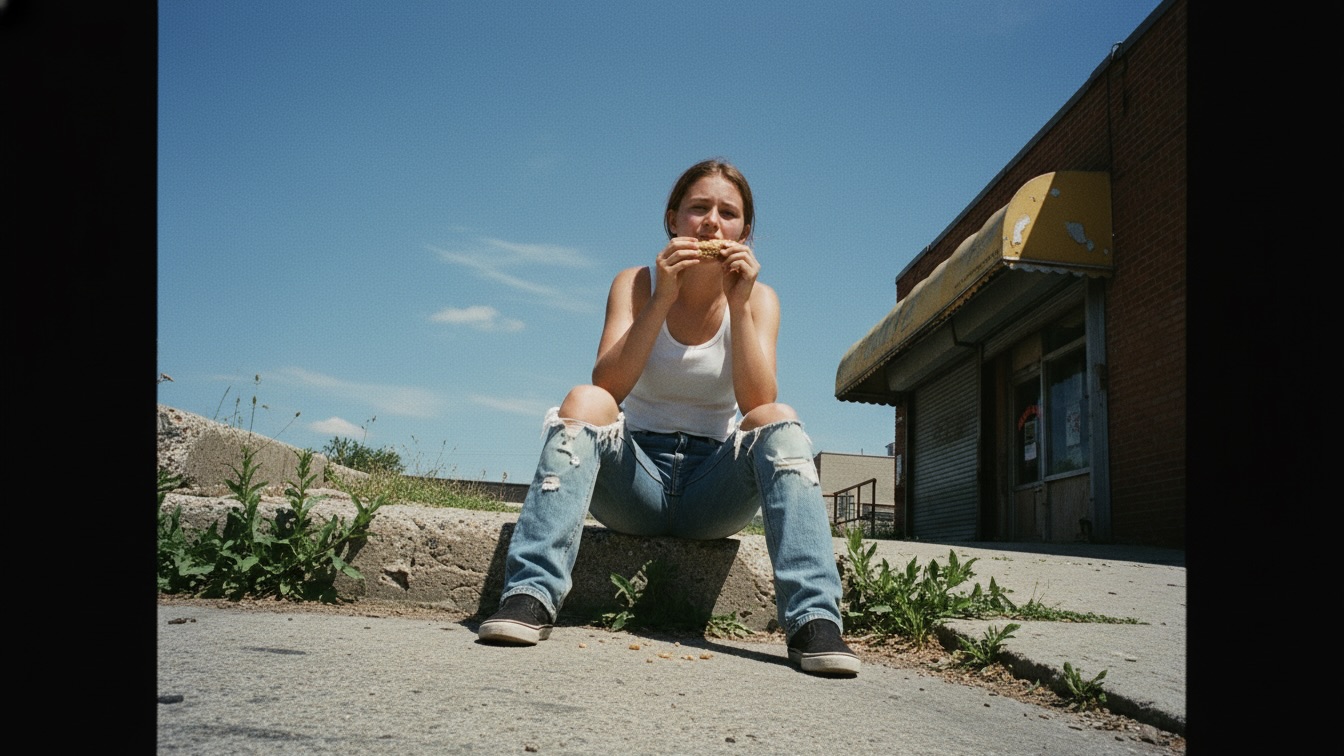
The visual style is defined by gritty, high-contrast realism with a "sweaty" color palette of saturated yellows, oranges, and browns to emphasize the oppressive summer heat. Handheld camera work will be used during Jada’s panic attack and the subsequent chase to create a sense of instability and urgent, first-person perspective.
Tonal influences include the relentless tension of Uncut Gems and the raw, neighborhood-centric aesthetic of The Florida Project. The sound design will prioritize the mechanical hum of the broken air conditioner and the rhythmic tapping of Jada’s foot, creating a sonic landscape of anxiety that only resolves into clear, ambient school-gymnasium sounds in the final scene.
The target audience consists of young adults (18-34) and fans of psychological thrillers, social realism, and anthology series like The Bear or Euphoria. It appeals to viewers who value character-driven narratives that explore mental health, domestic dynamics, and the complexities of urban survival.
The episode is paced as a "pressure cooker" that explodes into a high-speed pursuit. The first six minutes are slow and claustrophobic, building the internal tension within the apartment, while the final six minutes are a rapid-fire sequence of action and resolution. The runtime of 10-12 minutes ensures a tight, impactful narrative that focuses on a single, transformative choice.
Production will require a practical, cramped apartment set that can be safely "heated" to produce visible sweat on the actors, enhancing the sensory experience of the heatwave. The bodega sequence will benefit from a real-world location to capture the authentic clutter and fluorescent lighting of a neighborhood store.
Special attention must be paid to the "grounding" sequence, using visual cues—such as extreme close-ups of the objects Jada identifies—to mirror her internal psychological process. The duffle bag must be weighted realistically to ensure the actor’s physical struggle with the "burden" of the evidence is visible on screen.


