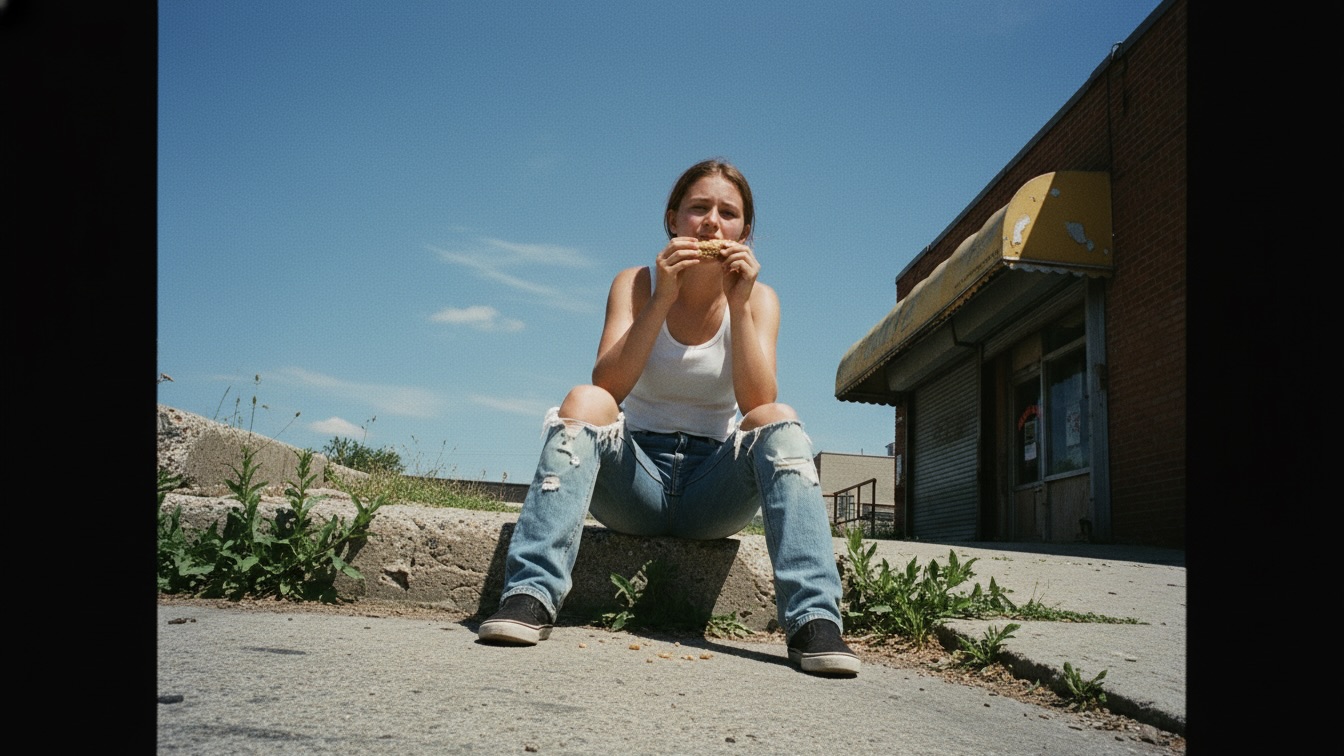
The story begins in a sweltering apartment where nineteen-year-old Jada is cleaning a bloodstain off her boyfriend Wes’s denim jacket. Wes, a manipulative and aspiring criminal, attempts to maintain a romanticized "ride or die" narrative while pressuring Jada to hide a duffle bag containing burner phones and a revolver at her four-year-old sister’s daycare. This demand triggers a severe panic attack in Jada, but she manages to ground herself using psychological techniques she learned from a school counselor. Realizing the true danger Wes poses to her family, Jada refuses to comply, leading to a physical confrontation where Wes slams her against a counter.
Jada feigns submission to lower Wes’s guard before seizing the bag and bolting out of the apartment. A tense chase ensues through the neighborhood, ending at a local bodega where the community and a police officer intervene to protect her. Jada hands the evidence over to the authorities, effectively ending her involvement in Wes’s criminal world. The chapter concludes with Jada sitting in a school gymnasium, watching her sister play a tree in a school performance. She finds a sense of profound peace in the mundane, safe reality she has reclaimed for herself.
One of the primary themes explored in this chapter is the deconstruction of the "romanticized outlaw" archetype often found in popular media. Wes views his life through a cinematic lens, using grand terminology like "destiny" and "kings" to mask the squalor and violence of his actual existence. Jada’s internal struggle highlights the gap between the "aesthetic" of being a loyal girlfriend and the grueling reality of destroying forensic evidence. The narrative suggests that such romanticization is a tool for coercive control, used to keep victims compliant in dangerous situations.
Another significant theme is the power of community as a safety net against domestic and criminal instability. Jada is initially isolated within Wes’s "chaotic orbit," but her interactions with Mrs. Parter and Luis provide her with grounding reminders of the normal world. Mrs. Parter’s baked ziti and Luis’s willingness to lock the bodega door represent a tangible, non-transactional form of care that Wes is incapable of providing. These moments of communal support act as the catalyst for Jada’s eventual escape. They prove that her "boring" life was actually a source of strength rather than a weakness.
The story also heavily emphasizes the theme of psychological autonomy and the reclamation of the self. Jada’s transition from a state of "cognitive static" to "cold, hard clarity" is achieved through the deliberate use of grounding techniques. By focusing on her physical senses, she breaks the dissociative spell Wes has cast over her. This psychological shift allows her to set a firm boundary when her core values—specifically the safety of her sister—are threatened. The ending suggests that true freedom is found not in grand escapes to Los Angeles, but in the ability to breathe freely in a boring, safe environment.
Jada is a protagonist defined by her journey from trauma-induced dissociation to empowered agency. At the start of the chapter, she is physically and mentally exhausted, exhibiting symptoms of chronic dysregulation like nausea and a racing heart. She has been conditioned to accept Wes’s narrative of "ride or die" loyalty, which has effectively silenced her own instincts for self-preservation. Her age, nineteen, places her at a crossroads between the lingering vulnerability of adolescence and the necessary boundaries of adulthood. This transition is forced into high gear when she realizes her sister’s life is being used as a pawn.
Her use of Acceptance and Commitment Therapy (ACT) tools serves as the turning point for her character development. Instead of succumbing to the "gray vignette" of her panic attack, she uses her environment to anchor herself in the present moment. This internal work gives her the strength to say "no" to Wes, which is her first true act of rebellion against his control. By the end of the chapter, her shaking hands have become "heavy and strong," symbolizing her newfound stability. She chooses the quiet boredom of a school play over the high-stakes drama of Wes’s world, signaling a healthy shift in her priorities.
Wes is a classic example of a narcissistic personality using theatricality to maintain power over those around him. He is constantly performing for a "camera only he could see," which allows him to distance himself from the ethical consequences of his actions. He treats Jada as an extension of his own needs rather than an individual, referring to her as an "accessory" to his survival. His language is consistently manipulative, alternating between grand promises of a future in Los Angeles and low, dangerous threats. He lacks genuine empathy, which is most evident when he dismisses the danger of placing a firearm in a child’s daycare.
When his charm fails to achieve compliance, Wes’s behavior shifts rapidly toward physical aggression and intimidation. This reveals that his "ride or die" philosophy is entirely one-sided; he expects Jada to die for him, but he will not sacrifice his own safety for her. His desperation during the chase shows that he is not the criminal mastermind he pretends to be, but a terrified boy in over his head. The moment he is confronted by the neighborhood men, his "king" persona evaporates, leaving him as nothing more than a nuisance. He is ultimately a character defined by his inability to exist in a reality that he does not control.
The pacing of the chapter is masterfully handled, moving from a slow, suffocating build-up to a high-octane climax. The initial scenes in the apartment are heavy with sensory details of heat and stagnation, mirroring Jada’s feeling of being trapped. The "ninety-eight degrees" and the "broken window unit" create a physical discomfort that the reader shares with the protagonist. As the conflict over the blue bag escalates, the sentences become shorter and more rhythmic, reflecting the onset of Jada’s panic and her subsequent adrenaline rush. This shift in tempo keeps the reader engaged with Jada’s internal and external movements.
The author uses sensory imagery to distinguish between the "toxic" and "healthy" worlds Jada inhabits. The smell of "bleach and copper" and "machine oil" characterizes Wes’s influence, representing the harsh, metallic reality of crime. In contrast, the smell of "baked cheese and tomato sauce" and "apple juice" represents the mundane world of safety and family. These sensory anchors help the reader understand Jada’s psychological state without the need for heavy-handed exposition. The "artificial cherry" of the bodega acts as a bridge between the two, providing a sterile but safe environment for her to make her final stand.
The narrative voice is grounded in Jada’s perspective, allowing for a deep exploration of her internal "cognitive static." The repetition of phrases like "Tap. Tap. Tap." and the focus on her physical symptoms create an intimate, almost claustrophobic experience. This choice of voice makes her eventual use of grounding techniques feel earned and significant rather than a plot convenience. The final shift to the cool, quiet gymnasium provides a tonal resolution that mirrors Jada’s internal peace. The story ends not on a cliffhanger, but on a deep, full breath of air, emphasizing that the conflict was as much about her nervous system as it was about the gun.


