A rusted spoon, a dead iPod, and the unbearable heat of a summer spent optimizing adolescent brainwaves.
The air conditioning in the SUV fought a losing battle against the July sun. Lane sat in the back seat. His knees pressed together. His hands rested flat on his thighs. The leather beneath his legs was sticky.
"You have your charger?" his mother asked. She did not look back. Her eyes stayed locked on the tablet in her lap. Her finger swiped down, refreshing a page that did not need refreshing.
"Yes," Lane said.
"And the cleaning solution? For the port?" She tapped the screen. "The documentation says it needs swabbing twice a day. Morning and night. Dr. Aris was very specific about the risk of infection."
"I packed it," Lane said.
His father hit the brakes. The SUV jerked forward, joining a line of identical luxury cars idling on a dirt road. Dust kicked up from the tires ahead, coating the windshield in a fine brown film. The wipers screeched dry across the glass. Lane's father muttered something and turned the wipers off.
Camp Apex did not look like a camp. There were no log cabins. There were no fire pits. Ahead, beyond the iron security gates, stood a cluster of geometric glass buildings. They reflected the harsh sunlight back into the forest. The pine trees surrounding the campus looked tired, their needles brown and drooping.
"This is a massive opportunity, Lane," his father said. He gripped the steering wheel. His knuckles were white. "Do you understand the waitlist for this program? The networking alone. And the neural calibration. You will go back to school in September operating at a capacity your teachers have never seen."
Lane rubbed the skin behind his left ear. A raised titanium circle sat flush against his skull. The skin around it was still red. It itched. He wanted to scratch it, but his mother had threatened to put him in mittens if he touched the surgical site.
"I understand," Lane said.
"Don't scratch," his mother said. She still had not looked up.
Lane dropped his hand.
The line moved. The SUV rolled past the iron gates. A man in a white polo shirt approached the driver's side window. He held a clipboard. He smiled. The smile did not reach his eyes. His eyes were flat and tired.
"Name?" the man asked.
"Lane Miller," his father said.
The man tapped his clipboard. A green light flashed. "Cabin Four. Neural sync is at 1800 hours in the main auditorium. Have his bags left on the curb. We will handle the rest."
"Thank you," his father said.
The drop-off took less than two minutes. There were no hugs. There were no tearful goodbyes. His mother handed him a plastic bag containing his approved toiletries. His father nodded at him.
"Optimize," his father said.
Lane closed the car door. He stood on the hot asphalt. The heat radiated through the soles of his sneakers. The SUV drove away, merging back into the line of departing cars.
He was alone.
He looked at Cabin Four. It was a concrete cube. A single window, tinted black, faced the lake. The lake itself looked artificial. The water was too blue. It did not ripple. It just sat there, heavy and stagnant under the sun.
Lane walked to the concrete cube. Inside, the air was aggressively cold. Four cots lined the walls. Three of them were already occupied by boys staring at the ceiling. They did not look at him. They all had identical titanium circles behind their left ears.
Lane found the empty cot. He sat down. The mattress was hard. He pulled his backpack onto his lap and waited for 1800 hours.
The main auditorium smelled like floor wax and ozone. Three hundred teenagers sat in folding chairs. The chairs were arranged in perfect, straight lines. Lane sat in row fourteen, seat twelve. He stared at the back of the head in front of him. The boy's neck was covered in acne.
Director Askew walked onto the stage. He wore a linen suit that was entirely inappropriate for the environment. Sweat stained the armpits. His hair was slicked back. He carried a small remote control.
"Welcome," Askew said into a headset microphone. His voice echoed off the concrete walls. "You are the future. You are the elite. You are the one percent of the one percent."
Nobody clapped. Nobody moved.
"For the next eight weeks, you will not be teenagers," Askew said. He paced across the stage. "You will be processing engines. We are going to strip away the distractions. The hormones. The anxiety. The lack of focus. We are going to activate your ports, connect you to the Apex Mainframe, and unlock your true cognitive bandwidth."
Askew stopped pacing. He raised the remote.
"Prepare for calibration," he said.
He pressed a button.
Lane's teeth hurt. The pain started in his molars and shot up into his sinuses. A low hum filled the room. It was not a sound he heard with his ears. He felt it in his chest. His stomach turned over. Acid rose in his throat. He swallowed hard.
The boy in front of him twitched. The boy's shoulders jerked upward, then relaxed.
Lane closed his eyes. The darkness behind his eyelids was not black. It was a bright, static gray. Numbers began to scroll across his vision. Rapid, meaningless strings of digits. His jaw clamped shut involuntarily.
"Calibration complete," Askew's voice cut through the hum. "Return to your cabins. Curfew is in ten minutes. Tomorrow, the work begins."
Lane stood up. His legs felt heavy. He walked back to Cabin Four. He brushed his teeth. He swabbed the port with the cold chemical solution. He lay down on the hard mattress.
The hum was still there. It was quieter now, a vibration right at the base of his skull. He stared at the ceiling. He waited for sleep.
When sleep came, it was not restful.
Lane stood in the middle of his hometown. The sky was the color of old paper. The air was thick and hard to breathe. He looked up.
A shadow fell over the street.
He turned. A massive, perfect circle blotted out the sun. It was an answer bubble from a standardized test. It was the size of a sports stadium. It was colored in completely with heavy graphite. The edges were perfectly smooth.
It was descending.
Lane tried to run, but his feet were stuck to the pavement. The asphalt had turned to wet tar.
The giant 'B' bubble dropped closer. It made no sound. It just displaced the air, creating a heavy wind that knocked over the streetlamps. Lane watched as it hovered directly over his high school.
It dropped.
The building was crushed instantly. There was no explosion. Just the terrible, wet sound of concrete and metal flattening into the earth. The bubble sat there, heavy and immovable.
Another shadow fell over him. He looked up again.
A giant 'C' bubble was falling toward him.
Lane woke up. He was choking. He sat up, gasping for air. His t-shirt was soaked in sweat. It clung to his chest. He touched his face. His skin was freezing.
He looked around the cabin. The digital clock on the wall read 03:14. The other three boys were perfectly still. They were not breathing heavily. They were not moving. They were completely, terrifyingly silent.
Lane touched the port behind his ear. It was hot.
Morning protocol at Camp Apex did not allow for conversation. The schedule dictated thirty minutes for breakfast. The mess hall was a cavernous room with long stainless-steel tables. The food was efficient. Gray oatmeal. Hard-boiled eggs. Black coffee.
Lane sat at a table near the back. He stared at his oatmeal. His stomach rolled. The memory of the giant graphite bubbles sat heavy in his chest. He picked up his plastic spoon and pushed the oatmeal around the bowl.
Someone sat down across from him.
Lane looked up. It was a girl. She had dark hair pulled into a tight, messy knot. Dark circles bruised the skin under her eyes. She held a cup of coffee. Her hand was shaking.
She took a sip. The cup rattled against her teeth.
"You look awful," Lane said.
"Shut up," she said. Her voice was raspy.
"I'm Lane."
"Dani."
Dani put the coffee cup down. She rubbed her eyes with the heels of her hands. She pressed hard, as if trying to push her eyeballs back into her skull.
"Did you sleep?" Lane asked.
Dani dropped her hands. She stared at him. Her eyes were bloodshot. "Sleep? No. I did not sleep. I spent six hours watching giant mechanical pencils erase my neighborhood. Just huge, yellow pencils wiping out houses. People. Erasing them into white space."
Lane froze. His plastic spoon snapped in his hand. The sharp edge bit into his thumb. He dropped the broken pieces onto the table.
"Pencils?" Lane asked.
"Yeah. Number twos. With those pink erasers. Just... rubbing everything out."
"Mine were bubbles," Lane said. His voice was low. He leaned across the table. "Scantron bubbles. Crushing the school."
Dani stared at him. She looked at the port behind his ear. Then she touched her own.
"It's the mainframe," she said. "It's feeding us. Or bleeding us. I don't know. But it's frying us. My brain feels like it's been microwaved."
"Askew said it was supposed to optimize us."
"Askew is an idiot," Dani said. She leaned in closer. "My parents are software engineers. I know how this hardware works. It's supposed to regulate delta waves to increase focus. But it's pushing too much data. It's forcing our brains to process abstract anxiety as physical trauma. If we stay hooked up for eight weeks, we're going to leave here catatonic."
"We just unplug," Lane said.
"You can't. The ports are magnetic, but they track the connection. If you break the seal, the logs show a disconnect. If you show a disconnect, Askew calls your parents. You get pulled from the program. You fail."
Lane thought about his father in the SUV. The white knuckles. Optimize. He could not fail.
"So we fake the logs," Lane said.
Dani laughed. It was a dry, ugly sound. "With what? We have zero tech. They took our phones. They took the laptops. The only thing connecting to that port is the camp server."
Lane looked down at his broken plastic spoon. He thought about his backpack. Underneath the rolled-up socks, hidden from the intake inspection, was his grandfather's old iPod. A thick, heavy brick of early 2000s technology. He brought it because it held thousands of songs and required no Wi-Fi.
"I have an iPod," Lane said.
"An iPod? What is this, ancient history class? What are you going to do, play it some indie rock until it feels better?"
"It has a hard drive," Lane said. "It outputs an electrical signal through the headphone jack. If we can convert that audio signal into a magnetic pulse, we can feed the port a looping frequency. Something that mimics deep-focus brainwaves."
Dani stopped laughing. She looked at the ceiling, calculating. "White noise. A specific frequency of white noise, converted to a magnetic pulse. It would tell the server we are in a state of hyper-productivity."
"Exactly."
"We need metal," Dani said. She looked around the mess hall. "Conductive metal. Everything here is plastic or stainless steel. Stainless won't carry the magnetic field right. We need iron. Something that rusts."
Lane stood up. "I'll get it."
He left his oatmeal. He walked out the back door of the mess hall. The heat hit him immediately. The air was thick with humidity. He walked toward the tree line, away from the glass buildings.
Near the edge of the artificial lake stood an old maintenance shed. It was a remnant of whatever this place used to be before Apex bought it. The wood was rotting. The door was locked with a heavy padlock.
Lane walked around the back. The ground was littered with trash. Old paint cans. Broken glass.
And a spoon.
It was half-buried in the dirt. It was not a camp-issue spoon. It was heavy, cheap metal. It was covered in rust.
Lane knelt down. He dug it out of the dirt. The metal was rough against his skin. It was perfect.
He wiped the dirt off on his shorts and walked back to Cabin Four.
The cabin was empty. He pulled his backpack out from under the cot. He unzipped the bottom compartment and pulled out the iPod. It was scratched and dented. He found a pair of cheap wired headphones.
He sat on the floor. He used his teeth to bite through the headphone cord. The plastic casing tasted terrible. He stripped the wire back, exposing the copper threads.
He took the rusted spoon. He wrapped the exposed copper tightly around the handle of the spoon. He used a piece of medical tape from his toiletries bag to secure the connection.
He plugged the other end into the iPod.
He turned the iPod on. The screen glowed a faint, watery blue. The battery was at seventy percent.
He scrolled through the menus. He found a track of heavy guitar feedback. He set the volume to maximum. He set the track to loop.
He held the rig in his hands. It looked like garbage. A rusted spoon taped to a frayed wire, connected to a dead piece of technology.
It was the only thing standing between him and the giant graphite bubbles.
The execution was terrifyingly simple.
Lane and Dani met behind the maintenance shed at 1400 hours. The camp schedule dictated 'Independent Focus Block.' Three hundred teenagers were sitting in their cabins, staring at walls, while the server fed them optimization algorithms.
Lane held the rusted spoon.
"Let me go first," Dani said. She sat in the dirt, her back against the rotting wood of the shed.
Lane knelt next to her. He pressed the bowl of the rusted spoon flat against the titanium port behind her left ear. He pressed play on the iPod.
The heavy guitar feedback pushed through the copper wire. The rust on the spoon acting as a crude magnetic conductor.
Dani gasped. Her eyes went wide, then immediately fluttered shut. Her shoulders dropped. The tension drained from her neck.
"Dani?" Lane asked. His voice cracked.
She opened her eyes slowly. They looked clear. The manic energy was gone.
"It's quiet," she whispered. "The hum is gone. It just feels like... nothing. Just empty space."
Lane handed her the rig. "My turn."
He sat down in the dirt. He closed his eyes. Dani pressed the cold, rough metal of the spoon against his port.
The relief was instant. The low, vibrating hum that had lived in his skull for thirty-six hours vanished. It was replaced by a dull, rhythmic static. It felt like standing far away from a waterfall. It was not silence, but it was peace.
They spent the next three hours sitting in the dirt under the pine trees.
Lane lay on his back. He watched a line of black ants carry a dead beetle across a dried leaf. He felt the rough bark of the tree root digging into his shoulder blade. He smelled the hot pine needles baking in the sun. He felt the sweat pool at the base of his neck.
It was miserable, hot, sticky summer weather. It was the most beautiful thing he had ever experienced.
Dani slept. She lay curled on her side, breathing deeply. Her face was relaxed. The dark circles under her eyes seemed less aggressive.
At 1700 hours, they pulled the spoon away. The hum returned immediately, hitting Lane like a physical blow. He winced, rubbing his temples.
They walked back to the mess hall for dinner.
Director Askew was standing at the front of the room. He was smiling. He held his clipboard.
"Attention," Askew said into his headset. "I want to commend two of our campers. Lane Miller and Dani Rojas. According to the server logs, they achieved a sustained, unbroken state of deep-level focus for three consecutive hours this afternoon. Their neural output was flawless. This is the Apex standard."
The other teenagers stared at them. Their eyes were hollow. Their faces were pale.
Lane kept his face blank. He sat down at the table. Dani sat across from him.
"Flawless," Dani mouthed over her water glass.
Lane kicked her under the table.
The routine held for four days. Every afternoon, during the Independent Focus Block, they snuck behind the shed. They took turns holding the spoon. They slept in the dirt. The server logs recorded them as prodigies of productivity.
On the fifth day, the dust clouds appeared.
Lane was lying on his back, watching a hawk circle high above the lake. The dull static of the iPod filled his head.
Dani was sitting up. She touched his shoulder. Her fingers dug into his collarbone.
Lane pulled the spoon away. The hum rushed back.
"Look," Dani said.
Three black SUVs rolled down the dirt road toward the main gates. They were identical to the ones the parents drove, but the windows were completely blacked out. They moved fast, ignoring the speed bumps.
They parked directly in front of the main auditorium.
Four men and two women got out. They wore sharp, dark suits. They carried silver metal briefcases. They did not look like parents. They looked like auditors.
Director Askew ran out of the auditorium to meet them. He was practically sprinting. His linen suit flapped around his legs. He was nodding frantically as the lead auditor, a tall woman with severe glasses, spoke to him.
"Tech developers," Dani said. Her voice was tight. "The hardware team. They're here for a manual data scrape."
Lane felt a cold drop of sweat slide down his ribs. "What does that mean?"
"It means they don't trust the remote logs. They are going to plug hard lines directly into the server and pull the raw data. They are going to check the physical cache on the ports."
"Will they see the spoof?"
"Of course they'll see it," Dani said. She stood up, brushing pine needles off her shorts. "The spoon trick only fools the wireless ping. If they pull the physical cache, they'll see a massive localized magnetic distortion. It's going to look like we stuck our heads in a microwave. They will know we hacked it."
Lane stood up. His legs felt weak. "What happens then?"
"Askew gets fired. The developers patch the exploit. And we get strapped down and hard-wired to the new update until we forget our own names."
Lane looked at the black SUVs. He looked at the glass buildings. He thought about the giant graphite bubbles falling from the sky. He thought about the hollow eyes of the kids in the mess hall.
"No," Lane said.
Dani looked at him. "No? What do you mean, no? We're dead, Lane."
"I have the nightmare," Lane said. He pulled the iPod out of his pocket. "I have the exact frequency of my nightmare saved on this drive. The panic response. The raw data of the terror."
Dani stared at the battered device. "So?"
"So, if we can push a fake signal to fool the server, we can push a real signal into the server."
"You want to upload your nightmare to the mainframe."
"I want to broadcast it," Lane said. "To everyone."
The main server room was located beneath the auditorium. It was the only room in Camp Apex that was heavily guarded. A biometric scanner locked the steel door.
Lane and Dani crouched behind a row of industrial air conditioning units outside the building. The fans roared, blowing hot, metallic air directly into their faces.
"The auditors are upstairs with Askew," Dani said, yelling over the noise of the fans. "They are pulling the camper logs now. We have maybe ten minutes before they hit our cabin's data cluster."
"How do we get past the scanner?" Lane asked.
"We don't. We bypass the door entirely." Dani pointed to a thick bundle of black cables running down the exterior wall and disappearing into a metal grate near the ground. "That's the external cooling exhaust. The data trunk lines run parallel to it. If we pop the grate, we can tap the trunk line before it hits the internal firewall."
Lane did not argue. He grabbed the edge of the metal grate. The metal was burning hot from the sun. He pulled. It didn't move. He gritted his teeth, braced his foot against the concrete wall, and pulled harder. The screws screeched, tearing out of the old concrete. The grate popped loose. Lane fell backward into the dirt, scraping his elbows.
Dani reached into the dark hole. She pulled out a thick, gray cable. "This is it. The main uplink."
She pulled a small pocket knife from her shoe. She sliced into the gray rubber casing, exposing a dense weave of fiber optics and copper wire.
"Give me the rig," she said.
Lane handed her the iPod and the rusted spoon.
Dani unwrapped the medical tape. She pulled the frayed headphone wire away from the spoon handle. She jammed the exposed copper wire directly into the bundle of cables she had just cut open.
Sparks spat from the connection. Dani cursed and jerked her hand back. A thin burn mark tracked across her index finger.
"It's live," she said, sucking on her burned finger. "Plug it in."
Lane plugged the headphone jack into the iPod. He turned the screen on.
"Which track?" Dani asked.
"Track four," Lane said. "I recorded the ambient static output of the port right after I woke up from the bubble nightmare. It's raw panic data."
Lane selected the track. He paused.
"If we do this," Lane said, looking at the dirty screen, "it's over. We get expelled. Our parents are going to kill us."
Dani looked at the glass buildings. She looked at the fake blue lake.
"Play it," she said.
Lane pressed play.
He pushed the volume to maximum.
For three seconds, nothing happened. The air conditioning units continued to roar. The sun beat down on their necks.
Then, the camp stopped.
It was a physical sensation. A heavy, suffocating pressure dropped over the entire campus. The ambient hum of the ports, which usually vibrated at a low, steady frequency, suddenly shrieked.
Inside the auditorium, three hundred teenagers screamed simultaneously.
The sound was horrifying. It was raw, animal terror. The scream cut through the walls of the building, echoing across the artificial lake.
Lane dropped the iPod.
The doors to the auditorium burst open. Teenagers poured out. They were stumbling, tripping over each other. They clutched their heads. They were weeping, screaming, tearing at their hair.
"Get it out!" a boy screamed. He was clawing at the side of his neck.
A girl fell to her knees in the grass. She grabbed the titanium port behind her ear. She dug her fingernails under the magnetic rim. She pulled. The magnetic seal broke with a loud, wet pop. She threw the small metal disc away from her as if it were a poisonous spider.
It started a chain reaction.
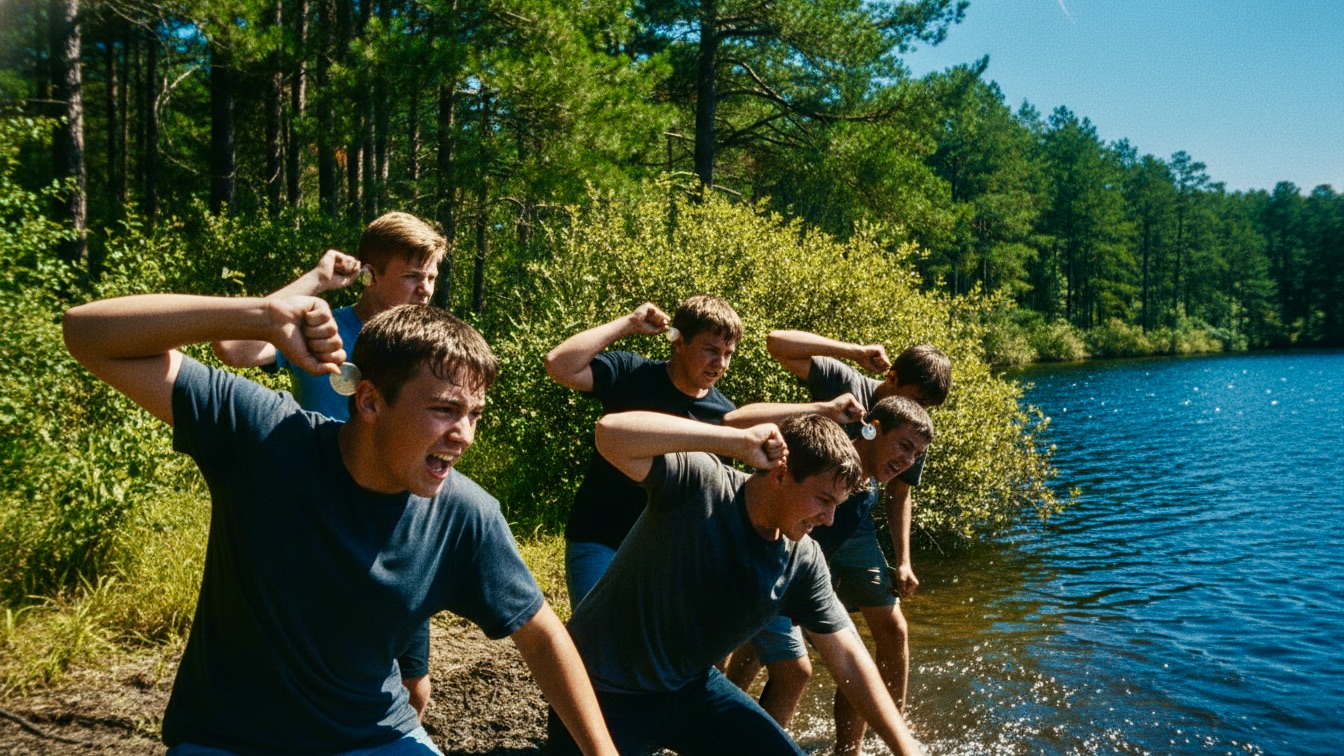
All around the courtyard, kids were ripping the external nodes off their heads. They were throwing them into the dirt. They were throwing them into the bushes. A group of boys ran to the edge of the lake and hurled their magnetic nodes into the stagnant blue water. Small splashes broke the perfect surface.
Director Askew ran out of the building. His linen suit was torn at the shoulder. He looked completely unhinged.
"Stop!" Askew screamed, his voice cracking. "Do not break the seal! You are compromising the data! You are ruining the baseline!"
Nobody listened to him. The kids were crying, holding each other, rolling in the grass. The forced silence of the camp was shattered. It was loud, chaotic, messy, and entirely human.
The lead auditor walked out of the building. She looked at the chaos. She looked at Askew. She pulled a walkie-talkie from her belt and spoke quietly into it.
Askew turned. He saw Lane and Dani standing by the cooling exhaust, the gutted cable sparking in the dirt, the old iPod resting on the ground.
Askew's face turned purple. He pointed a trembling finger at them.
Lane did not run. He stood his ground. He reached down, picked up the rusted spoon, and put it in his pocket.
Four hours later, Lane was sitting in the passenger seat of his father's SUV.
The drive back down the dirt road was silent. The air conditioning was still broken.
His father gripped the steering wheel. The knuckles were white again, but this time, it was from rage, not anticipation.
"Do you understand what you've done?" his father finally asked. His voice was dangerously low. "The financial cost. The reputational damage. You destroyed the mainframe of a multi-million dollar facility with a spoon."
"I know," Lane said.
"You threw away your future," his mother said from the back seat. She wasn't looking at her tablet. She was staring at the back of his head. "You threw away the advantage."
Lane turned his head. He looked out the window. The pine trees blurred past. The sky was turning a bruised purple as the sun began to set.
He reached up and touched the skin behind his left ear. The external node was gone. The titanium implant remained, dead and useless under his skin. It didn't hum anymore. It was just cold metal.
He felt tired. His muscles ached. His throat was dry. He smelled the hot asphalt, the dust, the exhaust of the car.
He rolled the window down.
The hot summer wind blasted into the car, ruining the terrible silence, whipping his hair across his face, loud and chaotic and real.
“He rolled the window down, letting the hot, chaotic wind blast into the sterile silence of the car.”


