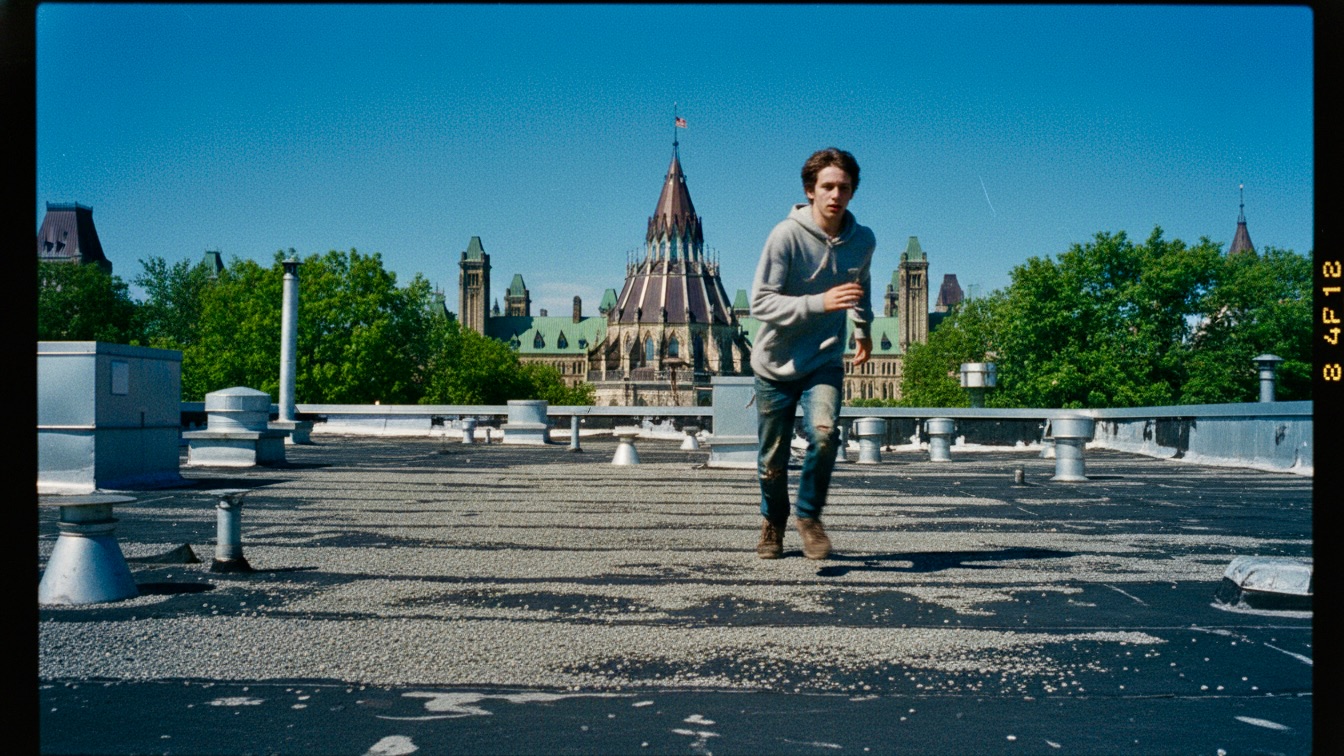
Kenny navigates a crumbling Ottawa with a drive that could crash the banks while his family falls apart.
Kenny's father, Mike, sat at the small laminate table. His hands were stained with grease that never quite washed out, even though he hadn't touched a steering wheel for a paycheck in three years. He was staring at a stack of printed bank statements, his thumb tracing the red lines where the accounts had been locked.
"They didn't just freeze the money, son," Mike said. His voice was gravelly, worn down by thousands of miles of highway and a bitterness that had become his only hobby. "They froze the future. You think you're going to college on promises? You think the bank cares you were top of your class?"
Kenny didn't look at the papers. He knew the numbers. Zero. Zero. Zero. It was a digital execution. He looked at his mother, Diane, who was standing by the sink, her back to them. She was wearing her work suit—stiff, expensive charcoal wool that looked like armor. She didn't belong in this kitchen anymore. She belonged in the high-ceilinged offices of the PMO, where the air was filtered and the decisions were made.
"Mike, stop it," Diane said. She didn't turn around. She was scrolling through her phone with a speed that made Kenny’s head spin. "The emergency measures were necessary. The city was under siege. We had to restore order. It’s not personal."
"Not personal?" Mike laughed, a dry, hacking sound. "I can’t buy gas. I can’t pay the property tax. That feels pretty personal to me, Di. But I guess from the Hill, we all just look like data points. Small ones."
Kenny grabbed his bag. The tension was a wire stretched to the snapping point. He couldn't breathe in here. Every conversation was a loop. The same grievances, the same cold justifications. He was eighteen, and his house felt like a museum of a dead marriage.
"Where are you going?" Diane asked. She finally turned. Her eyes were sharp, scanning him for signs of dissent. She looked at his sneakers, his worn backpack, the way he wouldn't meet her gaze.
"Out," Kenny said.
"Stay away from the Hill," she warned. Her voice dropped into her professional register. The one she used for press briefings. "The protests are escalating. There’s a new crowd coming in. Extremists. The police are going to clear the zone today. Don't get caught in the sweep. I can't protect you if you're in the system."
"I’m not a kid, Mom."
"Then start acting like a citizen," she snapped. "The Hate Speech Act is about safety. Those people out there? They don't want freedom. They want chaos. Stay home."
Kenny didn't answer. He pushed through the screen door. The heat hit him like a palm to the chest. The air in Ottawa in August was a swamp. He hopped onto his bike, the chain rattling. He didn't head for the suburbs. He headed for the core. He could hear the low rumble of the crowd from miles away. It sounded like a storm that refused to break.
As he pedaled toward Wellington Street, the atmosphere changed. The quiet residential blocks gave way to boarded-up windows and tactical cruisers parked on every corner. The sky was a hard, bright blue, the kind that made the stone of the Parliament buildings look bleached and skeletal. He saw the first line of police near the War Memorial. They were standing in a row, black visors down, looking like plastic toys under the sun. They didn't move. They just watched.
He saw his friends near the edge of the fountain. Leo and Sarah. They were holding a cardboard sign that said WHO CONTROLS THE KEYS? They looked small against the backdrop of the riot shields. He saw the movement before they did. A shift in the police line. A tightening of the perimeter. Kettling. He’d seen it on the news, but the physical reality was different. It was the sound of heavy boots on pavement, the rhythmic clack of batons against shields.
"Leo!" Kenny shouted, dropping his bike. "Get out of there!"
Leo didn't hear him. The noise was too much now. A loudspeaker crackled to life, a distorted voice telling the crowd they were in an illegal assembly. The crowd roared back. It wasn't a cheer; it was a howl of frustration. Kenny pushed through a gap in the barricade, his heart hammering against his ribs. He felt the sweat slicking his neck.
Then the first canister of gas popped. A hiss, a plume of grey-white smoke that smelled like burning pepper and chemical rot. People began to scramble. The panic was instantaneous. Kenny was shoved from behind, his shoulder hitting a brick wall. He stumbled into a narrow alleyway behind a row of food trucks.
That’s when he saw him. A man in a torn windbreaker, slumped against a dumpster. He was coughing, his face a mess of red and grey. He looked up as Kenny approached. His eyes were wide, bloodshot. He was clutching a small, silver object in his hand. A ruggedized USB drive, the kind used by the military.
"Hey," Kenny said, kneeling down. "You okay? I can call a medic."
The man shook his head. He grabbed Kenny’s forearm with a grip that was terrifyingly strong. He was wheezing, his lungs sounding like they were full of broken glass. "No time," he gasped. "They're coming. They're already behind us."
"Who?"
The man didn't answer the question. He shoved the drive into Kenny’s hand. "Show them," he whispered. The words were wet, punctuated by a sharp intake of breath. "Show them the receipts. The kill switch. It’s all in there. Everything they promised they’d never do."
"I don't understand," Kenny said, his fingers closing around the cold metal.
"The banks," the man said. He coughed, a spray of red hitting the pavement. "It’s automatic. Five hundred meters. If you're here, you're broke. They signed it. She signed it."
He slumped back. His eyes didn't close, but the light left them. Kenny stood up, his legs shaking. He looked at the drive. It was heavy. It felt like it had its own gravity. He heard the sound of running footsteps at the end of the alley. Men in plain clothes, wearing earpieces and tactical boots. They weren't police. They moved too fast, too smoothly.
Kenny didn't think. He ran. He climbed over a chain-link fence, the metal hot enough to sear his palms. He didn't look back at the man by the dumpster. He couldn't. The city was a maze now, and he was the rat.
The Rideau Centre was a glass-and-steel trap. Kenny burst through the revolving doors, the blast of air conditioning hitting him like a cold bucket of water. He was drenched in sweat, his lungs burning from the gas and the sprint. He didn't slow down. He ducked into the crowd of shoppers and tourists who seemed oblivious to the war zone two blocks away. They were carrying bags from Apple and Zara, their faces buried in their phones.
He glanced up at the ceiling. High-definition cameras were mounted every ten feet. He saw the black domes pivot. He knew what they were doing. Facial recognition. The system was probably already pinging his mother’s office. Subject 442-Kenny. Location: Rideau Level 2. Status: Wanted.
He pulled his hoodie up, despite the heat. He moved with a forced calm, weaving through a group of teenagers laughing near the food court. His heart was a drum. Every time a security guard looked his way, he felt a jolt of electricity in his spine. He needed to get off the grid. He needed a place where the Wi-Fi wasn't monitored by the feds.
He took the stairs two at a time, heading toward the back exits that led to the parking garage. As he reached the top of the escalator, he saw them. Two men in charcoal suits, standing near the elevators. They weren't looking at the stores. They were looking at faces. One of them held a tablet, his eyes flicking from the screen to the crowd.
Kenny turned abruptly, knocking into a woman carrying an iced coffee. The cup hit the floor, brown liquid splashing across her white sneakers.
"Hey! Watch it!" she yelled.
"Sorry," Kenny muttered, not stopping.
He ducked into a narrow service corridor marked Authorized Personnel Only. The door was heavy, clicking shut behind him. The silence was immediate. It was a concrete world of pipes and yellow light. He ran down the hall, his footsteps echoing like gunshots. He found a freight elevator, pushed the button for the basement, and waited. The seconds felt like hours. He could almost feel the digital net tightening around him.
When the doors opened, he was in the bowels of the mall. Loading docks, trash compactors, and the smell of wet cardboard. He found a side door that opened into a narrow street behind the mall. This was the old part of the city. Brick buildings, narrow alleys, and the kind of places that didn't show up on the official tourist maps.
He found it three blocks away. The Glitch. A basement gaming cafe with neon lights in the window and a door that looked like it had been kicked in more than once. He descended the stairs, the air becoming thick with the hum of servers and the smell of stale energy drinks.
Inside, it was dark. Maybe twenty people were hunched over glowing monitors, their faces illuminated by the blue light of tactical shooters and crypto charts. He went to the counter. A girl with neon-pink hair and a septum piercing looked up. She was chewing gum with a rhythmic, bored intensity.
"I need a private booth," Kenny said. "Offline."
"Offline costs double," she said. "No logs, no history?"
"Whatever it takes."
He handed her a twenty. It was one of the few physical bills he had left. She tossed him a keycard. "Booth 4. Don't break the gear."
Kenny locked himself in the tiny cubicle. The space was barely large enough for the chair and the desk. He pulled the drive from his pocket. It felt warm now. He plugged it into the terminal. The screen flickered. A prompt appeared: BIOMETRIC OVERRIDE REQUIRED.
"Damn it," he whispered.
He tapped on the glass of the booth. The pink-haired girl appeared a minute later, looking annoyed. "What?"
"I need a bypass," Kenny said. "It’s locked down tight. Biometrics. Can you get me in?"
She looked at the drive, then at him. Her eyes narrowed. "That’s a government-grade encryption block. You trying to get us raided?"
"I just need to see what’s on it," Kenny said. "Please. It’s important."
She sighed, stepped into the booth, and pushed him aside. Her fingers moved across the keyboard with a speed that was hypnotic. She opened a series of terminal windows, lines of green code scrolling past. "I’m not cracking the bio-lock," she said. "That takes a farm. But I can spoof the handshake. Give me a second."
Five minutes passed. The air in the booth was getting thin. Then, the screen turned white. A document folder appeared. Kenny leaned in. The girl backed away. "I didn't see anything," she said. "I’m going back to the desk. You have twenty minutes before the handshake fails."
Kenny opened the first file. It was a PDF marked OPERATION ARCHER: FINANCIAL ENFORCEMENT PROTOCOLS. He scrolled down. His eyes caught a map of Ottawa. A red circle was drawn around Parliament Hill. The radius was 500 meters.
Clause 12.4: Automated Asset Freezing (AAF). Any digital signature or mobile device detected within the designated protest zone for a period exceeding 120 minutes will trigger an immediate suspension of all associated Tier 1 and Tier 2 banking assets. No manual review required. Reinstatement pending security clearance.
Kenny’s stomach dropped. It wasn't just Mike. It was everyone. If you showed up to complain, you lost your life. It was a kill switch for dissent. He scrolled to the bottom of the document. The signature line was electronic, but the name was clear.
Diane Sterling. Chief of Staff, PMO.
His mother hadn't just known about it. She’d authorized it. She’d built the cage his father was trapped in. He felt a wave of nausea. The person who packed his lunch and reminded him to wear a coat was the same person who had deleted his father’s future with a keystroke.
He copied the files. He didn't know where to go, but he knew he couldn't stay here. He pulled the drive, the metal burning his thumb. He had the receipts. Now he just had to survive long enough to show them.
Kenny didn't go back to the street. He went through the back of the cafe, emerging into a narrow courtyard filled with overflowing dumpsters. The sun was lower now, casting long, jagged shadows against the brick walls. The heat hadn't broken. It had just turned heavy, like it was waiting for something to snap.
He needed to go home. It was the last place they’d expect him to go if he was smart, which meant it was the only place he could think to go. He needed to look his mother in the eye. He needed to know if she even cared.
He navigated the side streets, avoiding the main arteries where the sirens were constant. The city was a grid of tension. He saw people standing on their porches, watching the smoke rise from the Hill. They looked scared. They looked like they were waiting for the lights to go out.
When he reached his house, it looked exactly the same. The lawn was slightly yellow from the heat. His bike was still lying on the grass where he’d dropped it. He went in through the back door. The kitchen was empty, but he could hear voices in the living room. Low, urgent voices.
He walked down the hall. His mother was standing by the window, her phone pressed to her ear. She was silhouetted against the bright afternoon light.
"I don't care about the optics," she was saying. "The drive is missing. If that data gets to the organizers, the whole Act is dead. Secure the perimeter. I want a door-to-door if you have to."
Kenny stepped into the room. "The drive isn't missing, Mom."
Diane spun around. She dropped the phone. For a second, just a second, she looked like his mother again. Scared. Relieved. Then the mask slid back into place. The charcoal wool armor.
"Kenny," she said. Her voice was steady. "Give it to me."
"You signed it," Kenny said. He held the drive up between two fingers. "Clause 12.4. You froze Dad’s accounts before he even got to the Hill. You did it to everyone."
"It was a stabilization measure, Kenny. You don't understand the macro-economics of a national crisis. The country was on the verge of a bank run. We had to stop the momentum."
"By stealing from people?" Kenny’s voice cracked. "By making it illegal to stand in a park? Dad can’t buy groceries, Mom! He’s sitting in the kitchen counting zeros while you're in here ordering door-to-door raids!"
"I did it for us!" she shouted. It was the first time he’d ever heard her lose her composure. "Do you have any idea how close we came to losing everything? The system is fragile, Kenny. If the banks fail, there is no college. There is no house. There is nothing but the mob out there. I protected our future."
"You killed his," Kenny said.
He looked past her. Out the window, a black SUV pulled up to the curb. Then another. Men in tactical gear began to spill out. They weren't making any noise. They moved like shadows across the yellow lawn.
"You called them?" Kenny asked. The betrayal was a physical weight in his chest.
"I’m saving you," Diane said. She reached out her hand. "Give me the drive, and I can fix this. I can tell them you found it. I can make sure you’re not charged. Please, Kenny. Don't be a martyr for people who don't even know your name."
"They’ll know it soon," Kenny said.
He turned and ran for the stairs.
"Kenny! Stop!"
He didn't stop. He hit the second floor just as the front door was kicked in. The sound was a thunderclap. "POLICE! GET DOWN!"
He burst into his bedroom and slammed the lock. He grabbed his bag, shoved the drive into the secret compartment, and threw open the window. The heat rushed in. Below him, the roof of the porch was a ten-foot drop. He’d done it a thousand times as a kid, sneaking out to meet Leo.
He heard the boots on the stairs. Heavy. Fast.
"Kenny, open the door!" It was his mother’s voice, but it was drowned out by the shouting of the tactical team.
He didn't wait. He swung his legs over the sill. He felt the rough shingles under his palms. He dropped, his knees absorbing the impact on the porch roof. He scrambled to the edge and jumped again, hitting the grass and rolling. He didn't look back. He ran for the fence, vaulted it in one smooth motion, and disappeared into the neighbor’s yard.
He heard the window above him shatter. A flash-bang went off inside his room, the white light blooming against the glass. They were playing for keeps now. His mother had authorized the breach.
He was on the move. He wasn't just a kid in Ottawa anymore. He was a ghost in the machine, and he was running out of time.
The rooftops were a different city. Up here, the air was hotter, smelling of tar and old brick, but it was clear. Kenny moved with a desperate fluidity. He’d spent years practicing parkour in the parks and industrial zones of the suburbs, but this was the first time it mattered.
He leapt from the edge of a three-story apartment building to the fire escape of the next. The metal groaned, swaying under his weight, but it held. He climbed. He needed height. He needed to see the Hill.
Below him, the city was a grid of flashing lights. The safe zones were being enforced. Checkpoints at every intersection. If he stayed on the street, he was done. He ran along the ridge of a Victorian-era office building, his heart hammering in his ears. The jumbotrons at the main protest stage were visible now—three massive screens glowing like beacons against the darkening sky.
He reached the final gap. A twelve-foot jump between the ledge of a law firm and the roof of the tech hub that overlooked the stage. He didn't think about the distance. He didn't think about the drop. He just ran. His feet hit the very edge of the stone, and he launched. For a second, he was weightless, the wind whistling past his ears. Then, impact. His fingers clawed at the gravel on the roof. He pulled himself up, gasping for air.
He found the access hatch. It was locked, but the hinge was rusted. He kicked it twice, the metal screaming, until it gave way. He dropped into a server room. It was freezing in here, the air humming with the sound of cooling fans. This was the hub for the outdoor screens.
He found the main console. He didn't have a password, but he didn't need one. He had the drive. He plugged it in. The screen flickered to life. UPLOAD INITIATED.
He selected the files. All of them. The maps. The memos. The signature. He hit the command to broadcast to the external array.
ARE YOU SURE? THIS ACTION CANNOT BE UNDONE.
Kenny looked at the drive. He thought about Mike’s grease-stained hands. He thought about the man in the alley. He thought about his mother’s charcoal suit.
"No cap," he whispered.
He hit the key.
Outside, the world changed. Even through the soundproof walls of the server room, he heard it. A collective gasp from ten thousand people. Then, a silence so heavy it felt like the air had been sucked out of the city.
On the massive screens, the secret clauses were scrolling. Huge white text on a black background. CLAUSE 12.4: AUTOMATED ASSET FREEZING. The signature of Diane Sterling was ten feet tall, glowing over the heads of the police and the protesters alike.
Then, the roar started. It wasn't a riot anymore. It was a realization.
Kenny watched the monitor. The data was already viral. Hits were climbing into the millions. It was hitting X, Telegram, the international news wires. The kill switch had been exposed.
He heard the door behind him explode.
He didn't run this time. He just turned around. Three men in tactical gear burst in, their red laser sights dancing across his chest. They tackled him, the force slamming his head against the cold tile floor. He felt the zip-ties bite into his wrists.
They dragged him out of the room, down the stairs, and into the back of a waiting van. The city was a chaos of sound now. People were screaming. Not in anger, but in a kind of wild, terrifying triumph.
He was taken to a temporary holding cell in the basement of the courthouse. It was a concrete box with a single bench and a heavy steel door. He sat there for a long time. The adrenaline was fading, leaving a cold, hollow ache in its place. He wondered where his dad was. He wondered if his mother was still in the PMO, or if she was already being escorted out.
He closed his eyes. The walls were thick, but they couldn't stop the sound. From the street, blocks away, the chant started. It was low at first, then rhythmic, then deafening.
"No cap! No chains! No cap! No chains!"
Kenny leaned his head back against the cold stone. He felt the vibration of the voices in the floor. He felt the weight of the drive, gone now, but the mark it left was permanent. He’d lost his family. He’d lost his future. But for the first time in his life, he could breathe.
“As the steel door rattled with the force of the chanting outside, Kenny realized the lock wasn't the only thing that was about to break.”


