A missing camper, a nervous groundskeeper, and a forest that literally eats its visitors during the peak of summer.
The heat in Pennsylvania doesn't just sit on you; it burrows. I stepped off the bus and felt the humidity latch onto my linen vest like a damp hand. My jaw was already tight, a familiar ache starting near my molars. I’m the 'new kid,' a label that feels ridiculous at eighteen, but here at Camp Blackwood, I’m the outsider in a sea of legacy campers who’ve been coming here since they were in diapers. I smoothed my thrifted trousers and adjusted my glasses. My heart was doing that thing where it tries to escape through my ribs. I tapped my foot against the gravel, a rhythmic staccato that kept me from screaming.
Everyone else looked like a fitness influencer. I looked like I belonged in a coastal grandmother’s garden. I could feel their eyes—the 'vibe check' was failing. I needed a win. I needed to not be the guy who spent the first hour hyperventilating in a bunk bed. Then I saw the frisbee. It was a neon orange disc, spinning through the air, tossed by a group of guys who looked like they were carved from granite. It clipped a branch and sailed over a rusted chain-link fence marked with faded yellow tape. 'RESTRICTED AREA' the sign said. The letters were peeling like sunburnt skin.
"I’ll get it," I said. My voice sounded thin, like paper. No one really looked at me, which was worse than being mocked. I ducked under the tape. The air changed instantly. It was cooler, but not in a good way. It felt heavy, like the atmosphere in a room where someone just finished an argument. I pushed through a thicket of mountain laurel, the leaves waxy and stiff against my skin. My breath was shallow. I could hear my pulse in my ears, a dull thumping that matched my footsteps.
I saw the frisbee resting in a bed of dead pine needles. I also saw a pair of boots. They were old, the leather cracked and stained with something dark. I looked up. A guy stood there, maybe a few years older than me, holding a rusted shovel. He had hair the color of damp hay and eyes that looked like they hadn't seen a full night's sleep since the Obama administration. This was Marvin. The 'weirdo' assistant groundskeeper the bus driver had mentioned with a sneer.
"You shouldn't be here," Marvin said. His voice was a low rasp. He didn't move. He just stared at me, his knuckles white around the shovel handle. I felt my stomach turn over. My foot started tapping again, unbidden, against a root. I reached for the frisbee, but his boot came down on the edge of it. Not hard, but enough to tell me to stop.
"Just getting the disc," I said. I tried to sound casual. I failed. I looked at the sweat staining his work shirt. He smelled like mulch and something metallic, like old pennies. His jaw was locked so tight I thought his teeth might crack. He looked past me, toward the deeper woods where the shadows seemed to be moving even though there was no wind.
"The woods don't like visitors," Marvin whispered. He leaned in, and I could see the fine tremor in his hands. "Not after June 21st. The solstice changes things. The boundaries get thin. You need to go back to the cabins. Lock the door. Don't look out the windows if you hear someone calling your name."
"It’s just a camp," I said, but my skin was prickling. The sun was high, the sky a brilliant, mocking blue, but I felt a chill that had nothing to do with the shade. Marvin finally lifted his foot. I grabbed the orange plastic, my fingers trembling. He didn't look at me again. He just started digging a hole in the middle of the path, his movements frantic and jagged.
"Who are you digging that for?" I asked. The question slipped out before I could stop it. Marvin paused, his shovel halfway into the dirt. He looked at me with a profound, weary sadness that made him look fifty instead of twenty-three. He didn't answer. He just went back to work, the sound of the blade hitting the rocky soil echoing through the silent trees. I ran back to the tape, my lungs burning, feeling like I was being watched by a thousand eyes that didn't have faces.
The first bonfire was supposed to be a 'welcome' event. We sat around a massive pile of cedar logs that roared with a heat so intense it felt like it was peeling the moisture from my eyeballs. Counselor Pete was leading a song about friendship, his smile a little too wide, his eyes a little too glassy. I sat on the edge of the log, my hands shoved into my pockets. Leo, the kid who shared my cabin, had been sitting next to me ten minutes ago. Now, there was just an empty space on the wood.
"Hey, where'd Leo go?" I asked Pete when the song ended. Pete didn't skip a beat. He was busy roasting a marshmallow to a perfect, sickening gold. He looked at me, and for a second, I saw something flicker behind his eyes—a flash of absolute, cold terror that was gone as soon as it appeared.
"Who?" Pete asked. His voice was cheerful, the kind of cheerful that makes you want to bolt for the exit.
"Leo," I said. "The kid with the glasses. From Bunk Four. We walked down here together. He was wearing a red hoodie."
"Toby, buddy, you’re the only one in Bunk Four," Pete said, chuckling. A few other campers laughed. It wasn't a mean laugh; it was a hollow, programmed sound. I looked around. The other kids from my cabin were nodding. They were staring at me with those same glassy eyes. My jaw tightened until it hurt. I could feel a bead of sweat trailing down my spine. This wasn't a joke. This was something else.
I stood up and backed away from the light. No one tried to stop me. I headed toward the mess hall, my feet moving faster than my brain. I needed to find Marvin. He was the only thing that felt real in this place, even if he was terrifying. I found him behind the industrial kitchen, sitting on a milk crate and smoking a cigarette that smelled like cloves. He looked up as I approached, his face partially obscured by the shadows of the dumpster.
"He’s gone," I said. I didn't have to specify who. Marvin nodded slowly and reached into the pocket of his canvas jacket. He pulled out a small, leather-bound book. It was stained with water and what looked like grease. He flipped it open. The pages were covered in names, written in different inks, different handwritings. Some were crossed out. Some were underlined in blue.
"Leo Victor," Marvin read. He pointed to a fresh entry at the bottom of a page. "He was here. I saw him get off the bus. I saw him go into the woods to pee five minutes ago. He didn't come back."
"Pete said he never existed," I whispered. I felt like I was losing my mind. The 'Snap Point' was here. My breath was coming in short, jagged gasps. I looked at the ledger. The dates went back to 1996. Dozens of names. Hundreds. All of them 'deleted' by the camp staff.
"They have to," Marvin said. He stood up, his height imposing in the dark. "If they acknowledge them, the camp shuts down. If the camp shuts down, the gate isn't guarded. And if the gate isn't guarded..." He trailed off, looking toward the tree line. "You see things you shouldn't here, Toby. You’re seeing them now. That’s why you’re still talking to me instead of singing about s'mores."
He handed me the ledger. I felt the weight of it, the history of kids who had simply vanished into the Pennsylvania summer. My fingers brushed the cover, and I felt a strange, static-like hum vibrating through the leather. Marvin took a long drag of his cigarette, the cherry glowing bright. "I’ve been keeping this since I was a camper. I was in Bunk Four once. In 2012. My bunkmate went for a walk and never came back. I stayed to make sure no one forgot. But I’m tired, Toby. I’m so damn tired of being the only one who remembers."
We moved through the pines like ghosts. Marvin had a heavy-duty flashlight, but he kept it off, relying on the moonlight that filtered through the canopy in jagged silver shards. The air was thick with the scent of pine resin and something sharper, something chemical. I followed close behind him, my heart hammering a frantic rhythm against my ribs. We were deep in the restricted zone now, past the points where any sane camper would venture.
"Look," Marvin whispered. He pointed to the base of a massive white pine. A smear of blue phosphorus glowed against the bark, looking like spilled neon paint. It wasn't a natural color. It was too bright, too electric. It pulsed with a low, rhythmic light, like a heartbeat. I reached out to touch it, but Marvin caught my wrist.
"Don't," he snapped. "It’s a lure. Like an anglerfish."
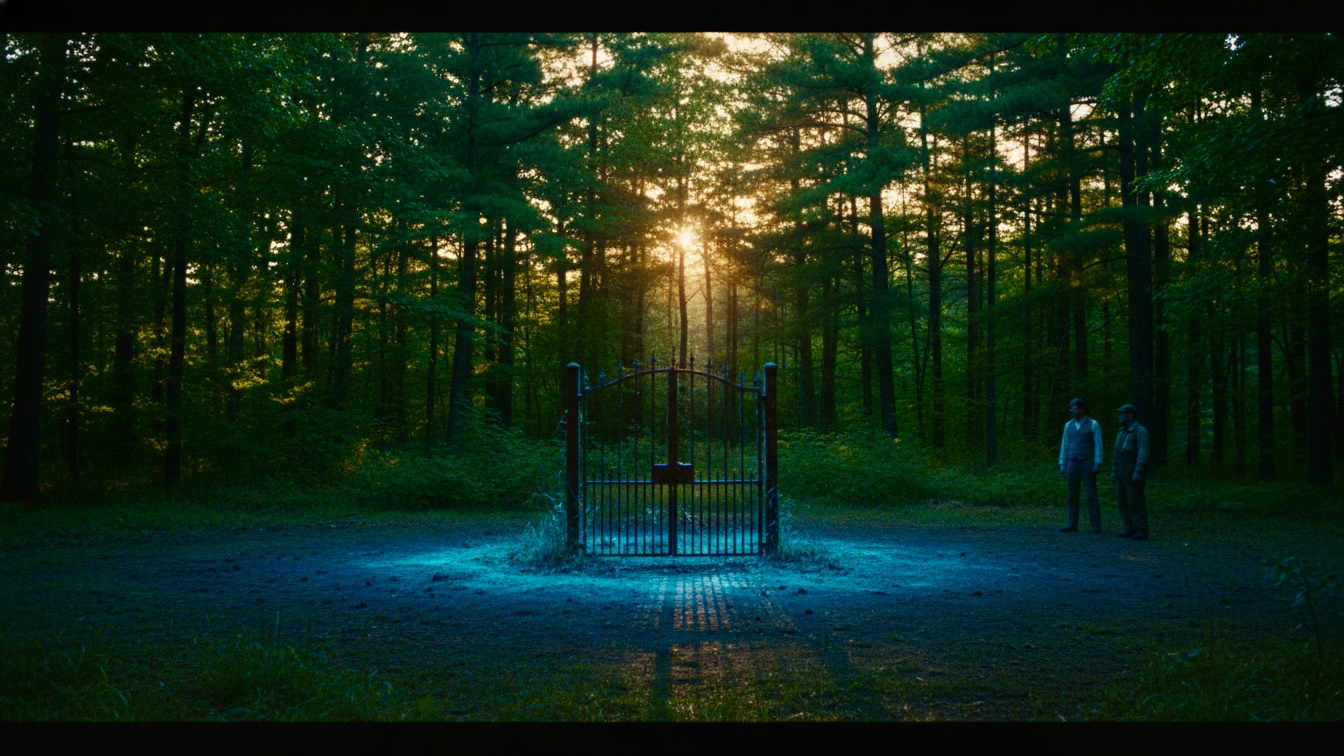
We followed the trail of blue smears. They led us to a ravine, at the bottom of which sat an old iron gate. It was tall, topped with rusted spikes, and it stood in the middle of a clearing with no fence attached to it. It was just a gate, standing alone in the dirt. But the space inside the gate was different. The air there looked thicker, distorted, like heat rising off a summer highway. Beyond the gate, the trees didn't look like pines. They looked like something older, something with too many limbs.
I looked at Marvin, wanting to ask what this was, but the words died in my throat. The collar of his shirt had shifted. On the side of his neck, just below the jawline, was a mark. It was a perfect circle with three lines radiating from the center. It looked like a burn, or a brand. My blood ran cold. I had seen that same mark on Leo’s neck while we were unpacking our bags in the cabin.
"Marvin," I said, my voice trembling. "Your neck."
He froze. He didn't turn around. He slowly reached up and pulled his collar higher, but it was too late. I stepped back, my foot snapping a dry branch. The sound was like a gunshot in the silence of the clearing. Marvin turned then, and his eyes were full of a desperate, pleading light.
"I’m not one of them," he said. "I swear. I’m a camper. I was a camper. I just... I never truly left. I couldn't. Once you’re marked, the woods think you belong to them. I’ve been gatekeeping this place, Toby. I’ve been trying to keep the Shiver-men on the other side. But they’re getting stronger. Every year, they take more. Every year, the camp forgets more."
As he spoke, the trees around us began to shift. It wasn't the wind. The trunks were literally leaning in, the branches intertwining above our heads to block out the moon. The forest floor felt soft, almost liquid, as if the dirt were turning into a mouth. My boots began to sink. I tried to pull my foot free, but the ground held on with a terrifying, suction-like force.
"They’re coming," Marvin said. He didn't sound scared anymore. He sounded resigned. He reached into his pocket and pulled out a flare. "They don't like the light. Not the real light. The phosphorus is their light, but fire... fire scares them. For a little while."
I looked back at the gate. A figure was standing there. It was tall, impossibly thin, and its skin looked like wet grey paper. It didn't have a face, just a series of vertical slits where a mouth should be. It vibrated, its body blurring as if it were out of focus. A Shiver-man. It stepped through the gate, and the temperature in the clearing dropped twenty degrees. My breath hitched, a puff of white vapor in the summer night.
Marvin didn't hesitate. He threw his flashlight—the heavy, metal Maglite—directly at the Shiver-man. The light tumbled through the air, casting wild, swinging shadows across the closing trees. The entity hissed, a sound like steam escaping a pipe, and lunged toward the light. It was a distraction, a desperate one.
"Run!" Marvin yelled. He grabbed my hand. His grip was cold, but firm. We scrambled up the side of the ravine, the forest floor snapping at our heels like a hungry animal. I could hear the Shiver-man behind us, the sound of its 'shivering'—a high-frequency rattling of bone on bone—getting louder. We broke through a wall of brambles, the thorns tearing at my linen vest, and stumbled toward the maintenance area.
We dived into the tool shed, Marvin slamming the heavy wooden door and sliding the iron bolt home just as something slammed into the outside with the force of a car crash. The whole shed shuddered. Dust rained down from the rafters. I collapsed against a rack of rakes, my lungs screaming for air. My jaw was locked so tight I could taste blood where I’d bitten the inside of my cheek.
Marvin was leaning against the door, his chest heaving. We were in total darkness, save for the thin slivers of moonlight peaking through the cracks in the wood. The rattling sound outside was constant now, a vibration that I could feel in my teeth. The Shiver-man was right there, on the other side of a few inches of rotting cedar.
"Toby," Marvin whispered. He was close. I could feel the heat radiating off him, the only warm thing in the world. "I’m sorry. I shouldn't have let you follow me."
"I chose to," I said. My voice was steadier than I felt. Adrenaline is a hell of a drug. It strips away the social anxiety, the 'cottagecore' pretension, the fear of what people think. I reached out in the dark and found his arm. He was shaking. Not a shiver like the monsters outside, but a human tremor. A snap point.
He turned toward me, and in the dim light, our eyes met. There was no subtext left, no cryptic warnings. Just two terrified people in a shed at the end of the world. He leaned in, and I met him halfway. The kiss was desperate, tasting of salt and clove cigarettes and the metallic tang of fear. It was a middle finger to the woods, a brief, violent assertion of life in a place that wanted us dead. His hands were in my hair, pulling me closer, as if he could merge our bodies into something the forest couldn't swallow.
We broke apart, both of us gasping. The scratching at the door had stopped, replaced by a heavy, expectant silence. Marvin looked at the ledger, which I was still clutching like a holy relic. He looked at the cans of gasoline lined up on the shelf behind me.
"I’ve spent ten years trying to protect this camp," Marvin said, his voice hardening. "Trying to keep the secret. But the secret is what feeds it. The forgetting is what makes the gate stay open. Pete, the directors, the legacy families... they’re all just part of the machine. They trade kids for another summer of prestige."
"We burn it," I said. I looked at the gasoline. I looked at the matches on the workbench. "We burn the gate. We burn the ledger. We delete the whole damn thing."
"It’s the only home I have, Toby," Marvin said. He looked around the cramped, dirty shed. "If we burn the gate, the connection breaks. I don't know what happens to the people who are marked. I might... I might go with it."
"Then we go together," I said. I grabbed a red plastic jerrycan. I could feel the Shiver-man starting to push against the door again, the wood beginning to splinter at the hinges. I struck a match. The flame was small, but in the darkness of the shed, it looked like a sun. Marvin took the can from me, his eyes fixed on the door. He didn't look like a weirdo groundskeeper anymore. He looked like a man who was finally ready to leave home.
“The heavy oak door groaned as the top hinge snapped, and a grey, needle-thin finger curled through the gap.”


