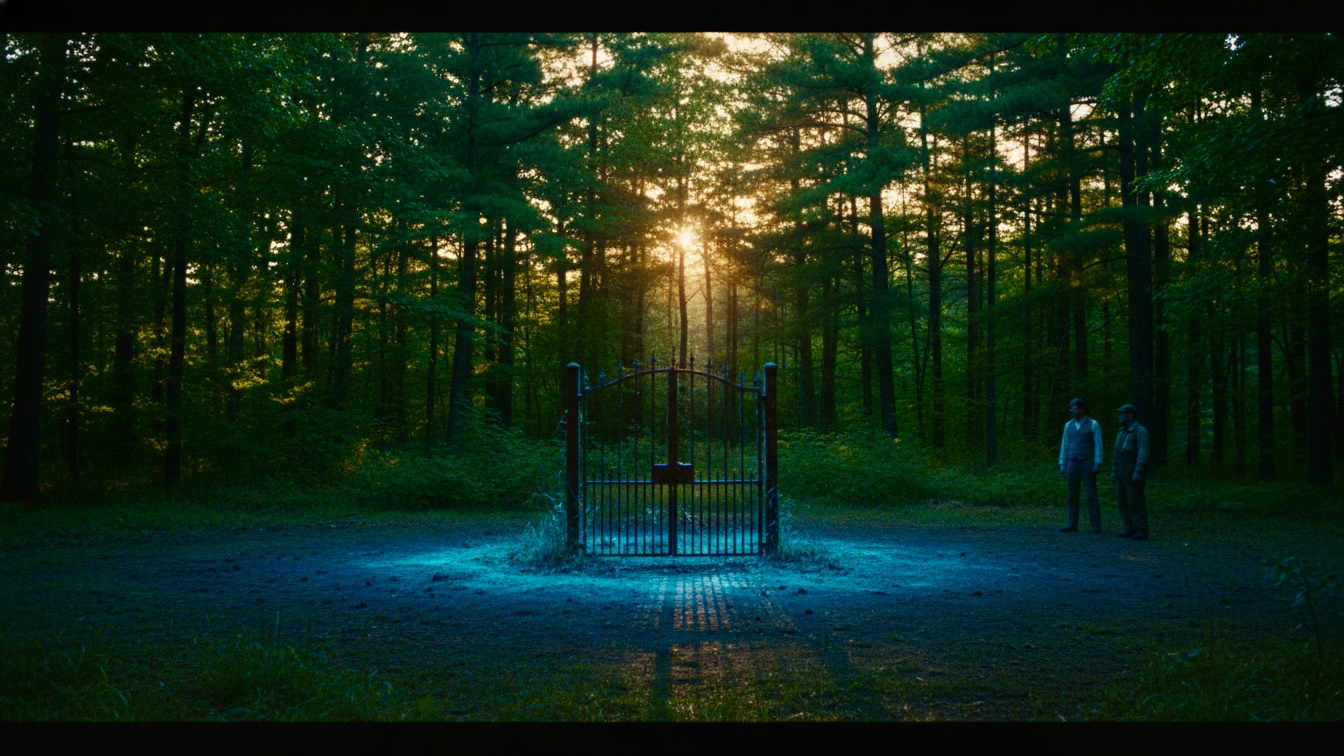
The story begins with Toby, an eighteen-year-old outsider, arriving at the humid and prestigious Camp Blackwood in Pennsylvania. Feeling alienated by the "legacy" campers and his own social anxiety, he ventures into a restricted area to retrieve a lost frisbee. There, he encounters Marvin, a weary and ominous assistant groundskeeper who warns him about the thinning boundaries of the woods following the summer solstice. Toby’s unease intensifies when his bunkmate, Leo, vanishes during a bonfire, and the camp counselor, Pete, insists that Leo never existed.
Driven by a need for truth, Toby seeks out Marvin, who reveals a secret ledger containing the names of dozens of children who have been "deleted" by the camp staff to maintain the institution's prestige. Marvin explains that the camp serves as a guard for a supernatural gate, and the woods demand sacrifices to stay contained. The two venture deep into the forest, where they encounter a "Shiver-man," a terrifying, faceless entity from beyond the gate. After a narrow escape to a tool shed, the pair shares a desperate moment of connection. Toby convinces Marvin that they must stop being complicit in the camp's cycle of erasure, and they prepare to burn the gate and the ledger to the ground.
The central theme of the narrative revolves around the tension between institutional preservation and individual existence. Camp Blackwood represents a corrupt system that prioritizes its own legacy and the comfort of its elite "legacy campers" over the lives of those it deems disposable. The act of gaslighting, performed by Counselor Pete, illustrates how institutions weaponize collective memory to erase inconvenient truths. By denying Leo’s existence, the camp attempts to maintain a facade of safety and perfection, suggesting that the "vibe" of the community is more valuable than the human beings within it.
Another prominent theme is the burden of memory and the psychological toll of being a witness. Marvin embodies this struggle, having spent over a decade as the sole keeper of the names of the disappeared. His weariness suggests that memory, when not shared or acknowledged by the collective, becomes a heavy, crushing weight that ages a person prematurely. He is a tragic figure who has sacrificed his own life to ensure that the lost are not entirely forgotten, yet he remains trapped in the very system he tries to mitigate.
The story also explores the concept of the "outsider" as a catalyst for change. Toby’s status as the "new kid" and his inherent anxiety make him more observant of the cracks in the camp's reality. Unlike the legacy campers who are "programmed" to ignore the anomalies, Toby’s lack of integration into the camp’s culture allows him to see the horror for what it is. His decision to burn the gate represents a rejection of a "middle ground" where one simply survives the horror; he chooses instead to destroy the entire corrupt framework.
Toby is a protagonist defined by his acute internal sensitivity and a high degree of social anxiety. His physical manifestations of stress, such as the tightening of his jaw and the rhythmic tapping of his foot, serve as a psychological anchor for the reader. He views himself through a lens of inadequacy, comparing his "coastal grandmother" aesthetic to the fitness-influencer physique of his peers. This self-consciousness initially makes him appear vulnerable, but it also provides him with a unique perspective that allows him to notice when Leo goes missing.
As the narrative progresses, Toby’s anxiety transforms into a source of desperate courage. When he is faced with the "Snap Point" of losing his mind due to the camp's gaslighting, he chooses to lean into the danger rather than retreat into the safety of the group's collective delusion. His decision to kiss Marvin in the tool shed is a pivotal moment of self-assertion, representing a move from passive observation to active participation in his own life. He becomes the moral engine of the story, pushing the resigned Marvin toward a final, destructive act of liberation.
Marvin serves as the story’s "wounded healer" and a cautionary tale of what happens when one stays too long in a place of trauma. At twenty-three, he possesses the exhaustion of a much older man, his physical appearance reflecting the "thinning boundaries" he guards. He is a man caught between two worlds, marked by the woods and yet still clinging to his humanity through the ledger he keeps. His initial hostility toward Toby is a defense mechanism intended to protect the boy from the same fate that Marvin has suffered.
The revelation of the mark on Marvin's neck highlights his tragic connection to the forest. He is not merely a groundskeeper; he is a prisoner who has convinced himself that his servitude is a form of protection. His character arc is one of resignation giving way to hope. Through Toby’s influence, Marvin realizes that "gatekeeping" is not enough and that his loyalty to the memory of the lost is better served by ending the cycle entirely. He moves from a state of stagnant mourning to one of transformative action.
The narrative voice is characterized by a blend of visceral sensory details and psychological introspection. The author uses the oppressive heat and humidity of Pennsylvania as a metaphor for the stifling atmosphere of the camp itself. Descriptions such as the "sunburnt skin" of the restricted area sign and the "metallic" smell of Marvin create a gritty, tactile world that contrasts sharply with the supernatural elements. These details ground the story, making the eventually appearance of the Shiver-man feel more jarring and earned.
Pacing is managed through the escalation of Toby’s internal tension, which mirrors the external threat. The story moves from the slow, simmering dread of the bus arrival to the frantic, high-stakes confrontation in the ravine. The use of "staccato" rhythms, both in Toby’s foot-tapping and the "shivering" sound of the monsters, creates a persistent auditory motif that heightens the reader's sense of unease. This rhythmic consistency helps to bridge the gap between Toby's psychological state and the literal horror of the woods.
The tone of the story is one of "suburban gothic," where the familiar setting of a summer camp is subverted by ancient, hungry forces. The author effectively uses contrast—the "mocking blue" sky against the "chilling" shade—to emphasize the isolation of the characters. The ending shifts the tone from horror to a defiant, almost romantic nihilism. By choosing to burn the gate, the characters reclaim their agency, turning the "real light" of fire against the "false light" of the phosphorus lures, ending the chapter on a note of pyrrhic victory.


