Format: Short Film / Anthology Episode | Est. Length: 10-12 minutes
Imagine a world where your bank account is a leash and the government holds the remote; this story serves as a visceral entry point into a series exploring the intersection of digital currency, state surveillance, and the disintegration of the nuclear family. The episode functions as a high-octane political thriller that transforms a domestic dispute into a national uprising, illustrating how the "kill switch" of financial enforcement can turn a citizen into a ghost overnight.
This episode belongs to an anthology series titled The Grid, which explores near-future scenarios where centralized digital control dictates human survival. Each episode focuses on a different "data point"—a person or family caught in the crosshairs of the PMO’s algorithmic enforcement. While the episodes are standalone, they are connected by the escalating tension of a national protest movement and the recurring presence of the "Operation Archer" protocols that slowly strip away civil liberties in the name of stability.
Eighteen-year-old Kenny watches his father stare at a bank statement filled with red lines and zeros, realizing his mother is the one who signed the order to freeze their lives. The domestic tension explodes into a city-wide manhunt when Kenny is handed a military-grade drive containing the government's secret financial "kill switch."
When a teenager discovers his high-ranking mother authorized the digital seizure of his father’s assets, he must outrun tactical teams to leak the evidence. He risks his family and his freedom to expose a government protocol that turns dissent into immediate poverty.
The primary themes explore the erosion of privacy and the weaponization of the financial system against the working class. It examines the "Macro vs. Micro" conflict, where Diane’s high-level "stabilization" measures result in the literal starvation and ruin of her own husband. The story highlights the dehumanization of citizens into data points and the moral cost of maintaining "order" at the expense of individual liberty.
The secondary theme is the death of the family unit under political polarization. Kenny’s home is a "museum of a dead marriage," symbolizing a nation that can no longer find common ground. The genre blends "Techno-Noir" with "Political Thriller," using the sweltering, claustrophobic atmosphere of a besieged Ottawa to mirror the internal pressure of a son forced to betray his mother to save his father’s dignity.
For Kenny, the stakes are existential: he faces life imprisonment or death as he transitions from a bystander to a "ghost in the machine." For Diane, the stakes are her career and the stability of the national financial system, which she believes will collapse without these draconian measures. For the public, the stakes are the very concept of ownership, as the revealed "Clause 12.4" proves that the state can delete a person’s future with a single keystroke.
The external conflict is a "Man vs. State" pursuit, characterized by facial recognition AI, tactical police units, and the "Operation Archer" enforcement team. Internally, the conflict is a "Man vs. Self" struggle for Kenny, who must reconcile his love for his mother with the objective evil of her professional actions. Diane serves as the primary antagonist, representing the cold, utilitarian logic of the state that views human suffering as a necessary variable for economic "macro-stability."
In a sweltering, protest-choked Ottawa, eighteen-year-old Kenny discovers that his mother, Diane, the PMO Chief of Staff, has frozen his father’s bank accounts to suppress his political dissent. Escaping the suffocating tension of his home, Kenny ventures into the protest "red zone" on Wellington Street, where he witnesses a brutal police crackdown. In the chaos of a tear-gas deployment, a dying whistleblower hands Kenny a ruggedized USB drive containing "Operation Archer," the secret protocols for automated financial execution of protesters.
Kenny becomes a fugitive in his own city, hunted by plainclothes agents and tracked by high-definition surveillance through the Rideau Centre. After a local hacker helps him bypass the drive’s encryption, Kenny discovers his mother’s electronic signature on the very document that bankrupted his father. He returns home for a final confrontation with Diane, only to realize she has already sent a tactical team to retrieve the drive. Kenny narrowly escapes a flash-bang raid on his bedroom and scales the city's rooftops to reach a broadcast hub, successfully leaking the files to the world before being tackled by police.
Kenny (Protagonist): An eighteen-year-old parkour enthusiast who begins the story as a passive observer of his parents' crumbling marriage. His arc is one of radicalization and moral clarity, moving from a boy who "won't meet his mother's gaze" to a martyr who stares into the red lasers of a tactical team. By the end, he has lost his family and his future but gained a sense of agency in a system designed to keep him powerless.
Diane (Antagonist): Kenny’s mother and the PMO Chief of Staff, she is a woman who wears "charcoal wool armor" and speaks in press-briefing registers. She is not a mustache-twirling villain but a pragmatic utilitarian who believes she is saving the country from a bank run. Her arc is a tragic descent into total state-loyalty, culminating in her authorizing a violent raid on her own son to protect a "fragile system."
Mike (Supporting): Kenny’s father, a former trucker whose hands are permanently stained with grease, representing the discarded working class. He is the emotional catalyst for Kenny’s journey, a man reduced to "counting zeros" and tracing red lines on bank statements. His bitterness and brokenness serve as the physical evidence of Diane’s "macro-economic" policies.
The Hacker (Supporting): A pink-haired girl at "The Glitch" gaming cafe who provides the technical bridge for Kenny. She represents the underground resistance—cynical, bored, but ultimately willing to help for the right price. Her role is brief but pivotal, as she provides the "spoof handshake" that reveals the truth on the drive.
The Kitchen Table: Kenny watches the silent war between his parents as his father traces the red lines of frozen accounts while his mother scrolls through PMO data. Diane justifies the emergency measures as "not personal," while Mike argues that losing his ability to buy gas is the definition of personal. Kenny realizes his home is a museum of a dead marriage and flees into the sweltering heat of the city.
The Red Zone: Kenny arrives at Wellington Street just as the police begin "kettling" the protesters with rhythmic baton clacks and heavy boots. A canister of gas pops, sending the crowd into a panic, and Kenny stumbles into an alley where a dying man in a windbreaker shoves a military USB drive into his hand. The man’s final words reveal that the drive contains the "kill switch" and the "receipts" for the bank freezes.
The Rideau Chase: Kenny enters the Rideau Centre to lose his tail, but the mall’s facial recognition cameras immediately ping his location to his mother’s office. He weaves through oblivious shoppers and knocks over a woman’s coffee to create a distraction before ducking into a service corridor. He realizes the digital net is tightening and he needs an offline location to see what is on the drive.
The Glitch: In a basement gaming cafe, Kenny pays a hacker to bypass the drive’s biometric lock using a "spoof handshake." He views "Operation Archer" and sees Clause 12.4, which automates asset freezing for anyone within 500 meters of the protest. The midpoint climax occurs when he sees his mother’s electronic signature at the bottom of the document, confirming her direct betrayal.
The Final Confrontation: Kenny returns home to confront Diane, who is silhouetted against the afternoon light while ordering a door-to-door search for the drive. He holds the drive up, accusing her of "killing" his father’s future, while she claims she was "protecting" their house and college funds. The tension snaps when black SUVs pull up and Diane admits she called the tactical team to "save" him from himself.
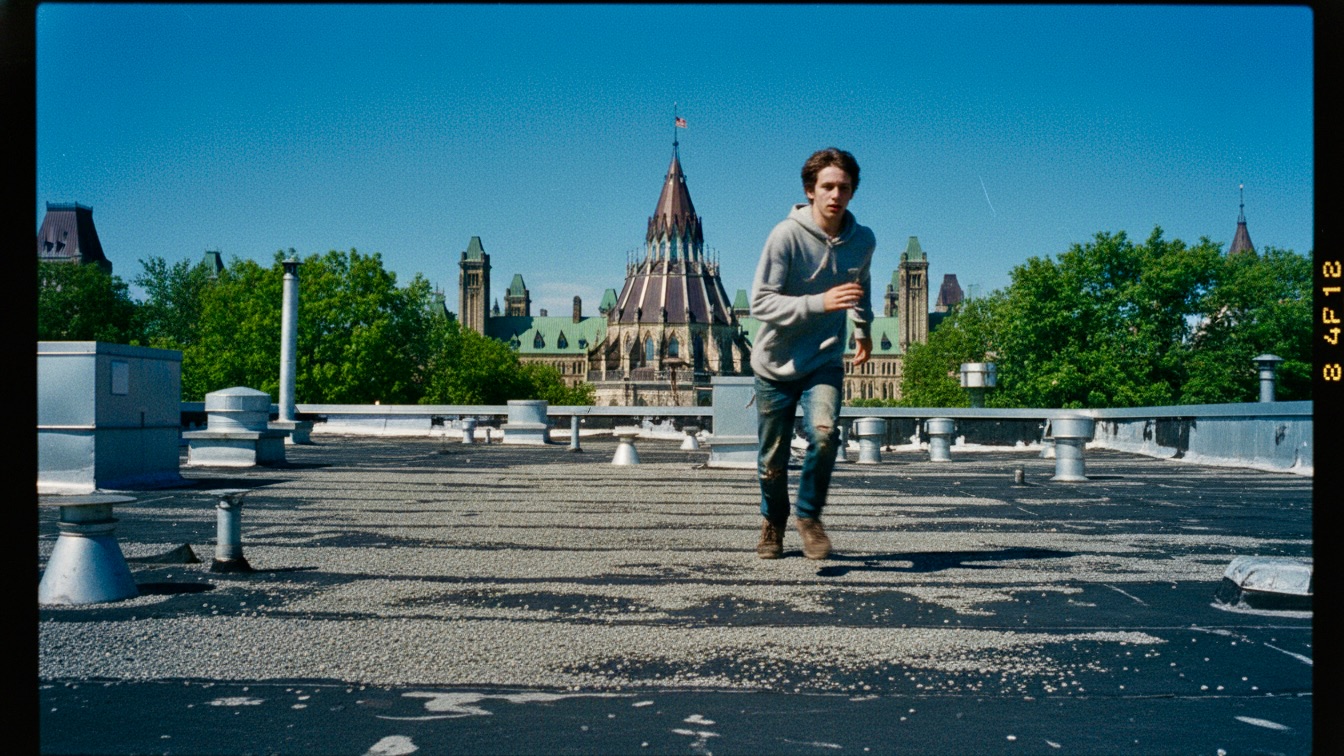
The Rooftop Sprint: As the tactical team kicks in the front door, Kenny escapes through his bedroom window and drops onto the porch roof. He uses his parkour skills to leap between Victorian-era office buildings, staying above the checkpoints and flashing lights of the safe zones. He reaches the tech hub overlooking the protest stage, his heart hammering as he prepares to make the final jump.
The Broadcast: Inside the server room, Kenny plugs in the drive and initiates a global broadcast to the jumbotrons outside and the internet at large. He watches as his mother’s ten-foot-tall signature appears over the heads of the crowd, triggering a roar of realization from the masses. As tactical teams tackle him and zip-tie his wrists, Kenny hears the crowd chanting "No cap! No chains!" and finally feels he can breathe.
The episode begins with a "Cold/Stagnant" mood, emphasizing the grey, grease-stained reality of the household. It shifts into "High-Anxiety/Paranoia" during the protest and mall chase, utilizing tight framing and jarring sound design to simulate Kenny’s panic. The emotional core peaks at "Betrayal" during the discovery of the signature, before concluding with a "Terrifying Triumph"—a bittersweet ending where the protagonist is captured but the truth is liberated.
If expanded, the season would follow the fallout of the "Operation Archer" leak, showing how other characters across the country react to the revealed "kill switch." Diane would face a public inquiry while secretly working to implement a more covert version of the protocol, creating a cat-and-mouse game with a growing underground resistance. Kenny would become a figurehead for the movement from behind bars, his "No Cap" slogan becoming a rallying cry for digital freedom.
The narrative would escalate as the government attempts to shut down the internet entirely to contain the viral data, leading to a "Dark Winter" scenario. Character evolution would focus on Mike regaining his purpose as a leader in the physical protests, while Diane is forced to choose between her son’s life and the survival of the administration. The season finale would center on a nationwide "Bank Run" triggered by the very protocols meant to prevent it.
The visual style is "Gritty Realism" meets "Technological Dystopia," utilizing a desaturated color palette of charcoal greys, navy blues, and the harsh, bleached whites of the Ottawa sun. Handheld camera work will be used during the street scenes to create a sense of documentary-style urgency, contrasting with the static, high-angle "God’s eye" shots of the surveillance cameras. Tonal influences include the claustrophobic urban tension of Children of Men and the cold, bureaucratic horror of Andor.
Lighting will play a key role, with the "The Glitch" cafe bathed in sickly neon blues and the PMO offices appearing in filtered, sterile light. The soundscape will emphasize the "rhythmic clack" of police batons and the low, constant hum of server fans, creating an auditory environment of industrial oppression. Tonal comparables include Mr. Robot for its technical accuracy and The Bourne Identity for its frantic, grounded chase sequences.
The target audience is adults aged 18-45 who are interested in political thrillers, civil liberties, and the impact of emerging technology on society. It appeals to viewers of "prestige" dramas who enjoy complex moral dilemmas where there are no clear heroes or villains. The "Techno-Thriller" elements will attract fans of speculative fiction, while the grounded, "ripped from the headlines" feel will resonate with followers of contemporary geopolitical events.
The pacing is "Accelerando," starting with a slow-burn domestic drama that rapidly increases in tempo once Kenny enters the protest zone. The 10-12 minute runtime is divided into three acts: The Discovery (0-3 mins), The Pursuit (3-8 mins), and The Leak/Consequence (8-12 mins). The middle act is designed as a continuous sequence of escalating tension, with very few "breathable" moments until the final scene in the holding cell.
The production requires a blend of practical locations (a suburban kitchen, a narrow alleyway) and stylized sets (the server room, the gaming cafe). The parkour sequences should be performed by a professional stunt double to ensure fluid, high-stakes movement that feels realistic rather than "action-movie" stylized. Special attention must be paid to the "User Interface" (UI) design on the monitors and jumbotrons to ensure the "Operation Archer" documents look authentic and legally dense.
The protest scenes can be achieved using a "small-crowd, big-sound" approach, utilizing tight framing and layered foley to simulate a massive assembly without the cost of thousands of extras. The flash-bang effect in the bedroom should be a practical light effect to capture the authentic reaction of the actor. The contrast between the "swampy" heat of the outdoors and the "freezing" air of the server room should be conveyed through visual cues like sweat-drenched clothing and visible breath.


