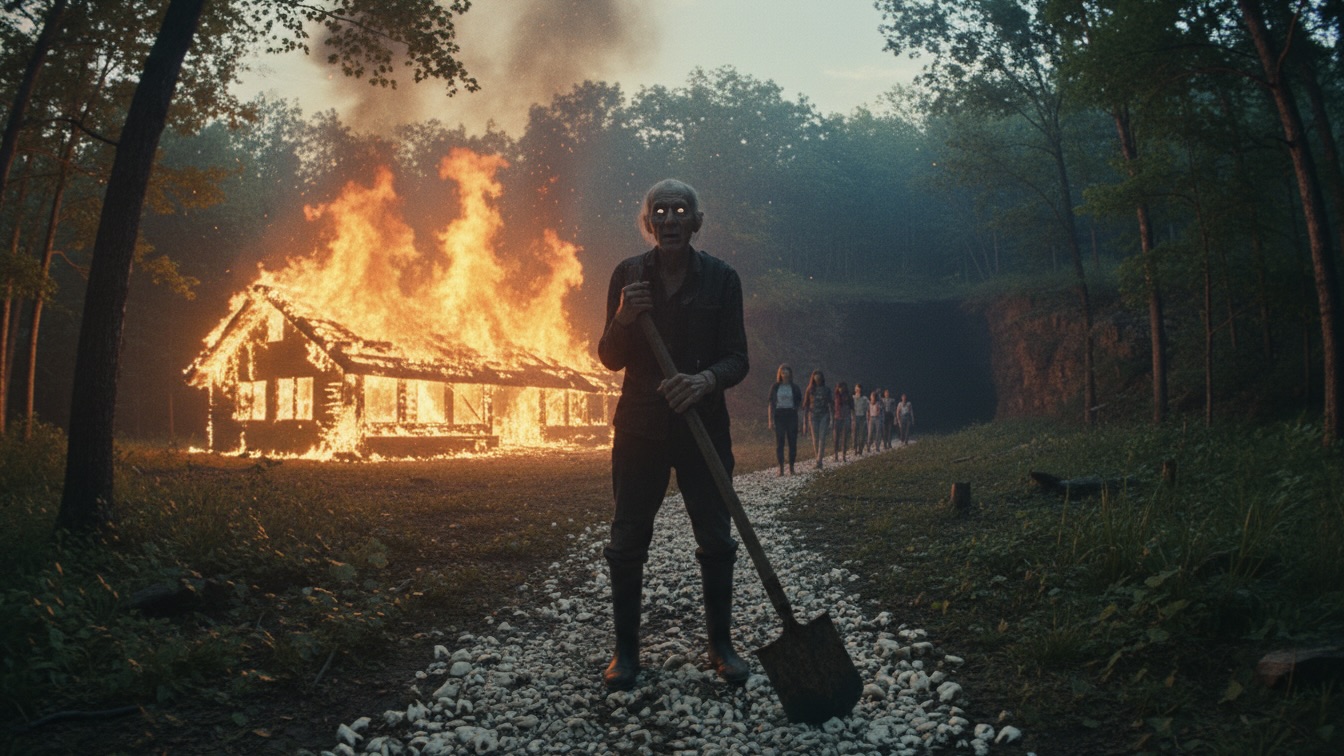
A new camper arrives at Blackwood as the groundskeeper struggles to keep the forest from rewriting his remaining memories.
The heat didn't just sit on the camp; it pressed down like a wet wool blanket. I sat on the milk crate behind the kitchen, the plastic honeycombs digging into my thighs. My hands were different now. They were thick, the skin mapped with deep lines and stained with the kind of grease that soap doesn't touch. I held a clove cigarette. The smell was sharp, medicinal. It helped hide the scent of the woods. The woods always smelled like wet dirt and something sweet, like rotting fruit. I looked at the shovel leaning against the brick wall. The edge was silver where the paint had worn away from years of hitting roots.
I heard the bus. It was a low, rattling groan that vibrated through the gravel. I felt it in my teeth. My jaw was tight, a dull ache that started at the hinge and radiated down to my chin. I tapped my boot against the stones. Thump. Thump. Thump. It was a rhythm I couldn't stop. It felt like a heartbeat that didn't belong to me. The bus pulled into the lot, kicking up a cloud of white dust that hung in the stagnant air. The engine died with a final, shuddering gasp.
The doors folded open. The sound was like a sharp intake of breath. I watched them climb out. Kids. They all looked the same from this distance. Bright t-shirts, oversized backpacks, eyes wide with that mix of excitement and terror. They didn't know yet. They thought they were here for archery and s'mores. They didn't know the trees were counting them. They didn't know the shadows had weight.
Then I saw him. He was the last one off the bus. He wore a linen vest that looked too big for him and wire-rimmed glasses that kept sliding down his nose. He stopped at the edge of the gravel and looked toward the maintenance yard. He looked directly at me. My heart did a slow, heavy roll. It wasn't him, I told myself. It couldn't be him. But he had the same slouch. The same way of tucking his hands into his pockets. He looked like a ghost that had found a new suit of skin.
I stood up. My knees made a dry, cracking sound. I felt the weight of the ledger in my back pocket. It was cold against my skin, even in this heat. It was a physical anchor, the only thing keeping me from drifting away into the green. I picked up the shovel. The handle was smooth, worn down by my own grip. I walked toward the fence. Each step felt heavy, like I was walking through water. The air was thick with the sound of cicadas. They were loud today. A screaming, metallic buzz that drowned out everything else.
Counselor Pete was there. He was wearing the 'World's Best Counselor' shirt. It was stained with sweat at the armpits. He was smiling, but it was a forced, jagged thing. His eyes were darting around, never settling on one thing for more than a second. He saw me and his smile flickered. He didn't say anything. He just nodded once, a quick, jerky movement. He looked like he was vibrating. Not like the Shiver-men, but close. Like he was a wire under too much tension.
"New batch," Pete said. His voice was thin. It sounded like it was coming from a long way off.
"Yeah," I said. My voice was a rasp. I hadn't used it much lately. Talking felt like swallowing glass.
"The Boy," Pete said, nodding toward the kid in the linen vest. "He's on your list?"
I reached back and touched the leather of the book. "Everyone's on the list, Pete."
"Not me," Pete whispered. He stepped closer. I could smell the salt on him. And something else. Gasoline. It was faint, but it was there. "I'm not in the book anymore, Toby. I checked."
I looked at him. His pupils were blown wide. "You shouldn't be looking in the book, Pete. It's not for you."
"I remember the fire," Pete said. He was whispering so low I could barely hear him over the cicadas. "I remember the red can. I remember the way the air turned orange. Why do I remember that?"
"The heat," I said. I gripped the shovel tighter. "It's the heat. Go lead the songs, Pete. Go do your job."
He stared at me for a long time. A fly landed on his cheek, right near his eye. He didn't blink. He didn't flinch. He just watched me with those empty, terrified eyes. Then he turned and walked back toward the kids. He started clapping his hands. "Alright, Bunk Four! Let's move! Adventure waits!"
The Boy followed him. He looked back one last time. He saw the shovel. He saw the grease on my face. He didn't smile. He just watched me until he disappeared behind the mess hall. I stood there until the dust settled. The sun was a white-hot coin in the sky. I looked down at the gravel. There was a blue smear on one of the stones. A tiny, electric drop of phosphorus. It was starting again. The solstice was coming, and the forest was hungry.
I walked back to the shed. I needed to check the inventory. I needed to make sure the gate was still slag. But as I passed the industrial kitchen, I saw a movement in the window. A reflection. It wasn't me. It was a kid in a red hoodie. He was standing right behind me. I spun around. The yard was empty. The only sound was the cicadas and the distant shouting of the campers. I looked back at the glass. The reflection was gone. But there was a handprint on the outside of the pane. A large, human-looking hand with fingers that had too many knuckles.
My breath came in a short, jagged burst. I felt the snap point. It was right here. I wasn't the groundskeeper. I was the prisoner. I looked at the shovel in my hand. It wasn't a tool. It was a weapon. And I was going to need it before the sun went down.
The maintenance shed was a tomb of hot air and the smell of old oil. I stepped inside, the darkness a temporary relief from the blinding white of the noon sun. I didn't turn on the light. I didn't need to. I knew every inch of this place. I knew where the rusted nails were. I knew which floorboard groaned. I knew the exact weight of every jerrycan on the shelf. I leaned my shovel against the workbench and sat down on the dirt floor. My jaw wouldn't relax. I rubbed the muscle, feeling the knot of tension that never went away. Thump. Thump. Thump. My foot was at it again, hitting the packed earth with a rhythmic dullness.
I pulled the ledger out. It was a small book, but it felt like a lead weight in my lap. I opened it to the middle. The pages were a blur of names. Some were crossed out. Some were smeared with blue phosphorus. I flipped to the end. The name I’d written—Toby—was still there. But the ink was changing. It was turning from black to a deep, bruised purple. Below it, a new line was forming. It wasn't ink. It was a scratch in the paper, like someone had used a dry needle. It was forming letters. B-O-Y.
"Not yet," I whispered. "You don't get him yet."
The shed door creaked. I didn't look up. I knew the silhouette. It was Pete. He was standing in the doorway, the light behind him making him a featureless black shape. He was holding something. The red jerrycan. The plastic was sun-faded, almost pink in the glare. He stepped inside, and the smell of gasoline filled the small space. It was sharp and aggressive. It made my eyes water.
"The pump is dry," Pete said. His voice was flat. "I need to fill the mower."
"The mower's fine, Pete," I said. I didn't close the book. I wanted him to see it. "You filled it yesterday."
"Dry," he repeated. He walked over to the shelf and set the can down. It hit the wood with a heavy thud. It was full. "Everything's dry. The grass. The trees. The kids. They're all just kindling, Toby. Don't you feel it?"
He looked at me then. The light caught his eyes. They weren't brown anymore. They were a pale, milky grey. The color of woodsmoke. He was losing his anchor. The forest was rewriting him, turning the counselor into something else. Something that knew about the fire.
"Put the can back, Pete," I said. I stood up, the ledger still in my hand. "Go to the lake. Take them swimming. Keep them away from the brush."
"They want the water," Pete said. He started to laugh. It was a dry, rattling sound. "But the water's gone. I went down there. The lake is just a hole. It's full of grey paper. Thousands of sheets of it, Toby. All blowing in a wind we can't feel."
I felt a cold spike of fear in my gut. A glitch. The forest was failing to maintain the illusion of the camp. If the lake was gone, the Shiver-men were getting closer. They were pulling the reality back into the ravine. I grabbed Pete by the shoulders. He felt thin, like he was made of balsa wood and old clothes. "Pete! Listen to me! You have to stay in the lines! Do you hear me? Stay in the lines!"
He blinked. For a second, the grey cleared. He looked at me, and I saw the man I’d known—the guy who liked bad jokes and cheap coffee. "Toby? It hurts. My head feels like it's full of static."
"I know," I said. "I know it does. But you have to hold on. For the kids."
"The boy," Pete whispered. "He looks like you. Why does he look like you?"
"He doesn't," I lied. "He's just a kid. Go. Take them to the mess hall. It's lunch. Focus on the food. Focus on the smell of the bacon."
Pete nodded slowly. He let go of the jerrycan. He turned and walked out of the shed, his movements still jerky, but more human. I watched him go. I looked at the red can. It sat there on the shelf, a silent promise of destruction. I wanted to throw it into the ravine. I wanted to pour it over the ledger and strike a match. But I knew what happened when you burned the debt. I knew the price. I was living it.
I stepped back out into the sun. The heat was even worse now. It was a physical weight. I walked toward the mess hall, my shovel over my shoulder. I saw The Boy. He was sitting on the steps, his backpack still on. He was staring at the ground. He had a stick in his hand, and he was drawing in the dirt. I walked over and looked down. He wasn't drawing pictures. He was writing. Names. Hundreds of them. They were small, cramped, and written with a precision that no twelve-year-old should have.
"Where did you see those?" I asked.
The Boy didn't look up. "In the trees. They're written in the bark. But you have to look sideways. If you look straight at them, they disappear."
I felt the tapping in my foot ramp up. Thump-thump-thump. "Don't look at the trees, kid. Look at the ground. Look at your shoes. Just don't look at the woods."
He looked up at me then. His glasses were thick, magnifying his eyes. They were the same eyes I saw in the mirror every morning before the forest blurred them. "You're the one who stayed," he said.
"I'm the groundskeeper," I said. "I fix things."
"You can't fix this," The Boy said. He pointed toward the ravine. "The iron is melting again. I can hear it. It sounds like someone screaming into a pillow."
I gripped the shovel so hard the wood groaned. The gate was gone. I had seen it melt. I had seen Marvin dissolve. But the forest doesn't lose. It just changes the rules. The gate wasn't gone; it was just waiting for a new shape. And The Boy was the key. He was the next entry. He was the one who would take the shovel when my hands finally turned to wood.
"Eat your lunch," I said. My voice was breaking. "Just eat your lunch and stay with the group."
I turned and walked away. I couldn't look at him anymore. Every time I did, I felt a piece of my own memory tear loose and flutter away. I headed for the industrial kitchen. I needed to see that handprint again. I needed to know if it was still there. As I rounded the corner, I stopped. The window was gone. In its place was a jagged hole in the brickwork. The edges weren't sharp; they were soft, like the building was melting. And inside the hole, standing among the stainless steel counters, was Leo Victor.
He was wearing the red hoodie. It was pristine, as if he hadn't spent years as a ghost. He was holding a tray of food. He looked at me and smiled. It was a normal smile. A happy smile. "Hey Toby. You want some peaches? They're fresh."
I didn't move. I couldn't. The air around the hole was shimmering with blue light. "Leo. You're not here."
"I'm everywhere, Toby," Leo said. He stepped forward, out of the hole and onto the gravel. He didn't have feet. His legs just faded into grey smoke. "The forest is finally full. There's no more room for names. We have to start over."
He reached out a hand. I saw the knuckles. Too many of them. The skin was the color of a dead fish. The shivering sound started then. It wasn't in the trees. It was coming from inside the kitchen. From inside the ground. From inside me. I swung the shovel. It went right through him. He didn't flinch. He just kept smiling. "The solstice is today, Toby. Are you ready for the exchange?"
I backed away, stumbling over a milk crate. I turned and ran. I didn't go to the shed. I didn't go to the gate. I ran toward the center of the camp, toward the noise and the kids and the safety of the group. But as I reached the mess hall, I saw them. The campers were all standing on the porch. They weren't moving. They weren't talking. They were all looking toward the ravine. And their eyes... they were all milky grey. Every single one of them.
I stood in the center of the gravel lot, the sun beating down on my head like a hammer. The silence was absolute. No cicadas. No birds. Even the wind had died. The only sound was the rhythmic thud of my own foot against the stones. Thump. Thump. Thump. I looked at the line of campers on the porch. They were like statues, their faces blank, their bodies rigid. They weren't kids anymore. They were vessels. The forest had emptied them out, preparing them for whatever was coming through the ravine.
I fumbled in my pocket for another clove cigarette. My hands were shaking so hard I dropped the pack. I knelt to pick it up, and that's when I saw it. The gravel wasn't gravel anymore. It was teeth. Thousands of small, white human teeth, packed together to form the ground. I scrambled back, my breath coming in shallow gasps. I looked again. It was just stones. White, sun-bleached stones. A glitch. My brain was trying to process two realities at once, and it was losing.
"Toby?"
I spun around. It was The Boy. He was the only one who wasn't on the porch. He was standing by the flagpole, his linen vest stained with something dark. He was holding the ledger.
"Give that to me," I hissed. I stepped toward him, my hand outstretched. "That's not for you. You don't know what that is."
"It's a map," The Boy said. He opened the book. The pages were fluttering in a wind that didn't exist. "It's a map of everyone who ever got lost here. Look. Here's Marvin. Here's Sarah. Here's James."
He pointed to the names. As he touched them, they began to glow with that sickly blue light. The light spread to his fingers, crawling up his arm like a neon fungus. He didn't seem to notice. He was mesmerized by the pages.
"And here's you," he said, pointing to the bottom of the last page. "Toby. But your name is fading. It's almost gone."
I lunged for the book, but he stepped back with a speed that wasn't human. He didn't move his feet; he just glided across the ground. His eyes were wide behind his glasses, but they weren't grey. They were still bright, full of a terrified intelligence.
"The forest wants a new name," The Boy said. "It needs a fresh record. The old one is full of holes. It's leaking."
He was right. I could feel the leak. It was the static in my head. it was the way the kitchen was melting. It was the way Pete was remembering the fire. The barrier between the camp and the forest was dissolving. The parasite was finally consuming the host.
"Give me the book, kid," I said. My voice was a low growl. "I can stop it. I've done it before."
"No, you haven't," The Boy said. "You just thought you did. You're just a part of the loop. You're the one who keeps the gate so they have something to break."
He closed the book with a sharp snap. The sound was like a gunshot in the still air. On the porch, the campers all turned their heads at the same time. Their necks made a collective cracking sound. They started to walk. Not toward us, but toward the ravine. They moved in perfect unison, their arms hanging limp at their sides.
"Pete!" I screamed. "Pete, stop them!"
I saw Pete at the end of the line. He wasn't walking. He was standing by the mess hall door, holding the red jerrycan. He had unscrewed the cap. The smell of gasoline was overpowering now, a thick, oily cloud that hung over the porch. He looked at me, and for a second, I saw a flash of his old self. He was crying. Thick, grey tears were rolling down his cheeks.
"I have to fix it, Toby," Pete said. "I have to burn the static."
"No! Pete, don't!"
He tipped the can. The gasoline splashed over the wooden boards of the porch, soaking the feet of the passing campers. They didn't stop. They didn't even flinch as the liquid drenched their socks and shoes. They just kept walking toward the woods.
I ran toward the porch, but The Boy stepped into my path. He was holding the shovel now. My shovel. He held it with an easy familiarity, the weight of it balanced perfectly in his hands.
"It's time to change shifts, Toby," he said.
He swung the shovel. Not at me, but at the flagpole. The metal pole snapped like a twig. The flag—the bright blue Camp Blackwood flag—fell into the dirt. As it touched the ground, it turned into a pile of dry, brown leaves. The entire camp was shedding its skin. The buildings were turning into hollow logs. The gravel was turning into peat. The illusion was over.
I felt a sharp pain in my chest. I looked down. My shirt was torn, and beneath it, my skin was turning grey. It was becoming papery, mapped with thin, vibrating slits. I wasn't the groundskeeper anymore. I was becoming one of them. A Shiver-man.
"No," I whispered. "I remember. I'm Toby. I was a camper. I had a life."
"Names are just sounds," The Boy said. He walked toward me, his face calm. He reached out and touched my cheek. His hand was warm. It was the only warm thing left in the world. "The forest doesn't care about sounds. It only cares about the record."
He handed me the clove cigarette I had dropped. It was lit. I took a drag, and the smoke tasted like ash. I looked toward the porch. Pete was striking a match. He looked like a man in a dream. He dropped the flame into the pool of gasoline.
A wall of orange fire erupted. It wasn't a normal fire. It was a roar of light that consumed the mess hall in seconds. But it didn't stop the campers. They walked right through the flames. Their clothes caught fire, their hair turned to smoke, but they didn't scream. They didn't slow down. They were pillars of fire walking into the dark green of the woods.
I looked at my hands again. The fingers were lengthening. Another knuckle was forming on each one. I could feel the shivering starting in my bones. A high-pitched hum that made my vision blur. I looked at The Boy. He was opening the ledger again. He pulled a pen from his vest.
He looked at me, his eyes full of a strange, cold pity. "What was your last name, Toby?"
I opened my mouth to answer, but all that came out was a hiss. A dry, mechanical sound that vibrated in my throat. I couldn't remember. I knew it started with an S. Or a G. It was gone. The forest had taken it.
"It's okay," The Boy said. He wrote something in the book. "I'll just put 'The Groundskeeper'. It's more accurate anyway."
He turned and started walking toward the maintenance shed. He moved with the same slouch I had. The same way of tucking his hands into his pockets. He was the new Toby. And I was the new shadow.
I looked at the burning mess hall. The heat was incredible, but I didn't feel it. I felt cold. A deep, sub-zero cold that started in my heart and radiated outward. I saw Pete standing in the middle of the fire. He was laughing now. A loud, hysterical sound that rose above the roar of the flames. He was finally free. The forest didn't want him anymore. He was just waste.
I turned toward the ravine. I could hear the shivering sound coming from the hollow. It was a call. A command. I started to walk. My legs felt long and spindly. My feet hit the ground with a soft, papery thud. I passed the line of burning campers. They were entering the woods now, their bodies leaving trails of smoke among the pines.
I reached the edge of the ravine and looked down. The gate was back. But it wasn't iron. It was made of bone. Thousands of white, bleached bones woven together into a massive, arching frame. And inside the frame, the shimmering space was wider than ever. It was a mouth. A giant, hungry mouth that was swallowing the summer whole.
I stood at the precipice of the ravine, my body no longer my own. The transformation was nearly complete. My skin was the color of a winter sky, taut and translucent over bones that had grown too long and too thin. I looked down at my hands—those long, multi-knuckled fingers that I had seen in the window. They were beautiful in a terrifying way, like delicate glass instruments. I couldn't feel the heat from the burning camp behind me, but I could feel the coldness of the gate below. It was a magnetic pull, a gravity that worked on the soul instead of the mass.
The shivering sound was a roar now, a symphony of static that filled my head, erasing the last few scraps of my identity. I tried to think of my mother. I found a blurry image of a woman with auburn hair, but the face was blank, like a thumbed-over photograph. I tried to think of my home. I saw a street with oak trees, but the houses were hollow shells, filled with the same grey smoke as the campers. Everything was being reclaimed. The forest was a giant eraser, and I was the last mark on the board.
I saw a movement at the bottom of the slope. It was Pete. He had survived the fire, or maybe the fire hadn't been real. He was crawling through the ferns, his clothes charred and smoking. He was still clutching the red jerrycan. It was empty now, the plastic warped by the heat. He reached the base of the bone-gate and looked up. He saw me standing on the ridge.
"Toby!" he screamed. His voice was a ragged shred of sound. "Toby, help me!"
I didn't move. I couldn't. I wasn't Toby anymore. I was a witness. I watched as a Shiver-man emerged from the shimmering space inside the gate. It was tall, its head bent at that impossible angle. It moved with the skipping-frame motion of a glitchy video. It reached out and touched Pete’s head. Pete didn't scream. He just went still. His eyes turned that milky grey, and then his entire body began to vibrate. He wasn't turning into a Shiver-man. He was turning into a name.
His body dissolved into a cloud of silver sparks, exactly like Marvin’s had. The sparks didn't rise into the sky; they were sucked into the gate. The shimmering space pulsed once, a deep, electric blue, and then Pete was gone. There was nothing left but the warped red jerrycan sitting in the mud.
I felt a presence behind me. I turned my head—the movement was slow and mechanical. It was The Boy. He was standing a few feet away, the ledger tucked under his arm. He had changed his clothes. He was wearing my old work shirt. It was too big for him, the sleeves rolled up to his elbows. He looked at me, and for the first time, I saw the weight of the consequences in his eyes. He knew. He finally understood the bargain.
"The debt is paid for this year," The Boy said. His voice had deepened. It was starting to sound like mine. "The camp can stay open. The town can keep its memories. The history remains."
He looked toward the burning mess hall. The fire was dying down, but the building wasn't a ruin. It was whole again. The wood was fresh, the paint was bright. The campers were back on the porch, laughing and talking, their clothes clean, their hair perfect. They didn't remember the fire. They didn't remember Pete. They were a fresh batch of memories, ready to be harvested.
"Why?" I hissed. The sound was a dry rasp of wind through dead leaves.
"Because the forest is lonely, Toby," The Boy said. He sat down on the ridge, his feet dangling over the edge of the ravine. He pulled out a clove cigarette and lit it. The smell drifted toward me—a final, mocking reminder of the man I used to be. "It wants to be seen. It wants to be remembered. But it's too big for a human brain. It's too old. So it creates these little stages. These little plays. And we're the actors. We keep the story going so the forest doesn't have to be alone in the dark."
He took a long drag of the cigarette and blew the smoke toward the gate. "You were a good groundskeeper. You kept the gate closed for a long time. Longer than most."
I looked at the bone-gate. The shimmering space was starting to shrink. The solstice peak was passing. The exchange was over. I felt the final snap. The last thread of Toby—the kid who wanted to save Leo, the man who tried to burn the debt—snapped.
I stepped off the ridge.
I didn't fall. I glided down the slope, my long limbs moving in perfect synchronization with the shivering of the trees. I reached the bottom of the ravine and stood before the gate. The Shiver-man who had taken Pete was waiting for me. It bowed its head. I bowed mine. We were brothers now. We were the static in the radio. We were the movement in the corner of your eye.
I looked back up at the ridge. The Boy was watching me. He looked so small against the vast, green backdrop of the woods. He looked like a target. He waved once—a slow, sad gesture—and then he stood up and walked back toward the camp. He had work to do. There were tools to fix. There were names to write. There was a gate to guard.
I turned toward the shimmering space. It was a cold, beautiful void. I stepped inside.
I wasn't in the ravine anymore. I was in a forest made of paper. Millions of white sheets hung from the branches of trees made of ink. The ground was a sea of names, flowing like water. I saw Leo Victor. He was sitting by a river of blue phosphorus, skipping stones. He looked up and smiled.
"About time," he said. "The game's about to start."
I sat down next to him. I looked at my hands. They were just hands again. But they weren't mine. They were made of the same paper as the trees. I felt a profound sense of peace. I didn't have to remember anymore. I didn't have to fight. I was part of the record. I was the history of Camp Blackwood.
But then, I heard a sound.
It was a low, rattling groan. The sound of a bus pulling into a gravel lot.
I looked at Leo. "Is that...?"
"New batch," Leo said, his smile widening. "But something's different this time."
I looked toward the edge of the paper-forest. The white sky was cracking. A jagged line of orange fire was spreading across the horizon. And through the crack, I saw a face.
It was Pete. But he wasn't a counselor. He was huge, his face filling the entire sky. He was holding a red jerrycan the size of a mountain.
And he was tipping it.
“I looked up at the cracking sky and realized that Pete wasn't trying to save the camp; he was trying to burn the book we were all living in.”


