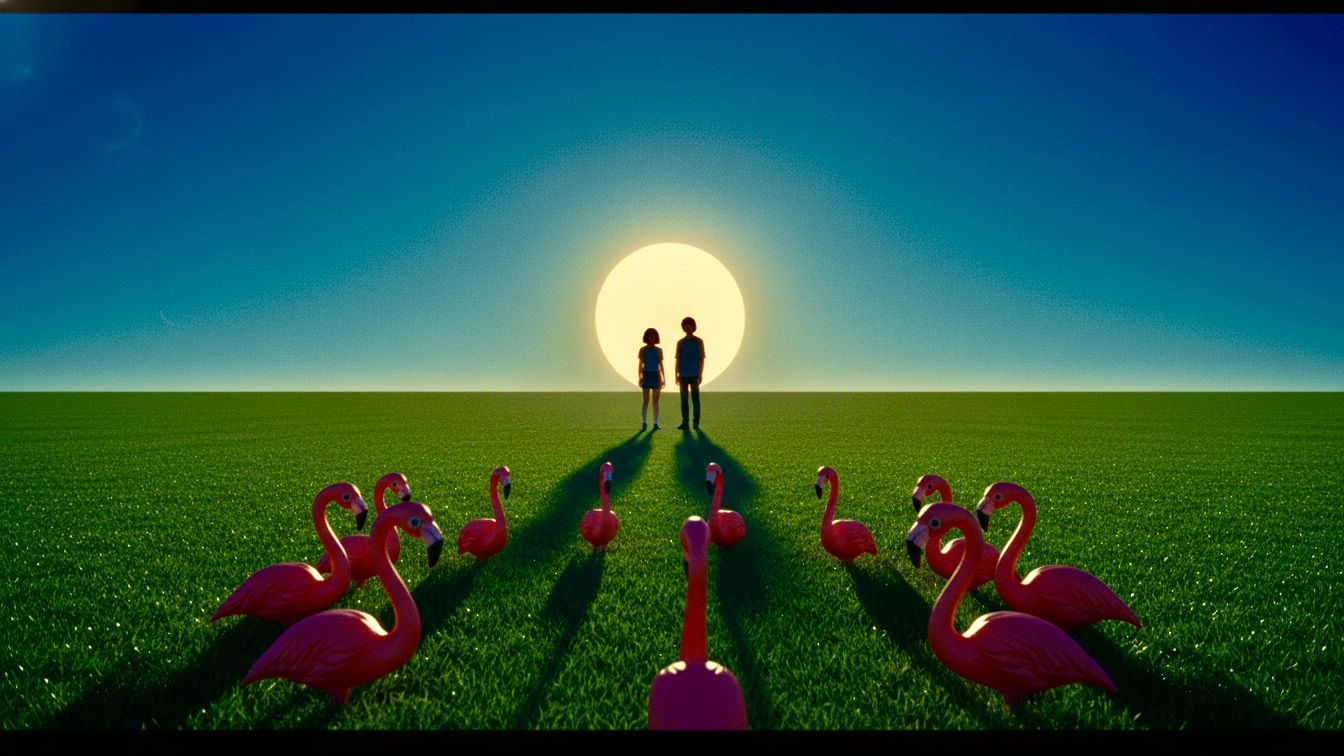
Mia and Sam hop a fence to escape their hometown, only to find themselves trapped in an endless lawn.
The cedar fence was hot. It was the kind of dry, splintering heat that suggested the wood had been baking in the sun for a century, though Mia knew Old Man Martin had only put it up last October. She gripped the top rail, feeling the rough grain bite into her palms. Her Doc Martens, scuffed at the toes from four years of high school hallways, found a precarious foothold. She hoisted herself up, the movement familiar and practiced. They were leaving. Not just the yard, but the town. This was the shortcut to the bus station, the final act of a long-planned departure. Below her, Sam was already halfway over, his lanky frame moving with a nervous, jerky energy. He smelled like cheap body spray and the lingering scent of the gas station taquitos they had eaten for lunch.
"Hurry up, Mia," Sam said. His voice was a sharp rasp in the still air. "If Martin catches us, he’ll spend three hours explaining the history of his prize-winning marigolds, and we will actually miss the two-fifteen. My life cannot end in a lecture about mulch. I refuse."
Mia didn't answer. She swung her leg over the top, the denim of her jeans catching for a second on a stray nail. She dropped. The landing was supposed to be a soft thud on grass. Instead, it was a hard, hollow 'clack'. Her knees didn't sink into soil; they vibrated with the impact of hitting something rigid. She looked down. The grass was green. It was a bright, aggressive green that made her eyes ache. But it wasn't grass. It was a carpet of plastic blades, each one identical to the last, standing in stiff, military rows. She stood up, brushing her hands off. No dirt. No stains. Just a faint, chemical residue that felt like wax on her skin.
"Sam," she whispered. The word felt small. The air here was different. It was heavy, like the atmosphere inside a greenhouse, but without the moisture. It was a dry, searing heat that seemed to come from everywhere at once.
Sam was standing five feet away, his mouth open. He wasn't looking at the grass. He was looking at the horizon. "Mia, where is the sidewalk? The sidewalk is supposed to be right there. We hop the fence, we walk twenty feet, we hit the pavement. That’s the geography. That is the literal map of our lives."
Mia turned. Behind them, the cedar fence stood tall. But beyond it, there was no Martin’s house. There was no street. There was only more green. The fence seemed to be floating in an ocean of plastic turf. It stretched out in every direction, a flat, emerald plane that met a sky so blue it looked like it had been applied with a roller. There were no clouds. There was no gradient. It was just a solid, unblinking slab of color. And the sun. The sun wasn't a glowing orb of gas. It was a perfectly round, yellow disc, fixed in the center of the sky. It didn't shimmer. It just glowed with a relentless, mechanical intensity.
"This is lowkey terrifying," Sam said. He adjusted his backpack straps, his knuckles white. "I think we entered a glitch. Like, the world just forgot to load the rest of the map. We’re in the loading screen, Mia. We’re stuck in the lobby."
"Don't start with the simulation talk," Mia snapped, though her heart was hammering against her ribs like a trapped bird. She checked her watch. The digital numbers were flickering. Two-twelve. They had three minutes. "We just need to keep moving. The bus station is north. The sun is... well, the sun is up. We just walk straight. We’ll hit the edge eventually. It’s a yard, Sam. Yards have edges."
They started to walk. The sound of their footsteps was a rhythmic, artificial crunch. It was the sound of cleats on a football field, magnified and distorted. After ten minutes of walking, Mia looked back. The fence was still there. It didn't look any smaller. It was the same distance away as when they had started. She looked forward. The horizon hadn't moved. The yellow bulb in the sky hadn't shifted an inch.
"The spatial logic of this environment is fundamentally broken," Sam declared. He stopped, wiping sweat from his forehead. The heat was prickly now, stinging his skin. "We have been walking for at least a mile. Look at the fence. It’s mocking us. It’s staying exactly where it is. We are on a treadmill, Mia. A giant, plastic, soul-sucking treadmill."
"We aren't on a treadmill," Mia said, her voice rising in pitch. She felt the first cold lick of a panic attack in the pit of her stomach. "We just need to try harder. Maybe we’re walking too slow. If I miss that bus, I miss the orientation. If I miss the orientation, I lose my housing slot. My entire future is tied to a two-fifteen departure from a town that smells like wet dog and failure. I am not staying here."
She began to run. Her boots slammed against the astroturf. She ran until her lungs burned, until the heat felt like a physical weight pressing down on her shoulders. When she finally stopped, gasping for air, she looked down. She was standing next to Sam. He hadn't moved. Or rather, she had run, but she had ended up right back where she began.
"The vibes are cooked, Mia," Sam said softly. "They are absolutely, unequivocally cooked."
The silence was the worst part. There were no birds. No wind. No distant sound of traffic. Just the hum of the heat and the increasingly loud, rhythmic drone of a lawnmower. It sounded miles away, a low-frequency vibration that rattled Mia’s teeth. It was a constant, monotonous growl that seemed to be coming from the horizon, yet no matter which way they turned, the volume remained the same. It was the soundtrack of suburbia turned into a weapon.
"Do you hear that?" Mia asked, rubbing her ears. "It’s like someone is mowing the world."
"It’s the boss music," Sam joked, but his eyes were darting around, searching for an exit that didn't exist. "Every thriller has a sound. This is ours. The sound of a dad in New Balance sneakers coming to tell us to get off his lawn. Except the lawn is forever."
They moved forward again, more cautiously this time. The landscape began to change, though not in any way that made sense. Patches of petunias began to appear. They weren't growing out of the ground; they seemed to be bursting through the plastic turf like purple explosions. They were aggressively vibrant, their petals a shade of violet that seemed to vibrate against the green. They didn't smell like flowers. They smelled like new car interior and ozone.
And then, they saw them. A flock of plastic pink flamingos. There were dozens of them, their spindly metal legs stuck deep into the astroturf. They were arranged in a perfect circle around a small, dry birdbath. At first, they were just lawn ornaments, the kind of kitschy decor Mia’s grandmother used to keep. But as they approached, the air seemed to thin.
"Don't look at them," Sam whispered, grabbing Mia’s sleeve. "They have a very judgmental energy."
"They’re plastic, Sam. Grow up," Mia said, though she felt the hair on her arms stand up.
as they stepped into the center of the flamingo circle, a soft, synchronized 'click' echoed through the heat. The flamingos didn't move their bodies, but their heads snapped around in unison. Their black, beady eyes, which Mia had assumed were just painted dots, blinked. They stared at the teenagers with an unnerving, artificial intelligence.
"Okay, the plastic birds are blinking," Sam said, his voice hitting a theatrical high note. "The birds are blinking, the sun is a lightbulb, and I am currently reconsidering every life choice that led me to this moment. Mia, we need to pivot. We need a new strategy. This is not a shortcut. This is a trap."
"It’s not a trap, it’s just... an anomaly," Mia said, trying to regain her composure. She addressed the flamingos. "Excuse us. We’re just passing through. We have a bus to catch. We don't want any trouble with the lawn ornaments."
The flamingos tilted their heads. One of them opened its plastic beak and let out a sound like a grinding gear. It wasn't a squawk; it was the sound of a machine failing.
"The logistics of this conversation are failing," Mia muttered. She felt the sweat trickling down her spine. The heat was becoming unbearable, a prickly sensation that felt like thousands of tiny needles pressing into her skin. "Sam, look at the sky. It’s getting brighter. How is it getting brighter?"
The blue was deepening, turning into a neon shade that made the edges of her vision blur. The yellow sun-bulb seemed to be expanding, its light washing out the details of the world until everything was a high-contrast nightmare.
"We have to keep moving toward the mower," Sam said, his face pale. "It’s the only landmark. If we can find the person mowing, we can find the person in charge. Maybe they have a remote. Maybe they can turn off the sun."
"Or maybe they’ll just mulch us," Mia countered. She looked at her watch again. Two-thirty. The bus was gone. The realization hit her with more force than the heat. Her hands started to shake. "I missed it. Sam, I missed the bus. My life is over. I’m going to be stuck in this town forever, and now I’m going to be stuck in this literal version of this town forever. I’m going to die in a yard full of blinking flamingos."
"You are being very dramatic, which I usually respect," Sam said, stepping over a patch of the purple petunias. "But we are currently in a survival situation. Focus on the geometry, Mia. Focus on the exit. We are seniors. We are adults. We can handle a few plastic birds."
As if in response, the flamingos began to rotate their bodies, their metal legs scraping against the plastic floor. They formed a wall, blocking the path toward the sound of the mower. Their eyes continued to blink in a slow, rhythmic pattern, a countdown of sorts. The drone of the mower grew louder, a thrumming roar that seemed to shake the very ground beneath their feet. The air tasted like burnt rubber and summer.
The attack came without warning. One of the petunia patches, a particularly large cluster of deep violet flowers, suddenly shuddered. The petals pulled back like the hammer of a gun, and with a soft 'thwip', a cloud of yellow pollen shot into the air. It didn't drift like dust. It moved with intent, a concentrated burst of golden particles that zipped through the air like tiny darts.
"Get down!" Mia screamed, diving for the ground.
Sam wasn't as fast. A handful of the pollen darts caught him in the shoulder. He let out a yelp, more of surprise than pain, as the yellow dust clung to his shirt. Where the pollen touched the fabric, it began to smoke. Small, circular holes charred through the cotton, leaving tiny red welts on his skin.
"They’re shooting us!" Sam yelled, scrambling toward a large garden gnome that sat twenty feet away. "The flowers are literally shooting us with allergic reactions! This is a violation of the Geneva Convention!"
They scrambled behind the gnome, a three-foot-tall plaster figure with a peeling red hat and a frozen, mischievous grin. It was heavy and solid, providing a much-needed shield against the next volley of pollen. Mia huddled against the gnome’s back, her breath coming in short, jagged gasps. Her heart was a frantic drum in her chest. The smell of the burnt cotton and the waxy grass was overwhelming.
"Are you okay?" Mia asked, reaching out to touch Sam’s arm.
"I’m fine. It just stings," Sam said, though his hand was trembling as he wiped a stray grain of pollen from his sleeve. He leaned back against the gnome’s plaster boots and slid down to the ground. "Mia, I have a confession. And I feel like if I don't say it now, I’m going to die with a secret, and that is very poor character development."
Mia looked at him, her brow furrowed. "Sam, now? You want to do this now? While we’re being pinned down by flora?"
"The stakes have never been higher!" Sam said, his theatricality returning as a defense mechanism. "Look, you’re all stressed about missing your bus to your Ivy League future where you’ll become a world-renowned philosopher or a high-powered lawyer or whatever. But I’m not worried about the bus because I have nowhere to go."
Mia went still. "What are you talking about? You got into State. We celebrated. We had cake."
"I bought that cake," Sam said, his voice dropping to a whisper. "I bought the cake to cover the lie. I didn't get into State. I didn't get into anywhere. My GPA was a disaster, and my essay was just a three-page rant about why the ending of that one space movie was scientifically inaccurate. I’m a failure, Mia. I’m the guy who stays in this town and works at the car wash until he’s eighty. I was just hopping the fence to walk you to the station because I didn't know how to tell you that tomorrow, you’re leaving and I’m just... staying."
The mower sound peaked, a deafening roar that seemed to pass right over them, though nothing was there. The ground shook. Mia stared at Sam, the heat and the fear momentarily forgotten. "Sam, why didn't you tell me? I wouldn't have judged you."
"Yes, you would have!" Sam snapped. "You’re Mia. You have a spreadsheet for your life. You have a five-year plan and a ten-year plan and a plan for what kind of dog you’re going to own in 2035. I’m just a guy with a collection of vintage sneakers and a talent for making people laugh when things get awkward. I’m terrified of being the person who gets left behind. And now, look at us. We’re both left behind. In a yard."
Mia felt a lump form in her throat. She looked at her own hands, the fingers stained with the chemical wax of the grass. "You think I’m so prepared? Sam, I’m terrified too. Every time I look at that orientation packet, I feel like a fraud. I feel like they’re going to realize they made a mistake. That I’m just a girl from a small town who read too many books and got lucky. I don't want to go to that school. I want to want to go. There’s a difference."
"So we’re both frauds," Sam said, a small, sad smile touching his lips. "That’s a vibe. We’re a matched set of disappointments."
"We’re not disappointments," Mia said firmly. "We’re just eighteen. We’re supposed to be confused. We’re not supposed to have the answers while we’re being hunted by a lawnmower."
Suddenly, the gnome behind them shifted. It was a subtle movement, the sound of stone scraping against stone. Mia and Sam both froze. The gnome’s plaster head turned slowly, the red hat tilting at an angle. The frozen, mischievous grin didn't change, but the eyes—painted blue and chipped at the edges—seemed to focus on them.
"To move toward the future, one must acknowledge the path already trodden," the gnome said. Its voice was deep and resonant, like the sound of a bowling ball rolling down a wooden lane. It was theatrical and formal, a voice that belonged in a Shakespearean play, not a suburban backyard. "You seek an exit where there is only an entrance. You walk forward, yet you remain still. Why do you fight the logic of the lawn?"
Sam stared at the gnome. "Did the lawn ornament just drop a riddle on us? Is this happening?"
"The lawn is a reflection of the mind," the gnome continued, ignoring Sam. "It is manicured. It is controlled. It is a cage of your own expectations. If you wish to leave the green, you must stop chasing the horizon. To find the gate, you must look where you have been."
"Look where we’ve been?" Mia asked. "We’ve been at the fence. We tried to go back to the fence, but it didn't move."
"You tried to walk back," the gnome said, its head creaking as it looked toward the sky. "But your eyes were still on the goal. To return is not to turn around. To return is to move backward while facing the sun. Heel to toe, the path is revealed to those who dare to retreat."
The petunias let out another volley of pollen, the yellow darts pinging off the gnome’s plaster back. The heat reached a fever pitch, the air shimmering like a desert mirage.
"Heel to toe," Mia whispered. "We have to walk backwards."
Sam looked at Mia, then at the horizon, and then at the blinking flamingos who were slowly closing the circle. "Walking backwards? That is fundamentally counterintuitive. It’s a terrible way to travel. I have zero peripheral vision in reverse."
"It’s a riddle, Sam!" Mia yelled over the roar of the invisible mower. "The gnome is giving us the cheat code. If forward doesn't work, we do the opposite. It’s the Bright Glitch logic. We have to lean into the weirdness."
Mia stood up, keeping her back to the fence they had hopped an hour—or a lifetime—ago. She looked directly at the giant, unblinking yellow sun. It was blinding, a searing light that forced her to squint, but she didn't look away. She took a step back. Her heel hit the plastic grass.
'Clack'.
She took another step. Behind her, she felt the space change. The roar of the mower dipped in volume. The heat, which had been a heavy blanket, suddenly felt a degree cooler.
"It’s working!" she shouted. "Sam, get up! Walk toward me, but stay facing the sun!"
Sam scrambled to his feet, his movements clumsy. He turned his back to the horizon and faced the yellow bulb. He took a hesitant step backward, his sneakers squeaking on the turf. "I feel like a backup dancer in a very low-budget music video. This is humiliating. If anyone sees this, my reputation is cooked."
"There is no one here to see you but the flamingos, and they’re already judging us!" Mia said.
They moved in sync now, a strange, rhythmic retreat. With every step they took toward the invisible fence, the world began to ripple. The neon blue of the sky started to bleed, the edges softening into a pale, dusty azure. The plastic blades of grass beneath their feet began to lose their rigidity. The 'clack' of their boots transitioned into a soft, muffled 'thud'.
Mia felt a drop of moisture on her forehead. It wasn't sweat. It was rain. A single, cool drop. The air, which had been sterilized and dry, suddenly filled with the scent of damp earth and mown clover. It was a messy, complicated smell, and it was the most beautiful thing she had ever experienced.
"The sun is dimming," Sam noted. His voice was no longer theatrical; it was filled with a quiet, genuine awe. "Look, Mia. It’s not a bulb anymore."
The yellow disc was softening, its sharp edges blurring into the hazy light of a late summer afternoon. The intense, artificial glow was being replaced by the long, golden shadows of five o'clock. The lawnmower sound didn't disappear, but it changed. It was no longer a roar; it was the distant, comforting hum of a neighbor three streets over finishing his chores before dinner.
They continued to walk backwards, their legs aching from the awkward motion. The petunias were no longer shooting pollen; they were just flowers, wilting slightly in the humidity. The flamingos were gone, replaced by a stray plastic rake leaning against a tree.
Suddenly, Mia’s back hit something solid and splintery. She gasped, her hands flying back to catch herself. It was wood. The cedar fence.
"We’re here," she whispered.
She and Sam turned around in unison. They weren't in an endless ocean of green. They were in Old Man Martin’s backyard. It was small. There was a patch of dirt where he was planning a vegetable garden. There was a rusted metal shed and a stack of old tires. Beyond the fence, the street was visible. A silver sedan drove past, its windows down, music thumping faintly.
Mia grabbed the top of the fence and hauled herself over, not caring about the splinters or the dirt. She tumbled onto the sidewalk on the other side, landing hard on the concrete. Sam followed a second later, landing in a heap beside her.
They lay there for a long time, staring up at the real sky. It was a messy sky, filled with wispy clouds and the orange tint of the approaching sunset. It wasn't perfect. It was beautiful.
Mia looked at her watch. Five-fifteen. She had missed the bus by three hours. She had missed the orientation. She had missed the start of her carefully planned future.
She began to laugh. It started as a giggle in the back of her throat and turned into a full-throated, hysterical roar. Sam joined in, his laughter sharp and jagged. They sat on the sidewalk, covered in dirt, sweat, and the faint yellow residue of the petunia pollen, laughing until their ribs ached.
"So," Sam said, wiping his eyes. "No bus."
"No bus," Mia agreed. She looked at the quiet street of their boring hometown. It didn't look so boring anymore. It looked like a place where things made sense. "I think I’m going to call the admissions office tomorrow. Tell them I’ll be a week late. Or maybe I’ll tell them I’m taking a gap year. I think I need to learn how to walk forward for a bit."
"I’ll help you," Sam said. He stood up, offering her a hand. "And maybe I’ll actually look at some community college brochures. I hear they have great programs for people who are into space movie accuracy."
Mia took his hand and pulled herself up. The world felt solid beneath her feet. The future was still a terrifying, unknown expanse, but for the first time, she didn't feel the need to have a map.
"We should go get some real food," Sam said, brushing the dirt from his jeans. "I am starving. And I promise, no more gas station taquitos. We deserve something that wasn't heated in a microwave."
As they walked away from the fence, the sun dipped lower, casting their shadows long across the pavement. Mia didn't look back. She didn't need to. The lawn was behind them, its lessons etched into the sting of the pollen welts on their skin. They walked toward the center of town, two teenagers with nowhere to be and everything to find.
“As they turned the corner, Mia glanced at a neighbor's lawn and saw a single pink flamingo turn its head to watch them pass.”


