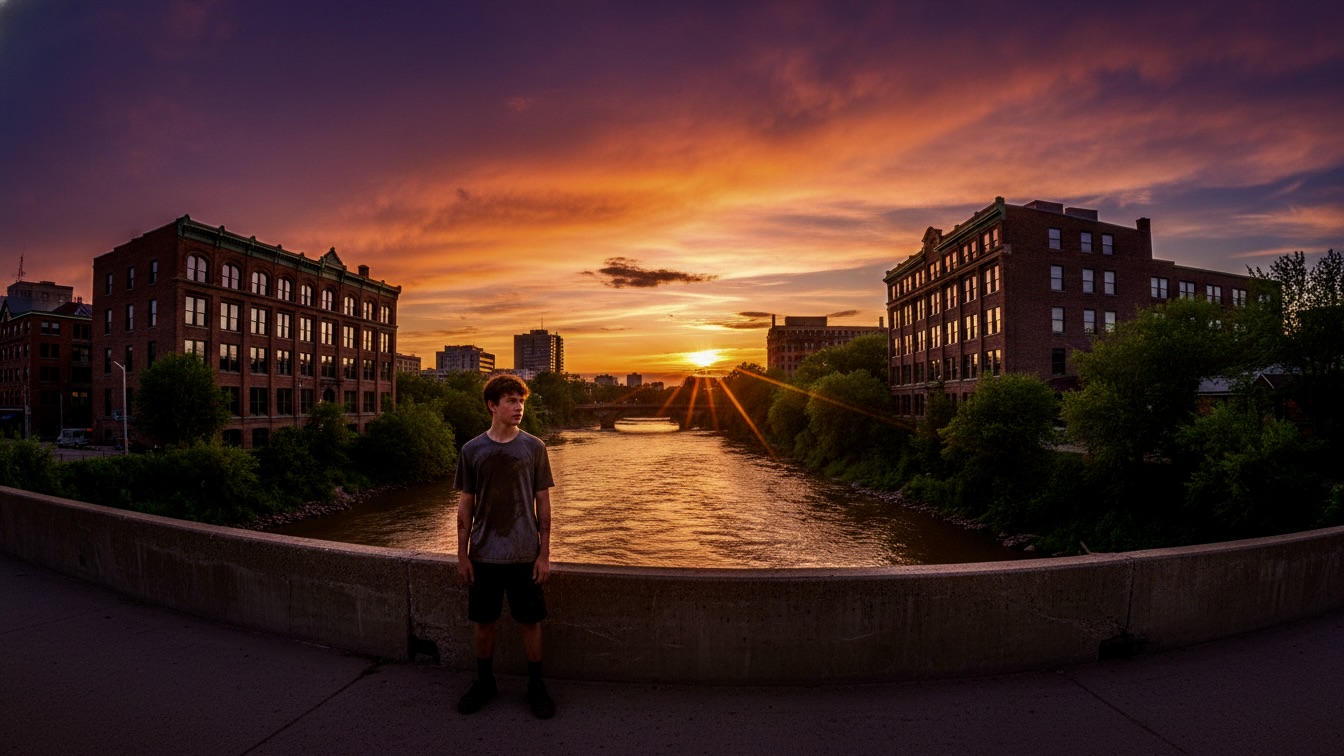
Paul waits for the 18 bus while the Winnipeg humidity turns the city into a literal pressure cooker tonight.
Paul’s jaw was so tight it felt like his molars might actually crack. He stood at the corner of Main and Higgins, the epicenter of Winnipeg’s bruised heart, watching the heat waves ripple off the asphalt. It was 5:14 PM. The 18 bus was already seven minutes late. His phone buzzed in his pocket—another notification from his mom asking if he’d picked up the milk, another reminder that his bank account was sitting at a cool four dollars and twenty-two cents. The sun was a physical weight, a humid blanket that smelled like hot rubber and the sour breath of a city that hadn't slept in a century. He tapped his foot against the cracked sidewalk, a frantic, uneven rhythm that matched the static in his brain. He needed to move. He needed to breathe. But the air was too thick to swallow.
Then there was Jesse. Jesse didn’t walk so much as he glided into the space, looking entirely too cool for a day that was currently melting the soles of everyone else's shoes. He was wearing a vintage jersey that was probably worth more than Paul’s entire wardrobe and a pair of wired earbuds that screamed 'don't talk to me' while simultaneously inviting curiosity. He stopped two feet away from Paul, leaning against the rusted bus shelter glass that was spider-webbed with old impacts. Jesse didn’t look at the street. He looked at Paul. His eyes were sharp, calculating, and vaguely amused. Paul felt the hair on his neck stand up. It wasn't a romantic spark—not yet—but it was a jolt of pure, unadulterated electricity that cut through the afternoon slump.
"Bus is cooked, man," Jesse said. His voice was low, a sandpaper rasp that sounded like he’d spent the morning screaming or whispering secrets. He didn't wait for an answer. He just pulled out a vape, the cloud of vapor smelling like a chemical accident disguised as blue raspberry. "Translink is a joke. Always has been. You look like you’re about to vibrate out of your skin, by the way. You good?"
Paul didn't look at him. He kept his eyes on the horizon, searching for the orange glow of the bus. "I'm fine. Just hot."
"You're lying," Jesse said, stepping closer. The smell of the vape lingered, cloying and heavy. "You’ve got that look. The 'I have five dollars and a dream' look. Or maybe just the five dollars part. I’m Jesse. And you’re... let me guess. Someone who thinks this bus is actually coming?"
Paul finally turned his head. His neck clicked. The stress was a physical cord pulling his shoulders toward his ears. "I'm Paul. And the bus has to come. I have a shift at the warehouse at six."
Jesse laughed, a short, sharp sound that had zero warmth in it. "The warehouse? On a Friday? In this heat? Buddy, the universe is giving you a sign. It’s saying 'Paul, go get a Slurpee and forget about the minimum wage grind.' But you’re not listening, are you? You’re a listener of rules. A follower of schedules. How's that working out for you?"
Paul’s foot stopped tapping. He shifted his weight, his sneakers sticking to a patch of melted gummy candy on the concrete. "It keeps the lights on. Mostly. Why do you care? You look like you’ve never worked a day in your life."
Jesse grinned, revealing a slightly chipped front tooth that made him look younger and more dangerous all at once. "I work. I just don't work for people who wear clip-on ties. There’s a difference. I do things. Moves. You know? The kind of stuff that actually pays for the jersey and the vibe. You want a ride? My brother’s got a car around the corner. We’re heading toward the Exchange. It’s better than waiting here for a bus that’s probably currently on fire in a ditch on Portage."
Paul hesitated. Everything about Jesse screamed 'bad idea.' The way he didn't blink enough. The way his hands were constantly moving, checking his pockets, adjusting his collar. But the heat was winning. Paul’s shirt was plastered to his back, and the thought of an air-conditioned car—even one owned by a guy who looked like he dealt in questionable logic—was more tempting than his moral compass. He looked at his phone. 5:20 PM. He was already late. If he missed this shift, he was done. His manager, a guy named Rick who smelled like stale cigarettes and disappointment, had already given him his final warning.
"Where in the Exchange?" Paul asked, his voice cracking slightly. He hated how small he felt next to Jesse’s easy confidence. The city hummed around them, a cacophony of sirens and distant construction, but in this small radius, it felt like the world was narrowing down to a single choice.
"Near the waterfront," Jesse said, shrugging. "We’re meeting some people. Low-key stuff. You could probably use the detour. You look like you haven't had a genuine thought that didn't involve a spreadsheet in three years. Come on. Live a little, Paul. Or stay here and melt. Your call."
Jesse started walking away before Paul could even process the offer. He didn't look back to see if Paul was following. That was the trick, Paul realized. He didn't care. Or he acted like he didn't care, which was even more effective. Paul looked at the empty street where the bus should be. He looked at his shaking hands. The snap point was here. He could feel it in the way his breath hitched. He stepped off the curb, the heat radiating through his shoes, and started after the guy in the vintage jersey. The air didn't get any thinner, but for the first time all day, the static in his head started to sound like music.
The car was a beat-up Civic that looked like it had been through a demolition derby and lost, but the air conditioning was blasting so hard it felt like stepping into a meat locker. Paul slumped into the passenger seat, the sudden chill making his skin crawl with goosebumps. Jesse was in the back, leaning forward between the front seats, while a guy with a buzz cut and a vacant expression sat behind the wheel. This was 'the brother,' apparently. He didn't say a word, just put the car in gear and lurched into traffic, the transmission groaning in protest.
"This is Paul," Jesse said, slapping the back of the driver’s seat. "He’s a refugee from the transit system. Treat him with respect."
The driver, whose name turned out to be Kaleb, just grunted. He didn't look at Paul. He was too busy weaving through the gridlock on Main Street, ignoring the indignant honks of other drivers. Paul gripped the door handle, his knuckles white. The interior of the car smelled like stale French fries and a very specific brand of cheap air freshener that was supposed to be 'New Car' but smelled more like 'Chemical Pine.'
"So, Paul," Jesse said, his face inches from Paul’s ear. "Tell me your life story. Or don't. Actually, don't. Let me guess. You're seventeen. You think you're going to go to U of M in the fall. You think if you work hard enough at the warehouse, you'll eventually be the guy who tells other people to move boxes. You have a crush on a girl who doesn't know your middle name, and you spend too much time on TikTok looking at houses you'll never own. Am I close?"
Paul stared out the window at the blurred storefronts of the North End. "You're annoying. Is that a guess? Because it’s a fact."
Jesse laughed, a genuine sound this time. "Ooh, he’s got teeth. I like that. Look, the warehouse is a dead end. Winnipeg is a dead end if you play by the rules. This city is built on two things: winter and people who are too scared to leave. I’m not scared. Are you?"
"I'm not scared of work," Paul snapped. "I'm scared of being broke. There’s a difference. Not everyone has a brother with a car and a closet full of vintage gear. Some of us actually have to show up to things."
"Showing up is for people who don't know how to manifest," Jesse said, and Paul could practically hear the eye-roll. "It’s 2026, man. The hustle is digital. The hustle is about who you know and what you’re willing to carry. You think those people in the Exchange, the ones in the lofts with the exposed brick and the five-dollar lattes, you think they got there by working in a warehouse? No. They got there by being clever. Or by having daddies who were clever."
"And what are you?" Paul asked, finally turning to face him. "Clever? Or just a guy with a vape and a lot of opinions?"
Jesse’s expression shifted. The playfulness didn't vanish, but it hardened into something sharper. "I'm the guy who’s going to make three thousand dollars tonight while you’re sweat-staining a polyester vest for twenty bucks an hour. That’s what I am. I’m an opportunist. And right now, I see an opportunity sitting in this front seat. You look like a kid who doesn't get in trouble. You have that 'I’ve never even stolen a grape from the grocery store' vibe. It’s a valuable aesthetic."
Paul felt a cold knot form in his stomach that had nothing to do with the AC. "What kind of opportunity?"
"Just a delivery," Jesse said, leaning back. "Kaleb here is a great driver, but he looks like he’s about to rob a bank even when he’s buying milk. He has 'suspicious' written in his DNA. But you? You’re invisible. You’re the background noise of the city. We need someone to walk a bag into a building. No questions, no drama. Five minutes of your time, and I’ll give you five hundred bucks. That’s what... twenty-five hours at the warehouse? In five minutes."
Paul looked at Kaleb, who was still staring straight ahead, his hands tight on the wheel. Then he looked at Jesse. The romance of the moment—the strange, magnetic pull of this beautiful, dangerous boy—was suddenly clouded by the reality of what was being asked. Paul wasn't stupid. He knew what 'walking a bag' meant. He knew about the fentanyl crisis tearing through the city, the headlines about kids his age ending up in the Red River, the way the police patrolled the Exchange looking for exactly this kind of 'opportunity.'
"I'm not a drug dealer," Paul said, his voice trembling.
"Who said anything about drugs?" Jesse asked, his eyes wide with mock innocence. "Maybe it’s just... very expensive electronics. Or documents. Legal stuff is boring, Paul. That’s why it pays so badly. Think about the five hundred. Think about your mom not having to worry about the hydro bill this month. Think about not having to go to that warehouse and smell Rick’s breath for eight hours."
Paul’s phone buzzed again. 5:45 PM. He was supposed to be clocking in fifteen minutes from now. The warehouse was on the other side of town. He’d already missed it. The realization hit him like a physical blow. He’d already made a choice by getting into this car, whether he’d meant to or not. The bridge was burned. Rick would have already replaced him. The four dollars and twenty-two cents in his account felt like a death sentence.
"Five hundred?" Paul whispered.
"Five hundred," Jesse confirmed, a slow, predatory smile spreading across his face. "And we’ll get you that Slurpee after. My treat."
Kaleb took a sharp turn onto Waterfront Drive. The high-end condos rose up around them, glass and steel reflecting the dying light of the afternoon. The river was a muddy brown ribbon to their right, sluggish and heavy in the heat. Paul felt like he was drowning in the cold air of the car, his heart hammering against his ribs like a trapped bird. He wasn't a hero. He was just a kid who was tired of being hungry. And Jesse... Jesse was the only one offering him a way out, even if the exit was through a dark alley.
They parked in a narrow alley behind one of the renovated textile factories that now housed 'creative agencies' and 'bespoke furniture studios.' The bricks were a dark, soot-stained red, and the air back here was stagnant, trapped between the tall buildings and smelling of old rain and garbage. Jesse hopped out of the car, his energy suddenly focused and tight. He reached into the trunk and pulled out a black messenger bag. It looked heavy. It didn't look like documents.
"Okay, Paul. Listen up," Jesse said, his tone shifting to something clinical. "You walk into the lobby of 244. There’s a front desk, but the guy there is usually on his phone. You don't talk to him. You take the elevator to the fourth floor. There’s a door at the end of the hall, 402. You knock twice, wait, then knock once more. A guy named ‘V’ will open it. You hand him the bag, he hands you an envelope. You walk back out. If anyone asks, you’re a courier. You’re delivering architectural plans. Got it?"
Paul stood on the cracked pavement, his legs feeling like they were made of lead. "What if he doesn't hand me an envelope? What if he... I don't know, has a gun?"
Jesse sighed, stepping close enough that Paul could smell the blue raspberry vape again, now mixed with the metallic scent of the car’s exhaust. "This isn't a movie, Paul. It’s a transaction. 'V' wants what’s in this bag more than he wants to cause a scene in a building full of graphic designers. He’s a professional. I’m a professional. You’re... a very convincing extra. Just do the steps. Two knocks, one knock. Envelope. Out. I’ll be right here in the alley. Kaleb is keeping the engine running."
"Why can't you do it?" Paul asked, his voice rising in pitch. "If it’s so easy, why am I the one going in?"
Jesse leaned in, his face inches from Paul’s. His eyes were a pale, icy blue that seemed to drain the warmth from the air. "Because 'V' knows my face. And 'V' and I have a history that involves a very expensive mistake that wasn't my fault, but he thinks it was. If I walk in there, we spend three hours arguing about the past. If you walk in there, it’s just business. You’re a fresh face. You’re safe. Don't you want to be the guy who helps his friend out?"
"We aren't friends," Paul said, but it sounded weak even to him. He wanted to be friends. That was the pathetic truth of it. He wanted to be part of whatever world Jesse lived in, a world where you didn't have to count quarters for the bus or worry about Rick’s temper. He wanted to be the kind of person who could wear a vintage jersey and glide through a heatwave.
"We could be," Jesse whispered. It was a calculated move, a hook buried in a velvet glove. He reached out and adjusted the collar of Paul’s sweat-stained polo shirt. "You do this, and you’re in. We can go to that spot on Corydon tonight. Get some real food. You can tell me all about the warehouse and I’ll tell you how to never go back there. Sound like a plan?"
Paul looked at the messenger bag. It was just a bag. A physical object in a physical world. He reached out and took the strap, the weight of it surprising him. It felt like it was filled with lead weights or thick stacks of paper. He slung it over his shoulder, the strap digging into his collarbone.
"Two knocks, then one?" Paul asked.
"That’s my boy," Jesse said, slapping him on the shoulder. "Go on. The sooner you go, the sooner we’re eating steak."
Paul turned and walked toward the mouth of the alley. Every step felt like he was moving through chest-high water. The street was busy now—people in summer dresses and expensive linen shirts were heading to dinner, their laughter ringing out over the sound of the traffic. Paul felt like a ghost among them. He was a teenager with a stolen-looking bag, heading into a building to meet a man named 'V.' The social divide felt like a canyon. On one side, the people who owned the city; on the other, the people who were used by it.
He entered the lobby of 244. It was exactly as Jesse had described: high ceilings, polished concrete floors, and a bored-looking security guard in a cheap blazer staring at a YouTube video on his phone. Paul didn't look at him. He kept his head down, his heart drumming a frantic beat against his ribs. He pressed the button for the elevator. The wait felt like an eternity. He could see his reflection in the brushed metal doors—a pale, sweaty kid who looked like he was about to vomit.
Get it together, he told himself. Two knocks. One knock. Five hundred dollars. Mom. The hydro bill. No more warehouse.
The elevator chimed. He stepped inside. The doors closed, sealing him in a small, mirrored box. He pressed 4. As the lift ascended, he felt a sudden, sharp pang of regret. What was he doing? He didn't know Jesse. He didn't know what was in the bag. He was a 'convincing extra' in someone else's crime. The elevator slowed, the floor numbers glowing red. 2... 3... 4.
The doors opened onto a quiet, carpeted hallway. It smelled like floor wax and expensive air conditioning. Paul stepped out, his sneakers silent on the plush carpet. He walked toward the end of the hall. Room 402. The door was heavy oak, with a small brass plate.
He stood in front of it for a long moment, his hand raised. His breath was shallow, coming in quick, jagged bursts. He could hear the hum of the building’s ventilation system, the distant sound of a siren on the street below. He was at the snap point. One movement, and his life would change. He didn't know if it would be for the better or the worse, but he knew he couldn't go back to the bus stop.
He knocked twice. Thud. Thud.
He waited, his heart stopping in his chest.
Then, he knocked once more. Thud.
The door didn't open immediately. There was a silence so profound it felt like the air had been sucked out of the hallway. Then, the sound of a deadbolt sliding back. A heavy, metallic clack that echoed in the quiet space. The door creaked open a few inches.
A sliver of a face appeared in the gap. It wasn't 'V.' Or, if it was, 'V' was much older and much more tired than Jesse had implied. The man had deep bags under his eyes and a graying beard that looked like it hadn't seen a trimmer in weeks. He looked at Paul, then at the bag, then back at Paul.
"You're not Jesse," the man said. His voice was a thin, reedy whistle.
"I'm... I'm the courier," Paul stammered, his rehearsed lines fleeing his brain. "Architectural plans. For the... for the thing."
The man stared at him for another heartbeat, then sighed and opened the door wider. "Get in here. You're making the hallway look suspicious."
Paul stepped inside. The apartment—if you could call it that—was a disaster. It was a high-end loft, but it was filled with cardboard boxes, tangled wires, and several computer monitors glowing with lines of code. There was no furniture, just a single folding chair in the center of the room.
"The bag," the man said, holding out a hand that was shaking slightly.
Paul handed it over. His shoulder felt lighter, but his stomach felt heavier. The man took the bag to a table and unzipped it. He didn't pull out drugs. He didn't pull out money. He pulled out a series of small, black boxes with blinking red lights.
"What are those?" Paul asked, his curiosity momentarily overriding his fear.
"None of your business," the man said, his eyes scanning the devices. "Jesse tell you what these do?"
"He said they were documents. Or electronics."
The man laughed, a dry, hacking sound. "Jesse is a liar. He’s a beautiful, talented liar. These aren't documents, kid. These are signal jammers. High-end ones. You know what happens when you turn these on in a place like the Exchange? Everything stops. Credit card machines, cell towers, security systems. It’s a blackout in a box."
Paul’s blood ran cold. "Why would he want that?"
"Because Jesse doesn't want to work for a living," the man said, reaching into a drawer and pulling out a thick manila envelope. "He wants to take. And tonight, he’s taking something big. Here. Take the envelope and get out. And if I were you, I’d run. I’d run as far away from that boy as you can get."
Paul took the envelope. It was heavy. He knew what was in it. Five hundred for him, and God knows how much for Jesse. He turned and ran for the door, the man’s laughter following him into the hall. He didn't wait for the elevator. He hit the stairs, his feet pounding against the concrete, his brain screaming a single word over and over: Run.
He burst out of the stairwell and into the lobby, nearly colliding with the security guard who was now actually looking up from his phone. Paul didn't stop to apologize. He pushed through the glass doors and into the stifling heat of the evening. The sun was lower now, casting long, distorted shadows across the street. The air was orange, thick with dust and the smell of the river.
He reached the alley. The Civic was still there, the engine idling with a low, rhythmic thrum. Jesse was leaning against the brick wall, tossing a coin into the air and catching it. He looked up as Paul approached, a wide, triumphant grin breaking across his face.
"You did it!" Jesse shouted, stepping forward. "I knew you had it in you, Paul. The invisible man strikes again. You get the envelope?"
Paul stopped five feet away, his chest heaving. He held the envelope out, but he didn't hand it over. "What are the boxes, Jesse?"
The grin didn't falter, but Jesse’s eyes went cold. "The boxes? They’re the 'opportunity' I told you about. Why? You been chatting with V? I told you, he’s a talker. He likes to make things sound more dramatic than they are."
"He said they’re jammers," Paul said, his voice shaking. "He said you’re going to cause a blackout. What are you doing tonight, Jesse? Are you robbing the boutiques? The jewelry store?"
Jesse stepped closer, his shadow falling over Paul. "I'm evening the playing field, Paul. That’s what I’m doing. You see these buildings? You see these people in their five-hundred-dollar shoes? They don't even see us. We’re the help. We’re the kids at the bus stop. Tonight, they’re going to see what happens when the lights go out and the systems fail. They’re going to see us then."
"You’re crazy," Paul whispered. "This isn't 'evening the field.' This is just... it’s just stealing. You’re using me to help you rob people."
"I'm using you to help us," Jesse corrected, his voice dropping to a persuasive, intimate level. "You have five hundred dollars in your hand right now. That’s more than you’d make in a month at that warehouse. You think Rick cares about you? You think the city cares? No. They want you to stay at that bus stop forever. I’m the only one giving you a way out. Now, give me the envelope."
Paul looked down at the manila packet. He could feel the thickness of the bills through the paper. It was life-changing money. It was rent. It was safety. But it was also the end of who he was. He looked at Jesse—the boy who had seemed like a savior only an hour ago. Now, he just looked like another predator, another version of the city that took what it wanted and left the rest to rot.
"No," Paul said.
Jesse’s face transformed. The charm vanished, replaced by a raw, ugly sneer. "Excuse me?"
"I'm not giving it to you," Paul said, his voice gaining a sudden, sharp clarity. "And I’m not going with you. You can have your jammers. You can have your blackout. But you’re not taking me with you."
Kaleb opened the driver’s side door, his vacant expression replaced by something much more menacing. He stepped out, his large frame blocking the exit of the alley. "Give him the bag, kid," Kaleb growled.
Paul felt the panic rising, the snap point finally arriving. He looked around. The alley was a dead end. Behind him was the building he’d just left, but the security guard would never help him. To his right, a pile of discarded pallets and a dumpster. To his left, the path to the river.
"Paul, don't be a martyr," Jesse said, stepping forward. "It’s a bad look. Just hand it over, and we’ll forget the whole thing. You can even keep fifty. For your trouble."
"Fifty?" Paul laughed, a jagged, hysterical sound. "You’re a joke, Jesse. You’re just a small-time crook with a big vocabulary."
Jesse lunged. He was fast, but Paul was faster, fueled by a pure, adrenaline-soaked terror. He ducked under Jesse’s arm and bolted toward the riverbank. He could hear Kaleb’s heavy footsteps behind him, the sound of Jesse shouting something incoherent.
He scrambled down the grassy embankment, his sneakers slipping on the dry, yellowed grass. The Red River was right there, a dark, swirling mass of silt and urban runoff. It looked cold. It looked final. Paul reached the edge, the mud sucking at his shoes. He turned around, the envelope clutched to his chest.
Jesse and Kaleb stopped at the top of the embankment. Jesse looked furious, his face flushed a deep, angry red. Kaleb looked like he was waiting for the order to kill.
"Give it back, Paul!" Jesse screamed. "You have nowhere to go!"
Paul looked at the water, then back at them. He felt a strange, terrifying sense of peace. He wasn't at the bus stop anymore. He wasn't at the warehouse. He was somewhere new, somewhere dangerous.
"You want the money?" Paul asked.
He ripped the envelope open. He didn't look at the bills. He just grabbed a handful of paper and threw it into the air. The wind, a hot, sudden gust from the south, caught the bills, swirling them into a chaotic cloud of green and blue. They fluttered over the water, landing on the surface and being pulled down by the current.
"No!" Jesse shrieked, scrambling down the hill.
Paul didn't wait. He threw the rest of the envelope into the mud and turned, running along the narrow strip of shoreline toward the bridge. He didn't look back to see if they were following. He just ran until his lungs burned, until the heat felt like it was melting his bones, until he reached the stairs leading up to the street.
He climbed them two at a time, his heart hammering a rhythm that was no longer static. It was a drumbeat. He reached the top and collapsed against the railing, gasping for air. The city was still there—the lights of the Exchange were starting to flicker on, the sound of traffic was a dull roar, and the heat was still a heavy, oppressive weight.
He looked at his hands. They were covered in mud and ink. He had nothing. No money, no job, no bus pass. He was seventeen years old, and he was completely, utterly alone in the middle of a Winnipeg summer.
But as he looked out over the river, he saw something. A police cruiser was pulling into the alley where the Civic had been. Its blue and red lights reflected off the glass of the condos, a rhythmic, pulsing warning. Paul didn't stay to watch. He turned and started walking toward the North End, his jaw finally, mercifully, beginning to relax.
He reached into his pocket and pulled out his phone. It was at three percent. One notification was waiting for him. A text from an unknown number.
You think it’s over?
“He reached into his pocket and pulled out his phone, only to see a text from an unknown number: "You think it’s over?"”


