Leo digs through toxic mud while the summer heat pulses, searching for a signal that isn't corporate-approved or monitored.
Leo’s thumb hooked into the seam of his haptic sleeve and yanked. The fabric resisted, the micro-filaments groaning against his skin, before the seal popped with a wet, suctioning sound. It felt like tearing off a layer of himself.
The skin underneath was pale, sweaty, and mapped with the faint red grid-lines of the sensor mesh. He didn't care. He shoved the sleeve up to his elbow, exposing his bare forearm to the thick, un-scrubbed air of the riverbank. It was ninety-four degrees with eighty percent humidity. The local weather app—synced directly into his optic nerve—tried to tell him it was a 'Perfectly Optimized 72 Degrees,' but the sweat stinging his eyes told a different story. He blinked hard, trying to dismiss the translucent temperature widget floating in his peripheral vision. It flickered, stubborn, then dissolved into a puff of digital smoke.
The mud here wasn't the clean, synthetic brown of the school parks. It was a greasy, iridescent sludge that smelled like copper and rotting citrus. Leo knelt in it, the knees of his cargo pants instantly soaking up the grime. He didn't have his gloves on. He wanted to feel the grit. He pushed his fingers into the silt, his nails catching on something hard and jagged. He pulled. A piece of a discarded drone chassis surfaced, its carbon-fiber wings snapped and tangled in weed-choked wires. It looked like a dead insect from a world that had forgotten what insects were. He wiped the mud off a small serial plate. 'Property of Aegis Logistics.' Junk. He tossed it back into the water.
The river—officially designated as 'Recirculated Waterway 4' but known to the kids as the Oxbow—didn't really flow. It pulsed. Every few minutes, a rhythmic surge would come from the upstream filtration plant, pushing a wave of lukewarm froth against the banks. Leo watched a plastic bottle bob in the scum. It was an old-style bottle, the kind that didn't biodegrade in twenty-four hours. A relic. He felt a weird kinship with it. He was seventeen, and in three days, he was scheduled for 'The Sorting.' His entire life—his biometric data, his academic 'pathway' credits, his social harmony score—would be fed into the city’s central processor, and a career would be spat out. He’d be a technician, or a data-farmer, or a maintenance drone. He wouldn't be here.
'Leo? You're off-sync.'
The voice was flat, slightly distorted by the distance. Leo didn't look up. He knew it was Jack. He could hear the soft whir of Jack’s cooling fans—the kid had the latest internal heat-sync, a gift from his parents for his eighteenth birthday. Jack was always 'Optimized.'
'I’m busy,' Leo said. His voice sounded raw to his own ears.
'Your pings are red, man,' Jack said, his boots crunching on the dry, sun-baked weeds above the bank. 'The monitor’s gonna flag you. My HUD says you’re experiencing 'unregulated emotional variance.' You need to take a breather. Run the mindfulness app.'
'I’m breathing just fine,' Leo muttered. He dug deeper. His hand hit something solid. Not plastic. Not carbon-fiber. Metal. Heavy metal.
'You’re digging in the outfall again,' Jack said, coming down the slope. He was wearing a pristine white tech-tee that stayed perfectly crisp despite the heat. His AR glasses were glowing a soft, neon blue—he was probably scrolling a feed while he talked. 'You’re gonna get a rash. Or a fine. Probably both. Seriously, Leo, if your harmony score drops another five points before Friday, you’re looking at Sewage Maintenance for life.'
'Maybe I like sewage,' Leo said. He gripped the metal object. It was a cylinder, about the size of a thermos. It was covered in a thick crust of mineral deposits.
'You’re being edgy for the sake of it,' Jack sighed. He stood over Leo, his shadow blocking the harsh glare of the sun. 'It’s the heat. It messes with the neurotransmitters. Come on, let’s go back to the hub. The AC is set to 'Mountain Breeze' today.'
'Look at this,' Leo said, ignoring him. He hauled the cylinder out of the mud. It was heavy, far heavier than it should have been.
Jack peered down, his glasses flickering as they tried to scan the object. 'It’s a pipe fitting. Or an old battery. Don't touch the terminals, you’ll fry your sync.'
'It’s not a battery,' Leo said. He rubbed a patch of the metal clean with his shirt-tail. Under the grime, there was a dull, brushed-steel finish. No logos. No QR codes. No 'Property of' stamps. It was blank. In a world where every square inch of every object was tracked and tagged, something blank was a miracle.
'Whatever it is, it’s trash,' Jack said, but he sounded less sure now. He crouched down, his own hand hovering near the mud, then recoiling. 'Leo, seriously. The pings. You’re at ninety percent stress. Just... put it back and let’s go.'
'No,' Leo said. He stood up, clutching the cylinder to his chest. The metal was cold. Incredibly cold, despite the ninety-degree heat. The sensation sent a shock through his system, a sharp, biting clarity that cut through the humid fog of the afternoon. 'I’m keeping it.'
'You’re crazy,' Jack said, but he didn't move to leave. He looked at the cylinder, then at Leo’s bare, un-synced arm. 'If the patrol drone catches you with un-tagged salvage...'
'Then they catch me,' Leo said. He felt a sudden, reckless surge of energy. For the first time in months, the 'Sorting' didn't feel like a death sentence. It felt like a distraction. He looked at the river, the grey, pulsing water, and then back at the cylinder. 'I think it's a drive, Jack. A physical drive.'
'Those don't exist anymore,' Jack said. 'Everything’s on the Mesh. Everything.'
'Not this,' Leo said. 'This is offline.'
The walk back to the outskirts of the Sector was a gauntlet of invisible sensors. Leo kept the cylinder shoved deep into his oversized cargo pocket, his hand resting on it to keep it from banging against his thigh. He felt the cold through the fabric. It was a localized, unnatural chill that seemed to defy the baking asphalt of the perimeter road. Jack walked beside him, his head tilted at that weird angle people got when they were reading an internal display.
'You're still red-lining,' Jack whispered. 'I'm getting proximity alerts from your Sync. It thinks you're having a panic attack.'
'I'm fine, Jack. Stop looking at my vitals.'
'I can't not look! We're linked for the study group, remember? If your stats tank, it drags my average down. The Algorithm sees us as a unit.' Jack wiped a bead of sweat from his upper lip, though his cooling system was hummed loudly. 'Is it... is it still cold?'
'Yeah,' Leo said.
'That's not right. Physics doesn't work like that. It’s been in the sun for twenty minutes. It should be hot.'
'Maybe it’s not physics,' Leo said. He liked the way that sounded. It sounded like something a person from a book would say. A person who didn't live in a world where 'physics' was just a set of parameters in a city-wide simulation.
They reached the edge of the residential blocks—rows of identical, white-polymer cubes with solar-glass windows that looked like unblinking eyes. This was 'The Fringe,' where the families with mid-tier harmony scores lived. It wasn't the slums, but it wasn't the 'Cloud-Towers' either. It was the middle. The place where you worked hard to stay, and worked harder to leave.
'My place?' Jack asked. 'My parents are at the Re-Education Seminar until six. We can use my deck. It has the high-bandwidth bypass.'
'No,' Leo said. 'Your place is too 'Smart.' The walls have ears. Literally. Your dad installed the 'Home-Harmony' upgrade last week.'
'It just monitors for elevated voice tones and potential domestic friction,' Jack defended. 'It’s for safety.'
'It’s a snitch,' Leo said. 'We go to the Shed.'
The Shed was a corrugated metal shack behind Leo’s unit. It was technically a graveyard for his father’s old hobby—mechanical repair. In a world of modular, self-healing tech, fixing things by hand was considered a low-status eccentricity. But the Shed was old. It was built before the 'Total-Mesh' initiative. The walls were lead-lined in some places, a remnant of a paranoid era Leo’s grandfather had lived through.
They slipped inside. The air was dry and smelled of oil and dust. Leo slammed the door and slid the manual bolt. The sound was a satisfying, heavy thud.
'Okay,' Jack said, his voice dropping an octave. 'Show me.'
Leo pulled the cylinder out and set it on the workbench. In the dim light of the Shed’s flickering LED strip, the object looked even more alien. The mud had dried into a grey crust, which Leo began to scrape away with a flathead screwdriver.
'Careful,' Jack cautioned. 'If there's a pressurized core or a chemical leak...'
'It’s just metal, Jack.'
'You don't know that. You don't know anything about it.'
As the crust fell away, a small, recessed port was revealed at the base of the cylinder. It wasn't a standard 'Universal-Link' port. It was rectangular, with tiny copper pins inside.
'Is that... a USB?' Jack asked, his eyes wide. 'I saw one of those in the History of Computing module. That’s like... twenty-first-century stuff. Pre-Collapse.'
'It’s older than the Sector,' Leo said. He felt a tingle of genuine excitement. 'My dad has an adapter kit in the bottom drawer. He used it for those old music players he used to collect.'
Leo rummaged through the drawer, tossing aside tangled cables and dead sensors. His heart was hammering against his ribs. This was the most 'unregulated' he’d felt in years. He found the kit—a dusty plastic box filled with strange, archaic plugs. He began matching the shapes.
'This is illegal, Leo,' Jack said, his voice trembling. 'Accessing un-vetted legacy data is a Tier-2 infraction. They could strip our credits. They could send us to the Re-Wilding camps.'
'They have to find out first,' Leo said. He found the plug. It fit with a solid, mechanical click.
'Leo, wait,' Jack said, reaching out to stop him. 'Think about Friday. Think about the Sorting. Do you really want to throw it all away for a piece of junk from the river?'
Leo looked at Jack. He saw the fear in his friend’s eyes—the genuine, deep-seated terror of being 'un-synced.' Jack was a product of the system. He was comfortable. He was safe. But Leo... Leo felt like he was suffocating. Every 'Optimized' breeze, every 'Harmony' notification, every 'Suggested Career Path' felt like a pillow over his face.
'I want to see,' Leo said.
He plugged the other end of the cable into a salvaged, offline tablet—a 'Ghost-Pad' he’d built from spare parts. The screen flickered to life. A single, blinking cursor appeared in the top-left corner. No logos. No 'Welcome' messages. Just the white line, pulsing in the dark.
'It’s empty,' Jack said, sounding relieved. 'See? It’s just a dead drive. Let's just go. We can say we found a cool rock.'
Then, the text started to scroll.
It wasn't code. It wasn't data. It was a video file.
'Play it,' Leo whispered.
'Leo—'
'Play it, Jack.'
Leo tapped the screen. The image that appeared was grainy, shaky, and saturated with colors that didn't make sense. It wasn't 'Optimized.' It was a forest. A real forest. Not the pruned, genetically-modified parks of the Sector, but a chaotic, tangled mess of green and brown. The camera panned up to a sky that wasn't 'Perfect Blue.' It was a pale, hazy violet, streaked with clouds that looked like torn wool.
'Where is that?' Jack asked, leaning in.
'The past,' Leo said. 'Or the outside.'
A person appeared in the frame. A girl, maybe their age, wearing a tattered shirt and no haptic gear. She was laughing. She reached out and grabbed a handful of dirt, letting it spill through her fingers. She wasn't checking her vitals. She wasn't syncing her mood. She was just... there.
'If you’re seeing this,' the girl in the video said, her voice crackling through the tiny speakers, 'it means the signal finally broke through. It means you found a way out.'
'A way out?' Jack whispered. 'Out of what?'
'Everything,' Leo said.
The video cut to a map. A series of coordinates. A location not far from the river.
'That’s the Dead Zone,' Jack said, his face pale. 'Beyond the filters. The radiation... the toxins...'
'Look at her, Jack,' Leo said, pointing at the girl on the screen. 'Does she look like she’s dying of radiation? She looks... she looks more alive than we are.'
'It’s a trick. It’s a simulation. A counter-culture hack.'
'No,' Leo said, his voice firm. 'The cylinder is cold. The tablets can't simulate temperature. This is real.'
He looked at the map. The coordinates were blinking, a rhythmic pulse that matched the beat of his own heart. The claustrophobia of the Shed, of the Sector, of his own skin, seemed to vanish. He felt a sudden, sharp intake of breath. Oxygen. Real, un-filtered oxygen.
'I’m going there,' Leo said.
'Now?' Jack asked. 'In the middle of the day? The drones...'
'The drones follow the Sync,' Leo said. He looked at his haptic sleeve, still shoved up to his elbow. He grabbed the hem of the fabric and pulled. This time, it didn't just pop. He grabbed a pair of industrial shears from the workbench.
'Leo, no!'
With a sharp snip, he cut the mesh. The connection died instantly. In his peripheral vision, the AR widgets flickered, turned bright red, and then vanished. The world went silent. The digital hum that had lived in the back of his skull for seventeen years was gone.
'Oh my god,' Jack whispered. 'You're a Ghost.'
'It feels amazing,' Leo said, a slow smile spreading across his face. 'Jack, do it. Cut the link.'
Jack stared at the shears. He looked at the cylinder, then at the door. He looked at the 'Sorting' countdown timer on his own HUD, which was currently flashing a 'Critical Peer Variance' warning.
'I... I can't,' Jack said, his voice breaking. 'I'm not like you, Leo. I like the 'Mountain Breeze.' I like knowing what the weather is.'
'You don't know what the weather is,' Leo said. 'You only know what they tell you.'
He picked up the cylinder and the tablet. He didn't need Jack. He didn't need anyone. For the first time in his life, he had a destination that wasn't a career path.
'I’ll see you at the river,' Leo said.
'Wait!' Jack called out. 'You're just going to leave? Just like that?'
'I’m not leaving,' Leo said, his hand on the bolt of the door. 'I’m arriving.'
The heat hit him differently without the haptic sensors trying to regulate his skin temperature. It was a physical blow, a heavy, humid weight that made his lungs work harder. But it was his heat. He could feel the sweat trickling down his spine, not as a 'Thermal Efficiency' alert, but as a warm, salt-slicked reality. He stayed in the shadows of the polymer cubes, moving with a predatory stillness he hadn't known he possessed.
Without the AR overlays, the Sector looked different. It looked smaller. The 'Optimized' colors were gone, replaced by the dull, sun-faded white of the plastic walls and the cracked grey of the pavement. The trees weren't the vibrant, glowing emeralds the Mesh portrayed; they were stunted, dusty things with yellowing leaves, struggling to breathe through the city’s filtered air. It was ugly. It was beautiful.
He reached the perimeter fence—a shimmering wall of ionized air that was supposed to keep the 'un-sorted' from wandering into the industrial zones. Normally, his Sync would have negotiated a passage or warned him away. Now, he was invisible to it. He watched the shimmer, looking for the tell-tale flicker of a power-cycle. Every thirty seconds, the ion-field pulsed to clear the dust.
He timed it. One... two... three...
He dived through the gap during the pulse. The air tasted like ozone and burnt hair. He landed on the other side, rolling into a patch of dry, thorny scrub. He waited for the sirens. He waited for the 'Containment' drones to swarm.
Nothing.
The world remained silent, save for the distant, low-frequency hum of the Sector’s power-grid. He was a Ghost. He was a glitch in the system.
He pulled out the tablet. The map showed him moving toward the 'Outfall Pipe 7'—the very place he’d been an hour ago. But the coordinates didn't point to the riverbank. They pointed under it.
'Of course,' he muttered. 'The old maintenance tunnels.'
He moved toward the river, keeping low. The summer sun was a white-hot eye in the sky, glaring down at him. He felt a sense of urgency. The Sorting was three days away. If he didn't find what he was looking for by then, his parents would report him missing, and the 'Recovery' teams would be sent out. They’d find him, they’d re-sync him, and they’d wipe the memory of the cold metal cylinder from his brain.
He reached the riverbank. The smell of copper and rot was stronger here. He found the opening to Pipe 7—a massive, rusted maw that vomited a steady stream of grey water into the Oxbow. The water was waist-deep.
'Great,' he said.
He stepped into the water. It was surprisingly warm, like a bath that had been left out too long. He waded into the pipe, the darkness swallowing him. He used the tablet’s screen as a flashlight. The walls of the pipe were slick with algae and something that looked like black grease.
He walked for what felt like miles. The sound of the river faded, replaced by the hollow echo of his own footsteps and the rhythmic drip-drip-drip of condensation. The air became cooler, smelling of wet stone and old iron.
Suddenly, the tablet beeped. A new message appeared on the screen.
'ACCESS GRANTED.'
A section of the pipe wall—seemingly solid concrete—slid back with a heavy, grinding sound. Behind it lay a room.
It wasn't a maintenance closet. It was a bunker.
The walls were lined with old-fashioned servers—massive, humming boxes with spinning tape-reels and blinking green lights. In the center of the room was a desk, cluttered with paper. Real paper. Leo reached out and touched a sheet. It felt rough, organic. It had words written on it in ink.
'The World as It Is,' the heading read.
He began to read. It wasn't a technical manual. It was a journal.
'They’re turning the filters on tomorrow,' the entry said. 'They call it 'The Optimization.' They say it will eliminate conflict, eliminate hunger, eliminate sadness. But they don't tell you the cost. They don't tell you that to eliminate sadness, you have to eliminate reality. We’re leaving this drive as a breadcrumb. If you’ve found this, you’ve already felt the itch. You’ve already realized that the 'Perfect' world is just a very comfortable cage.'
Leo felt a lump in his throat. He wasn't crazy. He wasn't 'unregulated.' He was just... awake.
'Leo?'
He spun around, the tablet almost slipping from his hands.
Jack stood in the doorway of the hidden room, his white tech-tee soaked with grey river water. He was shivering, despite the heat. His AR glasses were gone, replaced by a pair of raw, red eyes.
'You followed me,' Leo said.
'I... I cut it,' Jack said, holding up his arm. The haptic sleeve was gone, ripped away with jagged, desperate strokes. 'I couldn't stay there. Once you left... once the sync-alarm started going off... it felt like my head was exploding. I had to see what was real.'
Jack looked around the room, his jaw dropping. 'Is this... all of it? All the data they deleted?'
'It’s more than data, Jack,' Leo said, gesturing to the journal. 'It’s history. It’s what we were before the Algorithm.'
'What do we do?' Jack asked. 'We can't just stay here. They’ll find the pipe eventually.'
'We don't stay here,' Leo said. He pointed to the back of the room, where a heavy iron ladder led upward into the dark. 'The map says this leads to the Wilds. Real Wilds. No filters. No drones. Just... the world.'
'Is it dangerous?' 'Probably.' 'Will we have to grow our own food?' 'I think so.' 'Will there be AC?' 'No.'
Jack looked at the ladder, then back at the dark, wet pipe he’d just crawled through. He looked at Leo.
'Okay,' Jack said, his voice steadying. 'Better than Sewage Maintenance.'
'Way better,' Leo agreed.
He handed the tablet to Jack. 'You carry the map. I’ll carry the drive.'
They stood for a moment in the humming silence of the bunker. The summer heat was still out there, baking the fake world above. The Sorting was still coming. But down here, in the cool, dark belly of the old world, the air felt different. It felt thin. It felt sharp.
It felt like oxygen.
The ladder was a vertical nightmare of oxidized rungs and slick moisture. Leo climbed first, the metal cylinder tucked into his waistband, digging into his hip with every upward thrust. He could hear Jack’s heavy breathing below him, the sound of a kid who had never had to physically exert himself without a 'Performance-Enhancer' patch.
'You okay down there?' Leo called out. His voice bounced off the metal shaft, sounding like a stranger’s.
'My... legs... are on... fire,' Jack panted. 'The HUD... used to... tell me... how many... calories... I was... burning. Now I... just... feel it.'
'That's the point, Jack! That's the whole point!'
They climbed for what felt like hours. The air changed as they ascended. The damp, metallic smell of the bunker gave way to something sharper, something more aggressive. It smelled like pine needles, sun-baked earth, and something vaguely metallic—not the clean copper of the outfall, but the smell of lightning before a storm.
Leo reached the top. A heavy circular hatch blocked the way. It was locked with a manual wheel-crank. He grabbed the handle and pulled. It didn't budge. He braced his feet against the ladder and threw his entire weight into it. The metal groaned, a high-pitched scream of protest that echoed down the shaft.
'Help me!' Leo grunted.
Jack scrambled up the last few rungs, his face flushed a deep, alarming purple. He grabbed the other side of the wheel. Together, they pulled. The seal broke with a sound like a gunshot, and the hatch swung upward.
Light poured in.
It wasn't the soft, diffused glow of the Sector’s environmental domes. It was a violent, un-filtered explosion of white. Leo squinted, his eyes stinging. He pulled himself over the lip of the hatch and collapsed onto the ground.
He didn't feel plastic. He didn't feel polymer. He felt dirt. Real, dry, crumbling dirt. And grass. Long, yellowed stalks of grass that scratched at his bare arms.
He sat up, blinking back tears of light.
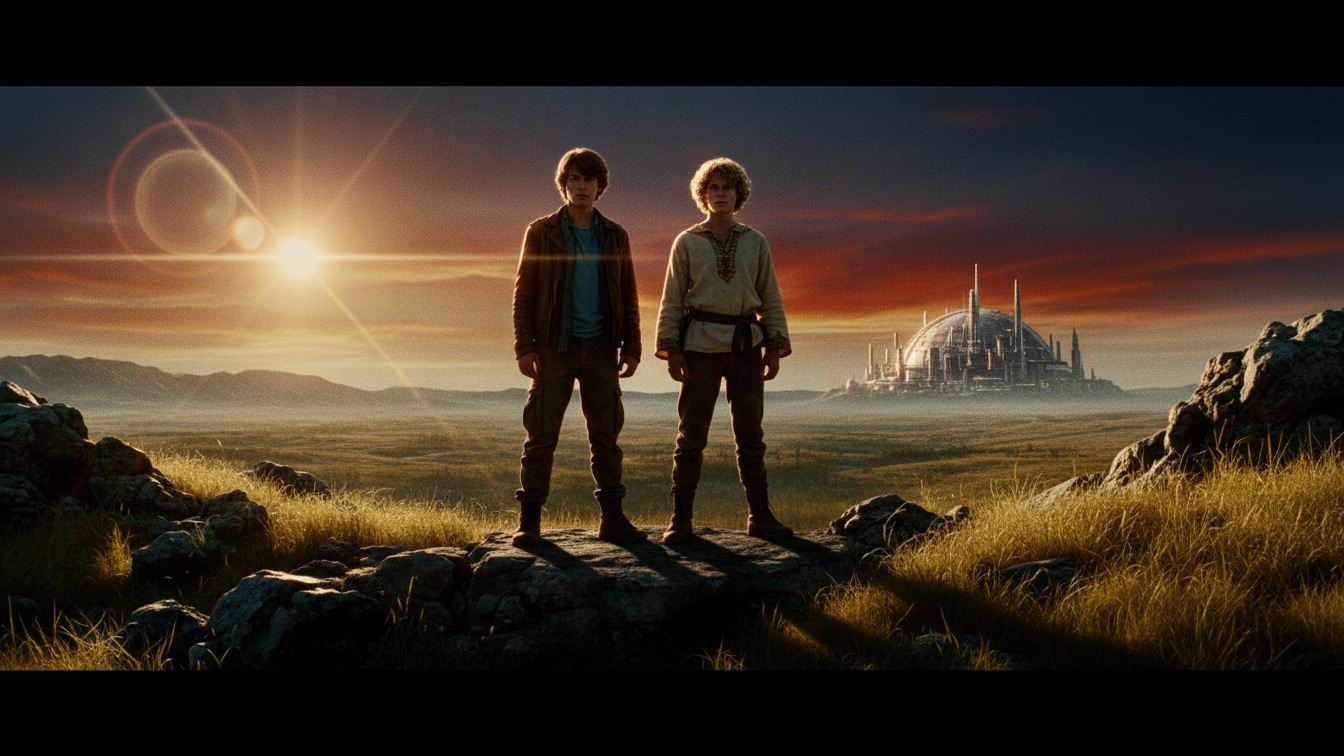
They were on a ridge, high above the Sector. Below them, the city looked like a toy model—a perfectly symmetrical grid of white cubes, encased in a shimmering, translucent bubble of grey haze. Beyond the bubble, the world exploded in a riot of un-optimized color.
To the west, a mountain range tore through the horizon, its peaks jagged and capped with dirty, grey-white snow. The sky wasn't violet or 'Perfect Blue.' It was a deep, bruised indigo, fading into a pale, dusty gold near the sun. And the sun... it was a blinding, terrifying orb of fire that felt like it was trying to peel the skin right off his bones.
'Look at it,' Jack whispered, crawling out of the hatch beside him. He was staring at the city. 'It looks so... small. Like a petri dish.'
'Because it is,' Leo said. He stood up, his legs shaking. The air here was thin and hot, but it was moving. A real wind. Not the 'Mountain Breeze' cycle, but a chaotic, unpredictable gust that carried the scent of miles of open space.
He felt a sudden, profound sense of weightlessness. The 'Sorting,' the 'Harmony Scores,' the 'Career Pathways'—they were all down there, inside the bubble. Up here, they didn't exist. He was just a boy on a ridge.
'Where do we go?' Jack asked. He looked terrified, but he wasn't reaching for his glasses. He was looking at the mountains.
'The coordinates point to a settlement,' Leo said, checking the offline tablet one last time. 'About twenty miles north. A place called The Raw Feed.'
'Catchy,' Jack said, his ironic defense mechanism finally kicking back in. 'I hope they have snacks. I’m at zero percent blood sugar.'
'We’ll find something,' Leo said.
He looked at the metal cylinder. He realized he didn't need it anymore. The 'breadcrumb' had served its purpose. He set it down on the edge of the hatch, a marker for the next person who felt the itch.
'Leo?'
'Yeah?'
'I can... I can see the veins in my hands,' Jack said, staring at his own skin with a kind of horrified fascination. 'I can see the blood moving. I’ve never... I’ve never seen myself without the 'Skin-Tone Correction' filter.'
'You look fine, Jack,' Leo said. 'You look real.'
Jack nodded, a small, genuine smile breaking through his exhaustion. 'Real is... real is a lot of work.'
'Yeah,' Leo said. 'But at least we’re the ones doing it.'
He turned away from the city and began to walk. The ground was uneven. There were rocks. There were thorns. There were bugs that buzzed around his ears and bit his neck. He loved every second of it.
Behind him, Jack hesitated for a second, looking back at the shimmering dome of the Sector. Then, he turned and followed.
As they descended the far side of the ridge, the sound of the city’s hum finally, mercifully, died away. It was replaced by the rustle of the grass, the chirp of a bird that wasn't a drone, and the steady, rhythmic thud of two pairs of boots hitting the earth.
Leo took a deep breath. His lungs expanded, filling with air that was hot, dusty, and absolutely perfect. The claustrophobia was gone. The burden was lifted.
He wasn't a student. He wasn't a technician. He was a Ghost in the Wilds, and for the first time in seventeen summers, he was finally awake.
“As the sun dipped below the jagged peaks, a single, un-synced light flickered in the distance, answering their presence.”


